Fighter Jets
The subsonic attack jet built around a 30 mm cannon and a titanium bathtub.
Updated: by Tim de Vries
The latest aviation news and stories sent to your inbox.
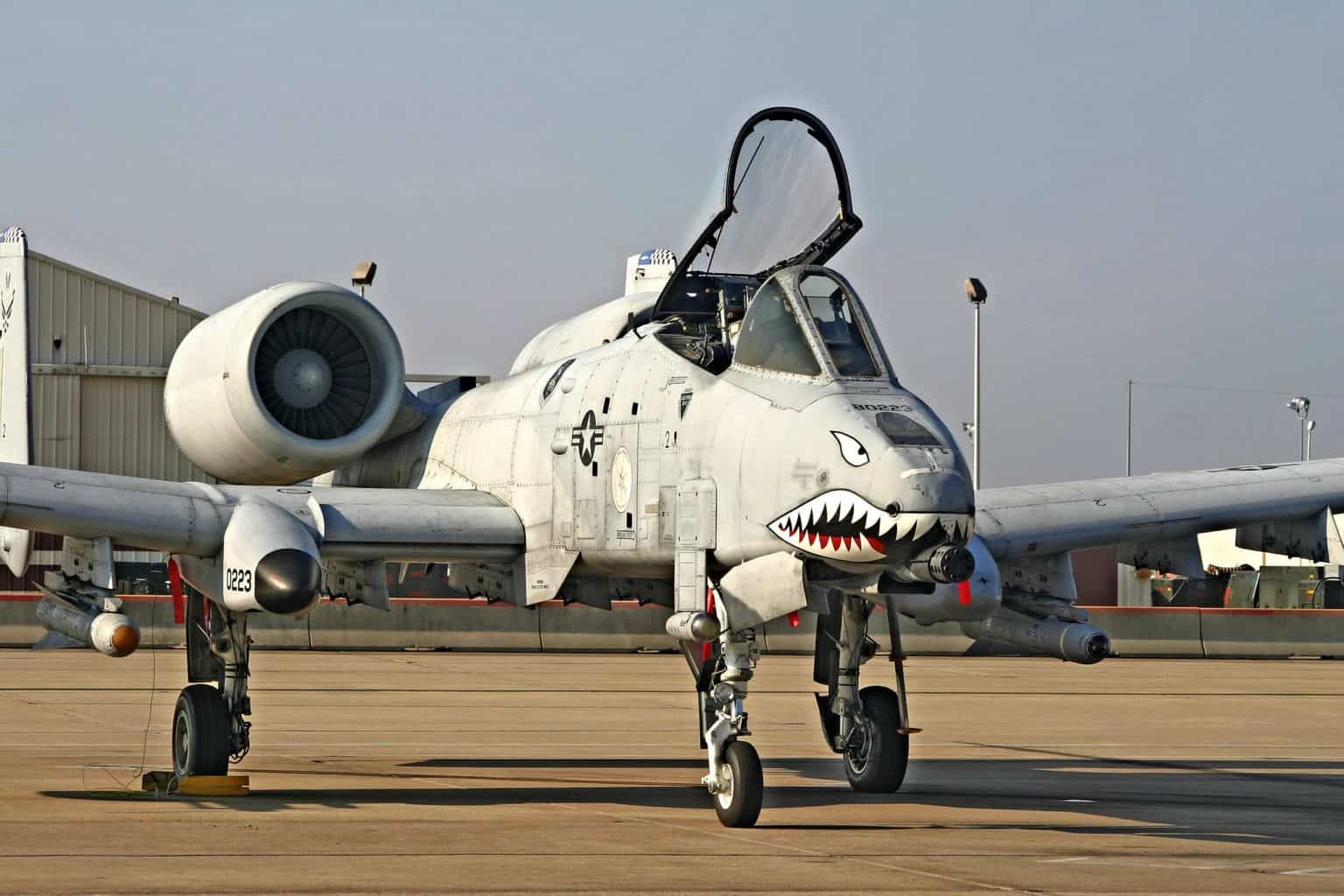
The Fairchild Republic A-10 Thunderbolt II, universally known as the Warthog, is the only production aircraft ever designed solely for close air support to serve with the US Air Force. The airframe was laid out around its 30 mm GAU-8 Avenger cannon and wrapped in 1,200 pounds of titanium armor, trading speed and altitude for the ability to loiter low over a battlefield and absorb hits. Fairchild built 716 between 1972 and 1984, and after repeated attempts to retire it the type is now scheduled to leave service in 2030.
Live Fleet Activity (A10)
Fetching live data…


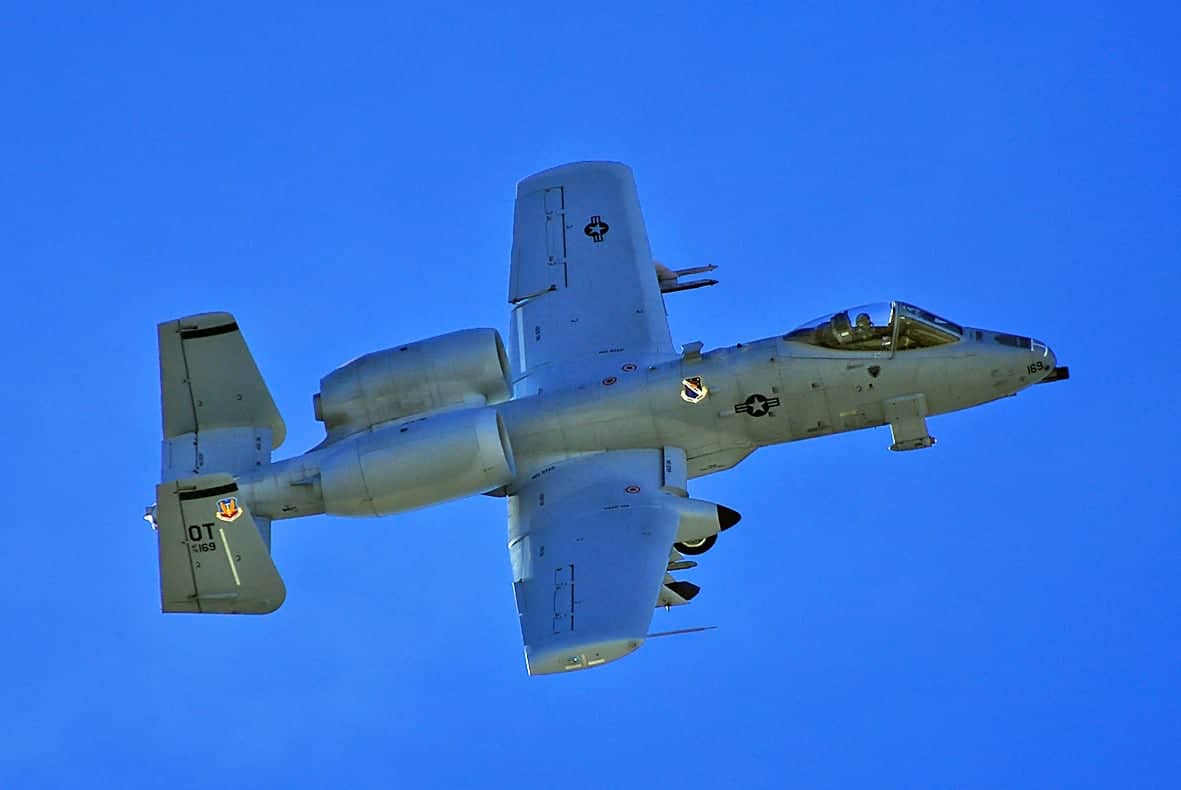
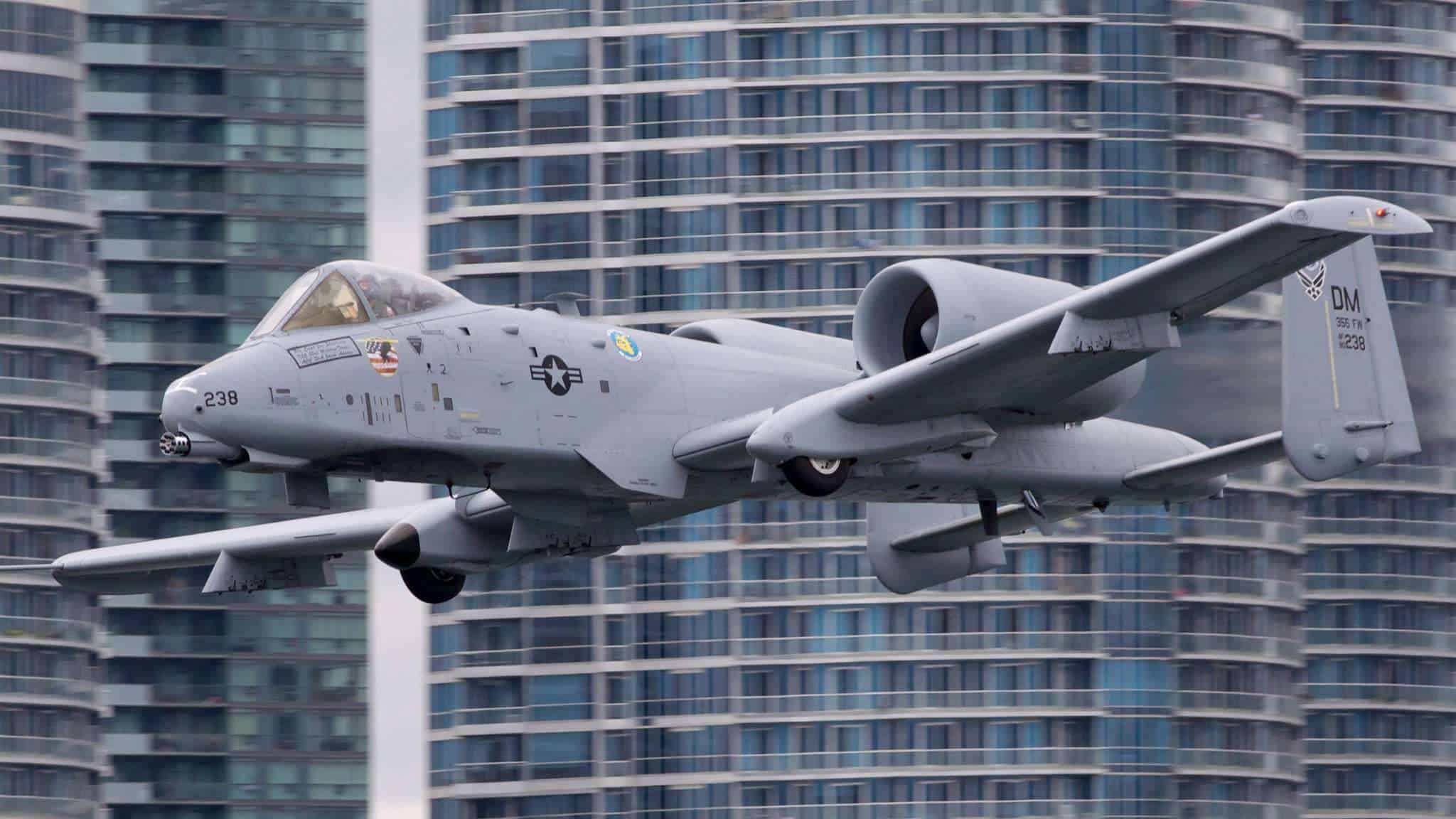


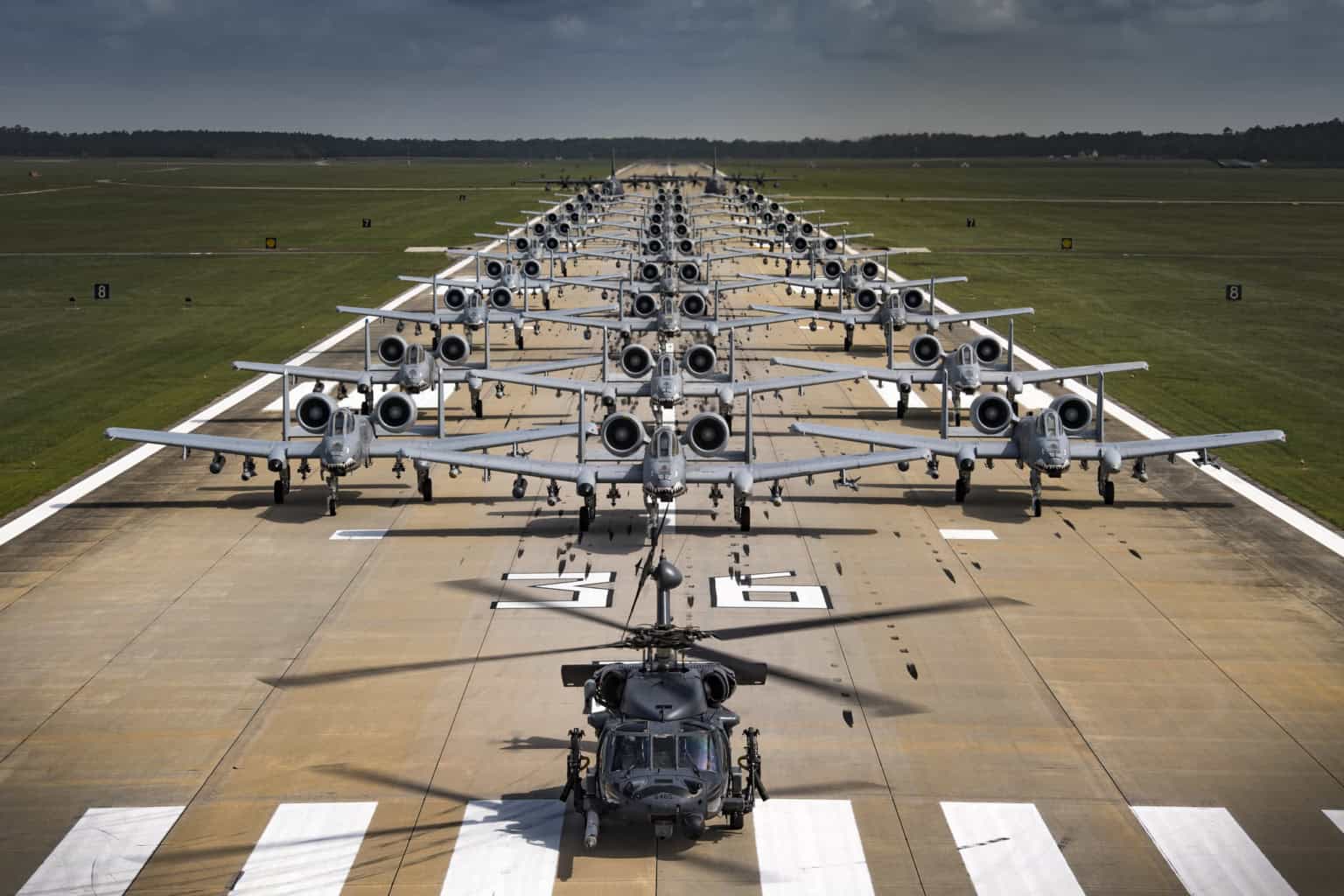
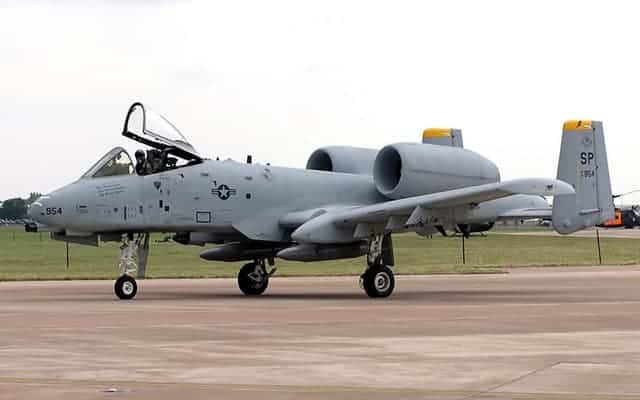
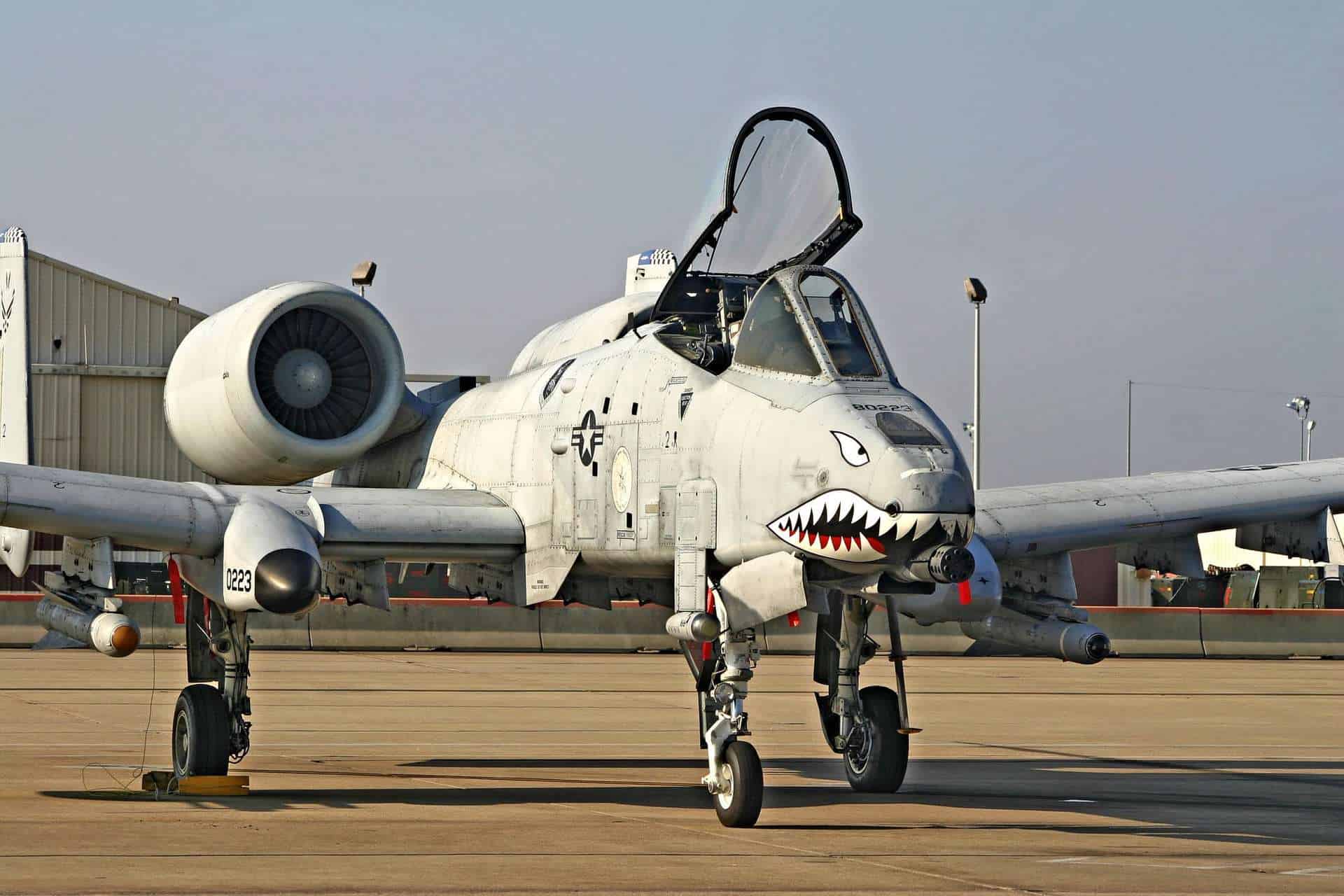
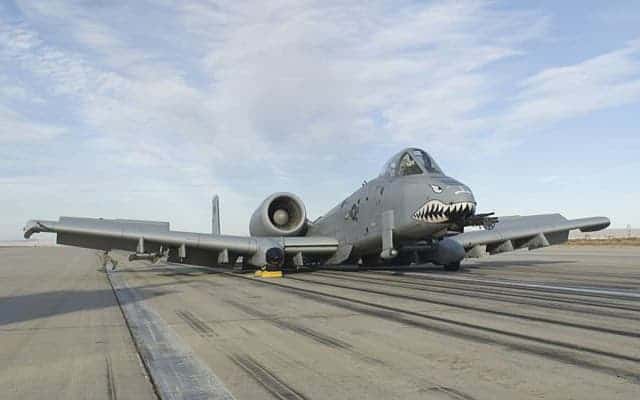
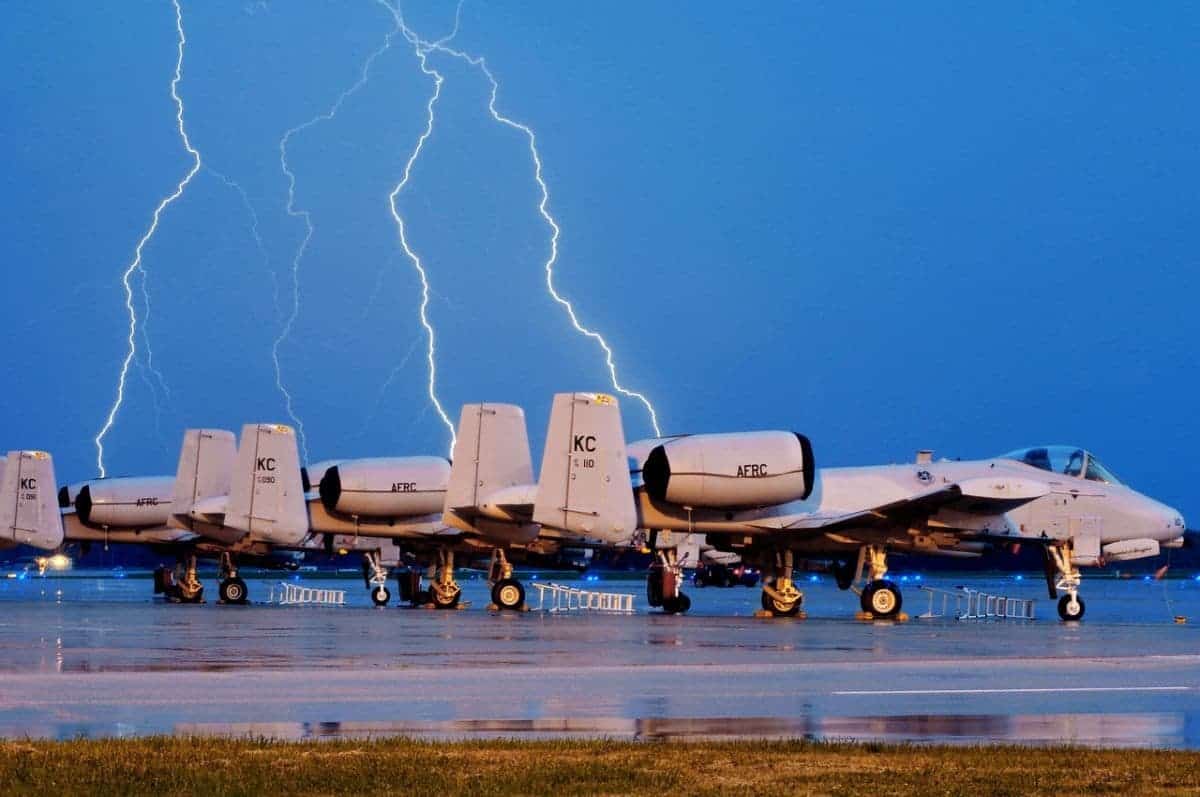
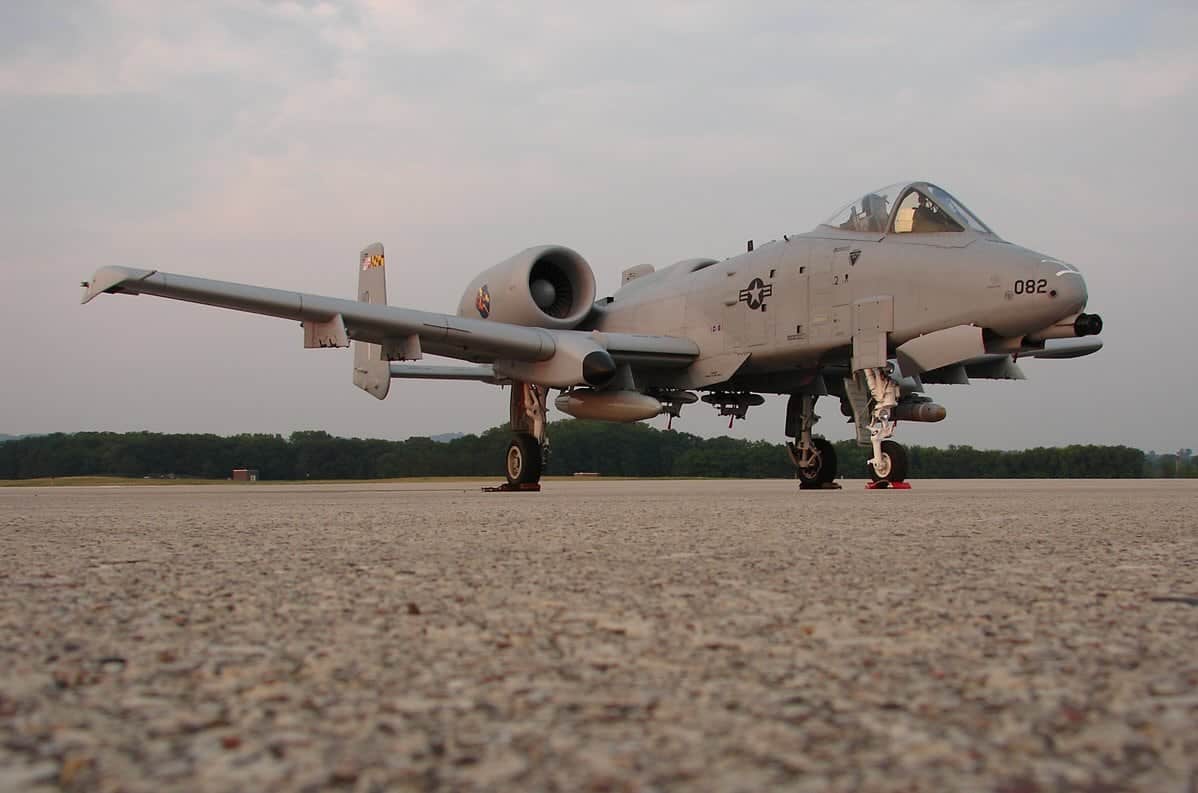
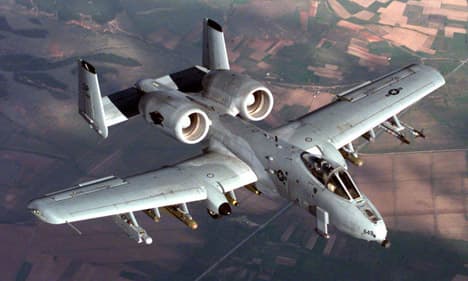

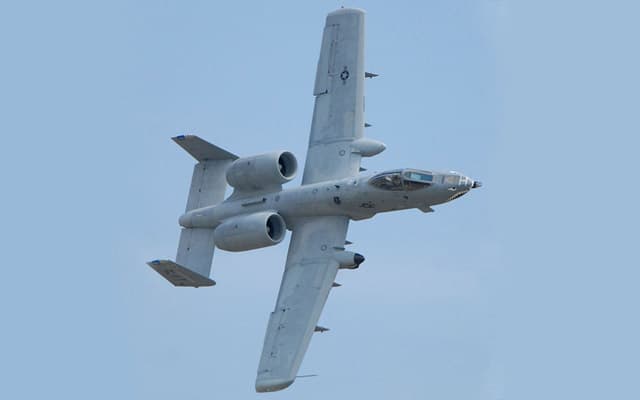

The Fairchild Republic A-10 Thunderbolt II is a single-seat, twin-turbofan, straight-wing attack aircraft built for one job: putting ordnance on targets a few hundred yards from friendly troops. It is the only production-built aircraft designed solely for close air support to have served with the US Air Force.
Almost nobody calls it the Thunderbolt II. The nickname Warthog came from the pilots and crews of the attack squadrons that flew and maintained it, and it stuck.
Fairchild built 716 of them between 1972 and 1984, and the type entered squadron service in October 1977. As of September 2026 the Air Force still flies it, under a congressional floor of 103 airframes, with retirement now scheduled to finish in 2030.
Three things explain the A-10’s reputation, and none of them is speed, altitude, or stealth.
The first is the gun. The A-10 is one of very few combat aircraft designed around its cannon rather than fitted with one, and the GAU-8 Avenger is large enough that the airframe was laid out to accommodate it.
The second is survivability. The A-10 carries 1,200 pounds (540 kg) of titanium armor around the cockpit and flight controls, and it is built to keep flying with an engine, half a tail, one elevator, and half a wing gone.
The third is loyalty from the people it works for. Soldiers and Marines who have been on the receiving end of A-10 support have lobbied for it repeatedly, and so has Congress, which is the main reason the aircraft has outlived repeated attempts to retire it stretching back to the 1980s.
By the mid-1960s the Air Force’s dedicated ground-attack aircraft was the Korean War era Douglas A-1 Skyraider, a piston-engine design that was slow and badly exposed to ground fire. The Air Force and Navy lost roughly 266 A-1s in action in Vietnam, mostly to small arms.
The fast jets that were supposed to inherit the mission were not suited to it either. The F-4 Phantom II could carry the load but had short loiter time, poor low-speed handling, and a flyaway cost of about $2 million in FY1965 dollars.
The resulting A-X requirement was unusually specific. It asked for a maximum speed of 460 mph (400 knots), a takeoff distance of 4,000 feet, a 16,000 pound (7,260 kg) external load, a 285 mile (460 km) mission radius, and a unit cost of $1.4 million, with the airframe designed around a 30 mm rotary cannon.
Northrop and Fairchild Republic were picked to build prototypes as the YA-9A and YA-10A. Two YA-10s were built at the old Republic plant in Farmingdale, New York, and first flew on 10 May 1972 with Howard “Sam” Nelson at the controls.
The Air Force announced the YA-10’s selection on 18 January 1973 after a fly-off against the YA-9, and a second fly-off in 1974 against the A-7D Corsair II confirmed the choice. Production aircraft were built by Fairchild in Hagerstown, Maryland.
The GAU-8/A Avenger is a hydraulically driven, seven-barrel 30 mm rotary cannon, and it is one of the most powerful guns ever flown on an aircraft. The airframe is arranged around it rather than the reverse.
The installation is deliberately asymmetric. The gun sits slightly to the port side so that the barrel in the firing position lines up with the aircraft’s centerline, which keeps recoil from yawing the aircraft off its aim point.
Rate of fire was originally selectable at 2,100 or 4,200 rounds per minute and was later fixed at 3,900. The gun takes about half a second to spin up, firing roughly 50 rounds in the first second and 65 to 70 rounds per second after that.
That is where the famous sound comes from. At nearly 65 rounds a second the individual reports stop registering as separate shots and merge into one long tearing noise, which is why the aircraft is associated with the word “brrrt” more than with any specification.
The ammunition drum holds up to 1,350 rounds but is normally loaded with 1,174. Armor plates of varying thickness sit between the aircraft skin and the drum, designed to set off incoming shells before they reach the ammunition.
Accuracy is the part most often left out. The gun is capable of placing 80 percent of its rounds inside a 40 foot (12.4 m) diameter circle from 4,000 feet.
The A-10’s survivability features are its other defining trait, and they are unusually literal. The cockpit and parts of the flight control system sit inside a titanium enclosure that crews call the bathtub, made of plates 0.5 to 1.5 inches (13 to 38 mm) thick chosen according to likely shot trajectories.
That armor has been tested against 23 mm armor-piercing and high-explosive fire, and against some indirect hits from 57 mm shell fragments. Self-sealing fuel cells are protected by internal and external foam.
The flight controls are doubly redundant hydraulically, with a mechanical backup called manual reversion. With hydraulics gone, pitch and yaw revert automatically and the pilot selects roll, and the aircraft stays controllable enough to get home in reasonable conditions.
That system has been used for real. In 2003, over Iraq, Captain Kim Campbell lost her hydraulics to ground fire and flew the aircraft back to base in manual reversion.
Smaller design decisions point the same way. Many parts are interchangeable left and right, including engines, main landing gear, and vertical stabilizers, and the main wheels protrude slightly from their nacelles when retracted so a gear-up belly landing is more survivable.
The full specification table for the A-10 is on this page, so rather than repeat it, here is what the figures that get argued about actually mean.
On speed, published figures disagree because they describe different conditions. Reference works give a maximum of 381 knots (439 mph) clean at sea level, the Air Force fact sheet quotes 420 mph, or Mach 0.56, and the flight manual sets a never-exceed limit of 450 knots at 5,000 feet with 18 Mark 82 bombs. Normal cruise is around 300 knots.
On range, the 2,240 nautical mile figure in the panel is ferry range, flown clean with 50 knot headwinds and 20 minutes of reserve. What matters operationally is much smaller: about 250 nautical miles on a close air support profile, which buys roughly one hour and 53 minutes of loiter at 5,000 feet plus 10 minutes of combat.
On weight, the panel carries the Air Force’s published 51,000 pound maximum takeoff weight. The A-10C flight manual is stricter, capping gross weight for towing, taxi, takeoff, and landing at 46,000 pounds, which is the number a crew actually works to.
On fuel, sources publish a weight rather than a volume: 11,000 pounds (4,990 kg) internal, in self-sealing tanks protected by foam. That works out to roughly 1,640 US gallons at typical JP-8 density, which is the volume figure in the panel. Two 600 US gallon external tanks can be carried for ferrying or extra loiter.
The A-10’s first deployment, to Grenada in October 1983 during Operation Urgent Fury, involved no weapons release at all. It flew cover for Marine landings and met no resistance.
The Gulf War in 1991 was the aircraft’s first real combat, with 132 deployed. A-10s flew 8,100 sorties at a 95.7 percent mission-capable rate and launched 90 percent of all AGM-65 Maverick missiles fired in the conflict.
A-10s also shot down two Iraqi helicopters with the cannon. Captain Robert Swain scored the first over Kuwait on 6 February 1991, the A-10’s first air-to-air victory.
The losses were real too. Four A-10s were shot down by surface-to-air missiles, eleven were hit by anti-aircraft artillery, and two more battle-damaged A-10s and OA-10As were written off after returning to base. Attrition was heavy enough that from 15 February the aircraft were restricted to within 20 nautical miles of the southern border.
The Balkans followed. A-10s fired roughly 10,000 rounds of 30 mm ammunition in Bosnia and Herzegovina in 1994 and 1995, then returned for Operation Allied Force over Kosovo from March 1999, where two were hit and damaged by missiles.
Afghanistan, Iraq, Libya, and the campaign against ISIS filled the next two decades. In December 2024, A-10s joined B-52s and F-15Es in strikes on more than 75 ISIS targets in Syria.
The aircraft’s most recent combat is also the reason it is still flying. US Central Command confirmed that A-10s were employed in the first 24 hours of the 2026 Iran war, which it designated Operation Epic Fury, on 1 March 2026.
General Dan Caine later described their role as hunting and killing fast-attack watercraft in the Strait of Hormuz, a maritime surface-warfare mission that suits a slow aircraft with a large cannon better than it suits a fast one.
On 3 April 2026 an A-10 was shot down by Iranian air defenses over the Persian Gulf while covering a combat search and rescue mission for the downed crew of an F-15E Strike Eagle. The pilot flew the damaged aircraft into Kuwaiti airspace, ejected, and was recovered.
Yes, and as of September 2026 the fleet’s future has been settled and unsettled several times in under two years. What follows is the state of play at the time of writing.
In June 2025 the Air Force asked to retire all 162 remaining A-10Cs in a single fiscal year, several years ahead of its own previous plan. Congress refused.
The FY2026 National Defense Authorization Act barred the service from retiring, preparing to retire, or reclassifying any A-10 if doing so dropped the fleet below 103 aircraft, with at least 93 kept as primary mission aircraft through 30 September 2026. That capped divestments at 59 airframes and required a briefing to Congress on the 2027 to 2029 plan.
Then combat changed the calculus. On 21 April 2026, Air Force Secretary Troy Meink announced the A-10 would keep flying through 2030 to preserve combat power while the defense industrial base ramps up aircraft production.
Three squadrons survive under that plan, each holding 18 aircraft: two active-duty units at Moody Air Force Base, Georgia, and an Air Force Reserve squadron at Whiteman Air Force Base, Missouri.
The FY2027 budget request would retire roughly half the remaining fleet, leaving 54 aircraft. None would go in FY2028, 18 would retire in FY2029 as the first Moody squadron shuts down, and the final 36 would retire during FY2030.
An extension on paper is not the same as an extension in the hangar, and the A-10’s support structure was dismantled on the old schedule before the new one arrived.
Hill Air Force Base completed its final A-10 depot overhaul in February 2026, and the 571st Aircraft Maintenance Squadron, which had handled structural repairs and wing replacements since 1998, was preparing to deactivate.
Davis-Monthan Air Force Base graduated its last class of newly qualified A-10 pilots in March 2026, and its maintainers completed the final TF34 engine build in May 2026. The formal training pipeline has ended.
The House-passed FY2027 defense bill would require the Air Force to retain enough training, testing, depot repair, logistics, and contractor capacity to keep the fleet viable through 2030, which in practice means rebuilding some of what was just closed.
Officially, the F-35A Lightning II. In practice, no single aircraft has taken over the mission, and that is the heart of the argument.
The Air Force’s position has long been that precision weapons let multirole aircraft do close air support, and that since 2001 multirole types and bombers have flown roughly 80 percent of operational CAS missions. F-16s and F-15Es were slated to absorb A-10 sorties in the interim.
Critics have pushed back on both cost and capability. Winslow Wheeler of the Project On Government Oversight called swapping the A-10 for the F-35 a giant leap backwards, and POGO’s Dan Grazier has argued the transition is undercooked because the Air Force requires no close air support training for its F-35 pilots.
Earlier attempts to find a purpose-built successor went nowhere. The Air Force examined the F-35B, off-the-shelf light attack types such as the AT-6 and the Scorpion, and clean-sheet designs, and none of them became a program of record for the CAS mission.
The A-10A single-seat version was the only variant ever put into production. Aircraft assigned primarily to airborne forward air control were designated OA-10, with no airframe change.
One pre-production airframe was rebuilt as the YA-10B, a two-seat prototype for an all-weather night version. It never entered production, which is why searches for a two-seat A-10 turn up exactly one aircraft.
The A-10C is what everything still flying is today. From 2005 to June 2011 the entire fleet of 356 A-10s and OA-10s went through the Precision Engagement program and was redesignated A-10C.
That upgrade brought all-weather combat capability, an improved fire control system, electronic countermeasures, smart bomb targeting, a communications suite including Link 16 and Satcom, and cockpit changes. The A-10C reached initial operating capability in September 2007 and deployed to Iraq that year with the 104th Fighter Squadron of the Maryland Air National Guard.
Targeting changed with it. The old Pave Penny laser receiver pods and their pylons were removed once AN/AAQ-28 Litening and AN/AAQ-33 Sniper pods, which both designate and range, made a receive-only device redundant.
Structure got attention too. The Thick-skin Urgent Spares Kitting program re-winged much of the fleet after the Air Force calculated it would run out of serviceable wings by 2011, and Boeing stated in 2016 that the new wings could take the aircraft to 2040.
No. The Air Force has consistently refused to release A-10s to anyone, and when Boeing held early discussions in July 2015 about selling stored or retired airframes in near-flyaway condition to international customers, the service said it would not permit any sale.
Published cost figures vary because they are quoted in different base years. The Air Force fact sheet gives $9.8 million in FY1998 constant dollars, the Federation of American Scientists lists $13 million for the same year, and inflation-adjusted figures near $18.8 million circulate widely.
What is available is static display. Dozens of retired airframes sit in museums and on base display, including examples at the Hagerstown Aviation Museum in Maryland, near where the production aircraft were built.
The A-10 is a genuine outlier in the modern US inventory. It is subsonic in a fleet built around supersonic multirole fighters, and it is the only aircraft in that fleet whose design premise is absorbing hits rather than avoiding them.
Its longevity is the other unusual thing. A type that first flew in 1972 and finished production in 1984 is now among the oldest military aircraft still in front-line service, and it has spent more than half its career under a retirement notice.
Comparisons with fast jets tend to miss the point in both directions. Ranked against the best fighter jets in the world, the A-10 loses on almost every axis that matters in air combat, because it was never built to fight aircraft.
Mostly because of its gun and its toughness. The airframe was designed around a 30 mm seven-barrel GAU-8 Avenger cannon firing 3,900 rounds a minute, and the cockpit sits inside 1,200 pounds (540 kg) of titanium armor rated against 23 mm fire.
The aircraft is also famous for surviving politically. It has outlasted repeated Air Force attempts to retire it, largely because of support from Congress and from the ground troops it works with.
Yes. As of September 2026 the A-10C remains in US Air Force service, and it flew combat missions in the 2026 Iran war as recently as spring 2026.
Retirement is now scheduled to finish in 2030. Secretary of the Air Force Troy Meink announced the extension on 21 April 2026, reversing an earlier plan to divest the fleet much sooner.
The FY2026 National Defense Authorization Act required the Air Force to keep at least 103 A-10s, with 93 of them as primary mission aircraft, through 30 September 2026. That is the best figure to quote for 2026, down from 162 before that year’s drawdown.
The FY2027 budget request would cut roughly half of what is left, leaving 54 aircraft in three squadrons of 18. Because the number is being actively negotiated between the Air Force and Congress, any specific count is a snapshot rather than a settled figure.
The F-35A Lightning II is the designated replacement, but nothing has actually taken over the dedicated close air support role. F-16s and F-15Es have absorbed A-10 sorties in the meantime.
The Air Force argues that precision weapons let multirole aircraft do the job, noting that multirole types and bombers have flown around 80 percent of operational CAS missions since 2001. Critics counter that no replacement is trained or optimized for the mission the way the A-10 was.
Reference sources give a maximum of 381 knots (439 mph) clean at sea level, and the Air Force fact sheet quotes 420 mph, or Mach 0.56. Normal cruise is about 300 knots.
The flight manual never-exceed speed is 450 knots at 5,000 feet with a full load of 18 Mark 82 bombs. The A-10 is subsonic by design, because loitering low and slow over a battlefield is the mission.
The Air Force fact sheet lists $9.8 million per aircraft in FY1998 constant dollars. The Federation of American Scientists gives $13 million for the same base year, and inflation-adjusted figures around $18.8 million are widely quoted.
All of these are historical numbers. Production ended in 1984, so there is no current procurement price for a new A-10.
No. The Air Force has declined to release A-10s to civilian or foreign buyers, and it blocked Boeing’s 2015 exploration of selling stored airframes to international customers.
Retired A-10s go to museums, to static display on military bases, or into storage. None have been released in flyable condition to private owners.
Fairchild built 716 A-10s, with production running from 1972 to 1984. The A-10A was the only production variant; the twin-seat YA-10B was a single converted pre-production airframe.
Yes. Four were shot down by surface-to-air missiles during the 1991 Gulf War, eleven more were hit by anti-aircraft artillery, and two damaged aircraft were written off after making it back to base.
The most recent loss came on 3 April 2026, when Iranian air defenses hit an A-10 over the Persian Gulf during a rescue mission for a downed F-15E crew. The pilot reached Kuwaiti airspace, ejected, and was rescued.
The nickname came from the pilots and crews of the USAF attack squadrons that flew and maintained the aircraft, and it displaced the official name almost entirely.
That official name is Thunderbolt II, after the Republic P-47 Thunderbolt of World War II. The A-10 is the last of Republic’s jet attack aircraft to serve with the Air Force.
Sources and references used for research and fact-checking.