

Table of Contents
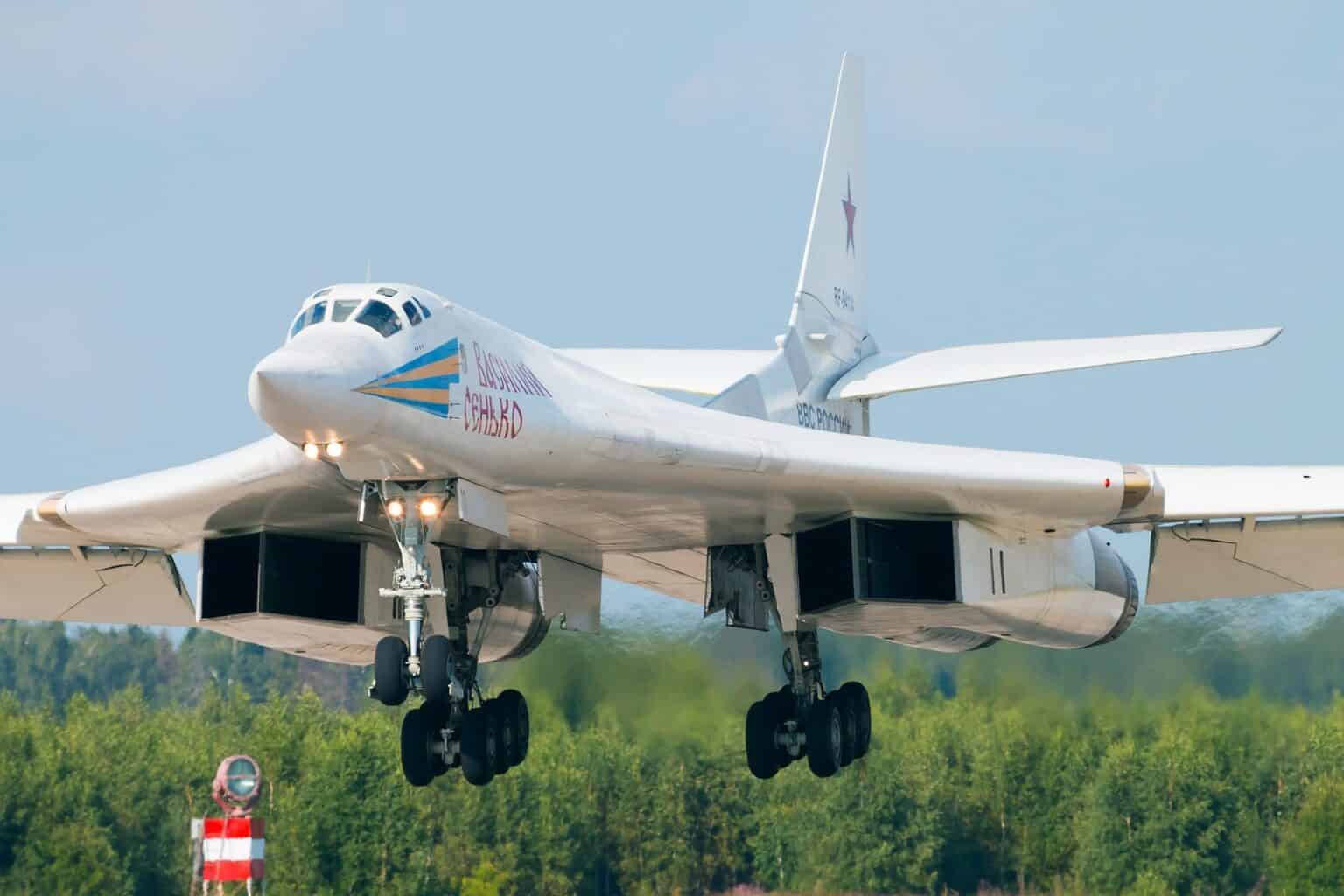
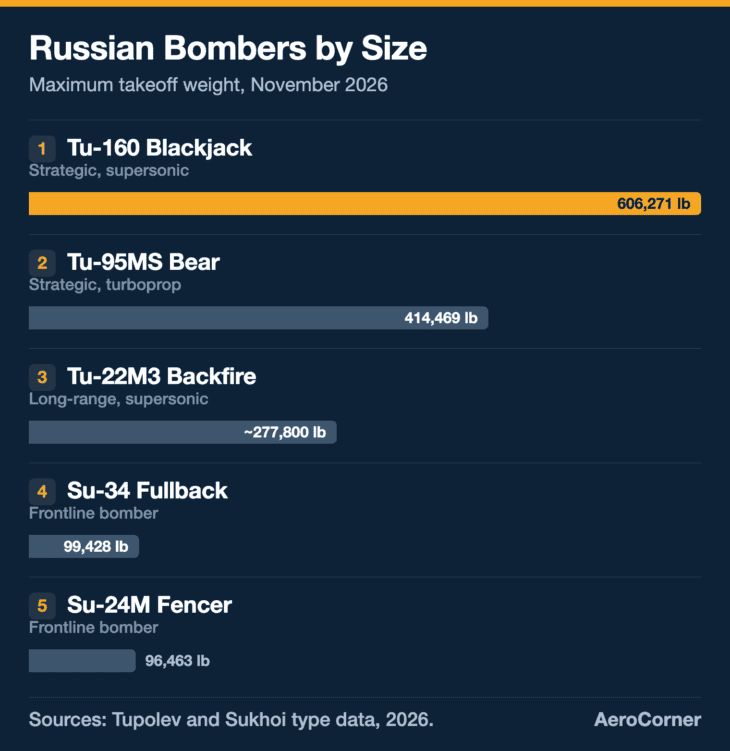
Russia flies five bomber types in November 2026, and the biggest is the Tu-160 Blackjack, a swing-wing supersonic bomber with a maximum takeoff weight of 606,271 pounds (275,000 kg). Behind it come the propeller-driven Tu-95MS Bear, the Tu-22M3 Backfire, and two tactical bombers, the Su-34 Fullback and the aging Su-24M Fencer.
The strategic force is small. The Federation of American Scientists counts 45 Tu-95MS and 15 Tu-160 bombers in its 2026 estimate, 60 aircraft in all, and in early November 2026 satellite watchers found 47 of them parked at a single base in the Far East.
This list ranks every bomber type in Russian service by maximum takeoff weight, the cleanest single measure of size and reach. Each entry also gives the best available fleet estimate and the losses confirmed since the full-scale invasion of Ukraine began in February 2022.
| Rank | Bomber | Max takeoff weight | Fleet estimate | Lost since 2022 |
|---|---|---|---|---|
| 1 | Tu-160 / Tu-160M Blackjack | 606,271 lb (275,000 kg) | 15 to 17 | 0 |
| 2 | Tu-95MS / MSM Bear-H | 414,469 lb (188,000 kg) | About 45 | 12 |
| 3 | Tu-22M3 Backfire-C | About 277,800 lb (126,000 kg) | About 55 | 12 |
| 4 | Su-34 Fullback | 99,428 lb (45,100 kg) | About 130 | 50 |
| 5 | Su-24M Fencer | 96,463 lb (43,755 kg) | 259 listed | 15 |
| Not ranked | PAK DA | Not published | 0 (not flown) | n/a |
How this ranking works
Entries are ranked by maximum takeoff weight, using Tupolev and Sukhoi figures as published in the aircraft’s reference data. A bomber here is any type Russia itself classes as a bomber: the long-range Tu-160, Tu-95MS and Tu-22M3, and the frontline Su-34 and Su-24M. Russia publishes no fleet numbers, so counts come from the Federation of American Scientists, the IISS Military Balance and FlightGlobal’s World Air Forces, and they are estimates. Losses come from Oryx, which only counts losses backed by photos or video, so they are a minimum. The PAK DA is listed but not ranked, because it has not flown.
1. Tu-160 and Tu-160M Blackjack
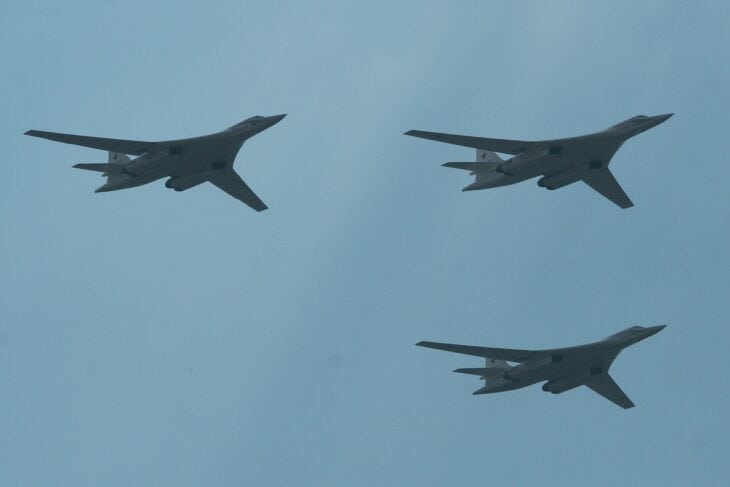

The Tu-160 Blackjack is the largest and fastest bomber Russia flies. It has a maximum takeoff weight of 606,271 pounds (275,000 kg) and a top speed of Mach 2.05, about 1,380 mph (2,220 km/h), at high altitude.
It first flew on December 18, 1981, and its four-person crew sweeps the wings back for a dash and forward for takeoff. Two internal bays carry up to 99,208 pounds (45,000 kg) of weapons, including 12 Kh-55SM or Kh-101 cruise missiles on rotary launchers.
The Federation of American Scientists counts 15 Tu-160 and Tu-160M bombers in 2026, while World Air Forces 2025 listed 17. Oryx has no confirmed Tu-160 loss in the war, which makes it the only Russian bomber type with a clean sheet.
The Tu-160M is the modernized version, with new engines and avionics. The first upgraded aircraft flew on February 2, 2020, and Defense Minister Andrei Belousov said at the end of 2025 that the Air Force had received two Tu-160Ms, without saying whether they were new-builds or rebuilt jets.
That is the real story of the Blackjack: 10 new-build Tu-160Ms are reported on order, and the first one only flew in January 2022. The Tu-160 still beats every other entry on this list in size, speed and payload, but Russia cannot build them fast.
2. Tu-95MS and Tu-95MSM Bear-H
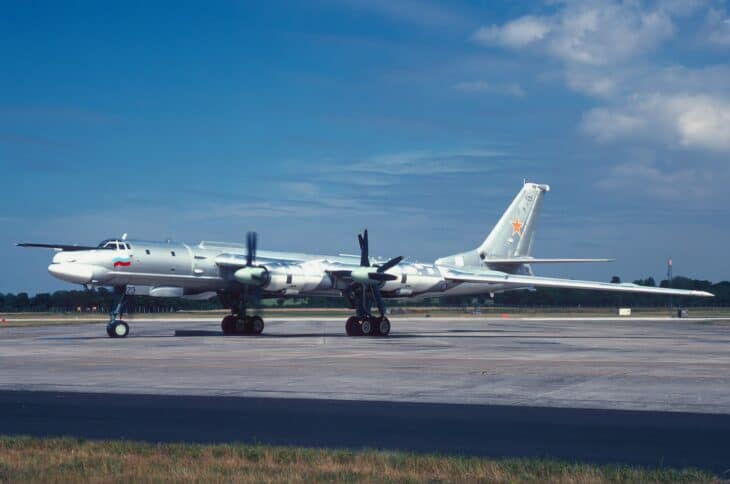

The Tu-95 Bear is the only propeller-driven strategic bomber still in service anywhere. The Tu-95MS weighs up to 414,469 pounds (188,000 kg) at takeoff and cruises on four turboprops with contra-rotating propellers, reaching 575 mph (925 km/h).
The design first flew on November 12, 1952, and more than 500 Tu-95s of all versions were built. Its range of about 9,300 miles (15,000 km) is the longest of any Russian bomber, beating even the Tu-160.
The Federation of American Scientists estimates that about 25 of the 45 Tu-95s in its 2026 count have been upgraded to the Tu-95MSM standard, which adds four pylons for eight Kh-101 or Kh-102 cruise missiles.
It has paid for that role. Oryx confirms 12 Tu-95MS bombers destroyed or damaged, most of them in Ukraine’s Operation Spiderweb drone attack on June 1, 2025, and drones disabled two at Engels on July 19 and August 28, 2026, UNITED24 Media reported.
Russia moved its bombers to the one base Spiderweb missed
Operation Spiderweb on June 1, 2025 targeted five bomber bases, including Ukrainka in the Far East, but the truck carrying the Ukrainka drones caught fire and exploded before launch. In early November 2026, the OSINT group AviVector counted 47 strategic bombers at Ukrainka: 37 Tu-95MS and 10 Tu-160s, about 3,355 miles (5,400 km) from Engels. That is close to the whole strategic bomber force at a single airfield.
3. Tu-22M3 Backfire-C
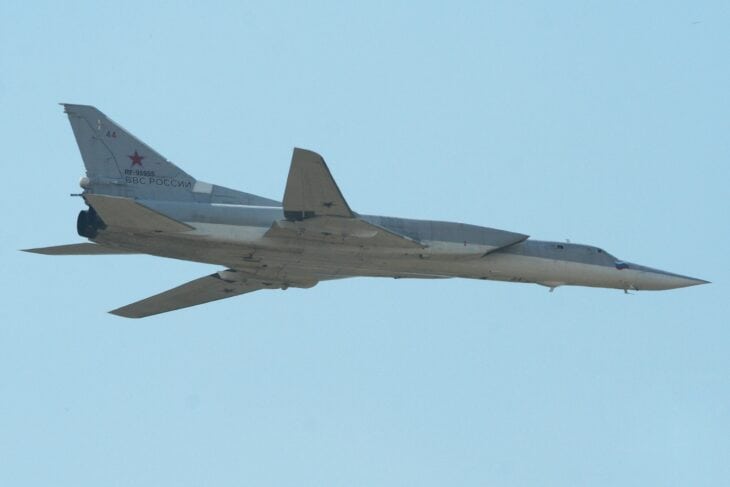

The Tu-22M3 is Russia’s long-range supersonic bomber, built to hit carrier groups and land targets with heavy anti-ship missiles. It weighs about 277,800 pounds (126,000 kg) at takeoff and reaches Mach 1.88, about 1,241 mph (1,997 km/h).
The Tu-22M first flew on August 30, 1969, the M3 version followed in 1977, and 268 Tu-22M3s were built before production ended in 1993. It carries up to three Kh-22 or Kh-32 missiles, or up to 18 FAB-500 bombs, with a combat radius of about 1,600 miles (2,500 km).
The IISS put the fleet at 55 Tu-22M3s in 2025. Oryx confirms 12 destroyed or damaged, including four destroyed at Belaya in Operation Spiderweb.
The Tu-22M3M upgrade first flew on December 28, 2018, and can carry Kh-32 and Kinzhal missiles, but how many have been delivered is not public. The Backfire ranks below the Bear on weight, yet in a war fought with glide bombs and cruise missiles it has taken just as many losses.
4. Su-34 Fullback
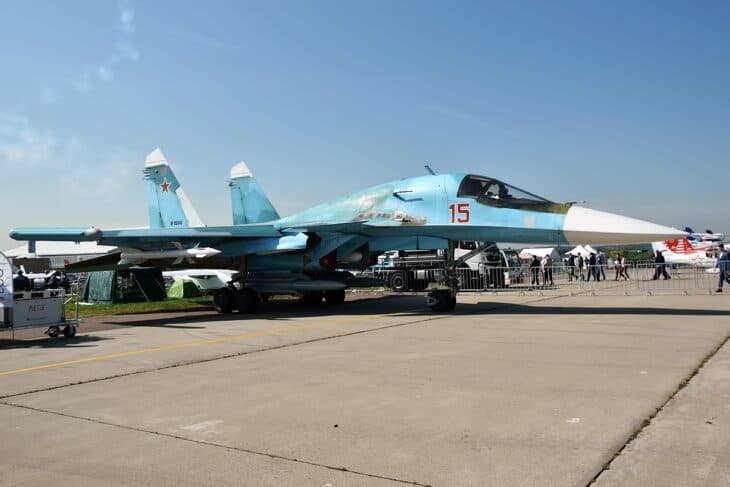

The Su-34 is Russia’s main frontline bomber, and the one it has lost most often in Ukraine. It weighs up to 99,428 pounds (45,100 kg) at takeoff, reaches Mach 1.8, about 1,200 mph (1,900 km/h), at altitude, and carries 26,000 to 31,000 pounds (12,000 to 14,000 kg) on 12 hardpoints.
It first flew on April 13, 1990, entered service in 2014, and seats its two crew side by side. It replaced nothing overnight: the older Su-24M it was built to succeed is still listed in large numbers.
The IISS Military Balance puts the fleet at about 130, and World Air Forces 2025 listed at least 142. Oryx confirms 50 Su-34s destroyed or damaged, one of them the newer Su-34M, the highest loss count of any Russian bomber, as our report on the Neptune strike on Su-34s at Borisoglebsk explains.
The Su-34 is a fraction of the Tu-160’s size, but it is the bomber Russia actually needs in this war. The upgraded Su-34M has been in delivery since June 2022, and an armed reconnaissance version entered service in July 2025.
5. Su-24M Fencer
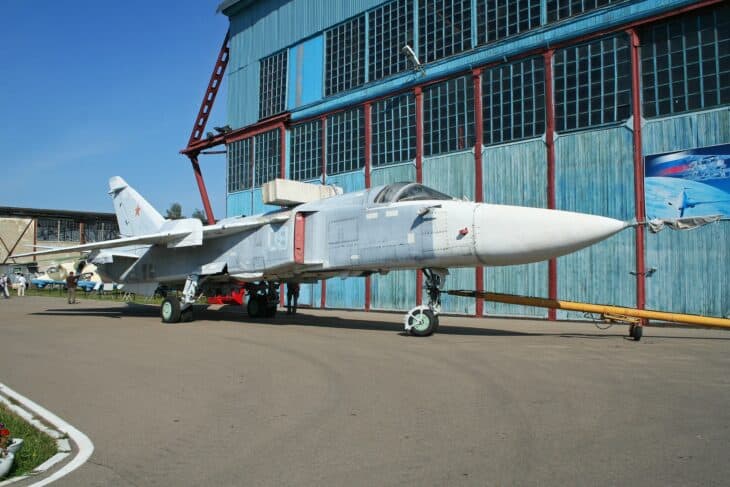

The Su-24 is a swing-wing frontline bomber from the late 1960s, the type the Su-34 was built to replace. It weighs up to 96,463 pounds (43,755 kg) at takeoff and reaches Mach 1.6, about 1,028 mph (1,654 km/h), at high altitude.
The prototype first flew on July 2, 1967, and about 1,400 Su-24s were built. World Air Forces 2025 listed 259 Su-24Ms in the Russian Aerospace Forces, and Naval Aviation had up to 30 Su-24Ms and 10 Su-24MR reconnaissance jets in 2024.
Treat the 259 with caution: it is a directory listing, not a count of flyable jets. Oryx confirms 15 Su-24 variants destroyed or damaged, and the Fencer sits last on size despite having the largest listed fleet.
For how Russia’s fighters, radar planes and helicopters fare alongside these bombers, see our full guide to what Russia’s air force still flies.
Not Ranked: PAK DA, the Stealth Bomber That Has Not Flown
The PAK DA is Tupolev’s planned subsonic stealth bomber, Russia’s answer to the B-2. TASS reported in 2020 that construction had begun and that final assembly should be complete in 2021.
As of November 2026, no PAK DA has flown and Russia has shown no flying prototype. A March 2026 analysis by 19FortyFive described it as existing mostly as AI-generated images and Kremlin press releases, citing RUSI’s view that Russian industry will struggle to produce a credible stealth design within the next decade.
Until it flies, Russia has no stealth bomber, while the United States flies the B-2 and is testing the B-21. Our ranking of every stealth bomber ever built shows how far behind that leaves Russia.
What about the MiG-31K?
The MiG-31K carries the Kinzhal missile and the Federation of American Scientists groups it with the Tu-22M3, Su-24M and Su-34 as a nuclear-capable strike aircraft. It is still an interceptor, not a bomber: it carries one large missile, has no bomb bay and is not classed as a bomber by Russia, so it is left off this list. Retired Soviet types such as the Tu-16 and the original Tu-22 are also excluded, because none remain in service.
How Russia’s Bombers Compare With America’s
Russia’s 60 strategic bombers are the Tu-160s and Tu-95s, and the Federation of American Scientists estimates about 54 of them are operational. Everything Russia has in the long-range role is a Cold War design, upgraded rather than replaced.
Russia’s bombers win on speed and size, while the US fields stealth bombers Russia cannot match. Our ranking of the best bombers in the world sets all of them side by side.
FAQ
Sources and references used for research and fact-checking.
- Bulletin of the Atomic Scientists / Federation of American Scientists, Russian nuclear weapons, 2026 (Table 1)
- Oryx, Attack On Europe: Documenting Russian Equipment Losses During The Russian Invasion Of Ukraine
- UNITED24 Media, Russia masses 47 nuclear-capable bombers at Far Eastern airbase
- Wikipedia, Tupolev Tu-160
- Wikipedia, Tupolev Tu-95
- Wikipedia, Tupolev Tu-22M
- Wikipedia, Sukhoi Su-34
- Wikipedia, Sukhoi Su-24
- Wikipedia, List of active Russian military aircraft
- www1.ru, Number of Su-34 and Su-57 in the Russian Aerospace Forces named
- Wikipedia, Operation Spiderweb
- 19FortyFive, Russia promised its stealth bomber would be flying by 2021. It is now 2026
- Air Data News, Russia delivers two upgraded Tu-160M strategic bombers to Air Force
Get the Newsletter
The latest aviation news and stories sent to your inbox.
About the Author

Tim is the owner and lead editor of AeroCorner since 2019, overseeing aviation content covering aircraft, airlines, airports, and the broader aviation industry. Through years of researching, writing, editing, and publishing aviation-focused content, he has developed extensive practical knowledge of commercial aviation and air travel. Based in Asia and a frequent traveler himself, Tim also brings firsthand passenger experience to AeroCorner’s coverage. Outside of publishing, he has also explored aviation firsthand through hands-on flight training in New Zealand.