

Table of Contents
In 1998, a small company registered in Macau paid $20 million at auction for the rusting, unfinished hull of a Soviet aircraft carrier. The stated plan was a floating hotel and casino.
That hull is now the Liaoning, the first of China’s aircraft carriers. Fourteen years after it entered service, China has three, a fourth is growing in a dry dock at Dalian, and the Pentagon’s latest estimate is that Beijing wants nine within a decade.
Here is the exact count, why the answer depends on what you call a carrier, and how fast China is really building them.
How Many Aircraft Carriers Does China Have?
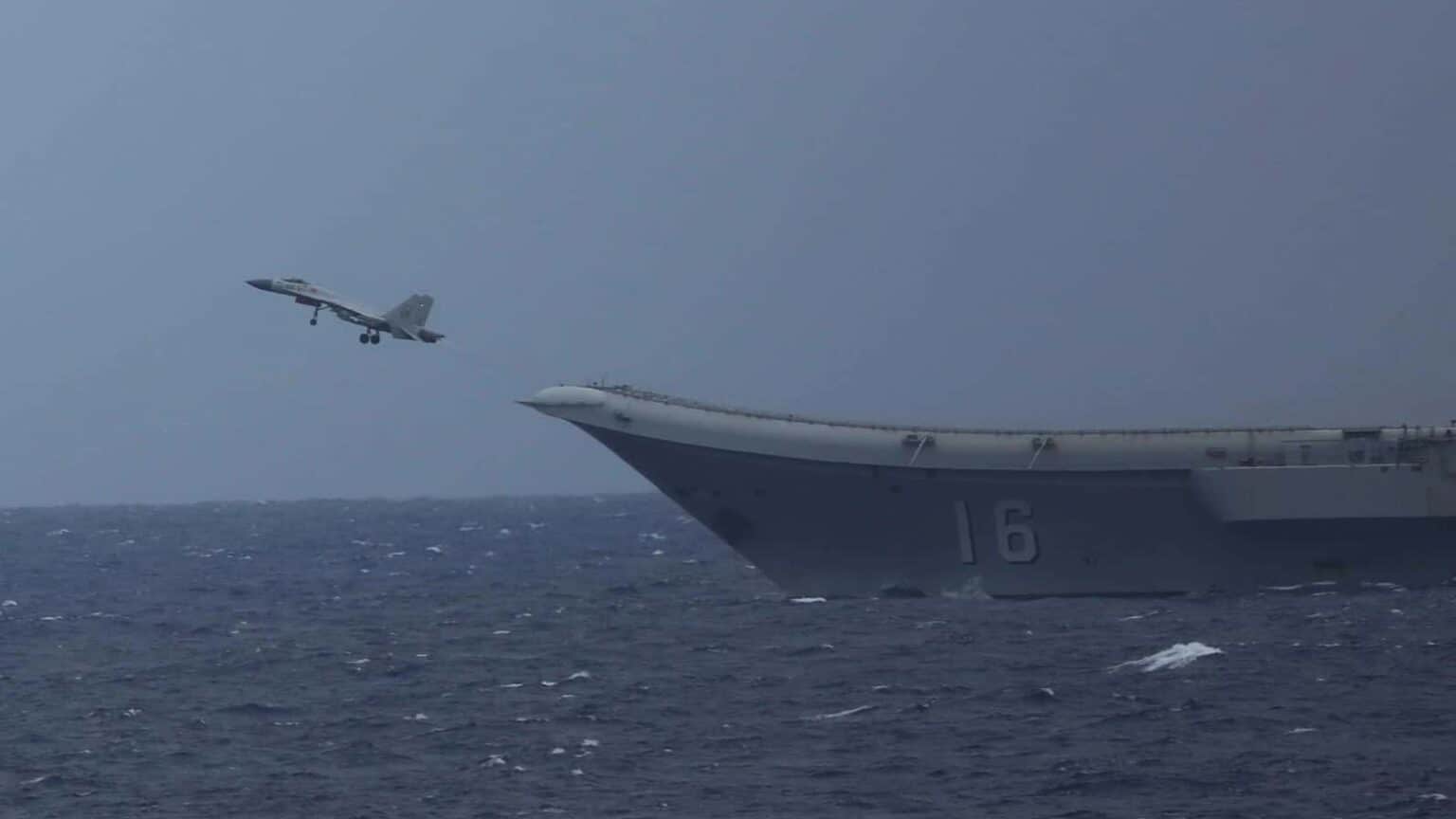
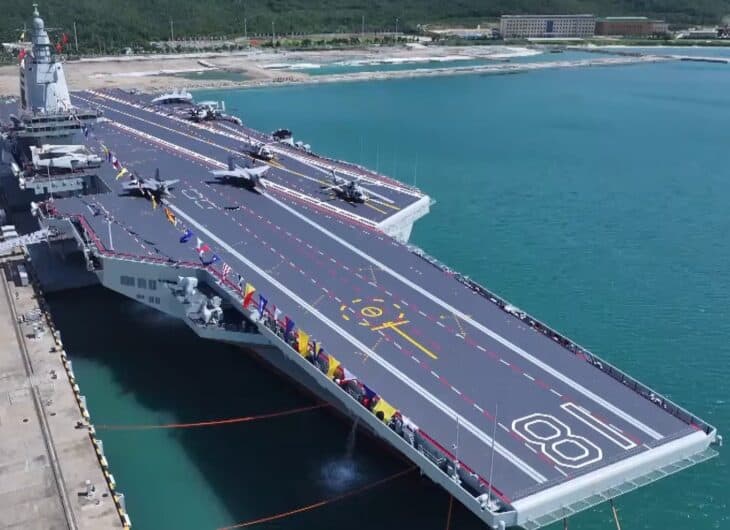
China has three aircraft carriers in commission as of September 2026: Liaoning, Shandong and Fujian. The third, Fujian, joined the fleet on November 5, 2025, at Sanya on Hainan Island, and China’s state media said the country had “officially entered an era with three aircraft carriers.”
A fourth carrier, known in the West as the Type 004, is under construction at Dalian but has not been launched. Satellite imagery points to nuclear power, which would make it China’s first nuclear carrier.
The count at a glance
Three carriers in service: Liaoning (2012), Shandong (2019) and Fujian (2025). One more under construction at Dalian, launch expected no earlier than 2027. The Pentagon assesses that China aims for nine carriers in total by 2035, a US estimate rather than an announced Chinese target.
| Carrier | Type | Built at | Commissioned | Launch system |
|---|---|---|---|---|
| Liaoning | Type 001 | Soviet hull, finished at Dalian | September 25, 2012 | Ski jump |
| Shandong | Type 002 | Dalian | December 17, 2019 | Ski jump |
| Fujian | Type 003 | Jiangnan, Shanghai | November 5, 2025 | Electromagnetic catapults |
| Type 004 (unnamed) | Type 004 | Dalian | Under construction | Not yet confirmed |
The two older ships launch their Shenyang J-15 fighters off a ski-jump ramp, which limits how heavily loaded a jet can be at takeoff. Fujian’s catapults remove that limit and let it fly heavier aircraft, including the KJ-600 radar plane and the stealthy J-35.

Why the answer can be three or eight
Three is the number China and the Pentagon both use, but it is not the number of flat-deck ships in the Chinese navy. Two other classes look like carriers from a distance, and one of them has a catapult.
China has four Type 075 amphibious assault ships in service: Hainan, Guangxi, Anhui and Hubei, the last commissioned in August 2025. They carry helicopters and troops, and they have a floodable well dock at the stern for landing craft, not a runway for jets.
Then there is Sichuan, the first Type 076, launched in December 2024. It displaces more than 40,000 tons, and it has an electromagnetic catapult, most likely for launching drones.
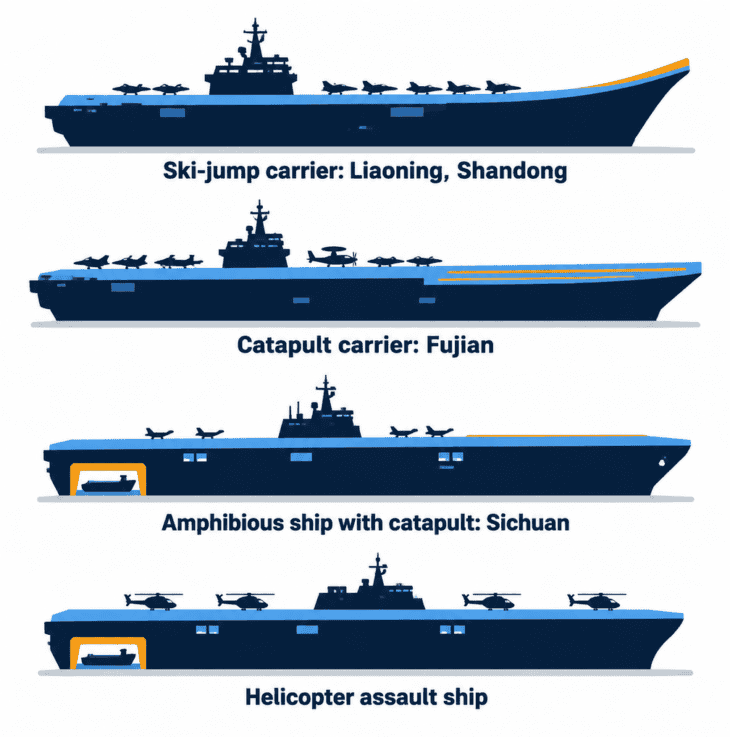
China calls Sichuan an amphibious assault ship, and so does the Pentagon. Janes places it in a niche between an amphibious ship and a light carrier. As of mid-September 2026 it was still on trials and had not been commissioned.
Count every flat deck that is in service and you get seven. Add Sichuan once it commissions and you get eight. Count only ships built to operate fixed-wing fighters and the answer is three.
The carrier that was sold as a casino
Liaoning was laid down in 1984 at a shipyard in what is now Ukraine, as the second ship of the Soviet Kuznetsov class. Its sister ship became Russia’s only aircraft carrier, the Admiral Kuznetsov.
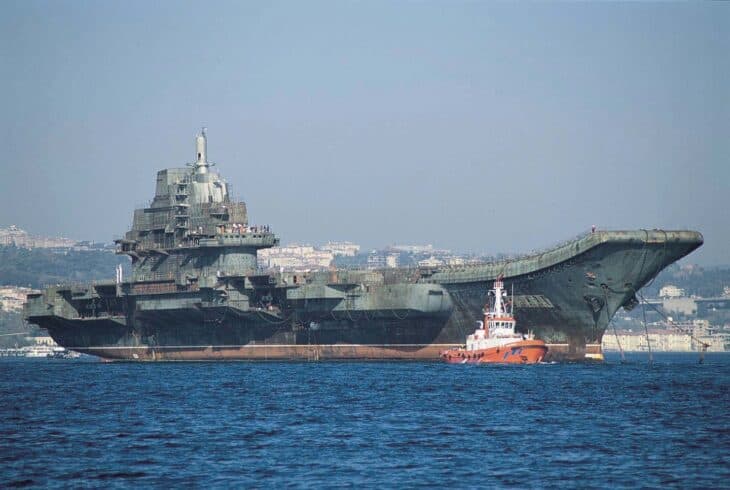
When the Soviet Union collapsed, the half-built ship, renamed Varyag, was left unfinished with no navy to pay for it. In 1998, the Chong Lot Tourism and Entertainment Company, registered in Macau, bought it at auction for $20 million.

A casino that never applied for a license
The buyer’s plan was a floating hotel and casino in Macau. The Macanese authorities never received an application to run a casino on an aircraft carrier. The hull was towed across the world instead, held up for about 18 months by disputes over its passage, and arrived at the Dalian naval shipyard on March 3, 2002.
A decade later, after a long refit at Dalian, the empty hull had become a working warship. It was commissioned as Liaoning on September 25, 2012, primarily as a training ship, carrying about 24 J-15 fighters.
That is the part most people miss. China did not start its carrier program with a design of its own. It started by learning to operate a ship the Soviets had designed and could no longer afford.
How fast is China building aircraft carriers?
Faster each time, but not yet at the pace the headlines suggest. The gap between Liaoning and Shandong entering service was about 87 months. The gap between Shandong and Fujian was about 71 months.
1998
Varyag bought at auction. A Macau-registered company pays $20 million for the unfinished Soviet hull.
March 2002
The hull reaches Dalian. Towed from the Black Sea after about 18 months of delays over its passage.
September 2012
Liaoning commissioned. China’s first carrier enters service as a training ship.
November 2013
Shandong construction begins. The first carrier built in China starts at Dalian.
December 2019
Shandong commissioned. Handed to the navy at Sanya, Hainan.
June 2022
Fujian launched. China’s first catapult carrier floats out at Jiangnan Shipyard in Shanghai.
December 2024
Sichuan launched. The first Type 076 amphibious assault ship, with its own electromagnetic catapult.
Early 2025
Type 004 hull blocks appear. The first sections of a fourth carrier show up in a Dalian dry dock.
November 2025
Fujian commissioned. China becomes a three-carrier navy.
September 2026
The Type 004 bow takes shape. Satellite imagery from September 4 shows bow construction under way.
The build times per ship tell a more mixed story. According to CSIS, Shandong took about 72 months from the start of construction to commissioning. Fujian, a bigger ship with an entirely new launch system, took about 104 months.
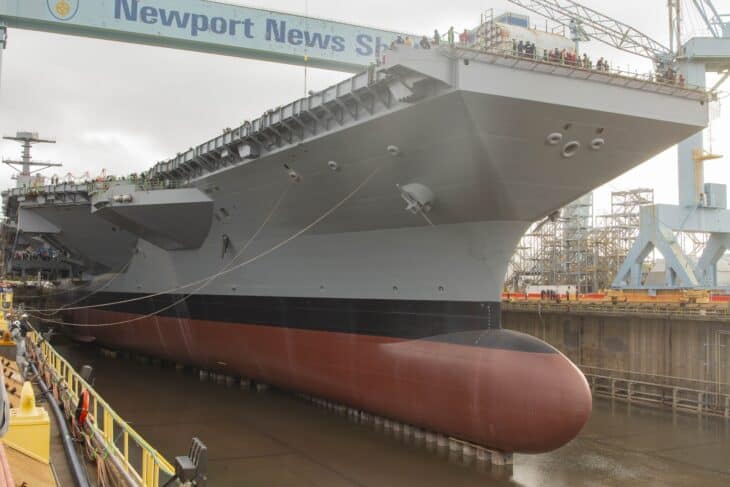
That is still quick by American standards. The USS John F. Kennedy, the second Ford-class carrier, had its keel laid in August 2015 and is scheduled for delivery in March 2027, roughly 11 and a half years later. The next one, USS Enterprise, slipped to a March 2031 delivery in the Navy’s fiscal 2027 budget.
_in_drydock_at_Newport_News_Shipbuilding,_Virginia_(USA)_on_29_October_2019_(191029-N-BD319-110).JPG)
The comparison is not perfectly fair. The Kennedy is a nuclear supercarrier and China’s first three are conventionally powered. But the fourth Chinese carrier is the first real like-for-like test.
Janes projects a hull 1,102 to 1,112 feet (336 to 339 m) long from the September imagery, the same size class as a US Ford-class ship. CSIS found two shielded compartments in May 2026 imagery that look like reactor containment, though China has not confirmed nuclear power. The earliest launch estimates point to 2027.
Will China really have nine carriers by 2035?
The nine comes from the Pentagon’s annual China report, released in December 2025. Its wording is precise: “The PLAN aims to produce six aircraft carriers by 2035 for a total of nine.”
China has published no such target. Asked about a fourth carrier in September 2025, a Chinese defense ministry spokesman said only that carrier development follows national security needs and the progress of technology.
Six more carriers in about ten years works out to one every 20 months or so, a calculation Nikkei Asia ran on the Pentagon’s figure. China has never managed anything close to that.
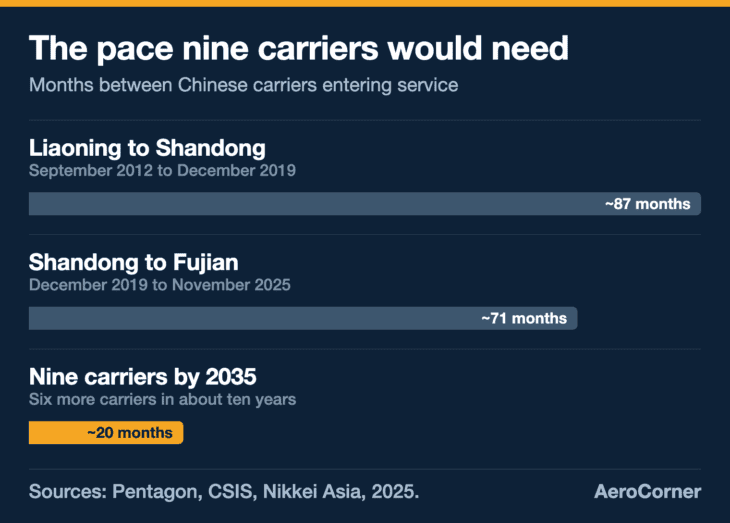
CSIS notes that hitting the Pentagon figure would force China to build at least two carriers at the same time. As of September 2026, no second carrier hull had been reported. CSIS names Jiangnan in Shanghai as the most likely second site.
Some analysts doubt it can be done. Naval analyst Alex Luck told Newsweek that even with accelerating parallel work, he was not sure the target was achievable.
The myths about China’s carrier fleet
Two numbers get repeated about Chinese carriers more than any others, and both are usually quoted wrong.
Myth: China plans six carriers by 2035
Many headlines since December 2025 say six. The Pentagon report says six more, for nine in total. The older six-carrier figure goes back at least to a 2019 South China Morning Post report quoting unnamed Chinese military experts, not to any official document.
The second is the claim that China has 230 times America’s shipbuilding capacity. It comes from a US Navy intelligence slide first reported by The War Zone in 2023, and it is measured in gross tons.
The Congressional Research Service points out that the measure appears to reflect capacity for relatively simple commercial cargo ships. It says a lot about China’s industrial base, but it does not mean China can build carriers 230 times faster.
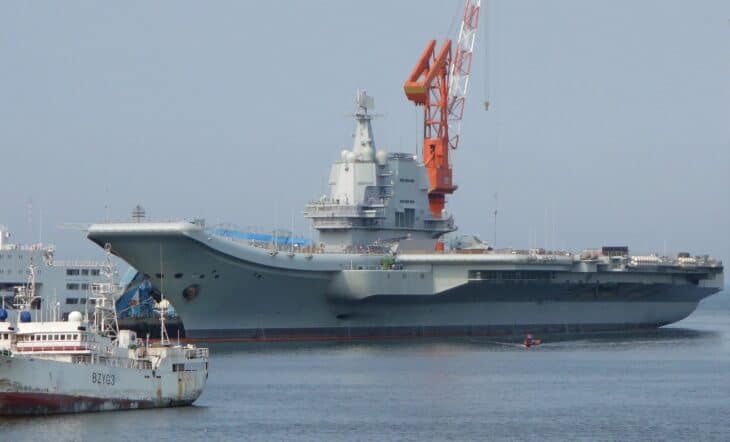
The deeper myth is that three against eleven settles anything. The US Navy has 11 carriers, but usually only about three at sea, and China is now running into the same arithmetic. In June 2026, The Diplomat reported that Shandong had been in a dry dock at Sanya since late January.
.jpg)
What China does have is a short commute. Fujian’s home port at Sanya puts it in the South China Sea already, while American carriers sail thousands of miles to get there. That trade-off, along with catapults, air wings and sortie rates, is laid out in our full US vs China aircraft carrier comparison.
So the honest count in September 2026 is three carriers, one more on the way, and a Pentagon estimate of nine that China would need to more than triple its building pace to reach.
Watch Dalian. The day the Type 004 floats out of its dry dock, likely no earlier than 2027, is the first real test of whether that pace is changing.
Sources and references used for research and fact-checking.
- US Department of Defense, Military and Security Developments Involving the People's Republic of China 2025, Annual Report to Congress
- CSIS Hidden Reach, Tracking China's Fourth Aircraft Carrier
- Janes, Satellite imagery suggests China's fourth carrier could rival Ford class in size
- Meta-Defense, China's Type 004 aircraft carrier takes shape at Dalian
- CSIS ChinaPower, How Advanced Is China's Third Aircraft Carrier?
- CSIS ChinaPower, How does China's first aircraft carrier stack up?
- Naval News, Chinese Navy Takes Aircraft Carrier Fujian Into Active Service in Hainan
- Global Times, China's Fujian aircraft carrier commissioned
- Naval News, China's 2nd aircraft carrier Type 002 Shandong commissioned with PLAN
- Xinhua, China launches second aircraft carrier
- Al Jazeera, China commissions first aircraft carrier
- The China Story, The emerging world-class navy: how China acquired its first aircraft carrier
- Wikipedia, Chinese aircraft carrier Liaoning
- Wikipedia, Type 075 landing helicopter dock
- Militarnyi, China has commissioned the fourth Type 075 amphibious assault ship
- Janes, Type 076 footage offers clearest glimpse yet of China's UAV carrier ambitions
- GlobalSecurity.org, Sichuan to be delivered soon (Global Times)
- china-arms.com, China Type 076 Sichuan: EMALS, drones and industrial analysis
- Congressional Research Service, Navy Ford (CVN-78) Class Aircraft Carrier Program
- HII, Newport News Shipbuilding celebrates the keel laying of aircraft carrier John F. Kennedy (CVN 79)
- The National Interest, The US Navy's next two aircraft carriers just got delayed again
- Congressional Research Service, China Naval Modernization: Implications for U.S. Navy Capabilities
- The War Zone, Alarming Navy Intel Slide Warns Of China's 200 Times Greater Shipbuilding Capacity
- Newsweek, China Plans To Build Six Aircraft Carriers in 10 Years: Pentagon
- Nikkei Asia, China aircraft carriers set to outnumber US in Pacific by 2035: analysts
- South China Morning Post, China will build 4 nuclear aircraft carriers in drive to catch US Navy
- Global Times, China's defense ministry on a fourth aircraft carrier
- The Diplomat, Has China Really Entered the Three-Carrier Era?
- The National Interest, China's new aircraft carrier just got a home port
Get the Newsletter
The latest aviation news and stories sent to your inbox.
About the Author

Tim is the owner and lead editor of AeroCorner since 2019, overseeing aviation content covering aircraft, airlines, airports, and the broader aviation industry. Through years of researching, writing, editing, and publishing aviation-focused content, he has developed extensive practical knowledge of commercial aviation and air travel. Based in Asia and a frequent traveler himself, Tim also brings firsthand passenger experience to AeroCorner’s coverage. Outside of publishing, he has also explored aviation firsthand through hands-on flight training in New Zealand.