

Table of Contents
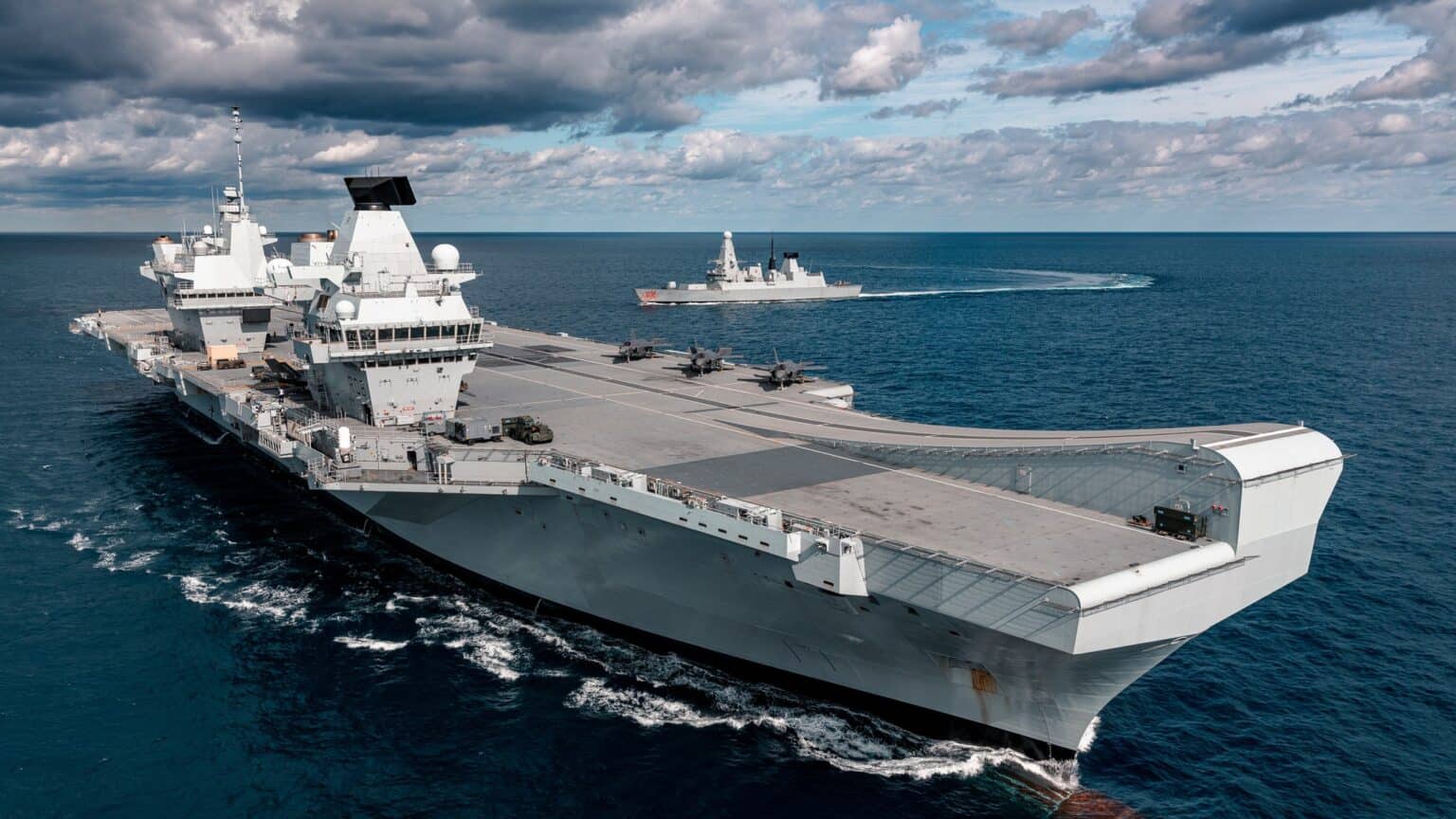
The United Kingdom has two aircraft carriers, HMS Queen Elizabeth and HMS Prince of Wales, according to the Royal Navy’s own fleet list, checked in October 2026. There are none in reserve and none on order.
That number nearly came out differently. The 2010 defense review committed to commissioning only one of the two ships then being built, and the second could have been mothballed or sold.
How Many Aircraft Carriers Does the UK Have?
Two. HMS Queen Elizabeth was commissioned on Dec. 7, 2017, and HMS Prince of Wales followed on Dec. 10, 2019. Together they make up the Queen Elizabeth class, the largest warships ever built in the UK.
Each is 932 feet (284 m) long and displaces 65,000 metric tons. Each can run on a crew of 679 and hold up to 1,600 people with the air group and Royal Marines aboard.
The count at a glance
Two carriers in commission as of October 2026: HMS Queen Elizabeth (R08) and HMS Prince of Wales (R09). None in reserve, none under construction, and no helicopter carrier since HMS Ocean was sold to Brazil in 2018.
What the Count Includes, and What It Leaves Out
The headline number is simple. The interesting part is the row of zeros beneath it, because Britain has given up every other flat-topped ship it used to run.
| Type of ship | Number | Which ships |
|---|---|---|
| Aircraft carriers in commission | 2 | HMS Queen Elizabeth, HMS Prince of Wales |
| Carriers in reserve | 0 | The 2010 reserve plan was dropped in 2014 |
| Carriers on order | 0 | None named in the 2026 Defence Investment Plan |
| Helicopter carriers | 0 | HMS Ocean sold to Brazil in 2018 |
| Helicopter training and casualty ships | 0 | RFA Argus retired in 2026 |
| Total carriers | 2 |
Two carriers does not mean two strike carriers at once. As of October 2026, Prince of Wales holds the job of flagship and high-readiness strike carrier, and Navy Lookout reports that Queen Elizabeth is being prepared to take it over in late 2027.
Both ships were at work in autumn 2026, in different roles. Prince of Wales sailed from Portsmouth on Oct. 18, 2026, to lead the second phase of Operation Firecrest in the Arctic and North Atlantic.
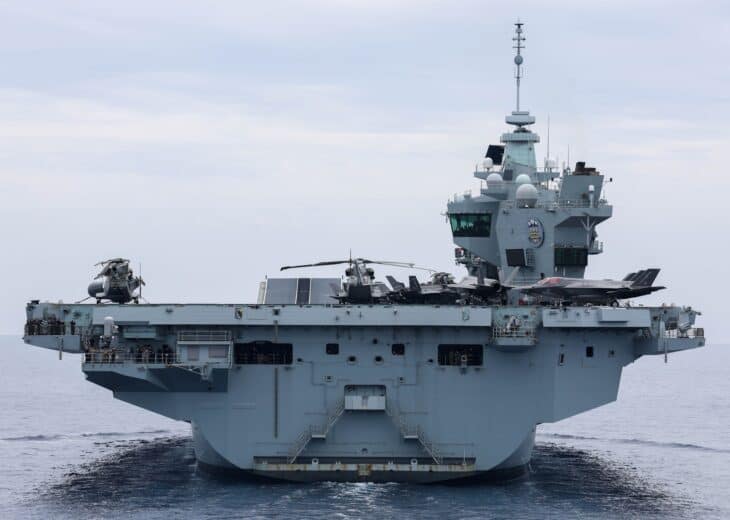

Queen Elizabeth finished her first major refit, a program that began in November 2024 and included eight months in dry dock at Rosyth. She was due to leave Portsmouth on Sept. 5, 2026, for a three-month deployment as a NATO command ship.
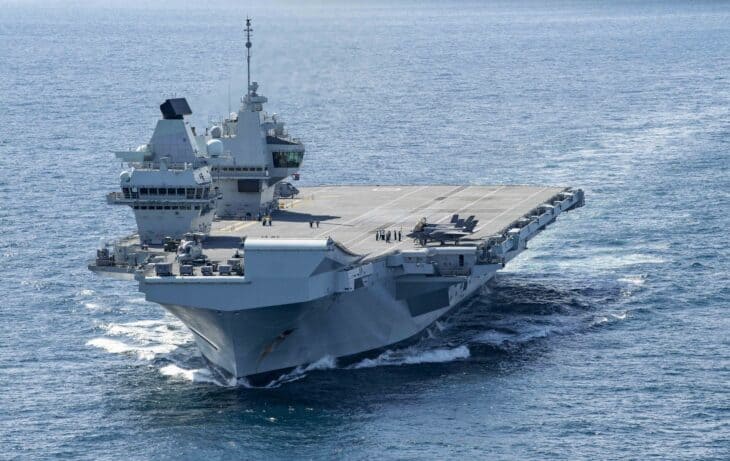

The tighter limit is the jets. Janes counted 43 operational F-35Bs in April 2026, out of 48 delivered, with one lost in an accident and four on test duties in the US.
Parliament’s Public Accounts Committee defined full capability as up to 24 jets on one carrier. Filling both decks to that level would take 48 jets, five more than Britain has operational. For context, see how many planes an aircraft carrier holds.
Why the Numbers Differ
Nearly every current source says two, but the numbers around it cause real confusion. The first cause is the definition of a carrier.
World Population Review’s 2026 ranking credits France and Japan with four carriers each, because it counts helicopter carriers as well. By that broader test, Britain’s count stood at four from 1998 to 2005. Today the broad count and the strict count are both two.
Older pages can also be out of date. HMS Ocean left the Royal Navy in March 2018 and now sails for Brazil, and RFA Argus, a helicopter training and casualty ship, was confirmed for the scrapyard in February 2026.
Assault ships cause a similar mix-up. HMS Bulwark and HMS Albion were amphibious ships, never carriers. The UK confirmed Bulwark’s £20 million sale to Brazil on Aug. 28, 2026, and Albion is awaiting disposal at Devonport.
Then there is the suggestion that Britain is about to have one. In November 2024 The Telegraph reported that mothballing a carrier was discussed in Treasury cost-cutting talks, and a Royal Navy source replied, “We are not looking to go down to one.” Both ships still sail.
The stat that will not retire
Articles still say Prince of Wales has spent a third of her life under repair and a fifth at sea, including one from September 2026. Those figures date from May 2023: 267 days at sea and 411 alongside or in dock, 21.3 percent at sea. They predate her eight-month Indo-Pacific deployment in 2025.
How the Number Got Here
Britain has been at two before, but with very different ships. The table below counts flat-topped ships in commission at each change, from the year the third Invincible-class carrier joined the fleet.
| Year | Jet carriers | Helicopter carriers | What changed |
|---|---|---|---|
| 1985 | 3 | 0 | Ark Royal joins Invincible and Illustrious |
| 1998 | 3 | 1 | HMS Ocean enters service |
| 2005 | 2 | 1 | Invincible decommissioned |
| 2011 | 0 | 2 | Ark Royal decommissioned, Harriers gone, Illustrious a helicopter carrier |
| 2014 | 0 | 1 | Illustrious decommissioned |
| 2017 | 1 | 1 | Queen Elizabeth commissioned |
| 2018 | 1 | 0 | Ocean decommissioned |
| 2019 | 2 | 0 | Prince of Wales commissioned |
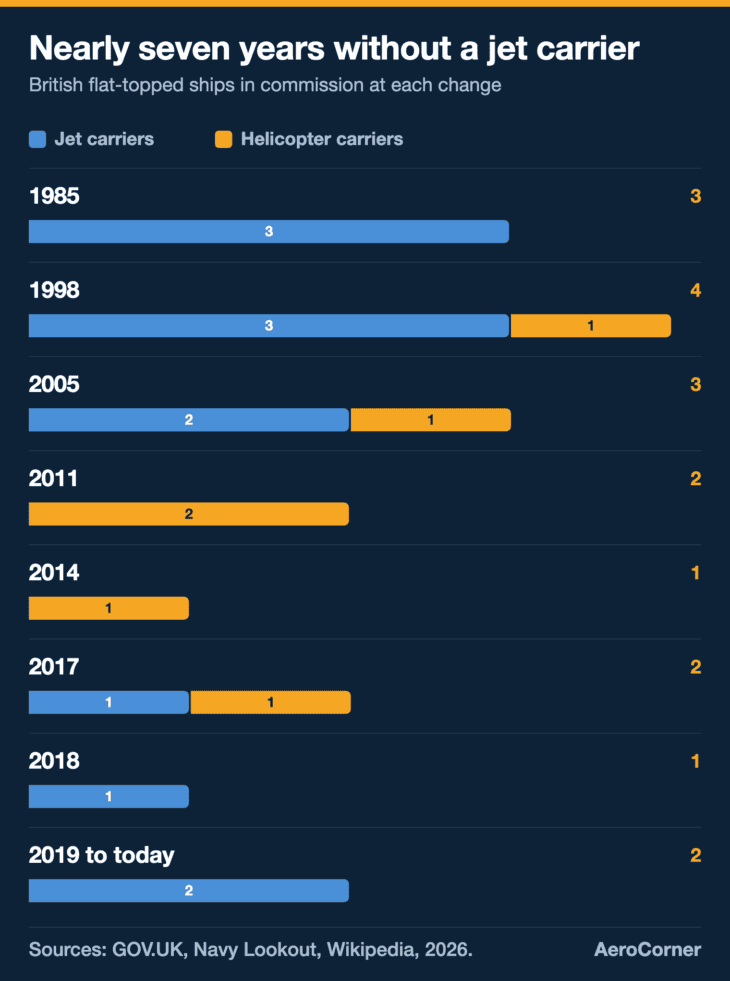
The hole in the middle came from one review. The October 2010 Strategic Defence and Security Review ordered Ark Royal retired early, and the Harrier fleet made its last operational flights that December, years before a replacement could reach the deck.
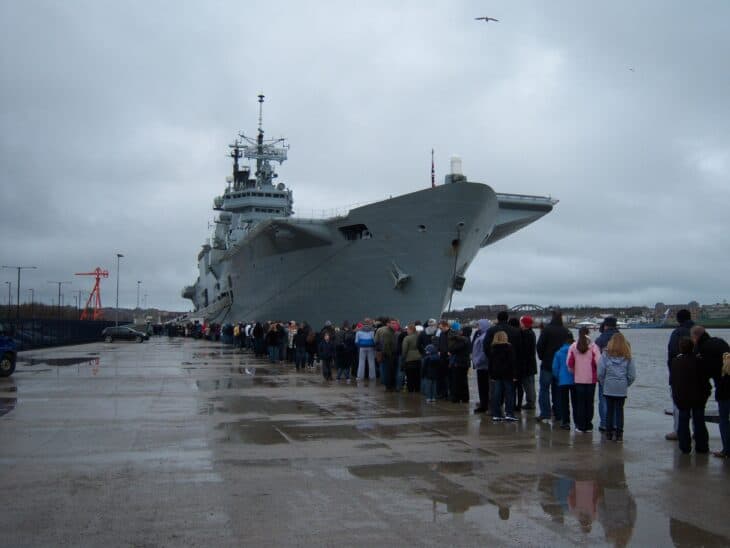

The same review said only one of the two new ships was certain to be commissioned. Plans held the other in reserve, a status the National Audit Office said meant at least a year’s notice to bring it back.
That lasted until the 2014 NATO summit in Wales, where Prime Minister David Cameron announced Prince of Wales would enter active service rather than be sold off or mothballed. It is the reason the count reads two today.
Commissioning did not restore the capability on its own. F-35Bs began trials on Queen Elizabeth in 2018, and her first combat strikes came on June 18, 2021, over Iraq and Syria.
Further back, the number was far higher. 19FortyFive puts the Royal Navy’s 1945 peak at more than 50 carriers of all types, counting escort carriers.
How Britain Compares
Two carriers put the UK behind the US Navy’s 11 and China’s three. It is ahead of France, whose Charles de Gaulle is its only fixed-wing carrier, and Russia’s one, which has not put to sea since 2017.
Britain’s real advantage over France is the second hull. When one Queen Elizabeth-class ship goes into a yard, the other can keep sailing, as Prince of Wales did during Queen Elizabeth’s refit. The 2026 Defence Investment Plan lists £510 million for the class and names no third ship, so nothing on paper changes the count.
FAQ
Sources and references used for research and fact-checking.
- Royal Navy, Ships
- Royal Navy, Queen Elizabeth Class Aircraft Carrier
- Navy Lookout, HMS Queen Elizabeth returns to operations on completion of her first major refit
- ArcticToday, Crowds gather as biggest British warship sets sail for North Atlantic
- UK Government, The Defence Investment Plan
- Janes, UK receives final contracted F-35
- UK Parliament, Public Accounts Committee, Delivering carrier strike
- National Audit Office, Carrier Strike (HC 1092)
- World Population Review, Aircraft Carriers by Country 2026
- GOV.UK, UK agrees sale of HMS Ocean to Brazil
- Maritime Executive, RFA Argus Set to be Towed Away as Royal Navy Confirms Scrapping Plan
- Naval Technology, HMS Bulwark sale to Brazil
- The Telegraph, via Yahoo News, Aircraft carriers face being mothballed in Treasury cost-cutting plan
- Naval Technology, UK carrier spent a third of active life undergoing repairs
- 19FortyFive, Aircraft carrier HMS Prince of Wales has spent about a third of its life in port under repair
- 19FortyFive, The Royal Navy once had more aircraft carriers than the rest of the world combined
- Navy Lookout, Farewell HMS Illustrious, good and faithful servant
- Wikipedia, Invincible-class aircraft carrier
- Wikipedia, List of aircraft carriers of the Royal Navy
- Wikipedia, Strategic Defence and Security Review 2010
- Wikipedia, HMS Prince of Wales (R09)
- Wikipedia, HMS Queen Elizabeth (R08)
- Wikipedia, Queen Elizabeth-class aircraft carrier
Get the Newsletter
The latest aviation news and stories sent to your inbox.
About the Author

Tim is the owner and lead editor of AeroCorner since 2019, overseeing aviation content covering aircraft, airlines, airports, and the broader aviation industry. Through years of researching, writing, editing, and publishing aviation-focused content, he has developed extensive practical knowledge of commercial aviation and air travel. Based in Asia and a frequent traveler himself, Tim also brings firsthand passenger experience to AeroCorner’s coverage. Outside of publishing, he has also explored aviation firsthand through hands-on flight training in New Zealand.