

Table of Contents
Five fifth-generation fighter jets are in squadron service as of October 2026: the F-35 Lightning II, the Chengdu J-20, the F-22 Raptor, the Shenyang J-35 and the Sukhoi Su-57. Three more, South Korea’s KF-21, Turkey’s KAAN and India’s AMCA, are somewhere between a first production jet and a drawing.
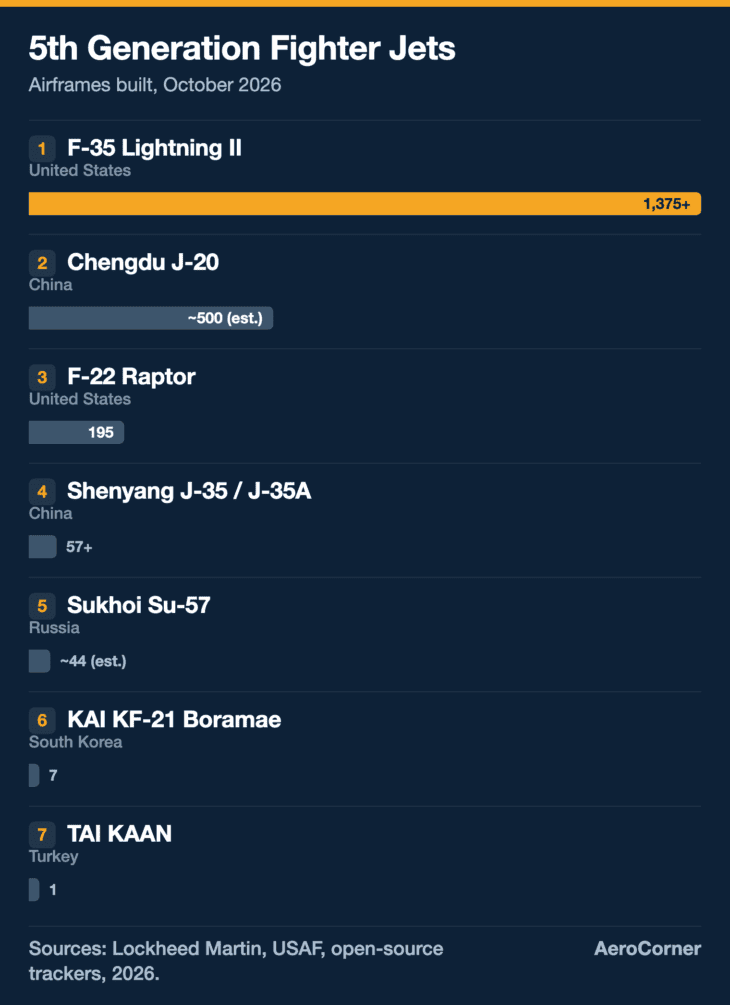
This list ranks all eight by one hard measure: how many airframes have actually been built. On that count the F-35 wins by a distance, with more than 1,375 delivered, which is more than every other fifth-generation fighter on Earth combined.
Numbers matter because a fighter generation is only real once it is in squadrons. A paper fifth-generation jet shoots down nothing, and two of the entries below have not yet built a second flying example.
| Rank | Fighter | Country | First flight | Built (Oct. 2026) | Status |
|---|---|---|---|---|---|
| 1 | Lockheed Martin F-35 Lightning II | United States | 2006 | 1,375+ delivered | In service |
| 2 | Chengdu J-20 | China | 2011 | About 500 (estimate) | In service since 2017 |
| 3 | Lockheed Martin F-22 Raptor | United States | 1997 | 195 (production ended) | In service since 2005 |
| 4 | Shenyang J-35 and J-35A | China | 2012 (as FC-31) | 57+ (Oct. 2025) | In service since 2025 |
| 5 | Sukhoi Su-57 | Russia | 2010 | About 44, incl. 10 test | In service since 2020 |
| 6 | KAI KF-21 Boramae | South Korea | 2022 | 7 (6 prototypes, 1st production jet) | Entering service |
| 7 | TAI KAAN | Turkey | 2024 | 1 flying prototype | Flight test |
| 8 | ADA AMCA | India | Not yet flown | 0 | In development |
How this ranking works
Every program here is sold or described by its builder as a fifth-generation fighter: stealthy, with weapons carried internally, an advanced radar and fused sensors. Entries are ranked by airframes built, prototypes included, as of October 2026. Western figures come from the manufacturer and the US Air Force. China and Russia publish nothing, so their counts come from open-source trackers, and where estimates disagree the table gives the figure the best-documented tracker reports and the text gives the range. This is not a ranking of which jet is best; for that, see our stealth fighter ranking.
What makes a fighter jet 5th generation?
There is no official definition. The usual list is stealth with weapons carried inside the airframe, high maneuverability, supercruise (sustained supersonic flight without afterburner), a low-probability-of-intercept radar, and networked sensor fusion that merges every input into one picture for the pilot.
Not every jet on this list ticks every box, and that is normal. Even Lockheed Martin’s own definition, written around the F-22 and F-35, dropped supercruise along the way. Our guide to the five generations of fighter planes explains how the labels from first to fifth came about.
Lockheed Martin tried to trademark the term
The phrase 5th generation fighter is closely tied to Lockheed Martin, which uses it for the F-22 and F-35 and attempted to trademark it. Boeing and Eurofighter have both criticized the company’s definition, which originally included supercruise before that requirement quietly dropped out.
1. Lockheed Martin F-35 Lightning II
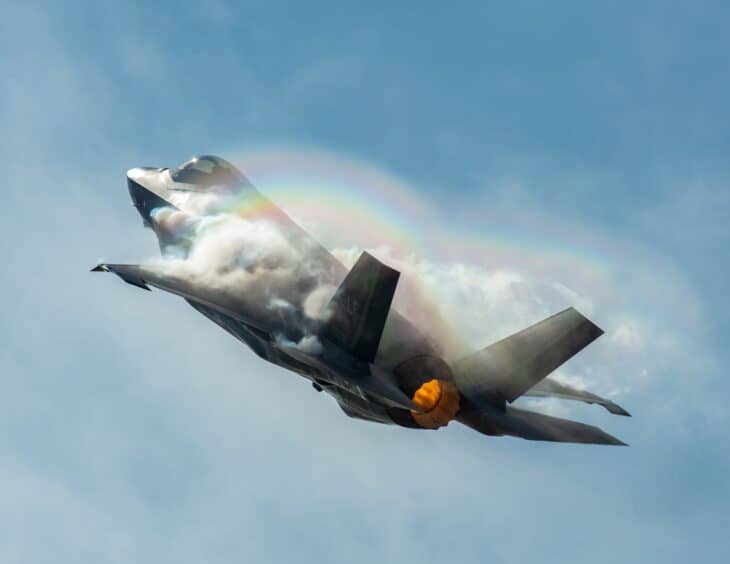

The F-35 Lightning II is the most numerous fifth-generation fighter by a wide margin. Lockheed Martin’s own monthly figures put deliveries at more than 1,375 aircraft as of October 2026, and the fleet has passed one million flight hours.
Production is still accelerating. Lockheed delivered a record 191 F-35s in 2025, up from 110 in 2024, although that total included jets held in storage while the Technology Refresh-3 upgrade was sorted out.
It comes in three variants on one family of airframes: the conventional F-35A, the short-takeoff and vertical-landing F-35B, and the carrier-capable F-35C. The A first flew in 2006, the B in 2008 and the C in 2010.
It is also the only fifth-generation fighter still on sale with a public price. The F-35 Joint Program Office put the average flyaway cost of an F-35A in Lots 18 and 19 at $92 million in September 2026, with the F-35B at $121.4 million and the F-35C at $110.8 million.
2. Chengdu J-20
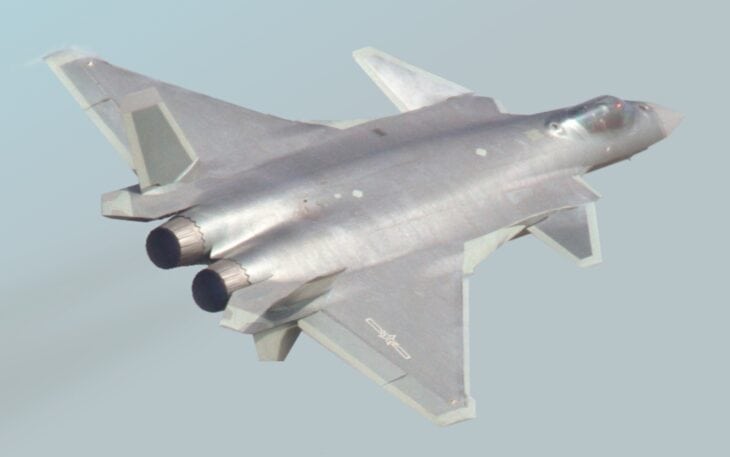

China’s J-20 first flew on January 11, 2011 and was reported in service in March 2017. It was the first fifth-generation fighter built outside the United States to reach squadrons, and it is now the second most numerous in the world.
Nobody outside China knows exactly how many exist. RUSI put the fleet at about 300 in late 2025, with Chengdu building around 120 a year, and the tracker Andreas Rupprecht estimated about 500 delivered by mid-2026. RUSI expects roughly 1,000 J-20s of all versions by 2030.
The J-20 carries long-range missiles in a main internal bay, with two smaller side bays for short-range missiles. Production jets have flown on the WS-10C since 2019, and a J-20 reportedly flew on the purpose-built WS-15 in June 2023.
A two-seat J-20S, shown at the 2024 Zhuhai Airshow, officially joined the fleet on September 3, 2025. For how the J-20 stacks up against American jets in numbers, see our comparison of US vs China fighter jets.
3. Lockheed Martin F-22 Raptor
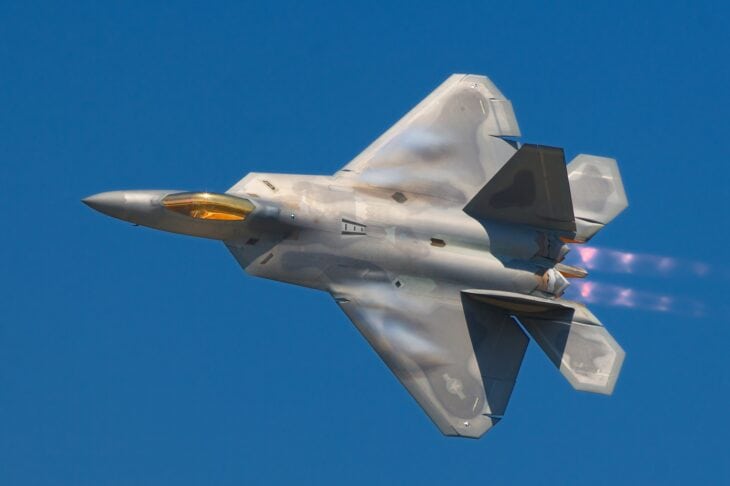

The F-22 Raptor is the original fifth-generation fighter. It first flew on September 7, 1997 and reached initial operating capability in December 2005, years before anything else on this list.
Only 195 were built: 8 test aircraft and 187 operational jets. The last one was completed in December 2011, and the US Air Force fact sheet lists 183 in the total-force inventory.
It is the jet built most completely to the classic checklist. Its two Pratt and Whitney F119 engines, each in the 35,000-pound thrust class, let it cruise above Mach 1.5 without afterburner, and the Air Force lists its unit cost at $143 million.
The fleet will never grow. Annual US defense appropriations acts have barred funding for foreign F-22 sales since fiscal 1998, and the production line is long closed, so a 195-jet fleet is the whole story.
4. Shenyang J-35 and J-35A
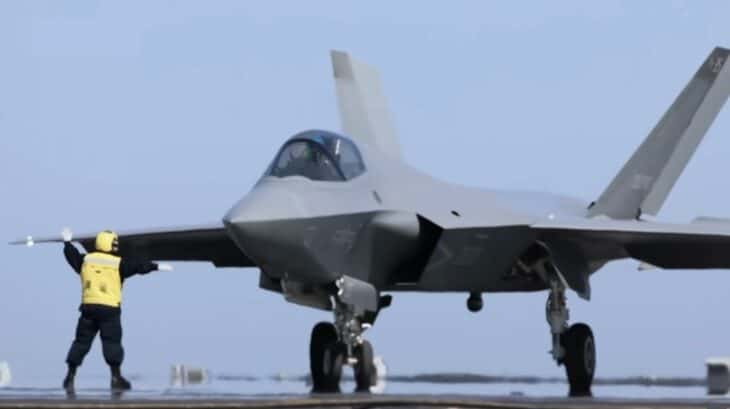

The J-35 began life as the FC-31 demonstrator, which first flew on October 31, 2012. It now exists in two forms: the naval J-35 for China’s carriers and the land-based J-35A for the air force.
The J-35A flew in public for the first time at the Zhuhai Airshow on November 12, 2024. Chinese state media reported both versions in service on September 3, 2025, and on September 22, 2025 the PLA Navy said the J-35 had been certified for catapult launches.
That makes China the second country, after the United States, to build its own carrier-based stealth fighter. Open-source counts put the J-35 family at 57 or more airframes as of October 2025, and Pakistan has announced plans to buy the J-35A, though no contract has been confirmed.
5. Sukhoi Su-57

Russia’s Su-57 flew first on January 29, 2010, a year ahead of the J-20. It then took a decade to reach squadrons: the first production jet crashed in December 2019, and service entry came on December 25, 2020.
How many exist is genuinely disputed. One widely used tally counts 44 or more, including 10 test aircraft, while Armada International put the lifetime total at just 20 to 25 in April 2026 and said the factory delivered only two to the Russian Aerospace Forces in 2025.
The airframe has internal bays for four long-range and two short-range missiles. It still flies on the interim AL-41F-1 engine, because the purpose-built AL-51F-1 has been slow through testing.
Algeria is the reported first export customer. In November 2025 United Aircraft Corporation said two Su-57E had gone to an unnamed foreign buyer, and grainy video of one flying over Algeria appeared in February 2026, but neither government has confirmed the deal.
6. KAI KF-21 Boramae
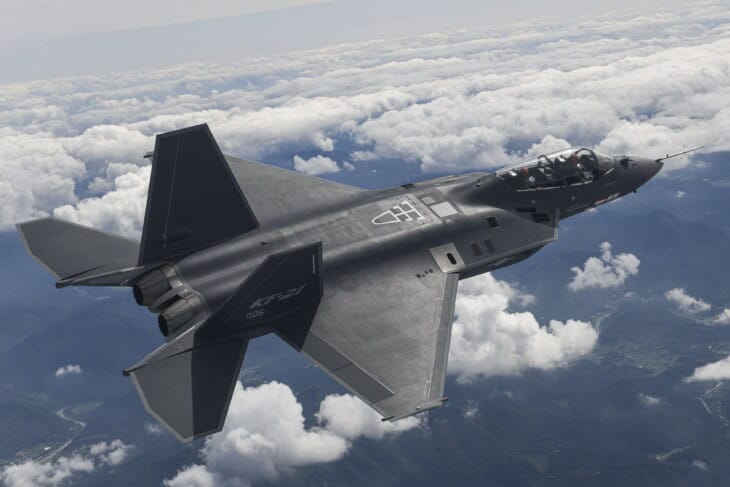
South Korea’s KF-21 is the borderline entry, and the honest one. The prototype first flew in July 2022, and the first production jet, tail 25-001, was handed to the Republic of Korea Air Force on September 22, 2026.
Six prototypes flew the development program, which DAPA said wrapped up its test flights on January 12, 2026. The air force plans 40 Block I jets by 2028 and 80 Block II jets by 2032, for 120 in all.
What keeps it off the full fifth-generation list is where it carries its weapons. Block I and II jets use recessed hardpoints under the fuselage, and internal bays are planned only for a later Block III. The story behind the program is in our piece on the KF-21 and the countries that build their own fighters.
7. TAI KAAN
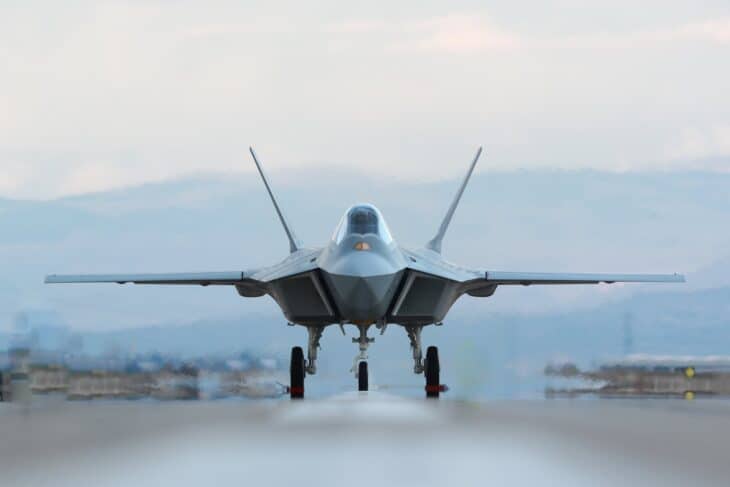

Turkey’s KAAN made its first flight on February 21, 2024, staying up for 13 minutes on two General Electric F110 engines. As of early October 2026 that first prototype was still the only one to have flown.
The next one is close. On October 2, 2026, Turkish Aerospace general manager Mehmet Demiroğlu said all system checks on prototype P1 were complete and it should fly within weeks, with P2 to follow.
KAAN already has an export customer. Indonesia signed for 48 jets at the IDEF 2025 show in Istanbul, a deal Turkish media valued at about $10 billion, with deliveries spread over 10 years.
8. ADA AMCA
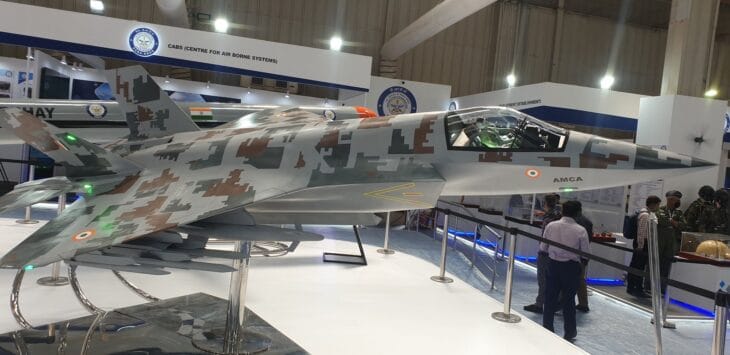

India’s Advanced Medium Combat Aircraft is the only program here with no airframe at all. On September 27, 2026, Defence Secretary Rajesh Kumar Singh set a first-flight target of September 2028.
The plan calls for five flying prototypes and one structural test airframe, built by a private-sector partner rather than state-owned HAL, with the Aeronautical Development Agency keeping design authority. The early prototypes will fly on the General Electric F414.
Which countries have 5th generation fighter jets?
Only three countries have built a fifth-generation fighter and put it in squadron service: the United States, China and Russia. South Korea joined them as a builder in September 2026 with the first production KF-21, if you count it.
Far more countries fly one, almost all of them through the F-35. Lockheed’s F-35 site has pages for 20 countries, and the jet’s flight-hour total covers 16 services already operating it.
What about the Super Hornet, F-15EX and Rafale?
They are often sold as close to fifth generation, and with modern AESA radars they get a long way there. Raytheon’s Michael Garcia once claimed AESA gives the Super Hornet 90 percent of fifth-generation capability at half the cost. But none of them carries its weapons internally, which is the line most definitions draw, so they are 4.5-generation fighters and stay off this list.
For a ranking by capability rather than numbers, with the F-22 on top, see our list of stealth fighter jets ranked. The wider field, fourth generation included, is in the best fighter jets in the world.
The sixth generation is already being built
The fifth generation is not the end of the line. The US Air Force picked Boeing in March 2025 to build the F-47, and Air Force Chief of Staff Gen. David Allvin said in September 2025 that the first one was under construction for a 2028 first flight.
The programs competing with it are in our guide to sixth-generation fighter jets.
FAQ
Sources and references used for research and fact-checking.
- Wikipedia, Fifth-generation fighter
- US Air Force, F-22 Raptor fact sheet
- Wikipedia, Lockheed Martin F-22 Raptor
- Lockheed Martin, F-35 Fast Facts
- The Aviationist, Lockheed Martin Delivered 191 F-35s in 2025
- 19FortyFive, The Pentagon is paying $24.29 billion for 296 F-35 fighters
- The War Zone, How many J-20 stealth fighters does China actually have?
- Wikipedia, Chengdu J-20
- Wikipedia, Shenyang J-35
- Wikipedia, Sukhoi Su-57
- Armada International, Sukhoi's troubled Felon
- The Aviationist, Algeria's first Su-57E
- The Aviationist, First Production KF-21 Boramae Delivered to ROKAF
- Asian Military Review, KF-21 Boramae completes flight test programme
- MIG-Flug, KAAN P1 First Flight Weeks Away, Says TUSAS
- Defence Industry Europe, Turkiye and Indonesia finalise $10 billion deal for 48 Kaan fighter jets
- MIG-Flug, AMCA first flight set for 2028
- Military Times, First F-47 now being built, will fly in 2028
Get the Newsletter
The latest aviation news and stories sent to your inbox.
About the Author

Tim is the owner and lead editor of AeroCorner since 2019, overseeing aviation content covering aircraft, airlines, airports, and the broader aviation industry. Through years of researching, writing, editing, and publishing aviation-focused content, he has developed extensive practical knowledge of commercial aviation and air travel. Based in Asia and a frequent traveler himself, Tim also brings firsthand passenger experience to AeroCorner’s coverage. Outside of publishing, he has also explored aviation firsthand through hands-on flight training in New Zealand.