

Table of Contents
Designing a modern combat aircraft is something only a handful of countries manage. Building the engine that powers it is a shorter list still, and South Korea is not on it yet.
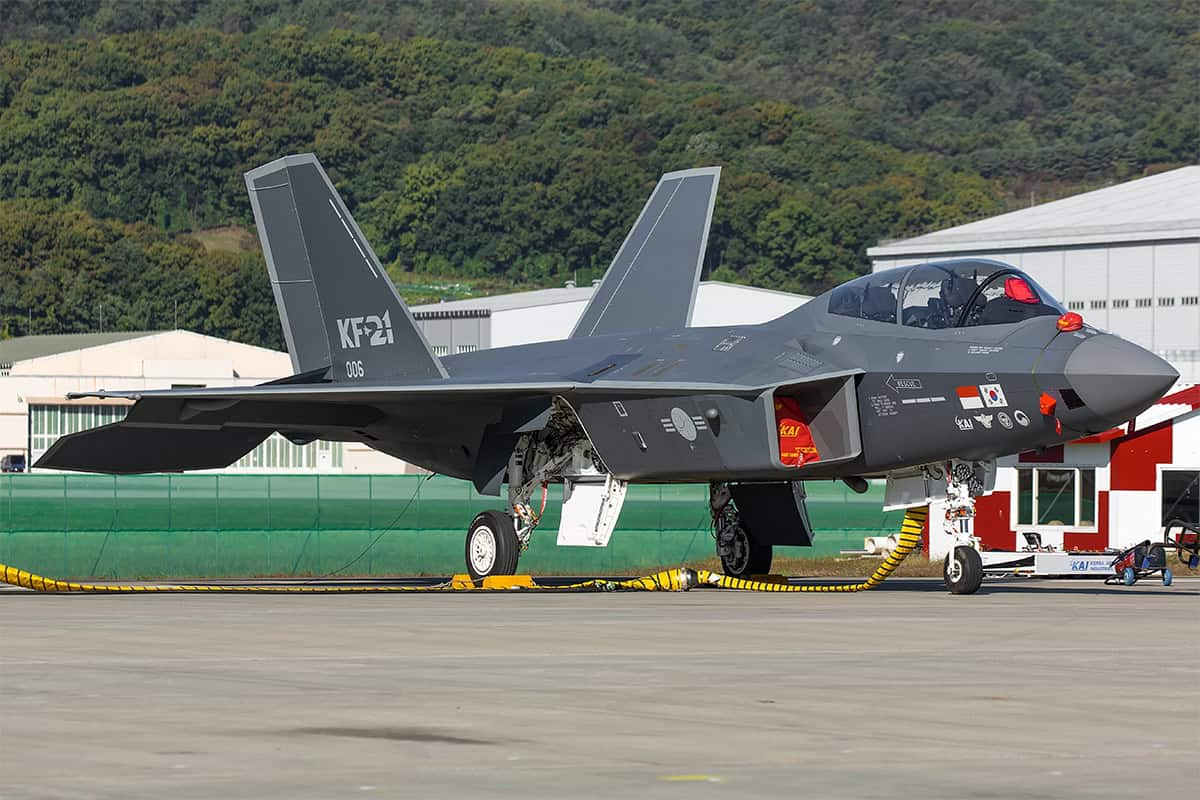
On September 22, 2026, the Republic of Korea Air Force accepted its first series-production KF-21 Boramae at Yecheon Air Base, where it joins the 156th Fighter Squadron of the 16th Fighter Wing. The squadron was reactivated in June to fly it.
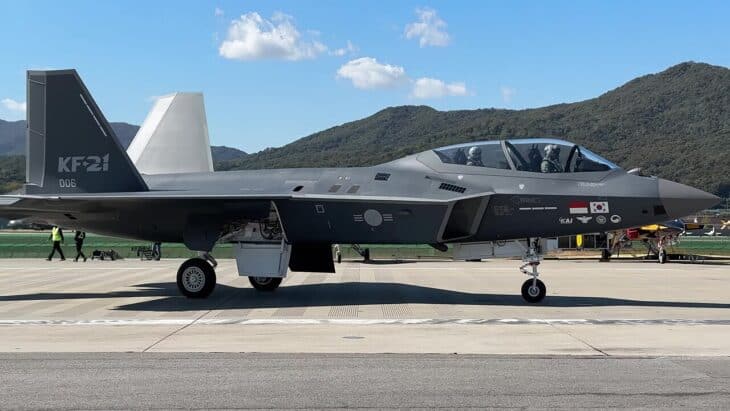
That makes South Korea one of a very small number of countries that designed a supersonic fighter at home and put it into production for its own air force. But the two engines in it are General Electric F414s, assembled in Korea under license from an American company.
Korean content across the aircraft runs above 65 percent. On the engine, it is about 39 percent. That single gap decides who Seoul is allowed to sell the jet to.
Korea Built Its Own Radar Because Washington Said No
The program traces to a 2001 declaration that Korea would build its own fighter, but the decision that shaped the aircraft came in 2015. Full-scale development had started, and the plan leaned on American technology transferred as an offset against Korea’s purchase of 40 F-35As.
In April 2015 the Defense Acquisition Program Administration was notified that four of those technologies would not be released: the AESA radar, the electro-optical targeting pod, the infrared search and track system, and the radio frequency jammer. The reason given was US export control.
A Lockheed Martin official put it plainly at the time: “There is no F-35 customer nation receiving the AESA radar technology.” Buying the F-35 had not bought the technology inside it.
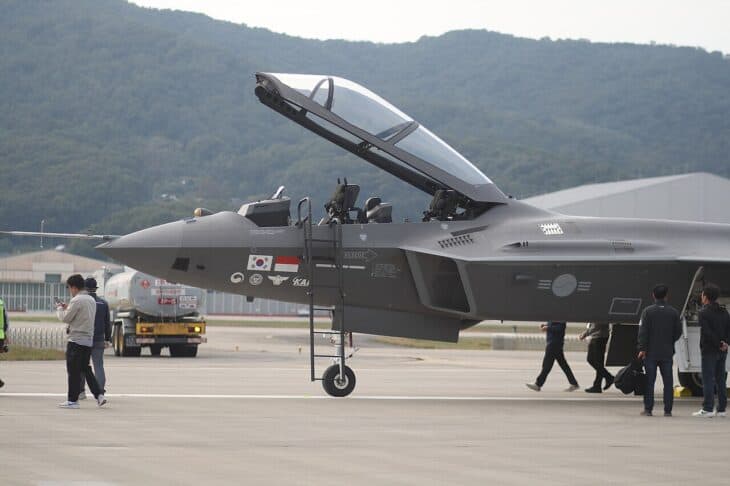
Korea built all four itself. Hanwha Systems developed the radar hardware and LIG Nex1 the software, an array of roughly 1,000 transmit and receive modules with a reported detection range of 93 to 124 miles (150 to 200 km). The refusal is the reason the KF-21’s most advanced systems are Korean at all.
System development ran from December 2015. The first prototype rolled out in April 2021, flew on July 19, 2022, and six flying prototypes carried the test program. Korea certified the Block I standard combat-capable in May 2026 and declared systems development complete that June.
Three National Fighter Programs, One American Engine
The word “indigenous” does a lot of work in fighter programs, and the engine is where it usually stops. The clearest way to see it is to line up the frontline fighters that different countries call their own and ask who made the powerplant.
| Fighter | Country | Engine | Engine origin |
|---|---|---|---|
| KF-21 Boramae | South Korea | GE F414-GE-400K | US design, assembled in Korea by Hanwha Aerospace |
| Gripen E | Sweden | GE F414-GE-39E (RM16) | US design |
| Tejas Mk2 | India | GE F414-GE-INS6 | US design, licensed production planned at HAL |
| Rafale | France | Safran M88 | French |
| Su-57 | Russia | Saturn AL-41F1 | Russian |
| F-35 | United States | Pratt & Whitney F135 | US |
Three separate national fighter programs on three continents run the same American engine family. Sweden’s Saab Gripen uses the F414-GE-39E, designated RM16 in Swedish service, and the first of 60 Gripen E jets entered service with the Skaraborg Wing at Satenas on October 20, 2025.
India’s HAL Tejas Mk2 takes the F414-GE-INS6, with up to 99 engines to be built under license near Bangalore and roughly 80 percent technology transfer negotiated. The first is expected out of that line in 2028.
One engine, three flags
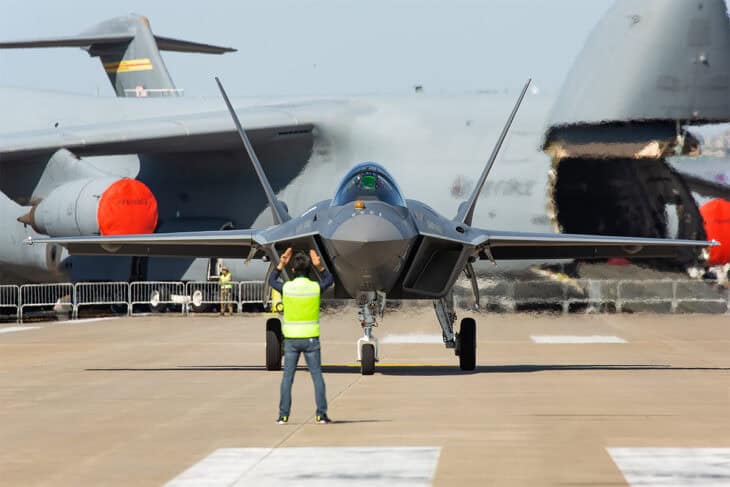
South Korea’s KF-21, Sweden’s Gripen E and India’s Tejas Mk2 are each described as a national fighter. All three are powered by versions of the same General Electric F414, rated at 22,000 pounds of thrust with afterburner.
France’s Rafale is the exception among mid-size powers. Its Safran M88 is French from the core out, which is why France can sell the aircraft without asking anyone. That independence is the thing Korea does not have, and it is expensive to buy.
The Engine Decides Who You Can Sell To
An engine built under American license carries American export law with it. The F414 falls under the International Traffic in Arms Regulations, administered by the US State Department.
Under ITAR’s third-country transfer rules, a single controlled US component is enough to require US approval before the finished aircraft goes anywhere else. Korea can build the KF-21. Korea cannot independently decide who buys it.
That matters because export is the point. Korea has 40 Block I aircraft due by 2028 and 80 Block II jets with long-range air-to-ground weapons by 2032, and the first 20 were contracted at 1.9 trillion won. A fleet that size does not amortize a development program on its own.
DAPA has said it will manage export approvals through the Korea-US cooperation framework so sales proceed without disruption. It has also designated advanced aircraft gas turbine engines a priority technology for domestic investment, which is the more revealing statement of the two.
Korea is not alone in worrying about engines. The US Air Force has gone looking for suppliers beyond Pratt & Whitney and GE for its own fighter fleet, and the GCAP partners are developing a new engine for their sixth-generation aircraft rather than adapting an existing one.
3.4 Trillion Won and Fourteen Years
In December 2025, Korea committed to fixing the gap. DAPA’s Advanced Aviation Engine Development Project runs from 2027 to 2040 at about 3.4 trillion won, roughly $2.5 billion at late-September 2026 exchange rates.
The target is an engine of 16,000 pounds dry thrust and 24,000 pounds with afterburner, about 15 percent better on specific fuel consumption than the F414 it would replace. Hanwha Aerospace, which assembles the American engine today, is expected to take a central role.
It would power a future KF-21 Block III. Fourteen years is the honest timeline for learning to build a fighter engine, and it is a fair measure of why so few countries do.
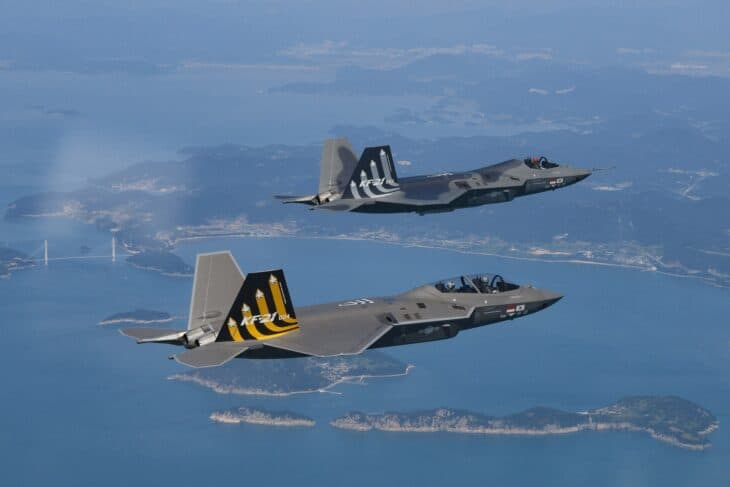
For now the aircraft in the hangar at Yecheon is a genuine achievement with an asterisk. Korea Aerospace Industries has delivered something most countries cannot, and the jet is expected to be declared operational in the second half of 2027.
The airframe, the radar, the jammer and the targeting systems are Korean. The thing that makes it move is not, and will not be until about 2040.
On any honest reading of what it takes to build a fighter, the engine is the last and hardest part. That is the reason the list of countries that can do all of it stays as short as it does.
Sources and references used for research and fact-checking.
- The Aviationist, First Production KF-21 Boramae Delivered to ROKAF
- Janes, South Korea inducts first production KF-21 fighter
- The Korea Times, Korea's homegrown KF-21 fighter makes 1st sortie to mark delivery to Air Force
- Wikipedia, KAI KF-21 Boramae
- Defense News, Tech Transfer Hobbles South Korea's Fighter Program
- Wikipedia, General Electric F414
- Seoul Economic Daily, KF-21's Borrowed U.S. Engine Blocks Exports Without Washington's Approval
- FlightGlobal, South Korea commits $3.4 billion to develop indigenous fighter engine for KF-21
- Janes, Swedish Air Force inducts Gripen E into service
- FlightGlobal, South Korean air force receives first production KF-21
Get the Newsletter
The latest aviation news and stories sent to your inbox.
About the Author

Tim is the owner and lead editor of AeroCorner since 2019, overseeing aviation content covering aircraft, airlines, airports, and the broader aviation industry. Through years of researching, writing, editing, and publishing aviation-focused content, he has developed extensive practical knowledge of commercial aviation and air travel. Based in Asia and a frequent traveler himself, Tim also brings firsthand passenger experience to AeroCorner’s coverage. Outside of publishing, he has also explored aviation firsthand through hands-on flight training in New Zealand.