

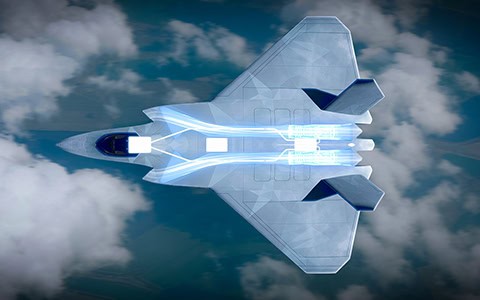
On July 20, 2026, at the Farnborough International Airshow, the consortium developing the engine for the Global Combat Air Programme said it has completed a series of design reviews that move its engine demonstrator closer to ground testing. The engine is being built jointly by Rolls-Royce of the UK, Italy’s Avio Aero and Japan’s IHI Corporation.
GCAP is the sixth-generation fighter being developed together by the UK, Italy and Japan, aimed at entering service around 2035. The three engine partners said they have run more than 100 subscale component tests so far and are moving toward final approval of the all-new centre-line demonstrator design.
What This Milestone Actually Means
The demonstrator is not the finished engine that will eventually power the fighter. It is a full-size test article built to gather data, prove out the architecture, and shape the design of the real power and propulsion system before it is committed to production.
Completing design reviews is the formal checkpoint that lets manufacturing and, next, ground testing proceed. On a program of this scale, that sequence exists to retire technical risk in stages, so problems surface on a test rig rather than on an operational aircraft.
Reality check: this is a test engine
The consortium announced design progress and a path toward ground tests, not a running engine or a fixed date. The demonstrator is meant to inform the production propulsion system, and GCAP itself is still years from first flight, so this is an early development step rather than a finished capability.
A “Flying Power Station,” Not Just Thrust
The most telling detail is how Rolls-Royce framed the engine’s job. Phil Townley, the company’s director of future programmes for defence, described it as needing to manage “unprecedented electrical and thermal loads required by next-generation sensors and weapon systems.”
That marks a real shift from earlier fighters. On a fourth-generation jet the engine’s main job was thrust, but a sixth-generation aircraft carries power-hungry radars, sensor fusion, and potentially directed-energy systems that draw enormous electrical loads and generate heat that has to be managed.
Designing the engine as a “flying power station” is how the consortium plans to meet those demands. It is one of the clearest markers of what separates the newer generations of fighter jets from the aircraft they replace.
For the UK, GCAP is the intended successor to the Eurofighter Typhoon, with Italy and Japan replacing their own current fleets. The partners have opened a collaboration hub in Reading, England, and say the propulsion work supports more than 9,000 skilled aerospace jobs across the three nations. Airframe development is handled by a separate joint venture, Edgewing.
A three-nation program
Unlike a single-country fighter, GCAP splits both the airframe and the engine across the UK, Italy and Japan. The propulsion consortium pairs Rolls-Royce with Avio Aero and IHI, which is why the milestone is announced jointly rather than by one company.
The update landed at Farnborough alongside a run of defense highlights, including Boeing’s Ghost Bat drone. For GCAP, the engine is one of the program’s hardest and most closely watched pieces, and moving it toward ground testing is a concrete sign the sixth-generation effort is progressing.
Sources and references used for research and fact-checking.
Get the Newsletter
The latest aviation news and stories sent to your inbox.
About the Author

Tim is the owner and lead editor of AeroCorner since 2019, overseeing aviation content covering aircraft, airlines, airports, and the broader aviation industry. Through years of researching, writing, editing, and publishing aviation-focused content, he has developed extensive practical knowledge of commercial aviation and air travel. Based in Asia and a frequent traveler himself, Tim also brings firsthand passenger experience to AeroCorner’s coverage. Outside of publishing, he has also explored aviation firsthand through hands-on flight training in New Zealand.