

Table of Contents
The Turkish Navy, officially the Turkish Naval Forces (Türk Deniz Kuvvetleri), is led by TCG Anadolu, a 758-foot (231 m) amphibious assault ship that Turkey turned into a drone carrier after it was thrown out of the F-35 program. Its first fixed-wing drone took off from the deck and landed back on it in November 2024.
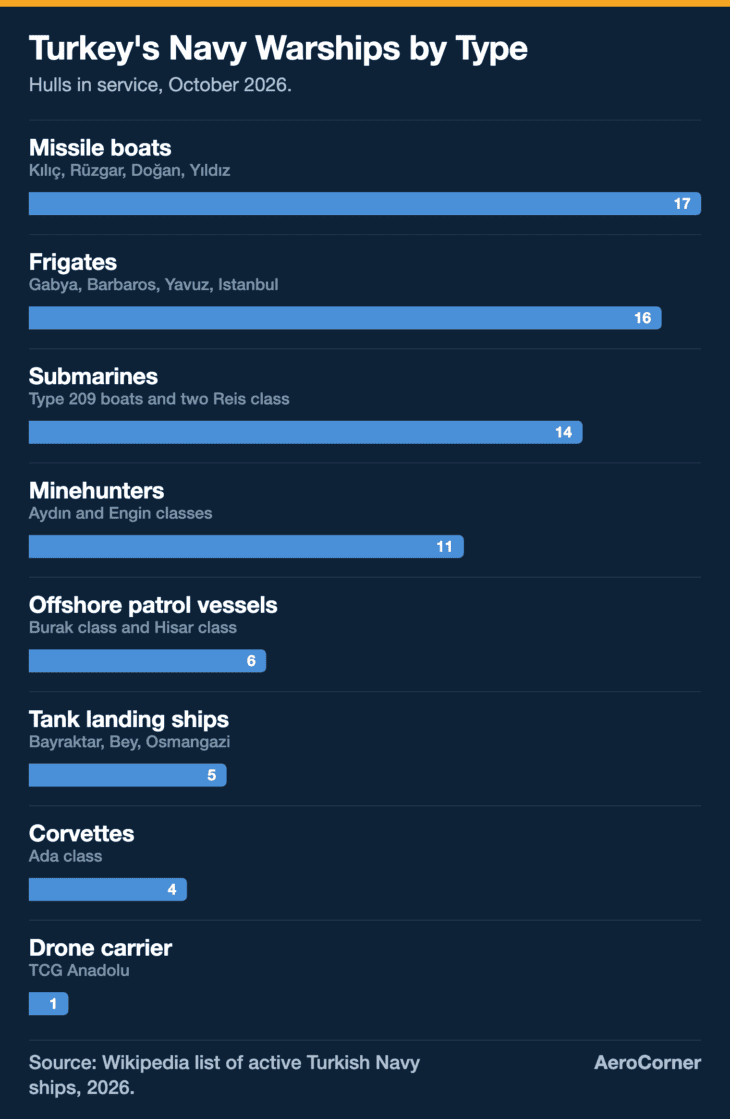
Behind it sail 16 frigates, four corvettes, 14 submarines and 17 missile boats. GlobalFirepower’s 2026 index counts 192 naval assets and ranks Turkey’s armed forces ninth of 145 countries, yet it lists zero destroyers: the first one is still being built.
This guide ranks every major class Turkey sails by fighting value as of October 2026, with hull counts, the ships that joined in the last year, the aircraft that fly from the fleet, and the carrier, destroyers and submarine Turkey started building on the same day.
| Rank | Class | Type | Hulls in service | Status, October 2026 |
|---|---|---|---|---|
| 1 | Anadolu | Amphibious assault ship, drone carrier | 1 | Fleet flagship since 2023 |
| 2 | Istanbul (I class) | Frigate | 1 | İzmir on sea trials, five more launched |
| 3 | Reis | Attack submarine, air-independent | 2 | Hızırreis joined December 2025 |
| 4 | Barbaros | Frigate | 4 | Mid-life upgrade |
| 5 | Gabya | Frigate (ex-US Perry class) | 8 | Active |
| 6 | Ada | Corvette | 4 | Active, exported to Pakistan |
| 7 | Preveze, Gür and Atılay | Attack submarine (Type 209) | 12 | Two Atılays used for training |
| 8 | Yavuz | Frigate | 3 | Yavuz herself now a museum |
| 9 | Bayraktar and older LSTs | Tank landing ship | 5 | Active |
| 10 | Kılıç and older boats | Missile boat | 17 | Active |
| 11 | Hisar and Burak | Offshore patrol vessel | 6 | Koçhisar joined in 2026 |
| 12 | Engin and Aydın | Minehunter | 11 | Active |
| 13 | ULAQ, Marlin and others | Unmanned surface vessel | Classified | ULAQ commissioned December 2025 |
How this ranking works
Classes are ranked by fighting value in October 2026: how modern each one is, what it carries, and how much it changes what the fleet can do. A ship that can launch drones and helicopters ranks above a dozen patrol boats. Hull counts come from open-source lists checked against 2025 and 2026 commissioning reports. Training ships, survey ships, inshore patrol boats, landing craft and auxiliaries are left out of the ranking.
1. TCG Anadolu: The Drone Carrier
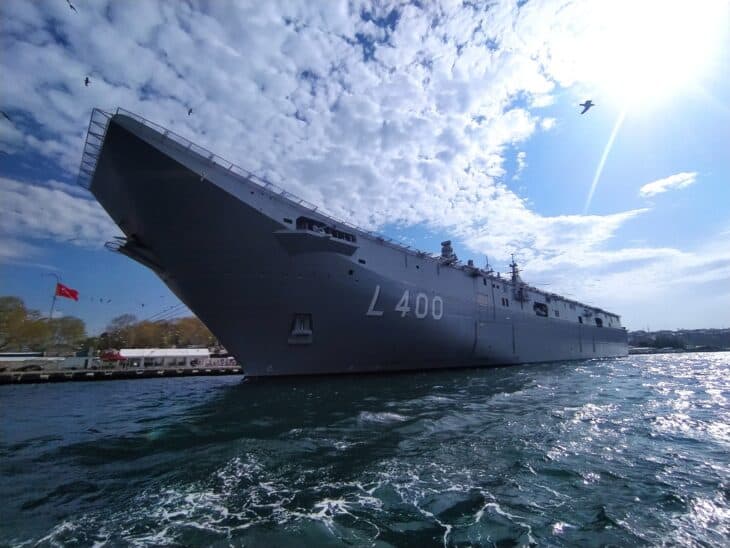

TCG Anadolu (L-400) is the largest warship Turkey has ever owned. It is 758 feet (231 m) long, displaces 27,436 tons fully loaded and cost more than $1 billion, and it was commissioned on April 10, 2023.
It is built to the design of Spain’s Juan Carlos I, with a ski-jump ramp at the bow. Turkey chose the ramp because it planned to fly F-35B jump jets from the deck, until the US removed it from the F-35 program in 2019 over its purchase of Russia’s S-400.
So Turkey rebuilt the plan around drones. Officials have said 30 to 50 folding-wing Bayraktar TB3s will be able to operate from the deck, alongside S-70B Seahawk and AH-1W SuperCobra helicopters, and the hangar holds 12 medium helicopters.
No arresting wires, no catapult
On November 19, 2024, a Bayraktar TB3 took off from Anadolu’s short deck over its 12-degree ramp, flew for 46 minutes over the Aegean and the Mediterranean, and landed back on the same deck without any landing support equipment. Baykar, which builds the TB3, calls it the first armed drone able to do that from a short-deck warship.
Anadolu can also carry an amphibious force, up to 29 main battle tanks in its heavy vehicle garage, and has a range of 9,000 nautical miles. A sister ship, TCG Trakya, is planned.
2. Istanbul Class: The Frigates Turkey Builds Itself
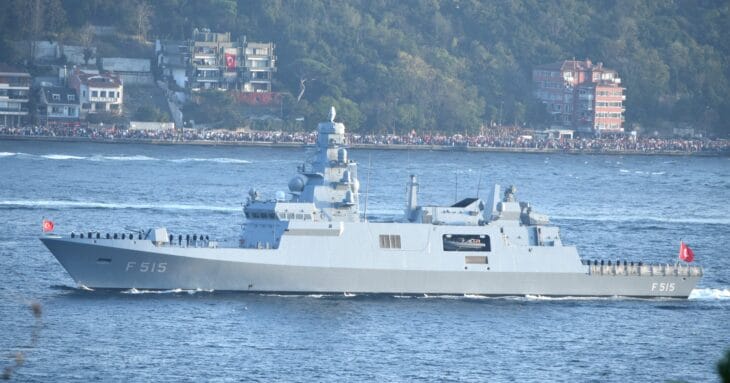

TCG Istanbul (F-515), commissioned on January 19, 2024, is the first of eight Turkish-designed frigates, also called the I class or İstif class. Each is 371 feet (113.2 m) long, displaces 3,100 tons and is designed to top 29 knots.
Istanbul carries 16 Atmaca anti-ship missiles, twice as many as the Ada-class corvettes it grew out of, and a 16-cell MİDLAS vertical launcher, Turkey’s own answer to the US Mk 41, for Hisar and Siper air defense missiles.
The second ship, TCG İzmir, began sea trials in August 2026 and could be delivered before the end of the year. İzmit, İçel, Akdeniz and Karadeniz have all been launched, the last in July 2026, and two more Indonesian ships are being built to the same design.
3. Reis Class: The Air-Independent Submarines
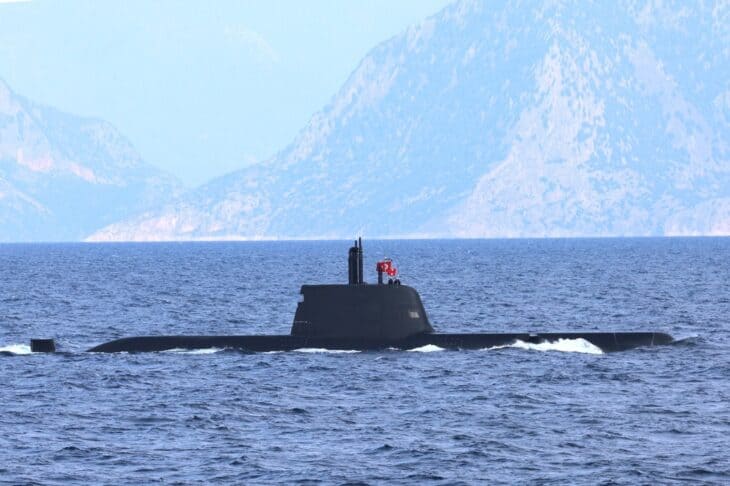

The Reis class are license-built versions of Germany’s Type 214, and the first Turkish submarines with air-independent propulsion. Fuel cells let them stay submerged far longer than a conventional diesel boat, which has to surface or snorkel to recharge its batteries.
Each boat is 224 feet (68.35 m) long, displaces about 1,860 tons surfaced and has eight torpedo tubes. TCG Piri Reis was commissioned on August 24, 2024, and TCG Hızırreis followed at a ceremony led by President Erdoğan in December 2025.
Murat Reis is due by the end of 2026, and the last three boats, Aydın Reis, Seydi Ali Reis and Selman Reis, are under construction at Gölcük for delivery one a year until 2030.
4. Barbaros Class: The Upgraded MEKO Frigates
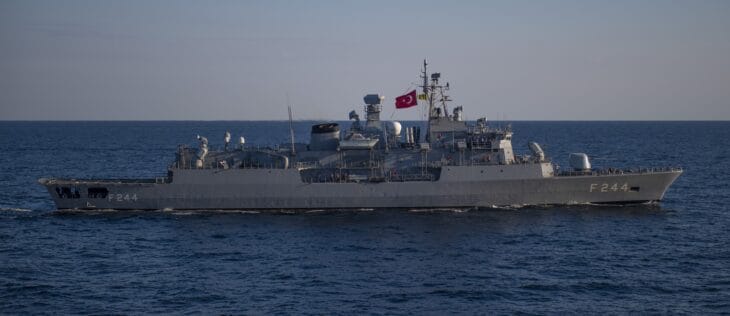

The four Barbaros-class frigates, Barbaros, Oruçreis, Salihreis and Kemalreis, are German MEKO 200 designs commissioned from 1997 to 2000. Two were built by Blohm+Voss in Hamburg and two at Turkey’s Gölcük Naval Shipyard.
They are about 383 feet (116.7 m) long, displace 3,100 tons standard and can reach 32 knots on gas turbines. They are going through a mid-life upgrade, which keeps them ahead of the larger but older Gabya class.
5. Gabya Class: Eight American Frigates, Rebuilt
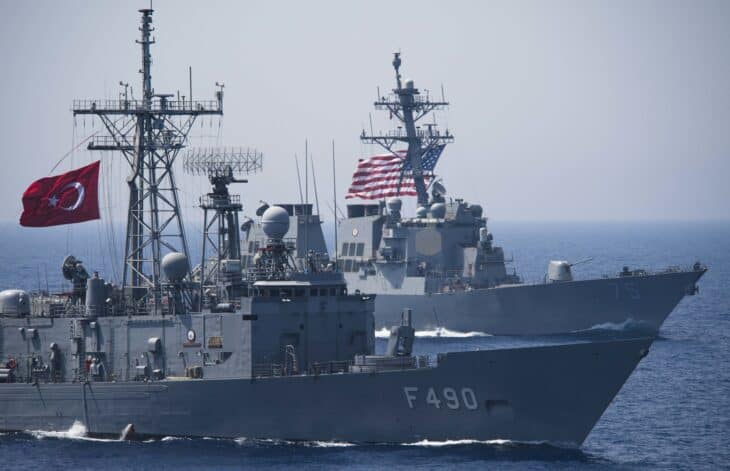

Turkey’s largest group of frigates came from the US Navy. The eight Gabya-class ships are former Oliver Hazard Perry-class frigates, each 445 feet (135.6 m) long and about 4,100 tons fully loaded, transferred and commissioned into Turkish service between 1997 and 2003.
Turkey has modernized them far beyond their American configuration, with a new combat management system, a long-range radar, new sonar and new weapons. They are based at Aksaz on the Aegean coast.
6. Ada Class: The Corvette That Started It All
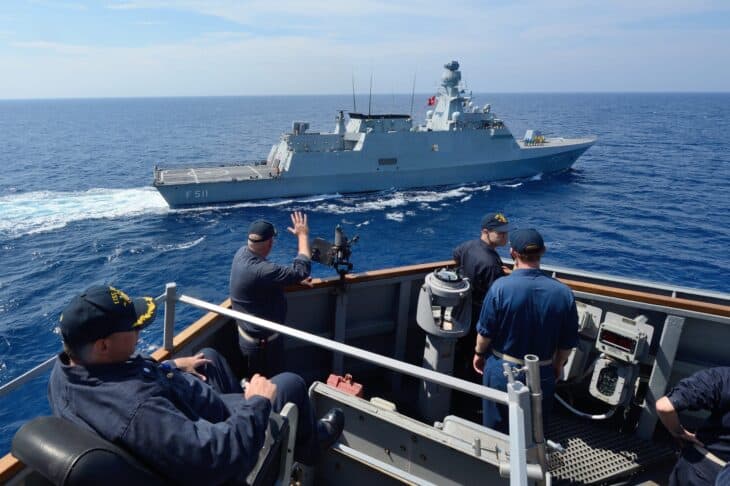

The Ada class was the first warship of Turkey’s MILGEM national program, and both the Istanbul frigates and the Hisar patrol ships grow out of it. Four were built at the Istanbul Naval Shipyard and commissioned between 2011 and 2019: Heybeliada, Büyükada, Burgazada and Kınalıada.
Each is 327 feet (99.56 m) long and displaces about 2,400 tons, and they are built for anti-submarine work. The design also sells: Pakistan received PNS Babur in May 2024 and PNS Khaibar in December 2025, and its fourth ship, PNS Tarik, is due in early 2027.
7. Preveze, Gür and Atılay: The Type 209 Boats
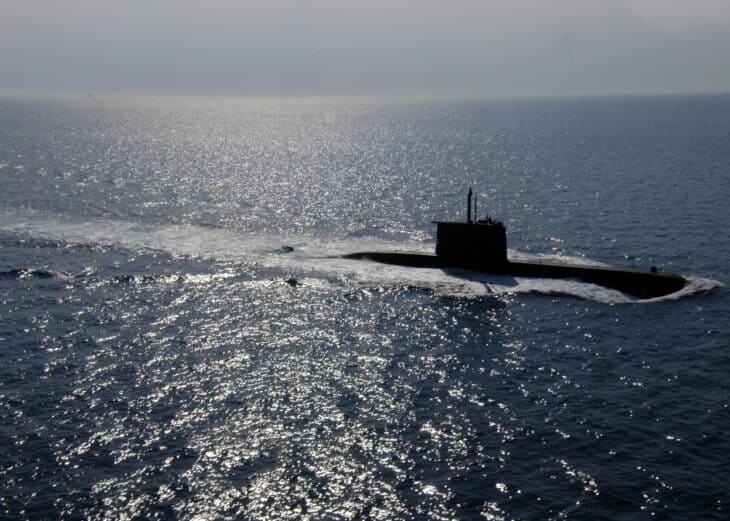

Twelve of Turkey’s 14 submarines are German Type 209 designs, commissioned from 1978 to 2007. The four Gür-class boats are the newest, the four Preveze-class boats came in the 1990s, and both groups have had mid-life upgrades.
The four older Atılay-class boats date from 1978 to 1989, and two of them, Batıray and Yıldıray, are now used for test and training. They are the boats the Reis class is replacing.
8. Yavuz Class: The Oldest Frigates
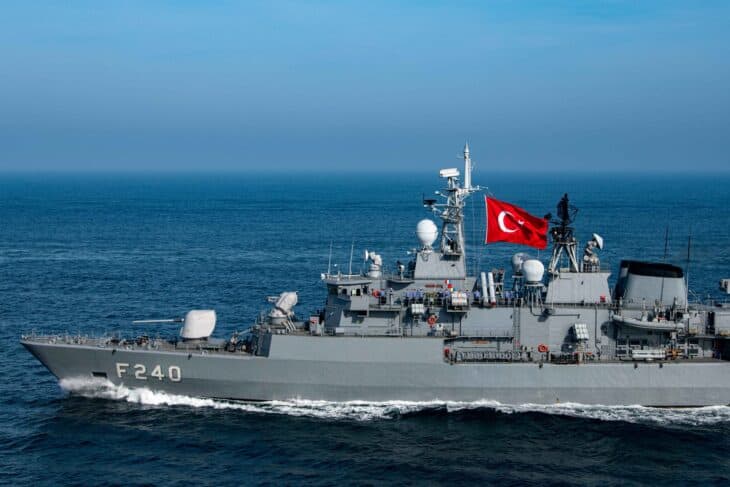

The Yavuz class were Turkey’s first MEKO frigates, commissioned from 1987 to 1989. Each is 363 feet (110.5 m) long and about 3,030 tons fully loaded.
Only three remain on the books. The lead ship, TCG Yavuz, was withdrawn from frontline service in 2024 and opened to the public as a museum ship in Istanbul in August 2026, and Fatih is used for test and training.
9. Bayraktar Class: The Tank Landing Ships
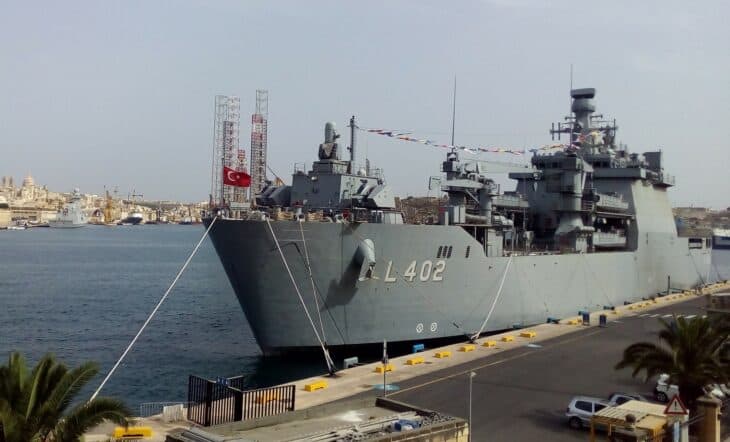

Turkey’s amphibious force rests on two big tank landing ships, TCG Bayraktar and TCG Sancaktar, commissioned in 2017 and 2018. Each is 455 feet (138.75 m) long, displaces about 7,250 tons fully loaded and carries up to 1,200 tons of cargo and 486 troops.
Three older landing ships, Osmangazi and the two Bey-class ships, are still in service from Foça. A new type of landing ship, Ç-159, was commissioned in December 2025, and Turkey plans eight of them by 2027.
10. Kılıç Class and the Missile Boats
Turkey still sails 17 fast attack craft, small missile boats built for the narrow waters of the Aegean and the Turkish straits. The nine Kılıç-class boats are the newest, 205 feet (62.4 m) long and capable of 40 knots, commissioned from 1997 to 2010.
The other eight belong to the Doğan, Rüzgar and Yıldız classes, the oldest dating from 1977.
11. Hisar and Burak: The Offshore Patrol Ships
The Hisar class is a patrol version of the Ada corvette, 327 feet (99.56 m) long. TCG Koçhisar joined the fleet in 2026, while its sister Akhisar was sold to Romania, and Turkey plans 10 in all: steel was cut for the seventh, Seferihisar, in December 2025.
Five former French avisos of the Burak class, in Turkish service since 2001 and 2002, served as corvettes until 2023 and now count as patrol ships.
12. The Minehunters
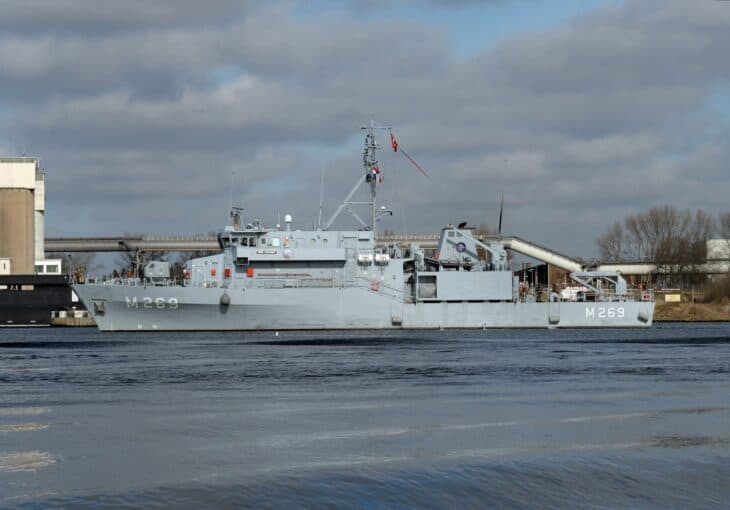

Eleven minehunters keep the approaches to Turkey’s ports and straits clear. Five Engin-class ships are former Circe-class vessels from 1998 and 1999, and six Aydın-class ships were commissioned between 2005 and 2009, all based at Erdek on the Sea of Marmara.
13. The Unmanned Surface Fleet
Turkey is building an unmanned navy alongside its crewed one. The armed Marlin SİDA joined in 2024, the ULAQ armed unmanned surface vessel was commissioned in December 2025, and missile, kamikaze and electronic warfare boats are planned.
The navy does not say how many it has. They rank last here only because none can yet do the work of a crewed warship, not because they matter least to Turkey’s plans.
The Aircraft of the Turkish Navy
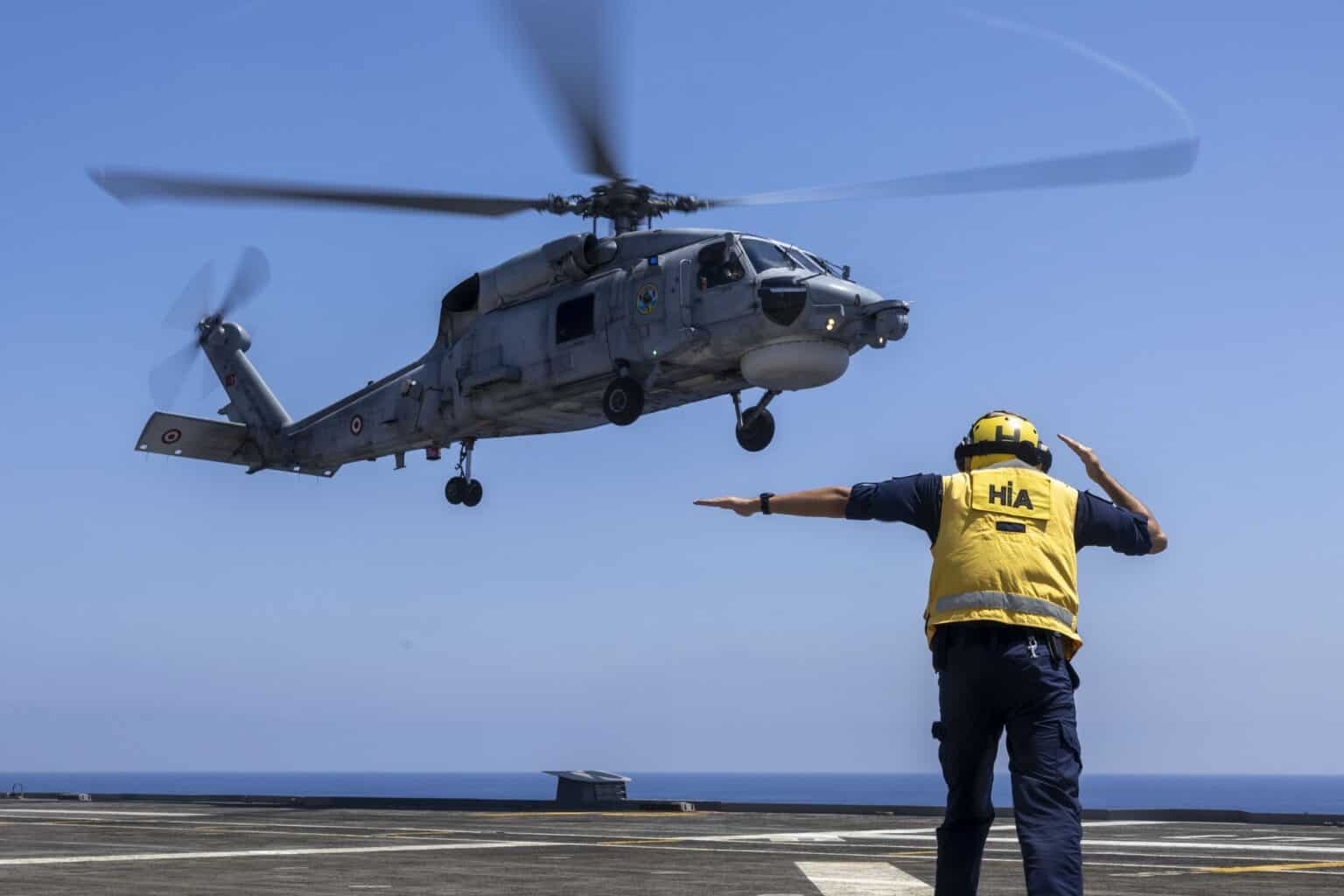
The navy flies its own aircraft. The S-70B Seahawk is its ship-based helicopter, flying from the frigates and from Anadolu, while maritime patrol and anti-submarine work falls to versions of the ATR 72 turboprop.
Drones do the rest: Bayraktar TB2s, Anka and Aksungur aircraft fly surveillance over the Aegean, the Mediterranean and the Black Sea. The jet-powered Kızılelma, which first flew on December 14, 2022, was designed to operate from Anadolu, and our guide to the Turkish Air Force in 2026 covers it and the rest of Turkey’s drone fleet.
What Turkey Is Building: A Carrier, Destroyers and a National Submarine
On January 2, 2025, Turkey began building three new kinds of warship on the same day: its first aircraft carrier and first destroyer at the Istanbul Naval Shipyard, and its first national submarine, MİLDEN, at Gölcük.
The carrier, known as MUGEM, is a 935-foot (285 m) ship of about 60,000 tons with a 12-degree ski jump. Its planned air wing of 52 aircraft includes a naval Hürjet jet, Kızılelma and Anka-3 drones and TB3s, and the navy expects delivery in 2032.
The Tepe class, long known as TF-2000, will be Turkey’s first destroyers, built for air defense with a 96-cell launcher. Eight are planned, and the lead ship will be named Kocatepe.
Is TCG Anadolu an aircraft carrier?
Not in the usual sense. It is an amphibious assault ship that can launch drones and helicopters, and GlobalFirepower counts it as Turkey’s one helicopter carrier and lists zero aircraft carriers. Turkey’s first true carrier, MUGEM, is under construction for delivery in 2032.
Once MUGEM and the Tepe destroyers arrive, Turkey’s fleet will look much more like the navies in our ranking of the largest navies in the world, where it already sits 10th by tonnage.
FAQ
Sources and references used for research and fact-checking.
- Wikipedia, List of active ships of the Turkish Naval Forces
- GlobalFirepower, Turkiye Military Strength 2026
- Defense News, Turkey's navy receives its largest-ever ship, the TCG Anadolu
- Wikipedia, TCG Anadolu
- Baykar, A first in the history of global aviation
- Wikipedia, Turkish Naval Forces
- Wikipedia, Istanbul-class frigate
- Navy Leaders, Newest Turkish I-class frigate begins sea trials
- Wikipedia, Reis-class submarine
- Türkiye Today, TCG Hızırreis submarine, two other platforms commissioned
- Wikipedia, Barbaros-class frigate
- Wikipedia, G-class frigate
- Wikipedia, Ada-class corvette
- Wikipedia, Yavuz-class frigate
- Wikipedia, TCG Yavuz (F 240)
- Wikipedia, Bayraktar-class tank landing ship
- Wikipedia, Kılıç-class fast attack craft
- Wikipedia, Hisar-class offshore patrol vessel
- Wikipedia, MUGEM
- Wikipedia, Tepe-class destroyer
Get the Newsletter
The latest aviation news and stories sent to your inbox.
About the Author

Tim is the owner and lead editor of AeroCorner since 2019, overseeing aviation content covering aircraft, airlines, airports, and the broader aviation industry. Through years of researching, writing, editing, and publishing aviation-focused content, he has developed extensive practical knowledge of commercial aviation and air travel. Based in Asia and a frequent traveler himself, Tim also brings firsthand passenger experience to AeroCorner’s coverage. Outside of publishing, he has also explored aviation firsthand through hands-on flight training in New Zealand.