

Table of Contents
Russia has 861 fighter jets. That is the sum of the fighter rows in FlightGlobal’s World Air Forces 2026 directory, with fleet data drawn on October 1, 2025, and Global Firepower’s 2026 ranking gives exactly the same figure.
Add the Su-34 strike jets and the fighters held by training units and the count rises to 1,082. Strip out the old jets that rarely fly, as RUSI’s Justin Bronk does, and it falls to 545 to 560.
How Many Fighter Jets Does Russia Have?
861, as of FlightGlobal’s October 2025 data. The figure covers the Russian Air Force and Russian Naval Aviation, and counts the jets in front-line units: Flankers, MiG-29s and MiG-35s, MiG-31 interceptors and the Su-57.
It leaves out the Su-34, Su-24 and Su-25, which are strike and attack jets, and the long-range bombers. With those added, FlightGlobal counts 1,559 Russian combat aircraft, third in the world behind the United States and China.
The count at a glance
861 fighters in front-line units of the Air Force and Navy (FlightGlobal World Air Forces 2026, data drawn October 1, 2025; Global Firepower 2026 agrees). 1,017 with the 156 Su-34 strike fighters. 1,082 with 65 more fighters in training units. Not counted: Su-24 and Su-25 attack jets, bombers and drones.
Russia’s fighter jets, type by type
Russia publishes no count of its own. FlightGlobal’s directory, compiled with aviation data firm Cirium, lists each type by service, and adding up its fighter rows gives the table below.
| Type | Role | Air Force | Navy | Training units | Total |
|---|---|---|---|---|---|
| Su-27, Su-30, Su-35 | Flanker family, fourth generation | 407 | 43 | 41 | 491 |
| MiG-29, MiG-35 | Light fighter | 235 | 18 | 24 | 277 |
| MiG-31 | Interceptor | 128 | 0 | 0 | 128 |
| Su-57 | Fifth generation, stealth | 30 | 0 | 0 | 30 |
| Fighters | 800 | 61 | 65 | 926 | |
| Su-34 | Strike fighter | 156 | 0 | 0 | 156 |
| Total | 956 | 61 | 65 | 1,082 |
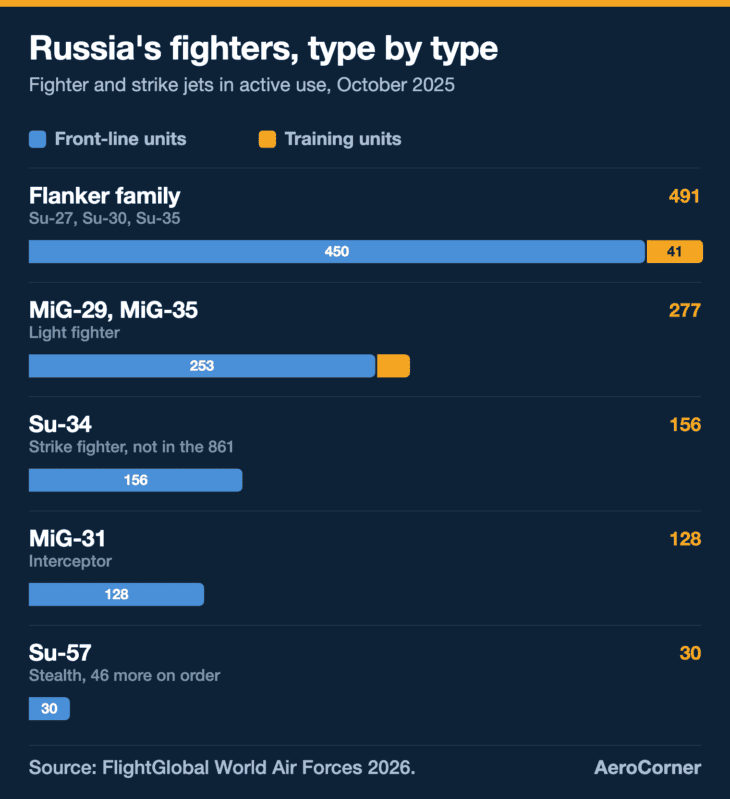
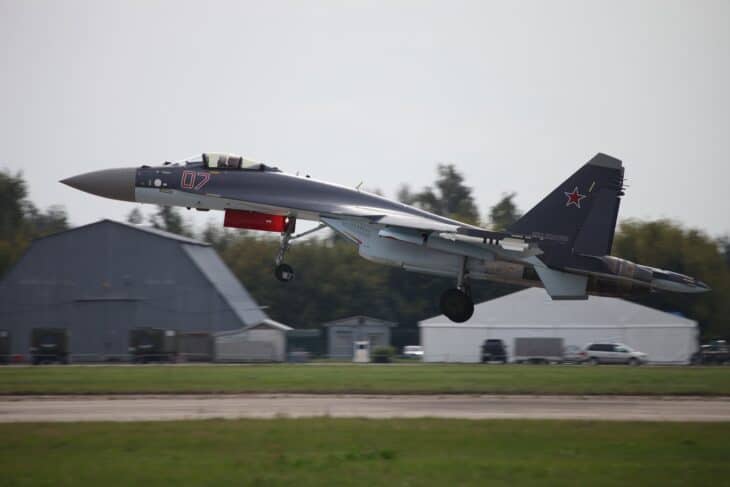
The Flankers are the force. The Su-27, the two-seat Su-30 and the newer Su-35 make up more than half of the fighters. The IISS counts up to 130 Su-35S fighters on their own.
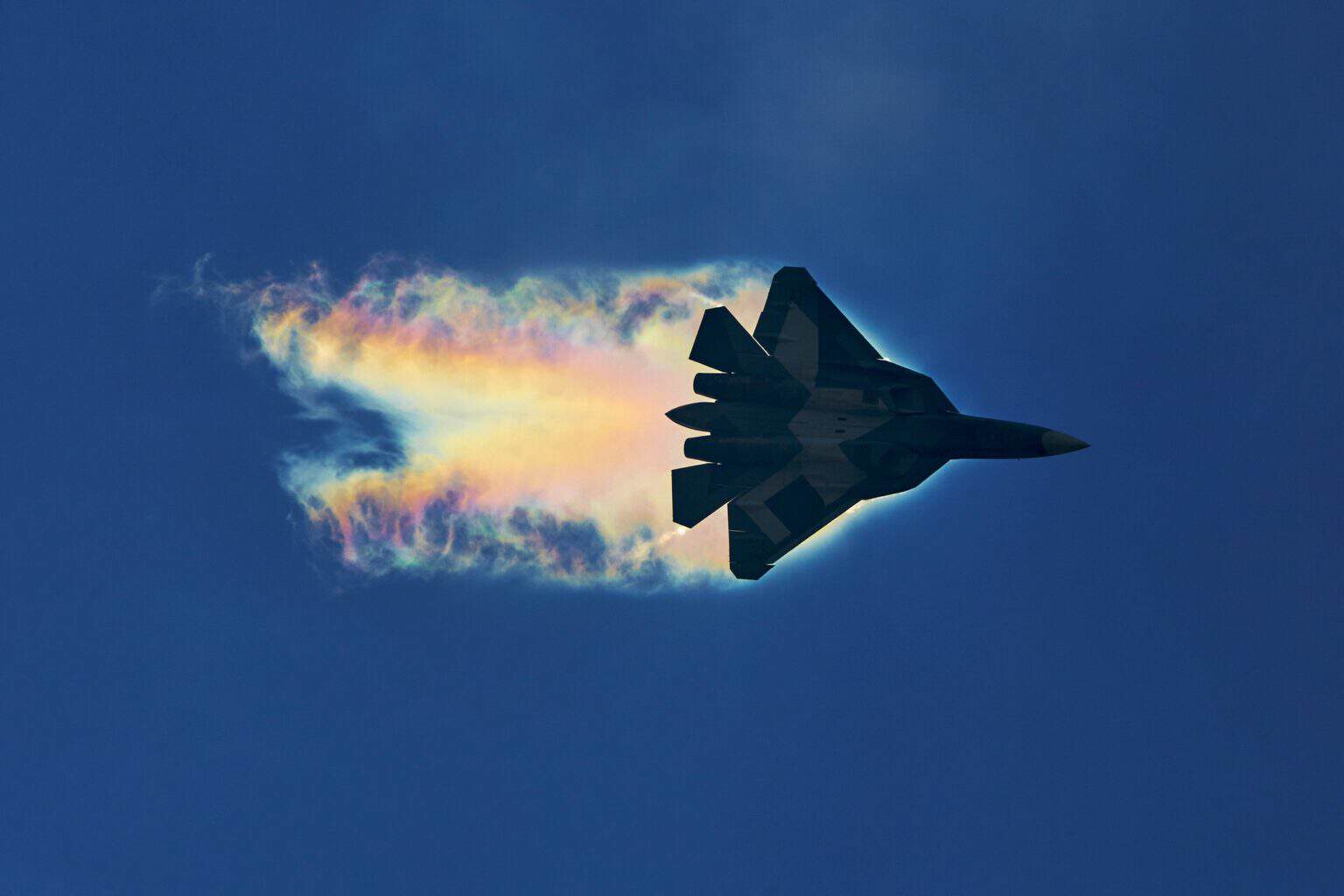
The Su-57 is the smallest line. FlightGlobal lists 30 in service and 46 more on order, but Ukrainian outlet Militarnyi could identify only 16 by tail number in September 2026.
The MiG-31 is a Cold War interceptor, and the IISS says up to 25 have been modified to carry the Kinzhal missile. Which of these jets is actually the best is a separate question, answered in our ranking of the best Russian fighter jets.
Why the numbers differ
Search this question and you will find answers from about 550 to more than 1,500. They come from a handful of sources that draw the line in different places, and none of them can see inside Russian hangars.
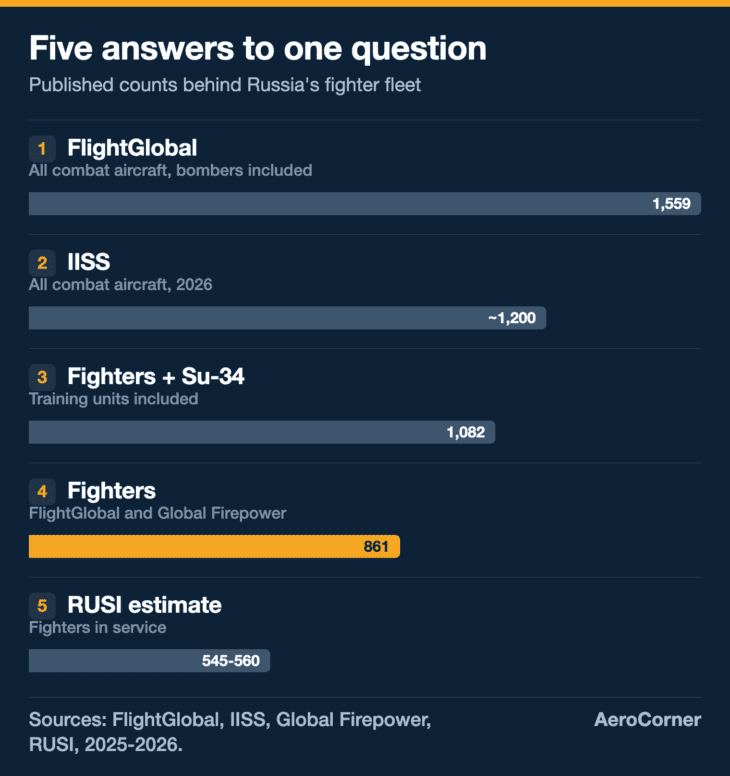
1,559 is FlightGlobal’s count of every Russian combat aircraft. Global Firepower splits the same total into 861 fighters and 698 “attack types”, which match FlightGlobal’s Su-34, Su-24, Su-25 and bomber rows exactly.
Russia does not have 1,500 fighter jets
Figures of 1,200 to 1,559 are Russia’s combat aircraft, which include Su-24 and Su-25 attack jets and the Tu-22M3, Tu-95 and Tu-160 bombers. The fighters within that total number 861.
About 1,200 is the IISS Military Balance 2026 estimate for all combat aircraft in the Russian Air Force and Navy, as reported by Russian outlet www1.ru. Polish outlet Defence24 gave the same round figure in January 2025.
545 to 560 is Bronk’s estimate of fighters in service. He discounts the older MiG-29s, which is where the sources split widest: FlightGlobal lists 235 MiG-29s and MiG-35s in the Air Force, while the IISS counts about 100.
The same pattern runs through other types. The IISS puts the Su-34 fleet at about 130 against FlightGlobal’s 156, and the MiG-31 fleet at almost 150 against 128.
The war adds a fourth problem: losses inside a conflict zone are hard to verify. FlightGlobal warns that its listings for the bombers hit in Ukraine’s “Spider web” drone attack are “likely to be higher than reality”, and the same doubt hangs over every type flying combat.
How the war has changed the count
Oryx, which counts only losses it can confirm from photos or video, lists 46 Russian fighters destroyed or damaged since February 2022, as of October 29, 2026. Another 48 Su-34s and Su-34Ms bring the total to 94.
That makes the Su-34 the most-lost Russian jet on Oryx’s list. Among the fighters, Oryx counts 23 Su-30SMs, 12 Su-35Ss, five MiG-31BMs, three Su-27s, two Su-57s and one MiG-29.
The modern core has still grown. Ukraine’s military intelligence put Russia’s Su-35 fleet at about 100 in March 2024, and the IISS counts up to 130 in its 2026 edition. Su-57 deliveries continue too, with a second 2026 batch handed over on September 24.

The headline number moves when the old types finally leave. If the 235 MiG-29s on FlightGlobal’s list shrink toward the IISS figure, Russia’s fighter count drops by more than 100 overnight, with no change in how many jets actually fly.
How many fighter jets does Russia have compared to the US and China?
About a third of the US fleet and a little over half of China’s. On FlightGlobal’s numbers, the US flies about 2,900 fighter jets, as our count of how many fighter jets the US has shows by service.
China has 1,485 on the same list, as our count of how many fighter jets China has explains. Global Firepower’s 2026 figures put the US at 1,791 and China at 1,443, against Russia’s 861.
Raw numbers are only part of it. How Russia’s fighters, bombers and radar planes stack up against the whole alliance is in our NATO vs Russia air power comparison, and the rest of the fleet is in our guide to the Russian Air Force.
FAQ
Sources and references used for research and fact-checking.
- FlightGlobal, World Air Forces 2026
- Global Firepower, Russia Military Strength 2026
- Global Firepower, Fighter Fleet Strength by Country (2026)
- Aerospace Global News, World combat aircraft fleets 2026
- www1.ru, Military Balance: Russia has up to 130 Su-34 units and more than 21 Su-57 units
- Defense Express, Defence24: 550 out of 1,200 Russian aircraft are nearing end of service life
- Oryx, Attack On Europe: Documenting Russian Equipment Losses During The Russian Invasion Of Ukraine
- Militarnyi, UAC delivers Su-57s to the Russian Aerospace Forces in 2026
- The Kyiv Independent, Military Intelligence: Russia has about 200 Su-34, Su-35 fighter jets, 7 A-50 planes
- Wikipedia, Sukhoi Su-37
Get the Newsletter
The latest aviation news and stories sent to your inbox.
About the Author

Tim is the owner and lead editor of AeroCorner since 2019, overseeing aviation content covering aircraft, airlines, airports, and the broader aviation industry. Through years of researching, writing, editing, and publishing aviation-focused content, he has developed extensive practical knowledge of commercial aviation and air travel. Based in Asia and a frequent traveler himself, Tim also brings firsthand passenger experience to AeroCorner’s coverage. Outside of publishing, he has also explored aviation firsthand through hands-on flight training in New Zealand.