

Table of Contents
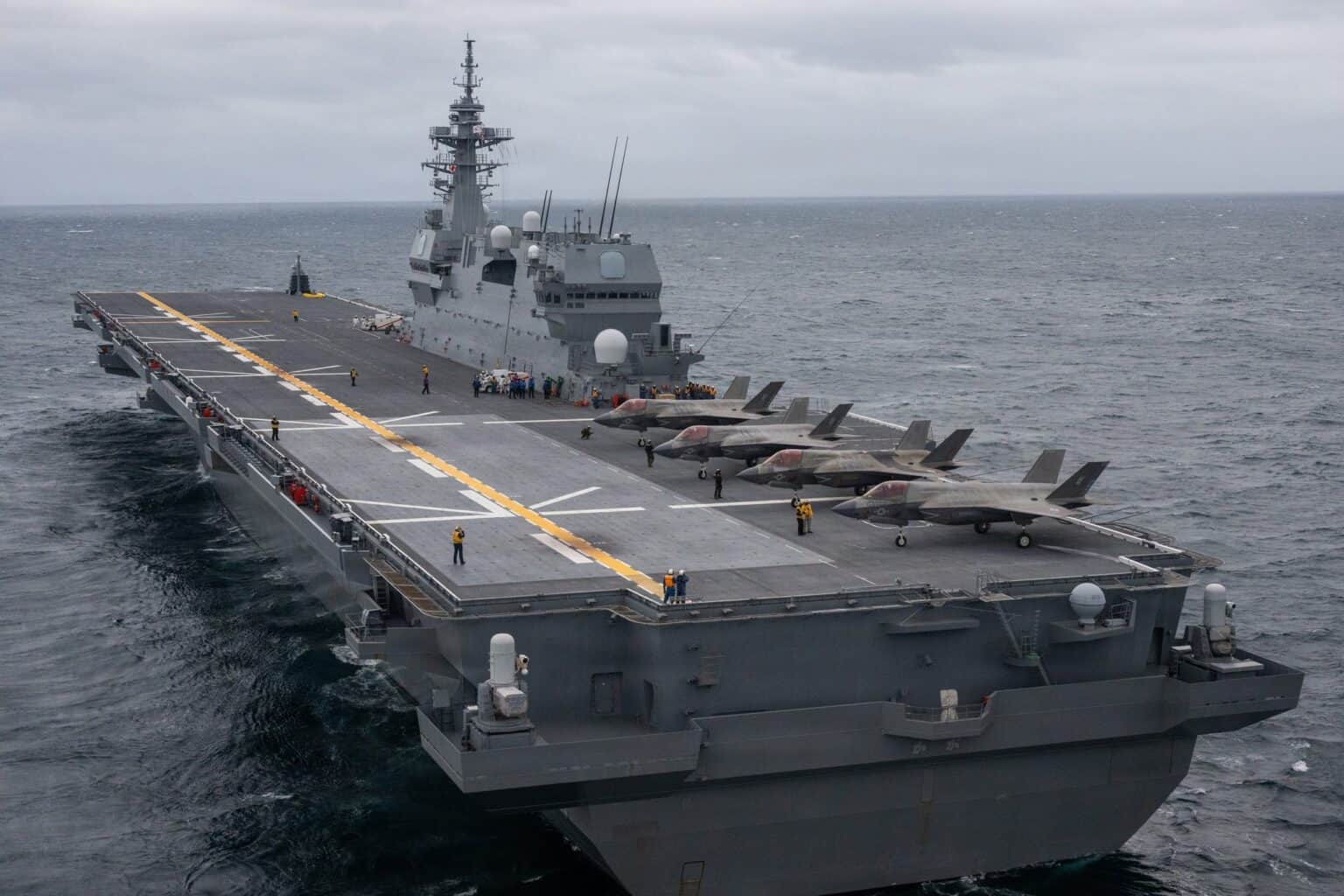
Japan’s navy, officially the Japan Maritime Self-Defense Force (JMSDF), is built around two 814-foot (248 m) flat-tops, Izumo and Kaga. They were commissioned as helicopter destroyers and are now being rebuilt to fly F-35B stealth jets, which makes them aircraft carriers in all but name.
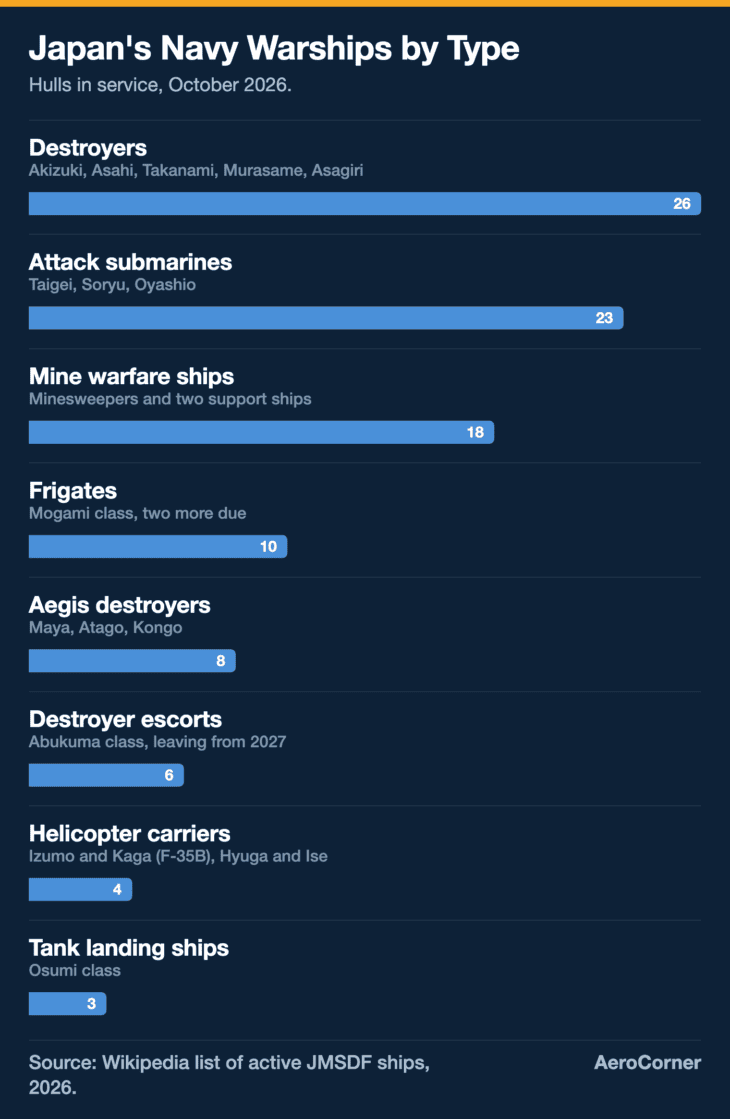
Around them sail eight Aegis missile defense destroyers, 26 other destroyers, 10 new Mogami-class frigates and 23 attack submarines. GlobalFirepower’s 2026 index counts 158 naval assets and ranks Japan’s armed forces seventh in the world.
This guide ranks every major class Japan sails by fighting value as of October 2026, with hull counts, the ships that joined this year and the aircraft that fly from the fleet.
| Rank | Class | Type | Hulls in service | Status, October 2026 |
|---|---|---|---|---|
| 1 | Izumo | Helicopter carrier, F-35B conversion | 2 | Izumo refit due to finish by 2027 |
| 2 | Maya | Aegis destroyer | 2 | Newest Aegis ships, 2020 and 2021 |
| 3 | Kongo | Aegis destroyer | 4 | Chokai now fires Tomahawk |
| 4 | Atago | Aegis destroyer | 2 | Active |
| 5 | Taigei | Attack submarine, lithium-ion | 5 | Chogei joined March 2026 |
| 6 | Soryu | Attack submarine | 12 | Active |
| 7 | Mogami | Frigate | 10 | Natori and Nagara joined 2026 |
| 8 | Hyuga | Helicopter carrier | 2 | Active |
| 9 | Akizuki and Asahi | Destroyer | 6 | Active |
| 10 | Takanami and Murasame | Destroyer | 14 | Active |
| 11 | Oyashio | Attack submarine | 6 | Two more used for training |
| 12 | Osumi | Tank landing ship | 3 | Active |
| 13 | Mine warfare force | Minesweepers and support ships | 18 | Nomi joined 2025 |
| 14 | Asagiri and Abukuma | Older destroyers and escorts | 12 | Abukumas leaving from 2027 |
How this ranking works
Classes are ranked by fighting value in October 2026: how modern each one is, what it carries, and how much it changes what the fleet can do. A ship that can carry stealth fighters ranks above a dozen escorts. Hull counts come from open-source lists checked against 2026 commissioning reports. Training ships, survey ships, patrol boats, landing craft and auxiliaries are left out of the ranking.
1. Izumo Class: Japan’s F-35B Carriers
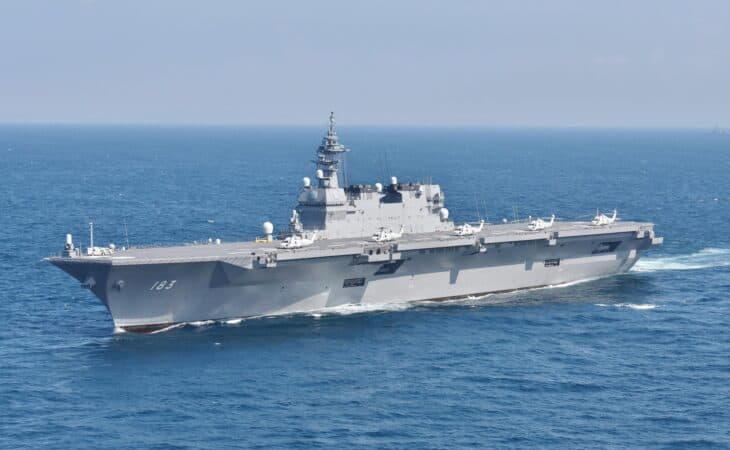

Izumo and Kaga are the largest warships in Japan’s fleet. Each is 814 feet (248 m) long and displaces 19,500 tons standard, and both were commissioned as helicopter destroyers, Izumo on March 25, 2015 and Kaga on March 22, 2017.
In December 2018 the Japanese cabinet approved turning them into ships that can fly the F-35B, the short-takeoff, vertical-landing version of the Lightning II. Two US Marine Corps F-35Bs made the first landings on Izumo on October 3, 2021.
Kaga finished the first stage of its rebuild on March 29, 2024, with a new rectangular bow and a heat-resistant deck. F-35B test jets from the US Navy flew trials from it off California in October and November 2024, and British F-35Bs first landed on it in August 2025.
Izumo’s own deck work was shown off on April 20, 2026, and is expected to be done by 2027. Kaga’s second stage, the interior work, is planned from late 2026 to the end of fiscal 2027, after which both ships take the new designation CVM.
The jets belong to the air force
Japan plans to buy 42 F-35Bs, and they belong to the Air Self-Defense Force, based at Nyutabaru on Kyushu, not to the navy. Each Izumo-class ship can carry up to 28 aircraft of all types.
For the jets themselves and the rest of the fighter fleet, see our guide to Japan’s air force in 2026.
2. Maya Class: The Newest Aegis Destroyers
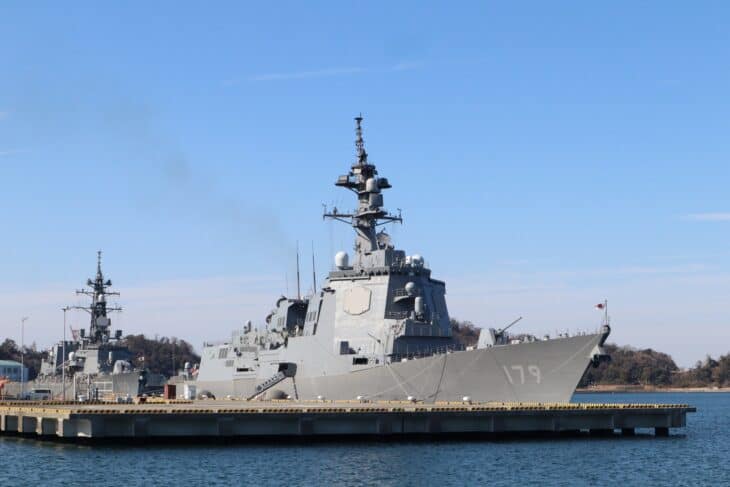

Maya, commissioned on March 19, 2020, and Haguro, which followed in 2021, are the most capable surface combatants Japan has. Each is 558 feet (170 m) long, displaces 8,200 tons standard and 10,250 tons fully loaded, and has 96 vertical launch cells.
Their job is shooting down ballistic missiles. On November 16, 2022, Maya fired an SM-3 Block IIA off Hawaii and hit its target outside the atmosphere, the first launch of that missile from a Japanese warship.
They also carry Cooperative Engagement Capability, which lets them share surveillance and targeting data with other ships and aircraft fitted with the same system.
3. Kongo Class: The First Japanese Tomahawk Shooter
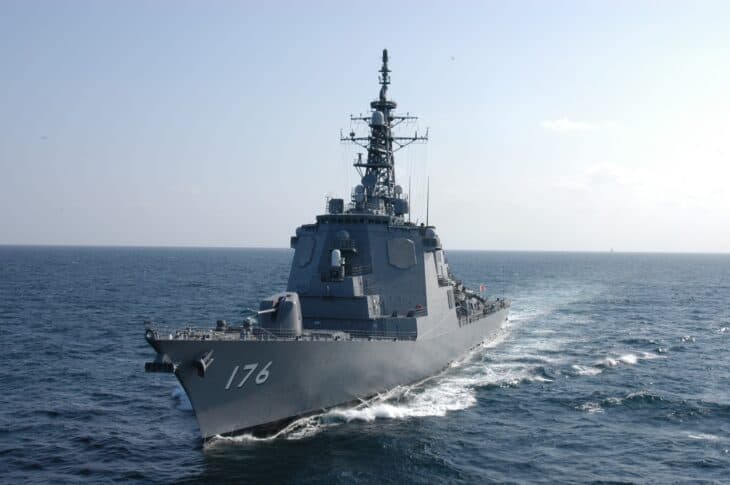

The four Kongo-class ships, commissioned from 1993 to 1998, were the first Aegis warships outside the US Navy. Modeled on the American Arleigh Burke class, each is 528 feet (161 m) long, displaces 9,500 tons fully loaded and has 90 launch cells.
They rank this high because of one ship. Chokai spent nearly a year in the United States being modified for Tomahawk cruise missiles, test-fired one in the Pacific on July 29, 2026, and returned home at the end of August.
A navy that can now strike land targets
In November 2023 the US approved selling Japan up to 400 Tomahawks, 200 Block IV and 200 Block V, for $2.35 billion. Chokai is the first of Japan’s eight Aegis destroyers to be able to fire them, and at least four more are slated for the same work.
4. Atago Class: The Middle Aegis Pair
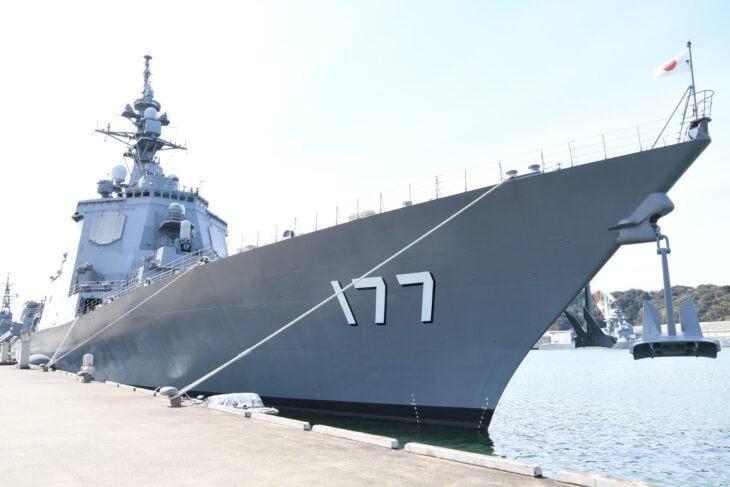

Atago (2007) and Ashigara (2008) complete the eight-ship Aegis force. They sit between the Kongos and the Mayas in age, and together the eight ships are Japan’s sea-based defense against North Korean ballistic missiles.
Two much larger ships will join them. The Aegis System Equipped Vessels, or ASEVs, are about 623 feet (190 m) long and 12,000 tons standard, with 128 launch cells and the SPY-7 radar.
The first was laid down at Nagasaki on July 18, 2025 and the second at Yokohama on February 5, 2026. They are due in March 2028 and March 2029, at about ¥392 billion ($2.5 billion) each.
5. Taigei Class: Submarines That Run on Lithium-Ion
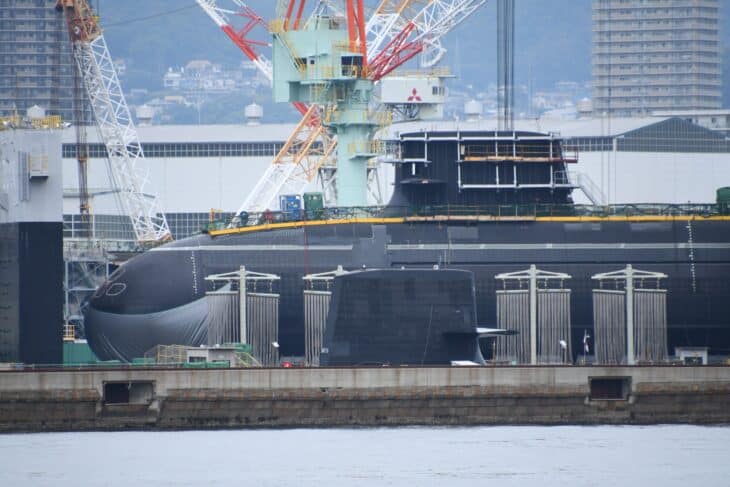

The Taigei class is Japan’s newest submarine, 276 feet (84 m) long, about 3,000 tons surfaced, with a crew of about 70. Instead of lead-acid batteries, it carries a large lithium-ion battery bank, the same approach the last two Soryus pioneered.
Japan has commissioned one a year: Taigei in 2022, Hakugei in 2023, Jingei in 2024, Raigei in 2025 and Chogei on March 10, 2026. Sogei was launched in October 2025 and is planned for March 2027, with 10 boats planned in all.
6. Soryu Class: The Backbone of the Submarine Fleet
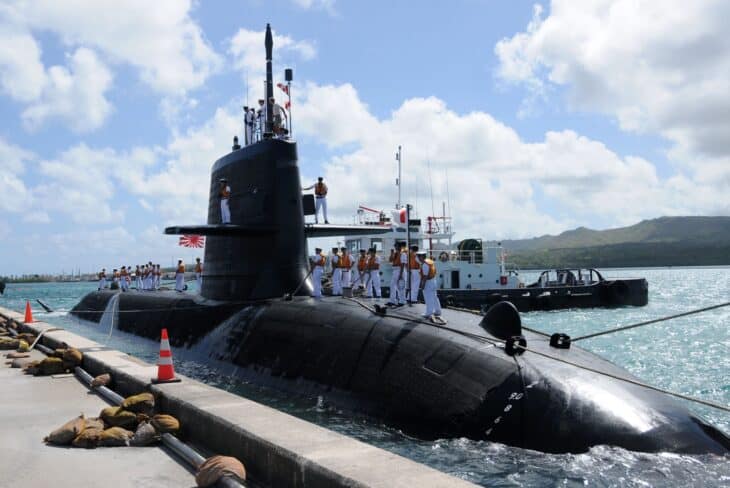

Twelve Soryu-class boats were commissioned between March 2009 and March 2021. Each is 276 feet (84 m) long and displaces 2,900 tons surfaced and 4,200 tons submerged.
The first ten use Stirling air-independent engines, which let a diesel submarine stay submerged far longer without surfacing. The last two, Oryu and Toryu, swapped those engines for lithium-ion batteries, and Wikipedia calls Oryu the world’s first lithium-ion battery submarine.
7. Mogami Class: The Frigate Australia Bought
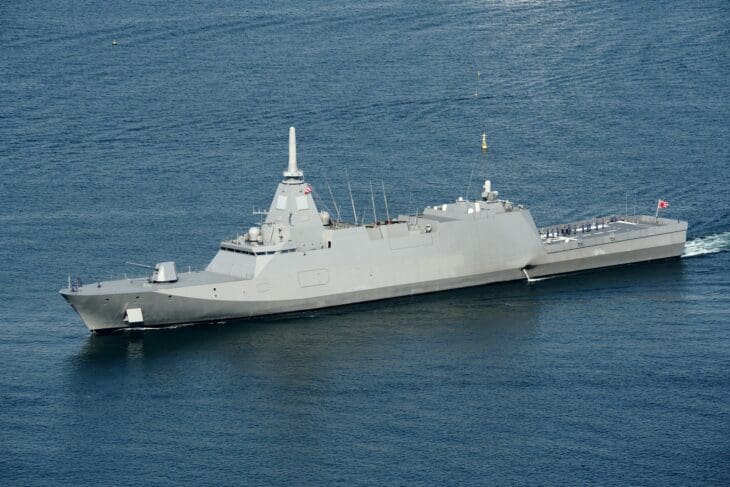

The Mogami class is where Japan’s shipbuilding pace shows. Ten have been commissioned since 2022, including Natori on May 21, 2026 and Nagara on June 29, 2026, and 12 are due by the end of fiscal 2027.
Each is 435 feet (132.5 m) long and displaces 5,500 tons fully loaded, but needs a crew of only about 90, roughly half that of a conventional Japanese destroyer. They carry eight Type 17 anti-ship missiles, a SeaRAM launcher, mine-hunting sonar and, from the seventh ship onward, a 16-cell launcher.
Australia picked an upgraded Mogami with 32 launch cells on August 5, 2025, and signed for the first three on April 18, 2026. The lead ship is due in 2029, and up to 11 are planned.
8. Hyuga Class: The First Flat-Tops
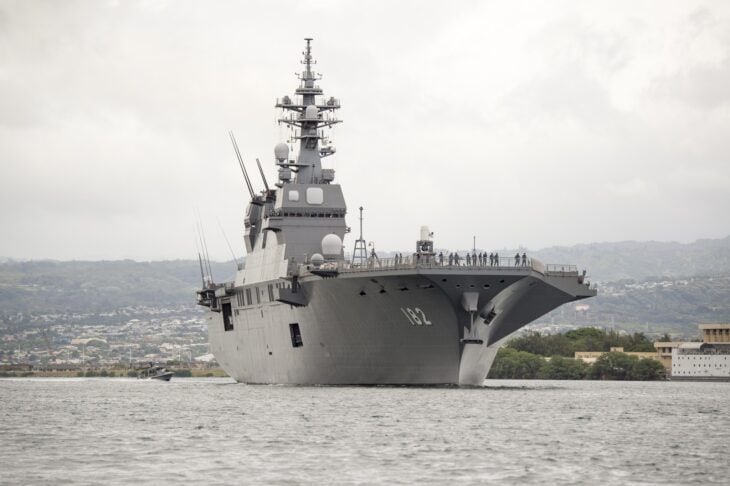

Hyuga (2009) and Ise (2011) were the largest ships in the fleet until Izumo arrived. Each is 646 feet (197 m) long, displaces 19,000 tons fully loaded and can carry up to 18 aircraft.
They are anti-submarine ships, normally carrying three SH-60K helicopters and one MCH-101, with 16 launch cells for air defense missiles. Both went straight to work after the March 2011 earthquake and tsunami, Hyuga on search and rescue off Miyagi and Ise delivering aid in the month it entered service.
9. Akizuki and Asahi Classes: The Carrier Escorts
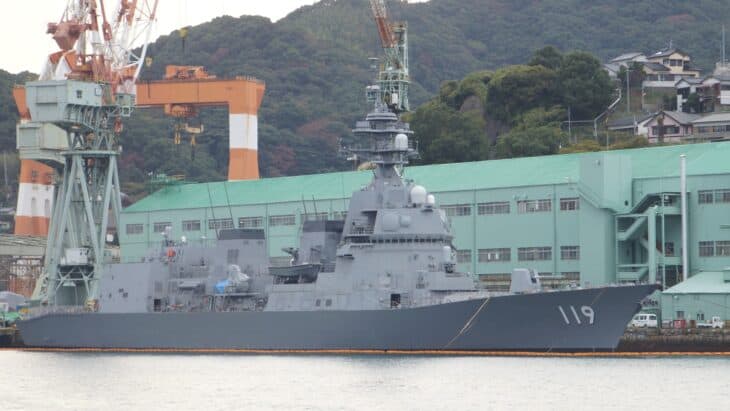

The four Akizuki-class ships (2012 to 2014) and the two Asahis (2018 and 2019) are Japan’s newest general-purpose destroyers. They rank below the frigates only because they have no part in the Aegis or carrier programs that define the fleet’s future.
10. Takanami and Murasame Classes: The Workhorses
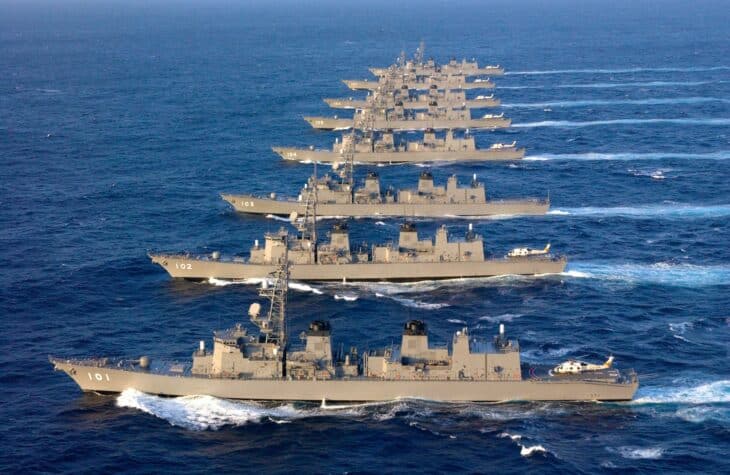

Five Takanamis (2003 to 2006) and nine Murasames (1996 to 2002) make up the largest group of destroyers in the fleet. Most are now more than 20 years old.
11. Oyashio Class: The Older Submarines
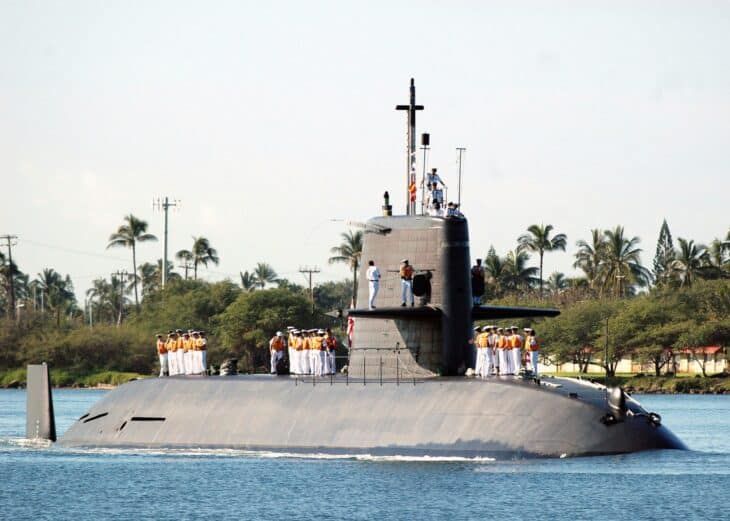

Six Oyashio-class boats, commissioned from 2003 to 2008, are still front-line submarines, and two older sisters now serve as training boats. They displace 2,750 tons surfaced and 4,000 tons submerged.
Add them to the Taigeis and Soryus and Japan sails 23 attack submarines, fifth in the world in GlobalFirepower’s 2026 count. None is nuclear powered.
12. Osumi Class: The Amphibious Ships
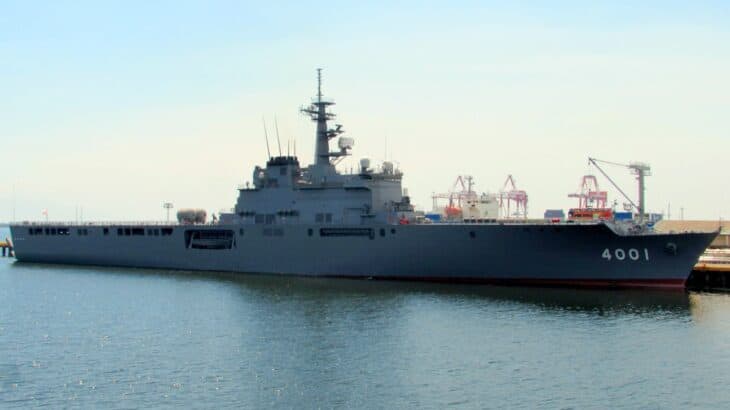

Osumi (1998), Shimokita (2002) and Kunisaki (2003) are listed as tank landing ships but are amphibious transport docks in all but name, with a flat deck and landing craft including hovercraft.
13. The Mine Warfare Force
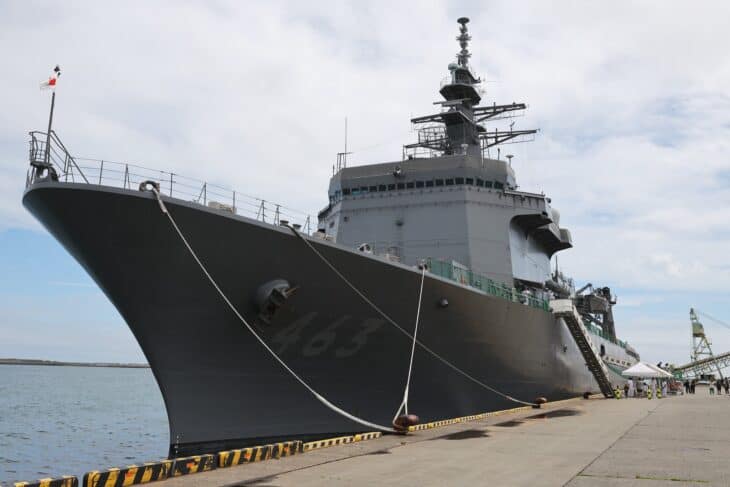

Japan keeps 18 mine warfare ships, fifth in the world by GlobalFirepower’s count: two support ships and 16 minesweepers. The newest, the ocean minesweeper Nomi, joined in 2025.
Minesweeping is the thread back to the old navy. When the Imperial Japanese Navy was dissolved in 1945, its minesweeping fleet passed to the Maritime Safety Agency, which kept the ships and expertise until the JMSDF was founded on July 1, 1954.
14. Asagiri and Abukuma Classes: On the Way Out
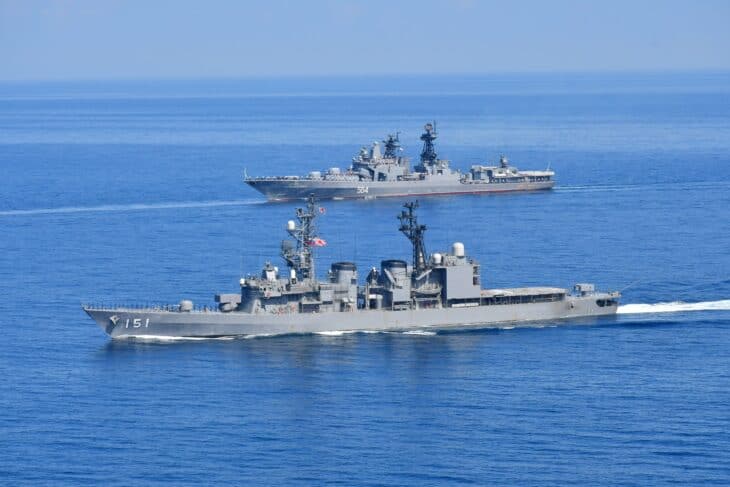

Six Asagiri-class destroyers (1989 to 1991) and six Abukuma-class destroyer escorts (1989 to 1993) are the oldest warships still in the line. The Abukumas are due to retire and be handed to the Philippines starting in 2027.
The Aircraft of the Japanese Navy
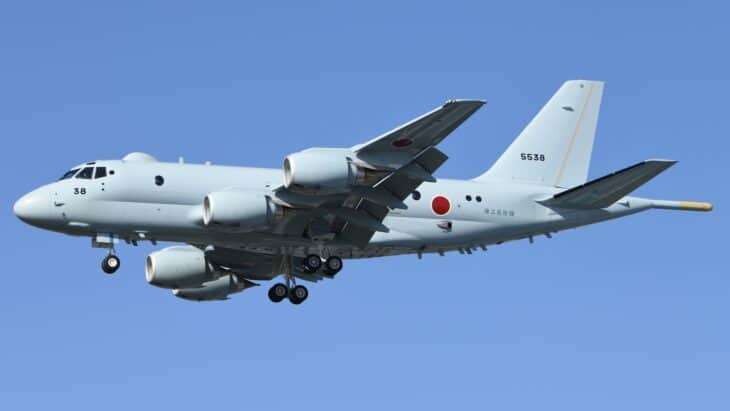
The JMSDF flies about 346 aircraft, 201 fixed-wing and 145 helicopters, so it is an air arm as well as a fleet. Its signature type is the Kawasaki P-1, a four-engine jet patrol plane that first flew on September 28, 2007 and entered service in 2013.
Roughly three dozen P-1s are in service, alongside the older P-3C Orions they are replacing. A July 2025 audit rated the P-1 fleet’s condition as poor, citing engine problems, avionics faults and a shortage of spare parts.

On the ships, the SH-60K Seahawk hunts submarines and the larger MCH-101 also flies from the fleet. The US-2 flying boat handles long-range search and rescue.
Is Japan allowed to have aircraft carriers?
Article 9 of Japan’s constitution renounces war, and the government’s reading bans attack aircraft carriers. It defines those as carriers built for strike bombers, and says the Izumo class does not qualify because it is defensive. That is why ships that will fly F-35Bs are still classed as destroyers. GlobalFirepower’s 2026 index lists Japan with zero aircraft carriers and four helicopter carriers.
Japan last sailed true aircraft carriers in World War II, among them the Akagi, which led the attack on Pearl Harbor. For how Izumo and Kaga compare with today’s big-deck ships, see our ranking of the best aircraft carriers in the world.
Measured by total naval assets, Japan ranks only 21st in GlobalFirepower’s 2026 table; our list of the largest navies in the world shows who leads. Its edge is quality: eight Aegis ships, a modern submarine force and two carriers in the making.
FAQ
Sources and references used for research and fact-checking.
- Wikipedia, List of active Japan Maritime Self-Defense Force ships
- Wikipedia, Japan Maritime Self-Defense Force
- GlobalFirepower, Japan Military Strength (2026)
- Wikipedia, Izumo-class multi-purpose operation destroyer
- Wikipedia, JS Kaga
- The Aviationist, JMSDF Reveals JS Izumo's Upgraded Flight Deck for F-35B Operations
- Wikipedia, Maya-class destroyer
- Wikipedia, Kongo-class destroyer
- Stars and Stripes, Japanese destroyer gains Tomahawk capability
- Naval News, Japan lays keel of both ASEV Missile Defense Ships
- Wikipedia, Taigei-class submarine
- Wikipedia, Soryu-class submarine
- Wikipedia, Mogami-class frigate
- Naval News, Japan Commissions 10th Mogami-class Frigate Nagara
- Naval News, Australia Announces Contract For First Three Upgraded Mogami General Purpose Frigates
- Wikipedia, Hyuga-class helicopter destroyer
- Wikipedia, Kawasaki P-1
Get the Newsletter
The latest aviation news and stories sent to your inbox.
About the Author

Tim is the owner and lead editor of AeroCorner since 2019, overseeing aviation content covering aircraft, airlines, airports, and the broader aviation industry. Through years of researching, writing, editing, and publishing aviation-focused content, he has developed extensive practical knowledge of commercial aviation and air travel. Based in Asia and a frequent traveler himself, Tim also brings firsthand passenger experience to AeroCorner’s coverage. Outside of publishing, he has also explored aviation firsthand through hands-on flight training in New Zealand.