

Table of Contents
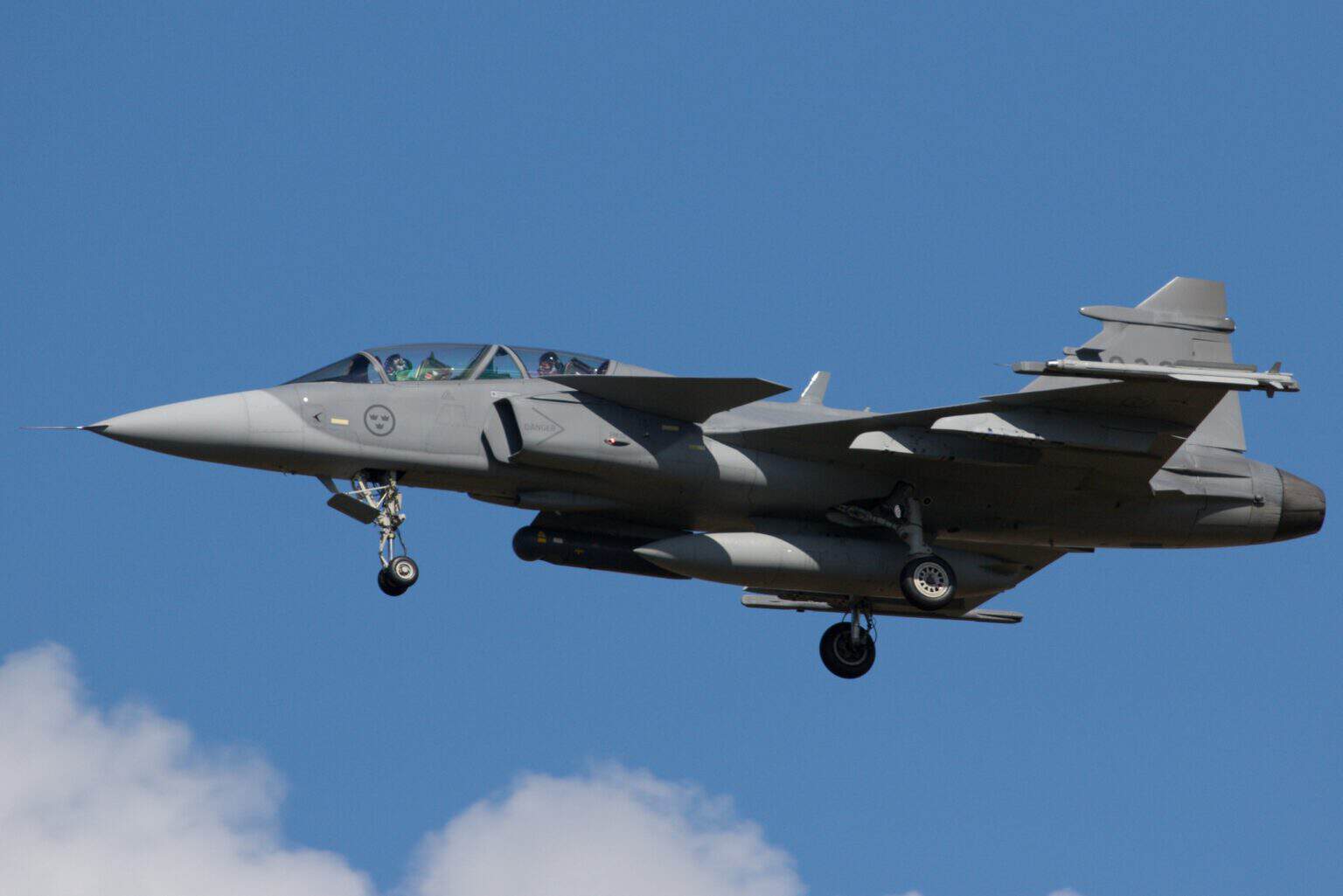
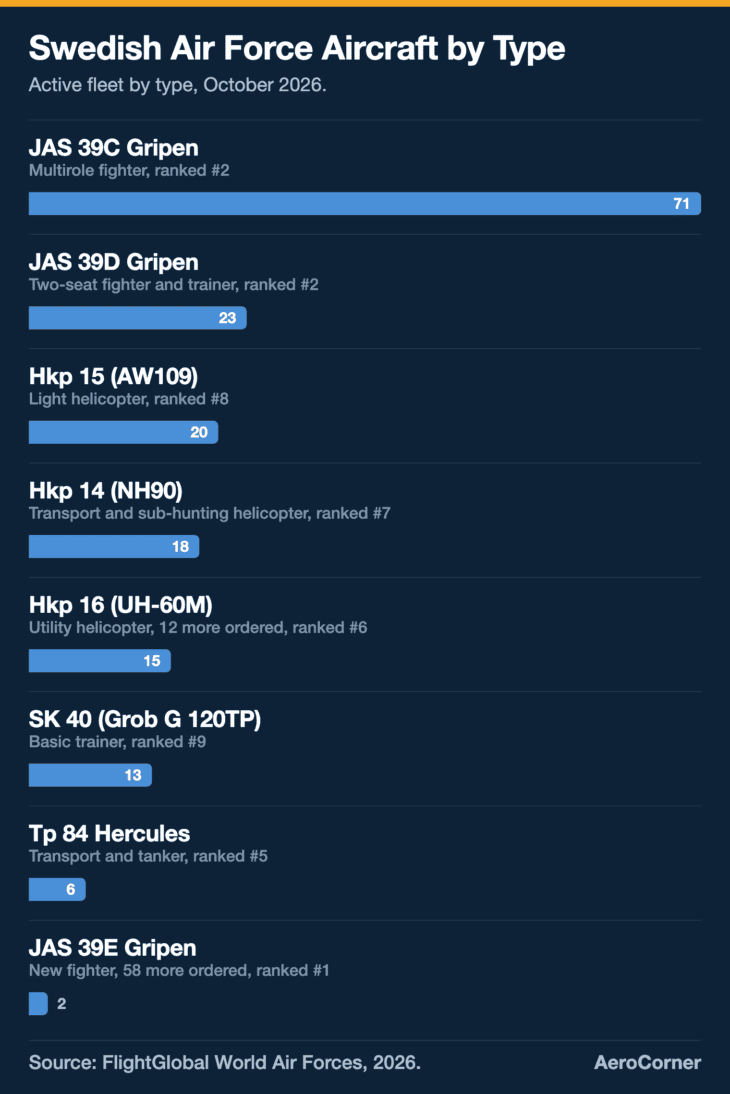
The Swedish Air Force is a Gripen air force, and in 2026 it is swapping one Gripen for another. FlightGlobal’s World Air Forces 2026 directory counts 71 single-seat JAS 39C and 23 two-seat JAS 39D fighters, plus the first 2 of 60 new JAS 39E Gripens on order.
Behind the fighters sit a small but specialized support fleet: two signals-intelligence Gulfstreams, six aging Hercules, a helicopter wing of 53 machines and 13 basic trainers. Three GlobalEye radar jets and four Embraer C-390 airlifters are on order.
This guide ranks every type Sweden flies by its weight in Swedish air defense as of October 2026, the year Flygvapnet turned 100. It also covers the Gripens leaving for Ukraine, where the air force is based and the shared jets it borrows from allies.
| Rank | Aircraft | Role | Fleet | Status |
|---|---|---|---|---|
| 1 | JAS 39E Gripen | Multirole fighter | 2 (58 more ordered) | Entering service |
| 2 | JAS 39C/D Gripen | Multirole fighter, two-seat trainer | 71 C, 23 D | In service; up to 16 going to Ukraine |
| 3 | S 106 GlobalEye | Airborne early warning | 0 (3 ordered) | First delivery 2027 |
| 4 | S 102B Korpen (Gulfstream IV) | Signals intelligence | 2 | In service |
| 5 | Tp 84 Hercules (C-130H, KC-130H) | Transport, aerial refueling | 5 + 1 tanker | To be replaced by 4 C-390s |
| 6 | Hkp 16 (UH-60M Black Hawk) | Utility helicopter | 15 (12 more ordered) | Growing |
| 7 | Hkp 14 (NH90) | Transport, anti-submarine helicopter | 18 | Transport version reported to leave from 2027 |
| 8 | Hkp 15 (AW109) | Light helicopter | 20 | In service |
| 9 | SK 40 (Grob G 120TP) | Basic trainer | 13 | In service |
| 10 | Tp 100 (Saab 340), Tp 106 (Global 6500) | Open Skies, transport, government VIP | 2 Saab 340, 2 Global 6500 | Global 6500s replacing VIP Gulfstreams |
How this ranking works
Aircraft are ranked by their weight in Sweden’s air defense in October 2026: fighters first, then the radar and intelligence jets that make them effective, then transport, helicopters and trainers. Active counts come from FlightGlobal’s World Air Forces 2026 directory, built on Cirium fleet data, and orders from the Swedish procurement agency FMV, Saab and the government. Helicopters are included because Sweden’s Helicopter Wing belongs to the Air Force. Drones are left out.
1. JAS 39E Gripen: The Fighter Sweden Is Betting On
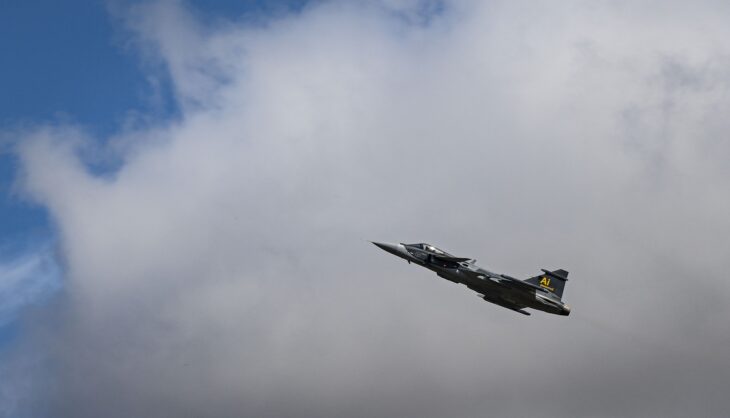

The Gripen E is the future of Swedish air power, which is why two jets top the list. The first was handed to the Skaraborg Wing (F 7) at Såtenäs on October 20, 2025, as the first of 60 the Swedish Air Force has ordered.
It is a much bigger step than the letter suggests. The E has a new AESA radar, an infrared search-and-track sensor, new electronic warfare systems and 10 weapons stations, and its General Electric F414G engine gives about 20% more thrust than the Gripen C’s RM12.
FlightGlobal’s 2026 directory lists 2 Gripen Es in service and 58 still to come, and Saab does not publish a running delivery count. Air Force chief Maj. Gen. Jonas Wikman said in July 2026 that bringing the new jet into service “took us only a few months.”
The order is also growing. At Farnborough on July 20, 2026, Wikman said Sweden plans to add 12 more Gripen Es “at a later date” to replace the C/Ds it is giving Ukraine, which would take the E fleet to 72. No contract has been signed for those 12 yet.
2. JAS 39C/D Gripen: 94 Jets Still Doing the Work
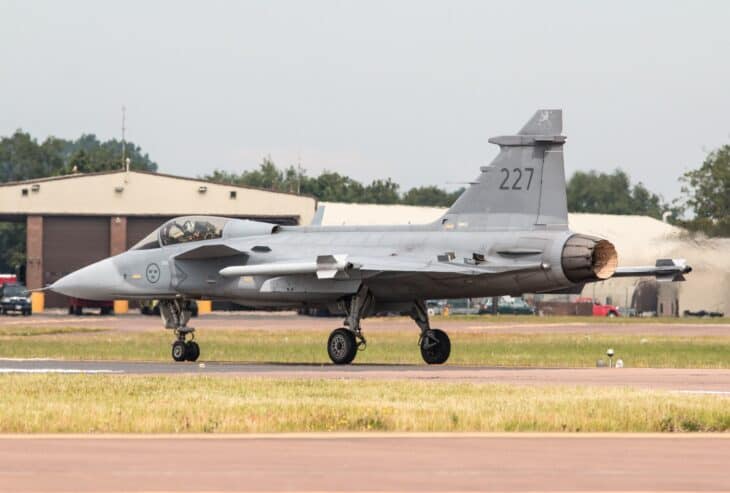
Every Swedish air-defense alert in 2026 is still flown mostly by the JAS 39 Gripen C and D. FlightGlobal counts 71 single-seat Cs and 23 two-seat Ds, the Ds doubling as conversion trainers.
They fly from three fighter wings: Skaraborg (F 7) at Såtenäs, Blekinge (F 17) at Ronneby and Norrbotten (F 21) at Luleå. In March 2025 Sweden, by then a NATO member, sent six Gripens to Poland for an enhanced air policing mission on the alliance’s eastern border.
The C/D is not going away soon. Sweden expects to retire its older Gripens between 2035 and 2040, or later, and has committed to deciding on a next-generation fighter in 2031, whether it builds one, develops one with partners or buys one.
Isn't Sweden giving its Gripens to Ukraine?
Some of them. On May 28, 2026, the government said it will donate up to 16 Gripen C/Ds, one division, with IRIS-T, AMRAAM and Meteor missiles, on condition that Ukraine buys new Gripen E/Fs. Ukraine signed for 16 Gripen Es on June 30, 2026, a SEK 24.6 billion contract with deliveries in 2029 and 2030, and its first donated C/Ds are expected in 2027. The donation package includes money to buy Sweden replacement Gripen E/Fs, so the Swedish fleet is meant to grow, not shrink.
3. S 106 GlobalEye: The Radar Jet Sweden Is Waiting For
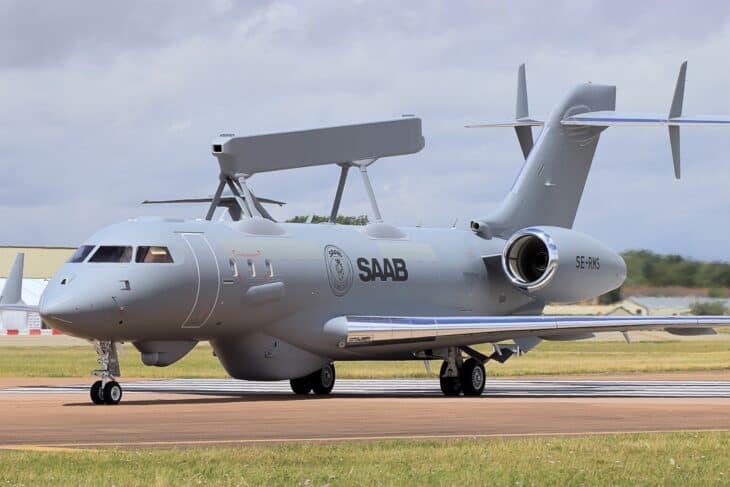

Saab sells airborne radar planes abroad, yet in October 2026 Sweden does not have one in service. The GlobalEye pairs Saab’s Erieye radar with a Bombardier Global 6000 airframe, giving the Gripens long-range eyes over the Baltic.
FMV ordered two in June 2022, with an option for more, and a third in 2024. Saab presented the first Swedish aircraft, designated S 106, on October 15, 2026, ahead of testing and its first flight, and deliveries are expected to begin in 2027.
Sweden gave away its radar planes first
On May 29, 2024, Sweden’s 16th military aid package handed Ukraine both of its Saab 340 ASC 890 early-warning aircraft. That left the Swedish Air Force without an airborne radar of its own until the GlobalEye arrives, a gap it accepted to help Ukraine’s air defense.
4. S 102B Korpen: Two Gulfstream Spy Jets
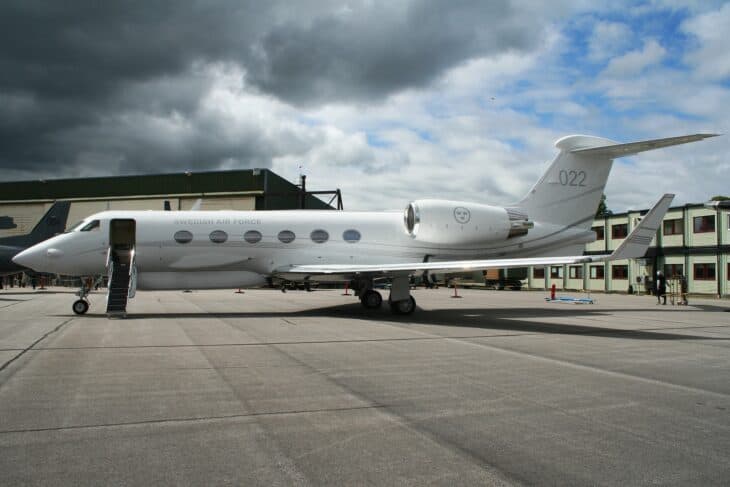

Sweden’s quietest aircraft are two Gulfstream IV business jets converted for signals intelligence, designated S 102B Korpen (“the raven”). FlightGlobal lists both as active.
They collect electronic signals from radar, navigation and weapon systems, and fly with the 74th Special Air Squadron at Malmen, near Linköping. Sweden has flown this mission a long time: in June 1952 Soviet MiG-15s shot down a Swedish signals-intelligence DC-3 over the Baltic, along with the Catalina sent to search for it.
5. Tp 84 Hercules: 60 Years of Airlift, and the C-390 Next
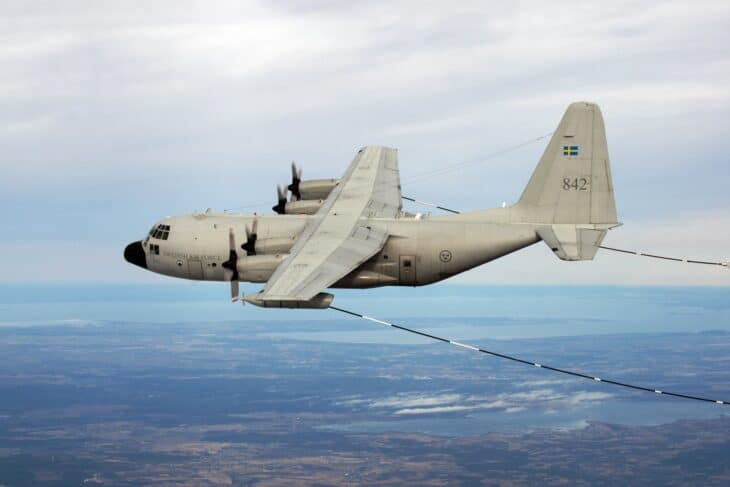

Sweden’s airlift fleet is five C-130H Hercules and one KC-130H tanker, known as the Tp 84, flown by the 71st Air Transport Squadron at Såtenäs. The Swedish Armed Forces say the type has served them for 60 years.
Its replacement is chosen and ordered. Sweden selected the Embraer C-390 in November 2024 and signed for four on October 6, 2025, joining an existing contract with the Netherlands and Austria. The first Swedish aircraft is expected at the end of 2027.
6. Hkp 16 Black Hawk: The Helicopter Sweden Keeps Buying
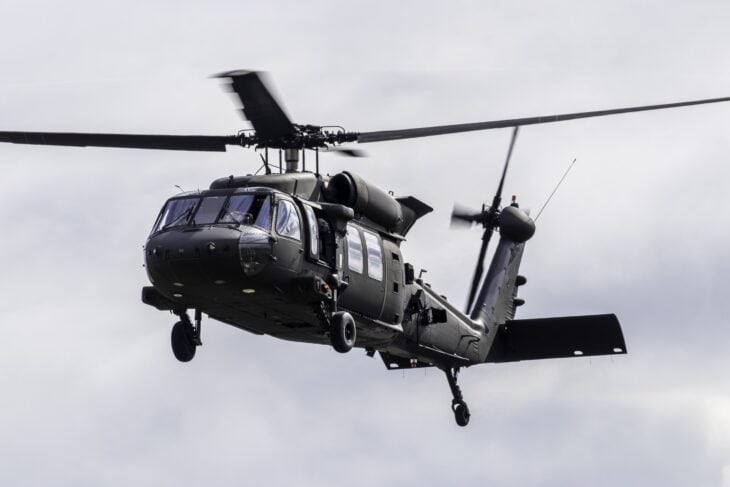

The UH-60M Black Hawk is the Helicopter Wing’s workhorse. Sweden first ordered 15 in 2011, and one of their earliest jobs was medical evacuation in Afghanistan.
FMV has since contracted 12 more, to be delivered over the coming years, which will take the fleet to 27. They fly troop transport and special forces missions from Malmen.
7. Hkp 14 NH90: The Helicopter Sweden Wants to Replace
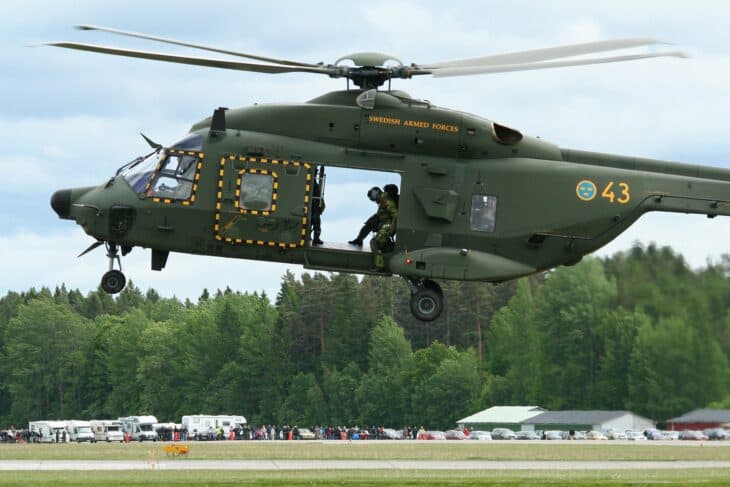

Sweden flies 18 NH90s: nine Hkp 14E transports and nine Hkp 14F anti-submarine helicopters. The first were due by 2005 but arrived in 2011, and the last production aircraft came in August 2019.
Poor availability made it unpopular. In November 2022 the then-commander cancelled plans for more and proposed replacing it, and August 2026 reports say the 2027 defense plan retires the nine transports from 2027, while the NH90 sub-hunters stay until a new maritime helicopter is bought.
8. Hkp 15 AW109: Light Helicopters for Land and Sea
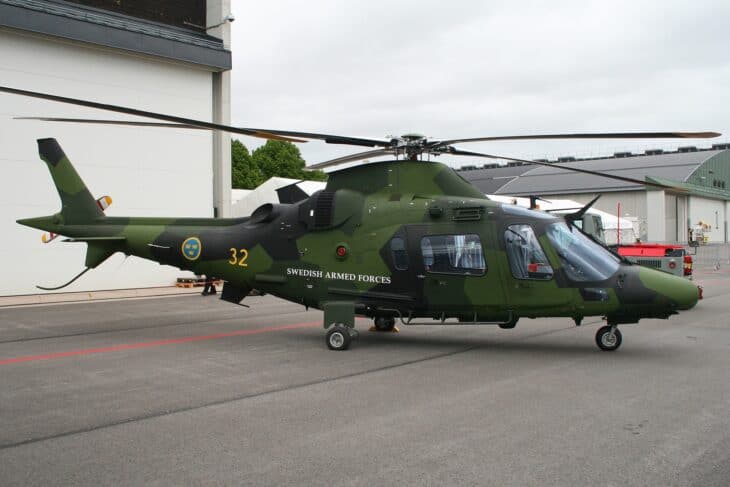

FlightGlobal counts 20 AW109 LUH light helicopters, designated Hkp 15. They train helicopter crews and fly liaison and medical missions.
The naval Hkp 15B version operates from Swedish Navy ships. Squadrons at Malmen and Ronneby share the fleet.
9. SK 40 Grob G 120TP: Where Every Pilot Starts
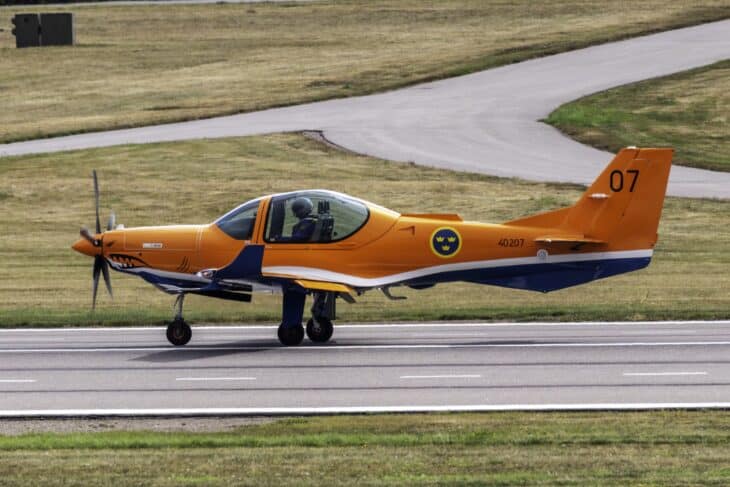

Every Swedish military pilot now begins on the SK 40, a German Grob G 120TP turboprop. FMV signed for the system in 2021, deliveries came in 2023 and 2024, and three more ordered in October 2024 took the fleet to 13.
It took over basic training from the Saab 105, the SK 60 jet trainer Sweden flew for decades and phased out in 2024.
10. Saab 340 and Global 6500: Open Skies and Government Jets
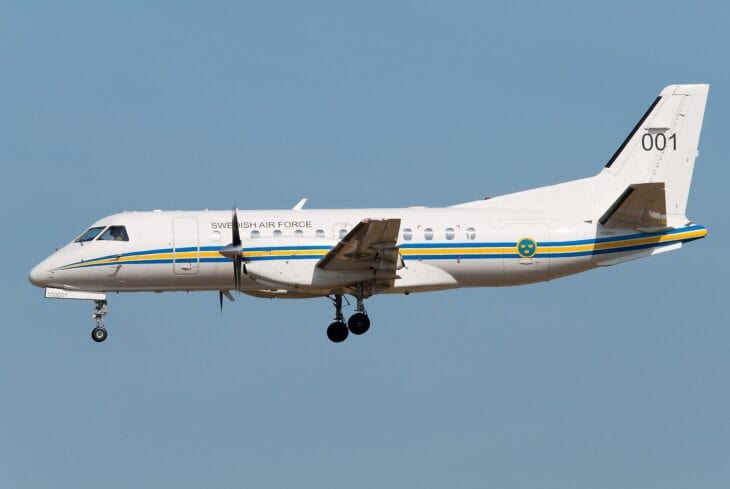

Two Saab 340 turboprops round out the fleet, one equipped for photographic reconnaissance flights under the Open Skies treaty and one for transport. FlightGlobal lists one of each.
For government flights, FMV signed in May 2025 to buy two secondhand Bombardier Global 6500s, designated Tp 106, for about SEK 1.1 billion. They replace the Gulfstream IV and G550 that carried Sweden’s leaders, and share an airframe family with the GlobalEye.
What Sweden Borrows From NATO
Sweden became NATO’s newest member on March 7, 2024. It already co-owned three Boeing C-17 Globemaster IIIs through the 12-nation Strategic Airlift Capability, based at Pápa in Hungary.
In June 2025 Sweden also joined the Multinational Multi-Role Tanker Transport Fleet, which flies Airbus A330 MRTT tankers from Eindhoven in the Netherlands. Those shared jets fill the heavy-lift and air-refueling gaps a country of Sweden’s size cannot fill alone.
Its closest partner is next door. In September 2026 Swedish Gripens and Finnish Hornets intercepted Russian aircraft together over the Gulf of Finland, the first joint mission of its kind, and Finland’s own transition is covered in our guide to the Finnish Air Force.
Where the Swedish Air Force Is Based
Fighters fly from Såtenäs (F 7) in the west, Ronneby (F 17) in the south and Luleå (F 21) in the far north. The Uppland Wing (F 16) at Ärna, near Uppsala, was reestablished in 2021.
Malmen, near Linköping, is home to the Helicopter Wing’s main squadrons and the special-mission jets. Helicopter squadrons also sit at Luleå and Ronneby.
Those peacetime bases are only half the picture. Since the late 1950s Sweden has planned to scatter its squadrons across many wartime bases, with stretches of highway as backup runways, under the Bas 60 and later Bas 90 systems, so an enemy could not destroy the air force on the ground.
100 Years of the Swedish Air Force
The Swedish Air Force was created on July 1, 1926, when the Army’s and Navy’s aircraft units merged, so 2026 is its centenary year. It grew fast during the Cold War: by 1957 Sweden had the world’s fourth most powerful air force, with about 1,000 modern aircraft in front-line service.
Much of that fleet was built at home, from the Saab J 29 Tunnan around 1950 to the double-delta J 35 Draken and the JA 37 Viggen. The Gripen continues that line, and it keeps a mid-sized country in the conversation about the best air forces in the world.
FAQ
Sources and references used for research and fact-checking.
- FlightGlobal, World Air Forces 2026
- The Aviationist, Sweden Receives First Gripen E
- Breaking Defense, Sweden eyes additional batch of Gripen E jets to replace Ukraine-bound aircraft
- Government of Sweden, Sweden to sell Gripen E/F fighter aircraft to Ukraine
- Saab, Saab signs contract for Gripen E for Ukraine
- Breaking Defense, Sweden commits to future fighter procurement decision in 2031
- Armada International, Saab presents the first GlobalEye for Sweden
- Joint Forces News, Saab Presents First GlobalEye for Sweden
- Ukrinform, Sweden to provide two Saab 340 AEW&C aircraft to Ukraine
- Swedish Armed Forces, Ceremony for the Air Force's new C-390 transport aircraft
- The Aviationist, Sweden to Acquire Four Embraer C-390 Airlifters
- FMV, Beställning av tolv helikoptrar
- The Aviationist, Sweden phasing out NH90 TTH by 2027
- FMV, FMV tecknar kontrakt om fler skolflygplan
- FMV, FMV tecknar avtal om två nya statsflygplan
- NATO, Sweden officially joins NATO
- Wikipedia, Swedish Air Force
Get the Newsletter
The latest aviation news and stories sent to your inbox.
About the Author

Tim is the owner and lead editor of AeroCorner since 2019, overseeing aviation content covering aircraft, airlines, airports, and the broader aviation industry. Through years of researching, writing, editing, and publishing aviation-focused content, he has developed extensive practical knowledge of commercial aviation and air travel. Based in Asia and a frequent traveler himself, Tim also brings firsthand passenger experience to AeroCorner’s coverage. Outside of publishing, he has also explored aviation firsthand through hands-on flight training in New Zealand.