

Table of Contents
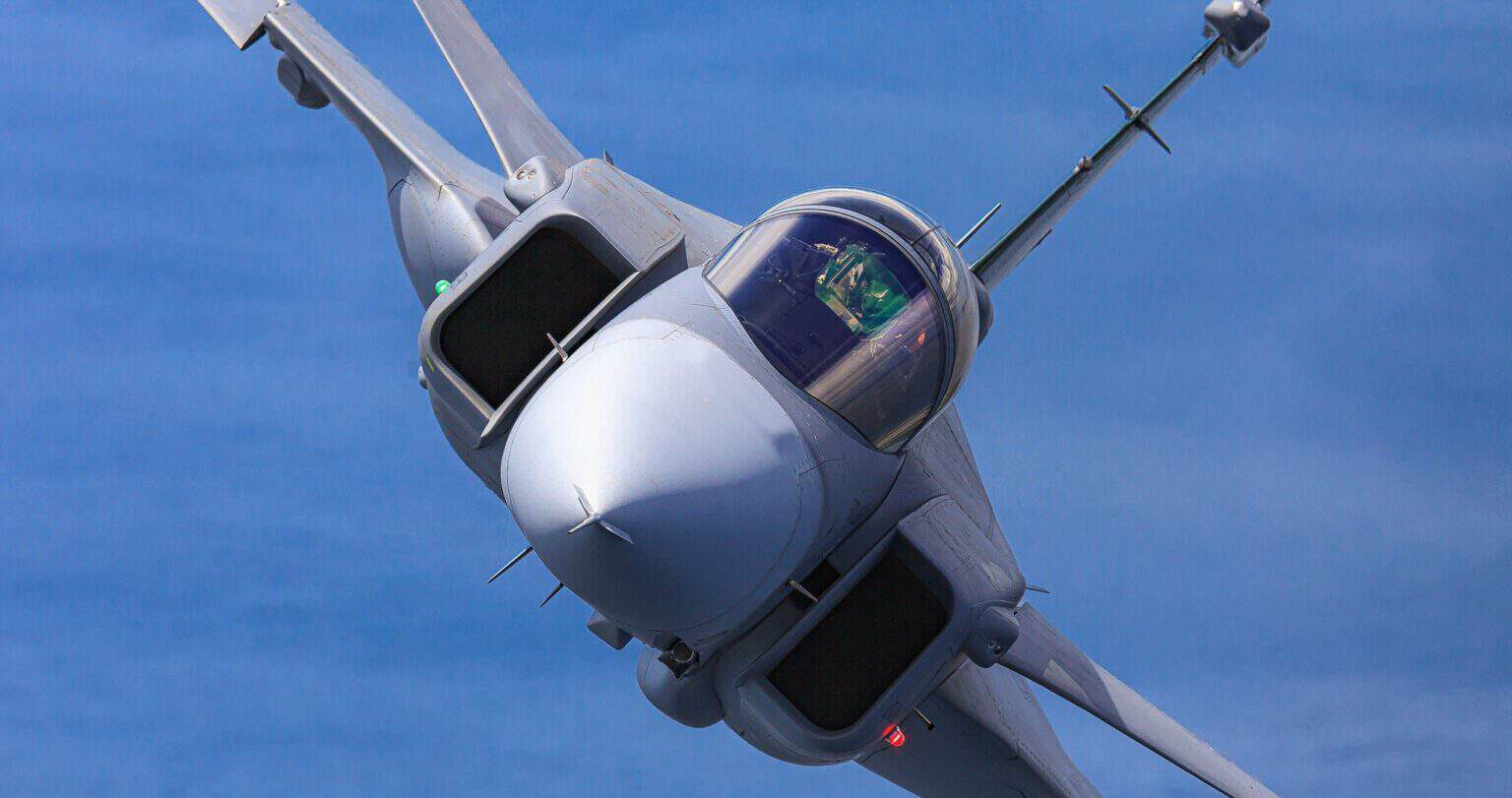
The Brazilian Air Force is the strongest air force in Latin America, ranked 16th in the world in 2026 by the World Directory of Modern Military Aircraft. Its front line is in the middle of a handover: 11 new Saab F-39E Gripens have arrived, while 34 Northrop F-5s from the 1970s still carry much of the air defense load.
In Portuguese it is the Força Aérea Brasileira, or FAB. It was created on January 20, 1941, when Brazil merged its Army and Navy air arms into one service.
This guide ranks every aircraft type the FAB flies by its weight in Brazilian air power as of October 2026. It then covers the delayed Gripen program, the law that lets Brazil shoot down drug flights, the squadron that fought in Italy in World War II and how strong the force really is.
| Rank | Aircraft | Role | Fleet | Status |
|---|---|---|---|---|
| 1 | Saab F-39E/F Gripen | Multirole fighter | 11 F-39Es delivered | 25 more due by 2032 |
| 2 | Northrop F-5EM/FM Tiger II | Air defense fighter | 34 plus 4 two-seaters | To retire by about 2029 |
| 3 | AMX A-1M | Attack jet | 10 | World’s last AMX operator, retirement planned |
| 4 | Embraer A-29 Super Tucano | Light attack, advanced training | 81 | In service since 2003 |
| 5 | Embraer E-99M and R-99 | Airborne early warning, surveillance | 5 and 3 | E-99M upgrades delivered 2020 to 2023 |
| 6 | Embraer KC-390 Millennium | Airlift and aerial refueling | 8 | 11 more due by 2034 |
| 7 | Airbus KC-30 (A330-200) | Long-range transport, presidential flights | 2 | Tanker conversion not started |
| 8 | P-3AM Orion and P-95 Bandeirulha | Maritime patrol | 3 to 4, and 8 | In service |
| 9 | C-105 Amazonas (Airbus C295) | Medium airlift, search and rescue | 13 | In service |
| 10 | H-36 Caracal and H-60L Black Hawk | Transport and rescue helicopters | 14 and 16 | 11 more Black Hawks bought in 2025 |
| 11 | Bandeirante, Brasilia, Caravan and Embraer jets | Light transport, VIP | 35, 17, 30, plus VIP jets | In service |
| 12 | T-27 Tucano, T-25 Universal, Esquilo | Pilot training | 31, about 38 T-25Ms planned, 19 | T-25 being upgraded |
How this ranking works
Aircraft are ranked by their weight in Brazilian air power in October 2026: fighters and attack jets first, then the radar planes that direct them, then tankers and airlifters, patrol aircraft, helicopters, light transports and trainers. Counts come from FlightGlobal’s World Air Forces 2026 directory, which lists aircraft in day-to-day use, updated with 2026 delivery news. The Brazilian Army and Navy fly their own separate fleets and are not counted here.
1. Saab F-39 Gripen: The New Front Line
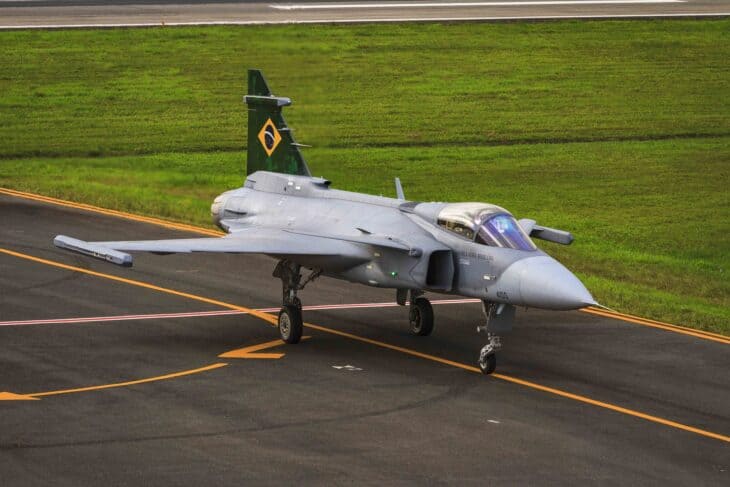

The Gripen is the most capable combat jet Brazil has ever flown. It signed for 36 in 2014, 28 single-seat F-39Es and eight two-seat F-39Fs, and Saab had delivered 11 F-39Es by June 2026.
The jets fly with the 1st Air Defense Group at Anápolis Air Base, in Goiás. The first Brazilian F-39E flew in Brazil on September 24, 2020. Our page on Saab’s Gripen family covers the versions.
It also brought new weapons. The F-39E carries an AESA radar, Brazil’s Link-BR2 datalink and the Meteor long-range air-to-air missile, which the FAB fired live for the first time in late November 2025 at Natal Air Base.
Brazil is also building the jet. Embraer is assembling 15 of the 36 at Gavião Peixoto, in São Paulo state, the only Gripen production line outside Sweden. The first, FAB 4109, was rolled out on March 25, 2026 and made its first flight on October 6, 2026.
Brazil is also the launch customer for the two-seat Gripen F. Saab presented the first F-39F to the FAB at Linköping, Sweden, on June 2, 2026, and it made its first flight on August 28. It will be tested in Sweden before shipping to Brazil.
One refueling reaches anywhere in Brazil
In October and November 2025, the FAB, Embraer and Saab certified the Gripen to take fuel in flight from the KC-390. With a single refueling, the FAB says, a Gripen from Anápolis can reach any point in Brazil, including border regions about 1,860 miles (3,000 km) away.
2. Northrop F-5EM/FM Tiger II: Fifty Years of Air Defense
.jpg)
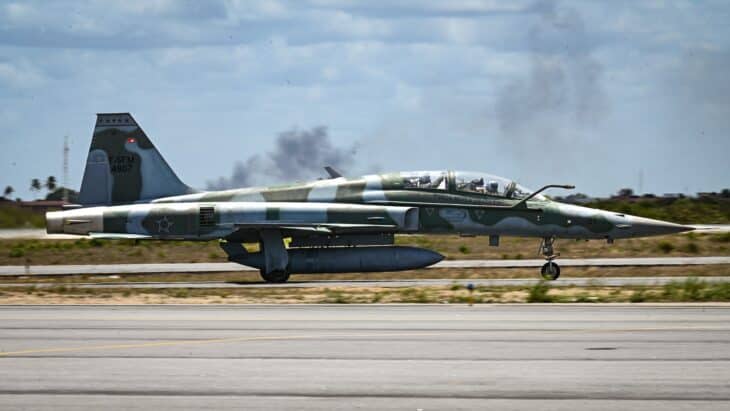
The Northrop F-5 Tiger II is still the FAB’s most numerous fighter. FlightGlobal’s 2026 directory counts 34 single-seat F-5EMs and four two-seat F-5FMs in day-to-day use.
Brazil’s first Tiger IIs were delivered in 1975, under a 1973 deal for 68 jets, and more came secondhand from the US Air Force and Jordan. When Brazil retired its 12 used Mirage 2000s in 2013, the F-5 became its main air defense fighter.
These are not 1970s jets inside. Embraer and AEL Sistemas rebuilt 49 of them to the F-5M standard, finishing in October 2020, with an Italian Grifo F radar, a glass cockpit, a helmet-mounted sight and Israeli Derby and Python missiles.
Their time is running out. The FAB has said the F-5 will serve until 2029, and in September 2025 Brazil was weighing 12 used Gripen C/Ds from Sweden to bridge the gap; no deal had been announced by October 2026.
3. AMX A-1M: The Last AMX Squadron on Earth
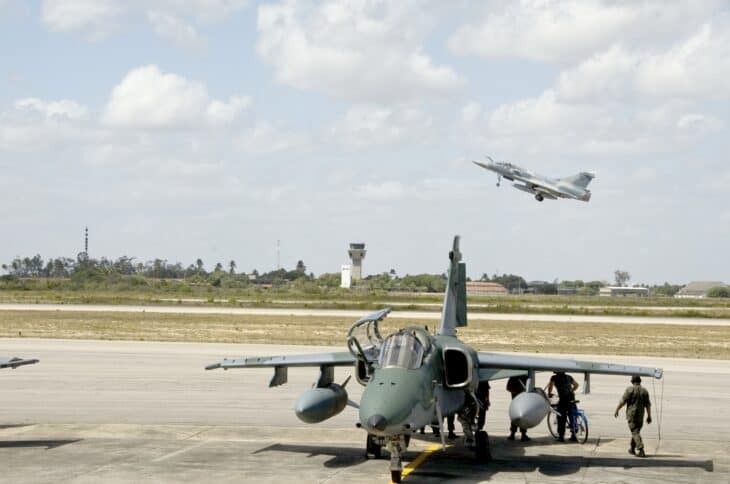

The AMX is a subsonic attack jet that Brazil and Italy developed together in the 1980s. It first flew on May 15, 1984 and entered Brazilian service in 1989 as the A-1.
Italy retired its last AMX in 2024, which left Brazil as the type’s only operator. FlightGlobal counts 10 still active, the survivors of 56 delivered, all upgraded to the A-1M standard with a new radar, glass cockpit and datalink.
The FAB once planned to retire them in 2025, then said in 2023 that “adjustments may occur.” By September 2025 it had confirmed that the A-1 and the F-5 will both go in the coming years, with the Gripen taking over their missions.
4. Embraer A-29 Super Tucano: The Drug-Flight Hunter
.jpg)
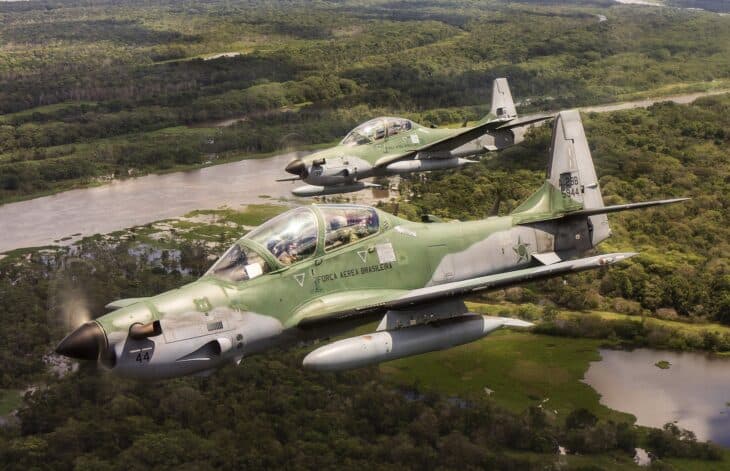
The Embraer A-29 Super Tucano is a Brazilian-built turboprop that trains pilots and carries guns, rockets and bombs. FlightGlobal counts 81 in FAB service, 22 assigned to combat units and 59 to training.
The FAB launched the type: it ordered 76 in August 2001 with options for 23 more, and took 99 in all from 2003. The Super Tucano has since been sold widely, and by February 2026 it was flying with 22 air forces and had logged more than 600,000 flight hours.
At home it hunts drug flights. On June 3, 2009, two A-29s guided by an R-99 surveillance jet intercepted a Cessna flying in from Bolivia, fired warning shots, and forced it to land carrying 388 pounds (176 kg) of cocaine base paste.
Can Brazil really shoot down a drug plane?
Yes, by law. Decree 5,144 of July 16, 2004 lets the FAB destroy an aircraft suspected of drug trafficking if it refuses every earlier step: radio and visual questioning, an order to divert and land, then warning shots with tracer rounds. Shots to stop the flight are a last resort, only over sparsely populated areas, with the Air Force commander’s authorization. The 2009 Super Tucano interception was the first use of those powers.
5. Embraer E-99M and R-99: The Eyes Over the Amazon
.jpg)
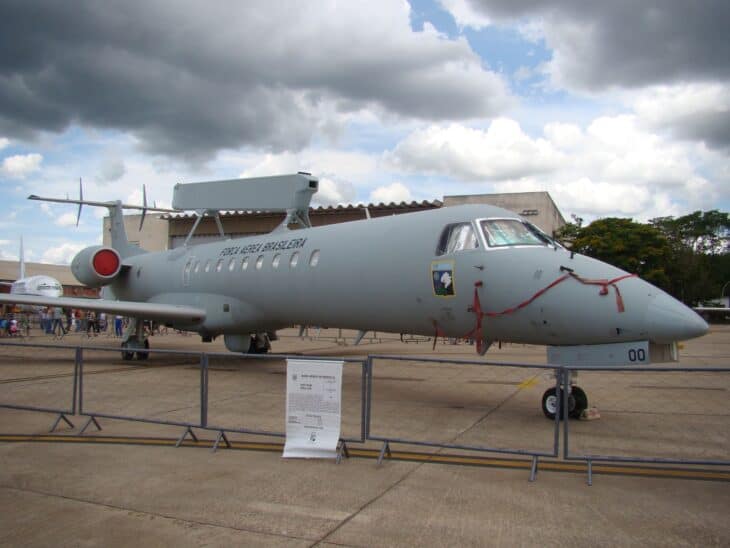
Brazil’s airborne radar fleet is built on the Embraer 145 regional jet. The E-99 carries Saab’s Erieye radar, and the FAB has five, all upgraded to the E-99M standard.
Embraer delivered the first E-99M in November 2020 and the fifth on November 23, 2023. Three more Embraer 145s fly as R-99 remote sensing aircraft.
Its drones are a thinner layer. A Hermes 900, FAB 7811, crashed near Campo Grande on March 25, 2026 during a multinational exercise, leaving one of the type active while a replacement is awaited.
6. Embraer KC-390 Millennium: The Export Hit That Barely Flies at Home
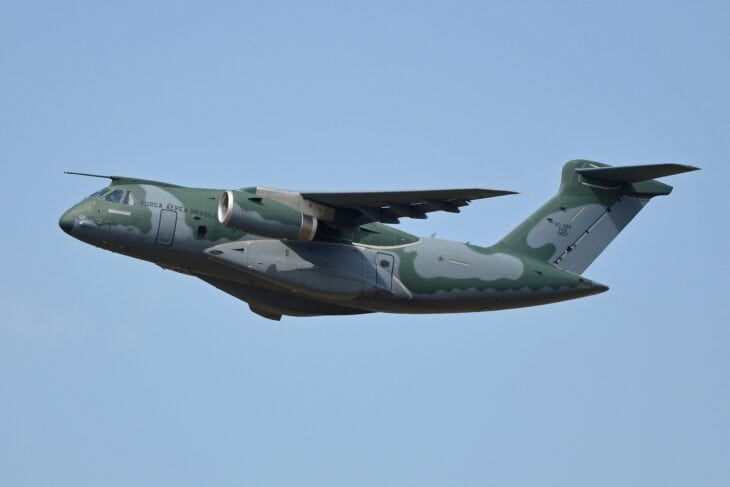
The Embraer KC-390 Millennium is a twin-jet airlifter and tanker built to replace the C-130 Hercules. It can carry up to 57,000 pounds (26 tonnes), 80 troops or 66 paratroopers, and refuel other aircraft in flight.
The FAB took the first on September 4, 2019 and the eighth on October 2, 2025. They fly with the 1st Troop Transport Group at Anápolis and the 1st/1st Transport Group at Galeão, in Rio de Janeiro.
Brazil has steadily cut its order. It planned 28, reduced that to 22 and then to 19 in 2022, and deliveries have slowed from four a year to one, with the last now due in 2034.
The fleet it has is struggling. Brazilian aviation site Aerojota, citing Revista Força Aérea, reported that only two of the eight were operational in March 2026, and that the KC-390 program lost about R$215.8 million in a 2026 FAB budget freeze.
Everyone wants one except the budget
Embraer lists Portugal, Hungary, the Netherlands, Austria, the Czech Republic, South Korea and Sweden among its KC-390 buyers. Meanwhile, the air force that launched the aircraft is taking one a year and has cut its order by a third.
7. Airbus KC-30: The Tanker That Carries the President
.jpg)
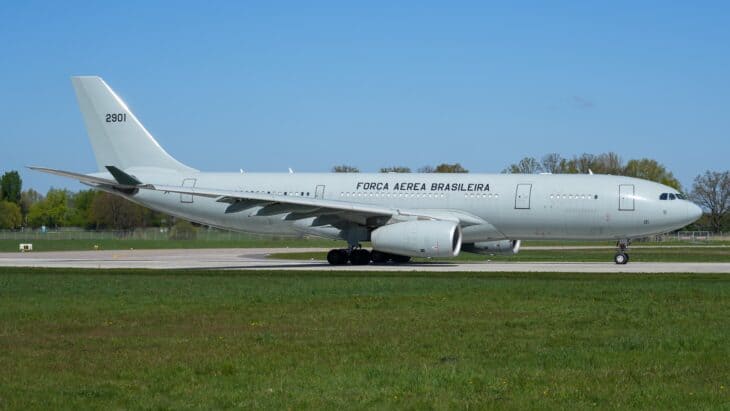
The FAB bought two used Airbus A330-200 airliners from Azul for about $80 million, to be converted into A330 MRTT tankers and named KC-30. They fly with the 2nd/2nd Transport Group at Galeão.
The conversion has not happened. In August 2026 the tanker work had still not started, one of the pair had not flown since August 2025 and was parked in an Azul hangar at Viracopos, and the other was flying the long-range missions alone.
That remaining jet is effectively Brazil’s Air Force One. President Lula has flown long trips on a KC-30 since 2023, using two Embraer 190s for shorter flights, while the older presidential Airbus A319, the VC-1, has flown with a rented engine since an incident in Mexico in October 2024.
A new presidential jet has been discussed and shelved. In April 2026, Aerojota reported that Lula had backed away from buying one in an election year. Our guide to every aerial refueling tanker in service shows what a converted KC-30 would join.
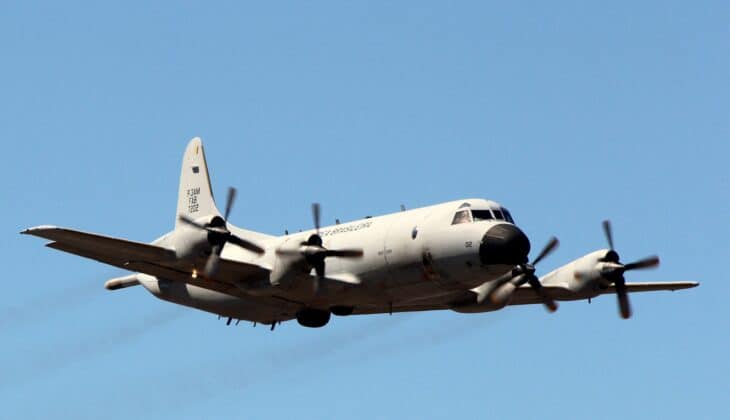
8. P-3AM Orion and P-95 Bandeirulha: Watching the Atlantic
.jpg)
The FAB also patrols Brazil’s Atlantic coast. Its heaviest patrol aircraft is the Lockheed P-3 Orion, flown in an upgraded version called the P-3AM.
FlightGlobal counts four in day-to-day use, while the IISS figure on Wikipedia is three. Eight P-95 Bandeirulhas, a patrol version of the Embraer EMB 110 Bandeirante turboprop, fly alongside them.
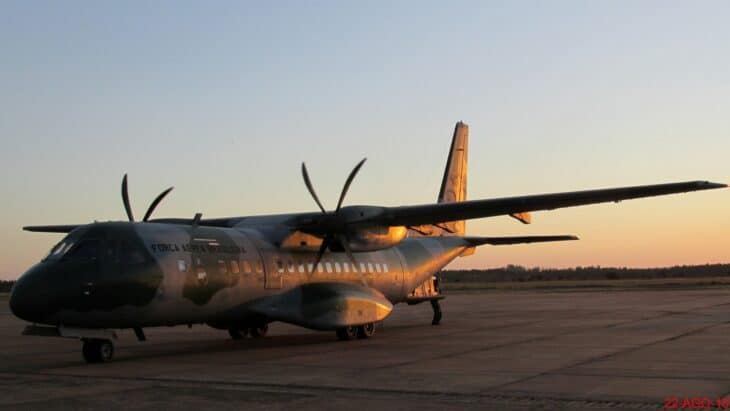
9. C-105 Amazonas: Airlift and Search and Rescue
,_parte_da_antiga_EADS_-_panoramio.jpg)
Until more KC-390s arrive, the FAB’s medium airlift rests on the Airbus C295, known in Brazil as the C-105 Amazonas. FlightGlobal counts 13: eight transports and five fitted for search and rescue.
10. H-36 Caracal and H-60L Black Hawk: The Helicopter Force

,_da_For%C3%A7a_A%C3%A9rea_Brasileira_(51986536194).png)
The FAB’s heaviest helicopter is the H-36 Caracal, Brazil’s name for the Airbus H225M, formerly the EC725 Caracal. FlightGlobal counts 14 with two more on order, built in Brazil by Helibras, and two serve as VIP transports.
The Black Hawk fleet is growing. FlightGlobal counts 16 H-60Ls, and in October 2025 Brazil announced the purchase of 11 more UH-60Ls through a US Army program for about $230 million, which Gazeta do Povo reported will take the FAB to 24.
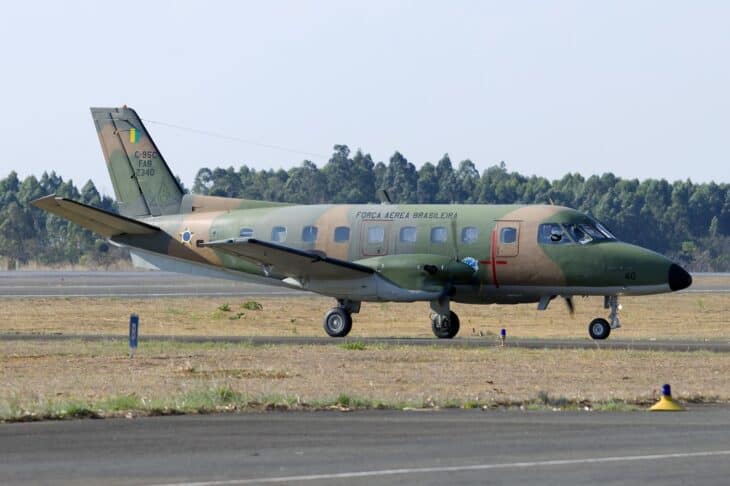
11. Bandeirantes, Brasilias and Caravans: The Light Transport Fleet
.jpg)
Embraer’s own older designs make up most of the light transport fleet. FlightGlobal counts 35 C-95 Bandeirantes and 17 C-97s, the military Embraer EMB 120 Brasilia.
Thirty Cessna 208 Caravans fly as the C-98. Six ERJ 145s, two Phenom 100s and three Embraer 190s, the VC-2, carry officials and the president on shorter trips.
12. T-27, T-25 and Esquilo: Where FAB Pilots Start
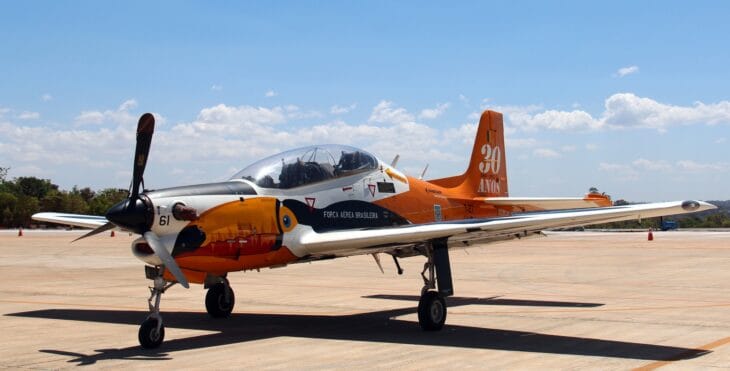

Cadets at the Air Force Academy in Pirassununga, São Paulo state, start on the piston-engine T-25 Universal. It is being modernized as the T-25M: the first flew on December 5, 2024, 38 are planned, and the first four reached the academy in December 2025.
The advanced trainer is the turboprop Embraer T-27 Tucano: FlightGlobal counts 31, alongside the 59 training Super Tucanos. Helicopter pilots train on 19 H-50 Esquilos, the Airbus AS350, with 11 newer H125s on order.
The FAB’s display team, the Esquadrilha da Fumaça or Smoke Squadron, flew the T-27 from 1983 until May 2013 and now flies the A-29. Two of its Super Tucanos collided over Santa Rita do Passa Quatro, São Paulo state, on July 30, 2025; the leader ejected, no one was killed, and the team resumed full training in January 2026.
The Gripen Program: Late but Growing
The Gripen deal was meant to be finished in 2026. After a string of contract changes, the final jet is now due in 2032, and CNN Brasil reported in June 2026 that only two aircraft were expected that year.
Brazil wants more anyway. On June 4, 2026, Brazilian defense minister José Múcio and Swedish defense minister Pål Jonson discussed about 20 more Gripens, which would take the planned fleet from 36 to about 56; no contract had been signed by October.
The gap is the problem. With 11 Gripens delivered and the F-5s and AMXs due to retire in the coming years, the FAB has to keep its old jets flying or find a stopgap. Mexico, with three F-5s left, faces a sharper version of the same squeeze, as our guide to the Mexican Air Force shows.
Senta a Pua: Brazil’s Fighter Pilots in World War II
Brazil sent fighter pilots into combat in Europe in World War II. Its 1st Fighter Group, formed on December 18, 1943 with 350 men including 43 pilots, flew the Republic P-47D Thunderbolt in Italy as part of the US 350th Fighter Group.
From November 11, 1944 to May 6, 1945, it flew 445 missions and 2,550 individual sorties, under the call sign Jambock and the emblem “Senta a Pua!” Our guide to American fighter planes of WW2 covers the P-47 it flew.
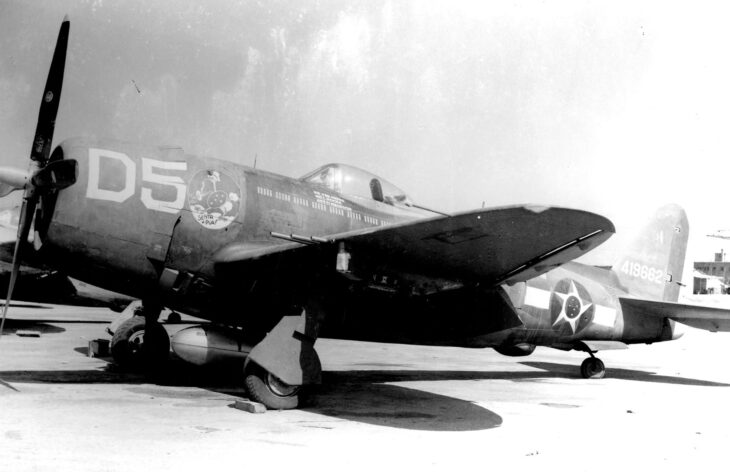

Its busiest day was April 22, 1945, when it flew 44 missions in northern Italy. Brazil still marks April 22 as Fighter Aviation Day.
The jet fighters Brazil paid for in cotton
After the war, Brazil wanted jets but had no convertible currency to buy them. In the early 1950s it ordered 60 Gloster Meteor F.8 fighters and 10 two-seat trainers from Britain and paid for them in cotton. The Meteors served until 1968, when low-level flying had fatigued their wing spars.
How Strong Is the Brazilian Air Force?
It is the strongest in Latin America by a wide margin. The World Directory of Modern Military Aircraft ranks it 16th in the world in 2026, with 418 aircraft and a score of 48.3, while the next Latin American air force, Chile’s, is 37th with a score of 27.9.
Counts vary with the method. Global Firepower’s 2024 index put the FAB 17th with 628 aircraft, while FlightGlobal’s 2026 directory, which lists only crewed aircraft in day-to-day use, counts about 360 in its Air Force table.
Its weakness is money, not size. The Gripen is years late, the KC-390 fleet is mostly on the ground and the KC-30 tanker conversion has not begun, while most of its fighters are a 1970s design.
Our rankings of the largest air forces in the world and the best air forces in the world show where Brazil sits against the global leaders.
FAQ
Sources and references used for research and fact-checking.
- FlightGlobal, World Air Forces 2026 directory
- Wikipedia, List of active Brazilian military aircraft
- Wikipedia, Brazilian Air Force
- CNN Brasil, FAB recebe primeiro caça sueco Gripen F para modernizar frota brasileira
- AeroTime, Sweden says Brazil could order 20 more Gripen fighters
- The Aviationist, First Brazilian-Built Gripen E Makes Maiden Flight
- El Cronista, Brazil manufactured the first Gripen F-39E
- Zona Militar, The Brazilian Air Force evaluates the purchase of 12 Gripen C/D fighters from Sweden
- Air Data News, Brazilian Air Force aims to decommission AMX attack aircraft by 2025 and F-5 fighters by 2029
- The War Zone, Brazil's Upgraded Tiger IIs Might Be The Most Capable F-5s In The World
- Wikipedia, AMX International AMX
- InfoMoney, FAB dispara míssil Meteor com alcance de 200 km e moderniza defesa aérea
- Jovem Pan, Pela primeira vez, FAB realiza reabastecimento em voo entre o Gripen e o KC-390
- Wikipedia, Embraer EMB 314 Super Tucano
- The Defense Post, Uruguay receives first Super Tucano
- Presidência da República (Planalto), Decreto nº 5.144, de 16 de julho de 2004
- Wikipedia, Embraer R-99
- Aviacionline, Embraer delivered fifth modernized E-99M AEW&C aircraft to Brazilian Air Force
- Click Petróleo e Gás, FAB perde drone de 50 milhões em exercício multinacional
- Air Data News, Embraer delivered the 8th KC-390 to the Brazilian Air Force
- Aerojota, Entregas do KC-390 sofrem atraso e FAB terá frota reduzida
- Aerojota, KC-390 da FAB em 2026 tem baixa disponibilidade
- Aerojota, KC-390 FAB 2861 e a crise orçamentária da FAB
- Aerojota, Incidente com KC-390 FAB 2859 em Ushuaia
- Wikipedia, Embraer C-390 Millennium
- Air Data News, Brazilian Air Force inducts first A330-200 to be converted for aerial refueling
- Aerojota, C-30 FAB 2902 entra em hangar em Viracopos
- Aerojota, Lula recua da compra de avião presidencial em 2026
- Wikipedia, Brazilian Air Force One
- Gazeta do Povo, FAB anuncia compra de 11 helicópteros dos Estados Unidos
- MigFlug, Smoke Squadron and the A-29 Super Tucano
- MigFlug, T-25M Universal modernization
- World Directory of Modern Military Aircraft, World Air Power Rankings 2026
- Folha de Pernambuco, Brasil tem a 17ª maior força aérea do mundo
- History of War, Overseas Operators of the Gloster Meteor
Get the Newsletter
The latest aviation news and stories sent to your inbox.
About the Author

Tim is the owner and lead editor of AeroCorner since 2019, overseeing aviation content covering aircraft, airlines, airports, and the broader aviation industry. Through years of researching, writing, editing, and publishing aviation-focused content, he has developed extensive practical knowledge of commercial aviation and air travel. Based in Asia and a frequent traveler himself, Tim also brings firsthand passenger experience to AeroCorner’s coverage. Outside of publishing, he has also explored aviation firsthand through hands-on flight training in New Zealand.