

Table of Contents
The US military has 13,033 aircraft in active use. That is the count in FlightGlobal’s World Air Forces 2026 directory, whose fleet data from Cirium was drawn on October 1, 2025.
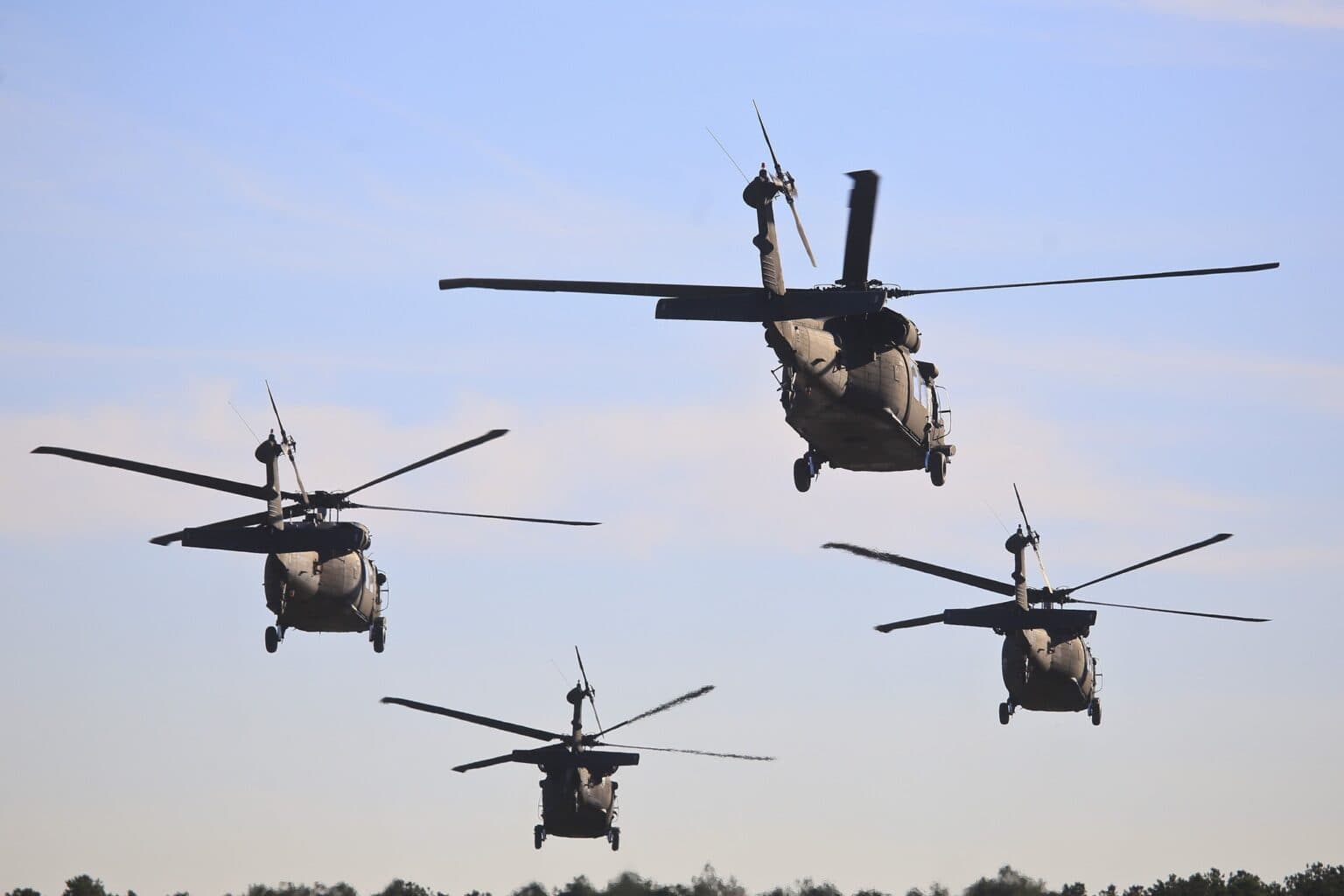
It is a quarter of all military aircraft on Earth, and more than the next five countries combined. The surprise is what fills it: 5,567 of those aircraft are helicopters and tiltrotors, against 2,718 combat jets and bombers.
How Many Aircraft Does the US Military Have?
13,033, as of October 2025. The count covers the Air Force, Army, Navy and Marine Corps, from F-35s and B-2 bombers to Black Hawks, tankers, transports and trainers.
It lists no drones, and it leaves out aircraft in storage or being upgraded, VIP transports, test aircraft and aircraft flown by display teams. The Coast Guard, which sits under Homeland Security in peacetime, is not in it either.
The count at a glance
13,033 US military aircraft in FlightGlobal’s World Air Forces 2026, data drawn October 1, 2025. That is 25% of the world’s 52,231. Helicopters and tiltrotors 5,567, combat aircraft 2,718, trainers 2,610, transports 917, special mission 611, tankers 610. Not listed: drones, stored aircraft, test aircraft and the Coast Guard.
What the 13,033 aircraft do
FlightGlobal sorts every military aircraft into six roles. The US leads the world in all six.
| Role | US aircraft | Share of US fleet | US share of world total |
|---|---|---|---|
| Helicopters and tiltrotors | 5,567 | 43% | 28% |
| Combat aircraft | 2,718 | 21% | 19% |
| Trainers | 2,610 | 20% | 24% |
| Transports | 917 | 7% | 21% |
| Special mission | 611 | 5% | 33% |
| Tankers | 610 | 5% | 75% |
| Total | 13,033 | 100% | 25% |
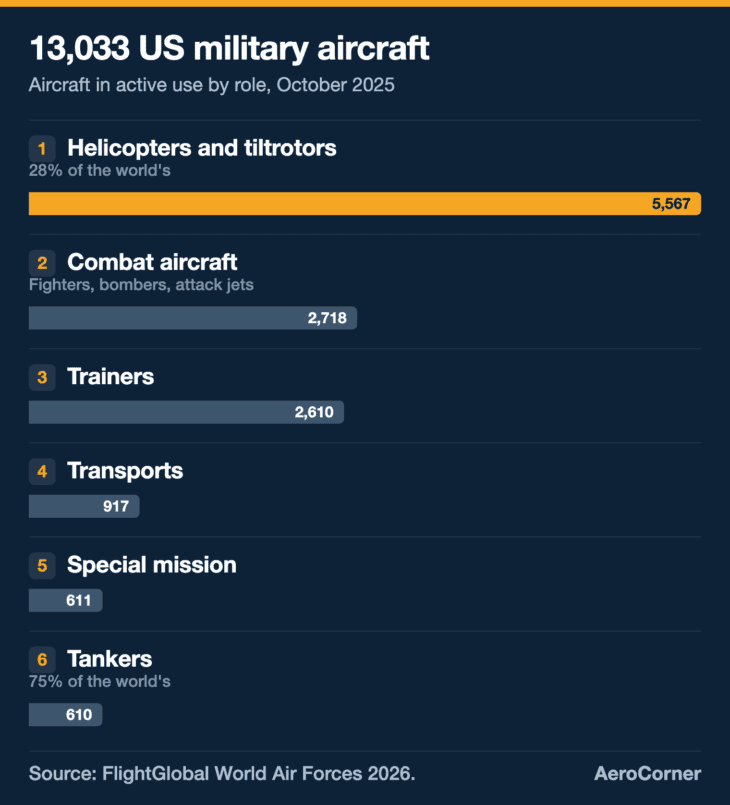
Fighters are a minority. The “combat aircraft” row also holds 132 bombers, A-10 attack jets and AC-130 gunships, and the US flies about 2,900 fighters once the ones in training units are added, as our count of how many fighter jets the US has shows.
The tanker row is where the gap with everyone else is widest. The US owns 610 of the world’s 810 military tankers, led by 376 KC-135s that the Air Force’s own records put at an average of almost 63 years old.
The fleet, service by service
FlightGlobal lists each service’s aircraft type by type. Added up, they give the totals below.
| Service | Combat aircraft | Helicopters and tiltrotors | Trainers | Everything else | Total |
|---|---|---|---|---|---|
| Air Force | 1,844 | 205 | 1,349 | 1,362 | 4,760 |
| Army | 0 | 4,066 | 109 | 203 | 4,378 |
| Navy | 526 | 519 | 1,043 | 474 | 2,562 |
| Marine Corps | 347 | 777 | 109 | 104 | 1,337 |
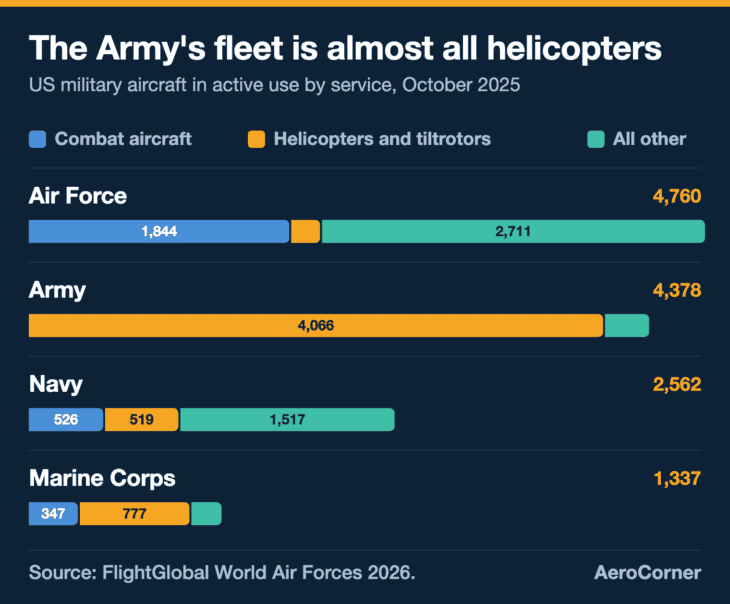
The Air Force has the most aircraft, but only just. The Army is 382 behind, and its fleet is close to a single shape: 4,066 of its 4,378 aircraft are front-line helicopters.
The UH-60 Black Hawk family alone accounts for 2,281 of them. That is more aircraft than India, the world’s fourth-largest military air arm, has in total (2,183).
Add 838 AH-64 Apaches and 494 Chinooks, and the Army holds about 73 percent of the US military’s front-line helicopters. Every type it flies is in our guide to US Army helicopters.
The Navy is a training force as much as a carrier force: 1,043 of its 2,562 aircraft sit in training units. The Marines lean on rotors, with 313 MV-22 Ospreys and 186 AH-1Z Vipers.
Why the numbers differ
Most answers to this question land near 13,000. Where they part ways, it is over drones, stored aircraft and which year they counted.
The Air Force does not have 13,000 aircraft
13,000 is the whole US military. The Air Force’s share is under 5,000, and the Army, Navy and Marine Corps fly the other 8,000 or so. The Air Force on its own still has more aircraft than any other country’s entire military.
13,032 is Global Firepower’s 2026 figure, one aircraft below FlightGlobal’s. It counts fixed-wing aircraft and helicopters from all four branches, as FlightGlobal does.
4,865 is the Air Force’s own total aircraft inventory on September 30, 2025, from the Air & Space Forces Almanac. It is about 100 more than FlightGlobal’s Air Force total, and part of the gap is drones: the inventory includes 182 MQ-9A Reapers and 9 RQ-4B Global Hawks.
The rest comes down to what counts as in use. FlightGlobal drops aircraft that are not in day-to-day use, along with test and research aircraft, while an inventory lists everything the service owns.
About 4,000 is the Department of the Navy’s figure, Navy and Marine Corps together, from the Pentagon’s fiscal 2022 aviation inventory report as cited by the Congressional Research Service. FlightGlobal’s 2026 equivalent is 3,899.
About 80 percent is the share of Army aircraft that are manned rotorcraft, in a 2024 Congressional Budget Office report. FlightGlobal, which lists no drones, has helicopters at about 95 percent of the Army’s fleet.
How the number got here, and where it is going
The Air Force alone had about 24,971 aircraft in fiscal 1952, its all-time high, according to Mitchell Institute data in the Almanac. Its 4,865 in fiscal 2025 is its all-time low.
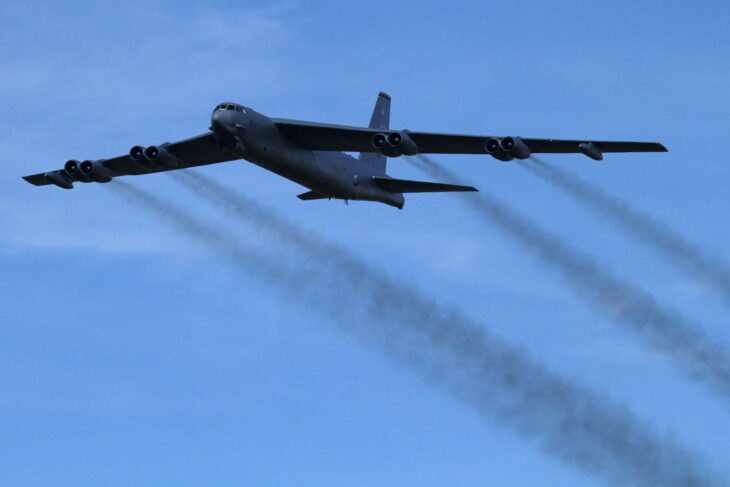
Much of what is left is old. The Air Force’s average aircraft is almost 32 years old, its B-52s average almost 63 and its T-38 Talon trainers almost 58. Why it keeps retiring more than it buys is in our look at the Air Force’s aging fleet.

The replacements are mostly still on paper. FlightGlobal records plans or options for 100 B-21 Raider bombers, 185 F-47 fighters and 346 T-7A trainers.
How the US compares with the rest of the world
The 13,033 US aircraft are 25 percent of the world’s 52,231. Russia is second with 4,237, China third with 3,529 and India fourth with 2,183.
Add South Korea’s 1,540 and Japan’s 1,429, and the next five countries still come to 12,918, short of the US total. The full ranking is in our list of the largest air forces in the world.
FAQ
Sources and references used for research and fact-checking.
- FlightGlobal, World Air Forces 2026
- Air & Space Forces Magazine, 2026 USAF & USSF Almanac Equipment: Total Aircraft Inventory (TAI)
- Congressional Research Service, Defense Primer: United States Military Aviation (IF12803)
- Global Firepower, Military Aircraft Fleet Strength by Country (2026)
- U.S. Air Force, C-5 A/B/C Galaxy and C-5M Super Galaxy fact sheet
Get the Newsletter
The latest aviation news and stories sent to your inbox.
About the Author

Tim is the owner and lead editor of AeroCorner since 2019, overseeing aviation content covering aircraft, airlines, airports, and the broader aviation industry. Through years of researching, writing, editing, and publishing aviation-focused content, he has developed extensive practical knowledge of commercial aviation and air travel. Based in Asia and a frequent traveler himself, Tim also brings firsthand passenger experience to AeroCorner’s coverage. Outside of publishing, he has also explored aviation firsthand through hands-on flight training in New Zealand.