Military Trainers
Alenia Aermacchi M-346
ICAO: M346
The world's first supersonic trainer, still teaching Air Force pilots 65 years on.
Updated: by Tim de Vries

The latest aviation news and stories sent to your inbox.
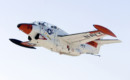
The Northrop T-38 Talon is a two-seat, twin-engine supersonic jet trainer and the world’s first supersonic trainer. Northrop built 1,187 between 1961 and 1972, and the US Air Force has trained its fighter and bomber pilots on it ever since. In 2026 it is still flying with the Air Force, NASA and the US Navy, as Boeing’s T-7A Red Hawk arrives to replace it.
Live Fleet Activity (T38)
Fetching live data…


The Northrop T-38 Talon is a two-seat, twin-engine supersonic jet trainer. It was the world’s first supersonic trainer and, with 1,187 built, also the most produced.
Northrop built them between 1961 and 1972, and the US Air Force has trained its fighter and bomber pilots on them ever since. Estimates of how many pilots learned on the type vary: Wikipedia puts it at about 50,000 military pilots, while Northrop Grumman says more than 72,000 US Air Force pilots have trained in it.
In September 2026 the Talon is still flying, 65 years after it entered service. Its replacement, Boeing’s T-7A Red Hawk, joined its first Air Force squadron in January 2026, and the Air Force plans to retire the T-38 between 2030 and 2035.
The T-38 began as a fighter. In 1954 Northrop launched the N-156, a small, twin-engine supersonic jet meant to fly from the US Navy’s escort carriers, but the Navy chose to favor large fleet carriers instead.
At the same time, the US Air Force wanted a supersonic trainer to replace its 1940s-era Lockheed T-33. Northrop adapted the N-156 for the competition, where its only rival was a two-seat version of the F-100 Super Sabre.
Northrop won, and in June 1956 it received a contract for three YT-38 prototypes. The first YT-38 flew on April 10, 1959, with test pilot Lew Nelson at the controls.
The Talon entered service on March 17, 1961, at Randolph Air Force Base in Texas. It took students through the advanced phase of pilot training after they had finished basic jet flying in the Cessna T-37 Tweet.
The fighter version of the N-156 was later selected for the US Military Assistance Program and became the Northrop F-5. The two are easy to tell apart: the T-38’s wing meets the fuselage straight and ends square, while the F-5 has leading-edge extensions at the wing roots and missile rails on its wingtips.
The T-38 was built around General Electric’s J85, a small turbojet whose 8-to-1 thrust-to-weight ratio was, according to GE, the highest of any jet engine in production at the time. Northrop chose it for both the T-38 and the F-5.
Two afterburning J85s sit side by side inside the fuselage, fed by intakes at the wing roots. The J85-GE-5 in the T-38A weighs 584 lb (265 kg) and is rated at 2,680 lbf dry and 3,850 lbf with afterburner.
The US Air Force fact sheet quotes lower numbers: 2,050 lb dry and 2,900 lb with afterburner, rising to 2,200 and 3,300 lb on engines modified under the propulsion modernization program. It does not say how those figures were measured, so the panel on this page carries the engine’s published rating.
That modernization gives the modified jets about 19 percent more thrust and cuts their takeoff distance by 9 percent, according to the Air Force. In 2001 the Air Force awarded a $601 million contract for hardware kits to upgrade 1,202 of the T-38’s J85 engines.
The engines hang from rails on either side of a central keel, with the hydraulic pump and accessories mounted on the airframe rather than the engine. That arrangement lets ground crews change an engine in roughly one hour.
The T-38 has a small, low-mounted, long-chord wing, a single tail fin and tricycle landing gear. Its fuselage narrows at the waist in a “coke bottle” shape that follows Richard Whitcomb’s area rule, which improves its supersonic performance.
Instructor and student sit in tandem on rocket-powered ejection seats in a pressurized, air-conditioned cockpit. The flight controls are powered by two independent hydraulic systems, and because the original design had no manual reversion, the aircraft could not be flown if both engines failed.
The original T-38A carried only basic navigation and communication equipment, the result of a strict weight-control regime during its design. The T-38C, which Air Education and Training Command began receiving in 2001, added a glass cockpit, a head-up display, GPS, an inertial navigation system and a traffic collision avoidance system.
Pilots nicknamed it the “White Rocket.” It was once considered too easy to fly compared with the frontline fighters of the 1960s, but by the 21st century it had come to be regarded as the most challenging aircraft in the Air Force inventory.
The wings were designed for 7.33 G and a fatigue life of 4,000 flight hours, enough for the training syllabus but not for aggressive dogfighting. After wingtips separated in flight, Northrop fitted new wings with thicker skins.
In 2005, around a third of the fleet, the jets used hardest, was receiving new wings and structural work to extend its service life to 2029.
The full specification table for the T-38 is on this page, and it describes the original T-38A. Several of its figures are quoted in very different forms elsewhere, so they need context.
Start with speed. The panel’s 746 knots (858 mph) corresponds to Mach 1.3, a speed the T-38 reaches at high altitude, where the speed of sound is lower. At sea level the Air Force gives a top speed of 812 mph, just Mach 1.08.
That is why published top speeds for the same aircraft disagree. This Day in Aviation puts Mach 1.3 at 882 mph at 30,000 feet, while the Pima Air & Space Museum lists 805 mph and March Field Air Museum 812 mph.
Next is climb rate. The panel’s 33,600 feet per minute has been printed in Air Force material for years, and the fact sheet says the T-38 can climb from sea level to nearly 30,000 feet in one minute.
Read that as a peak, not a sustained climb. The 1962 time-to-climb record took three minutes to reach 30,000 feet, and Northrop’s Roy Martin put a normal climb at military power, the maximum without afterburner, at around 6,000 feet per minute.
A T-38 instructor writing for Warbird Alley describes a full-afterburner climb at 300 knots as giving a calculated initial climb rate of 30,000 feet per minute. Without afterburner on cold days, the author saw more than 12,000 feet per minute at the start of the climb.
Range varies by source too. The panel uses 991 nautical miles (1,140 miles), the figure in Wikipedia’s specification block, while the Air Force fact sheet gives 1,093 miles and Pima 860 miles, and none of the three states the reserve or flight profile behind its number.
The ceiling works the same way. The panel shows 50,000 feet, from Wikipedia’s specification block, while the Air Force says the T-38 can fly above 55,000 feet.
The T-38 is fast at both ends of a flight. In the Warbird Alley pilot report, the instructor starts pulling back on the stick at 135 knots and lifts off at 160 knots.
Below 10,000 feet the T-38 has a waiver to fly at 300 knots, above the usual 250-knot limit. Final approach is flown at 155 knots plus one knot for every 100 lb of fuel above 1,000 lb, so a jet with 2,500 lb of fuel comes down final at 170 knots.
The approach speed in the panel is that 155-knot base figure. No-flap approaches start at 170 knots before the fuel additions.
The Air Force says the T-38 needs as little as 2,300 feet (700 m) of runway to take off. Landing takes far more: the same pilot report gives a normal landing distance of 4,000 to 7,500 feet, and a heavyweight no-flap landing on a wet runway can use more than 9,000 feet.
Part of the reason is the brakes, which Wikipedia describes as relatively weak. Pilots slow down by holding the nose 12 degrees up after touchdown to aerobrake, and most T-38 bases have a web barrier on at least one runway to catch a jet that runs long.
The stall is unusual as well. Instead of a clean break and a nose drop, the T-38 holds a near-level attitude, buffets heavily and rocks its wings up to 60 degrees each way while sinking at more than 6,000 feet per minute, and it is not approved for spins.
Most Talons were built as the T-38A, the standard production two-seater. Before it came two YT-38 prototypes and four pre-production aircraft, and the pre-production jets were later redesignated T-38A.
The AT-38B was a small number of T-38s converted for weapons training, with a gunsight and a centerline pylon that could carry a gun pod, rockets or bombs. Air & Space Forces Magazine’s fiscal 2024 inventory still lists six of them.
The T-38C is today’s main Air Force version, the product of the Avionics Upgrade Program that added the glass cockpit, head-up display and modern navigation. The first T-38C flew on July 8, 1998, and most T-38As and AT-38Bs have since been converted.
Turkey’s T-38Ms were modernized by Turkish Aerospace with a full glass cockpit, under a project named ARI, Turkish for “bee.” The US Navy converted some T-38As into DT-38A drone directors, and other airframes became QT-38A target drones, NT-38A test aircraft and GT-38A ground trainers.
The T-38C’s main job is still the advanced phase of Air Force pilot training. Air Education and Training Command uses it to teach aerobatics, formation, night, instrument and cross-country navigation flying to students headed for fighters and bombers.
Graduates go on to aircraft including the F-15, F-16, A-10, B-1B, B-52, B-2 Spirit, F-22 Raptor and F-35. The Air Force is one of the few military flying services that still trains pilots on a dedicated supersonic trainer, while most, including the US Navy, use high-subsonic jets.
Pilots from most NATO countries also learn on the T-38 at Sheppard Air Force Base, Texas, through the Euro-NATO Joint Jet Pilot Training Program. Germany bought 46 T-38As in 1968, since upgraded to T-38C standard, and keeps them at Sheppard in US markings.
Strategic Air Command flew T-38s from 1978 until it was inactivated in 1991, first to build the experience of bomber and tanker copilots and later as proficiency jets for B-52, B-1, SR-71, U-2, KC-135 and KC-10 pilots.
Its successors kept the idea. Air Combat Command retains T-38s as proficiency aircraft for U-2 pilots, and Air Force Global Strike Command does the same for B-2 pilots.
The Air Force Test Pilot School at Edwards Air Force Base trains test pilots and flight test engineers in T-38s, and Air Force Materiel Command uses them to test experimental equipment. In 2018, pilots of the 71st Fighter Training Squadron were flying the Talon as aerial adversaries for F-22 pilots.
The US Navy had 10 T-38s in December 2024, and its principal operator is the US Naval Test Pilot School at Patuxent River, Maryland.
Keeping the fleet flying is getting harder. Air & Space Forces Magazine lists 437 T-38Cs, 52 T-38As and six AT-38Bs in the fiscal 2024 inventory, and reports that a shortage of overhauled engines has pushed mission-capable rates as low as 58 percent.
The Air Force also planned to retire 17 T-38s that could no longer be repaired during fiscal 2026.
NASA flies T-38s for astronaut spaceflight readiness training and as chase planes for research flights, and Johnson Space Center in Houston operates about 25 of them. The FAA register lists 28 T-38s registered to NASA, all in Texas.
During the Space Shuttle era it became a NASA tradition for astronauts to arrive at Kennedy Space Center in T-38s. T-38 chase planes also followed shuttles down to landing, as two did with Columbia at White Sands at the end of STS-3.
The jet has also cost NASA astronauts their lives. Theodore Freeman died on October 31, 1964, when his T-38 hit a snow goose near Ellington Air Force Base, damaging the canopy, and both engines flamed out.
Elliot See and Charles Bassett were killed on February 28, 1966, when their T-38 hit the roof of a fabrication building at Lambert Field in St. Louis in poor visibility. Clifton “C.C.” Williams died on October 5, 1967, after an aileron jammed on his T-38.
That long career is nearing its end. On August 27, 2026, NASA opened market research for a modern high-performance jet to support astronaut training, because the Air Force’s plan to retire its T-38s between 2030 and 2035 will leave the supply chain behind NASA’s jets to wither.
NASA describes the first step as a limited evaluation of a small number of modern aircraft over several years, not a full fleet purchase.
The US Air Force Thunderbirds flew T-38s from 1974, according to the Smithsonian’s National Air and Space Museum. That era ended after the Diamond Crash of January 18, 1982, when four T-38As crashed while practicing for an airshow, and the team moved to the F-16A.
The T-38 set records early, too. In 1962 it took the absolute time-to-climb records for 3,000, 6,000, 9,000 and 12,000 meters from the F-104 Starfighter, only for the F-4 Phantom to beat them less than a month later.
In 1961 Jacqueline Cochran, then 55, set eight world records for speed, altitude and distance in a T-38A. They included 844.2 mph (1,358.6 km/h) over a 9.3-mile (15 km) closed course on August 24, 1961, and that aircraft is now in the National Air and Space Museum.
The Air Force credits the T-38 with an exceptional safety record. Between 1961 and 2005 the fleet flew 25 million hours, and 150 of the 1,187 aircraft built were recorded as lost, with 45 deaths.
Landings are the known weak spot. Several accidents, some of them fatal, have come from imprecise handling of the throttles and airspeed on landing, and the Warbird Alley report stresses that new T-38 pilots must watch airspeed, angle of attack and sink rate closely in the final turn.
Recent losses include a February 19, 2021, landing crash near Montgomery, Alabama, that killed both crew and was attributed to pilot error, and a November 19, 2021, collision on approach to Laughlin Air Force Base, Texas, that killed a student pilot.
On May 12, 2026, a T-38 from Columbus Air Force Base, Mississippi, crashed in Lamar County, Alabama, and both pilots ejected safely. The Air Force paused the entire T-38 fleet on May 19 while the safety board investigated, and lifted the pause on May 28.
Aircraft went back to flying as they passed inspection. The cause had not been made public when the fleet returned to flight in early June 2026, and we found no published finding as of September 2026.
The Air Force launched the T-X program to replace the T-38 in late 2010. Boeing and Saab won it in September 2018 with a new design powered by the General Electric F404, under a contract Boeing puts at $9.2 billion for 351 jets.
The first T-7A, aircraft APT-5, arrived at Joint Base San Antonio-Randolph on December 5, 2025, and was inducted into the 99th Flying Training Squadron on January 9, 2026. The Air Force approved low-rate production at Milestone C on April 23, 2026, with a $219 million contract for the first 14 aircraft.
Initial operational capability is targeted for 2027, and the full program covers 351 T-7As and 46 simulators across five training bases. The Air Force plans to retire the T-38 between 2030 and 2035.
The Air Force gives the T-38’s unit cost as $756,000 in 1961 constant dollars, the figure shown in the panel. Northrop Grumman says every T-38 was delivered on time and at or below the contract price.
Operating costs are a different matter. By one calculation reported by The National Interest in 2018, a T-38 cost $9,300 per flight hour, against $22,000 for an F-16C, then the cheapest Air Force fighter to operate.
Outside the United States, Turkey’s air force has 68 T-38Ms in service. Portugal flew 12 from 1977 until replacing them with the Alpha Jet in 1993, and Taiwan returned all of its aircraft to the US in 1998.
South Korea received 30 T-38As from the US in April 1999 and returned them all by 2009, as production of its own T-50 Golden Eagle supersonic trainer neared completion.
A handful of T-38s are in corporate and private hands in the United States. The FAA aircraft register, downloaded on September 13, 2026, lists 36 Northrop T-38s with valid registrations, 28 of them registered to NASA.
The other eight belong to Boeing (two), the National Test Pilot School in California (one) and four private companies (five, including an AT-38B). Wikipedia says Boeing uses its two as chase planes.
It is the US Air Force’s advanced jet trainer, flown in the final phase of pilot training by students going on to fighters and bombers.
The Air Force also flies it at its Test Pilot School, as a proficiency jet for U-2 and B-2 pilots, and for NATO students at Sheppard Air Force Base. NASA uses it to train astronauts and as a chase plane.
The standard T-38A and T-38C carry no weapons; the Air Force lists their armament as none. A small number were converted into AT-38B weapons trainers with a gunsight and a centerline pylon for a gun pod, rockets or bombs, and the fighter built from the same N-156 design is the F-5.
Yes. As of September 2026 it is flown by the US Air Force, NASA, the US Navy, Turkey and Germany, and the Air Force’s fiscal 2024 inventory listed 495 aircraft.
Its replacement, the Boeing T-7A Red Hawk, began arriving in 2026, and the Air Force plans to retire the T-38 between 2030 and 2035.
Yes, though very few do. Of the 36 Northrop T-38s on the FAA register in September 2026, eight belong to owners outside government: Boeing, the National Test Pilot School and four private companies.
Its top speed is about Mach 1.3, which Wikipedia lists as 746 knots (858 mph, 1,382 km/h). At sea level, where the speed of sound is higher, the Air Force gives 812 mph, or Mach 1.08.
The Boeing-Saab T-7A Red Hawk. The first one joined the 99th Flying Training Squadron at Joint Base San Antonio-Randolph in January 2026, the Air Force approved low-rate production in April 2026, and initial operational capability is targeted for 2027.
Two General Electric J85-GE-5 afterburning turbojets, each rated at 2,680 lbf dry and 3,850 lbf with afterburner. The Air Force fact sheet quotes 2,900 lb with afterburner, or 3,300 lb after the propulsion modernization program.
The Air Force gives a unit cost of $756,000 in 1961 constant dollars. To operate, one calculation reported in 2018 put the T-38 at $9,300 per flight hour, against $22,000 for an F-16C.
Both grew out of Northrop’s N-156 design. The T-38 is the unarmed two-seat trainer the US Air Force bought, while the F-5 is the fighter version, which also has leading-edge extensions at the wing roots and wingtip missile rails that the T-38 lacks.
Northrop built 1,187 T-38s between 1961 and 1972 at its Hawthorne, California, factory, plus two N-156T prototypes. That makes it the most produced supersonic trainer.
Sources and references used for research and fact-checking.