

Table of Contents
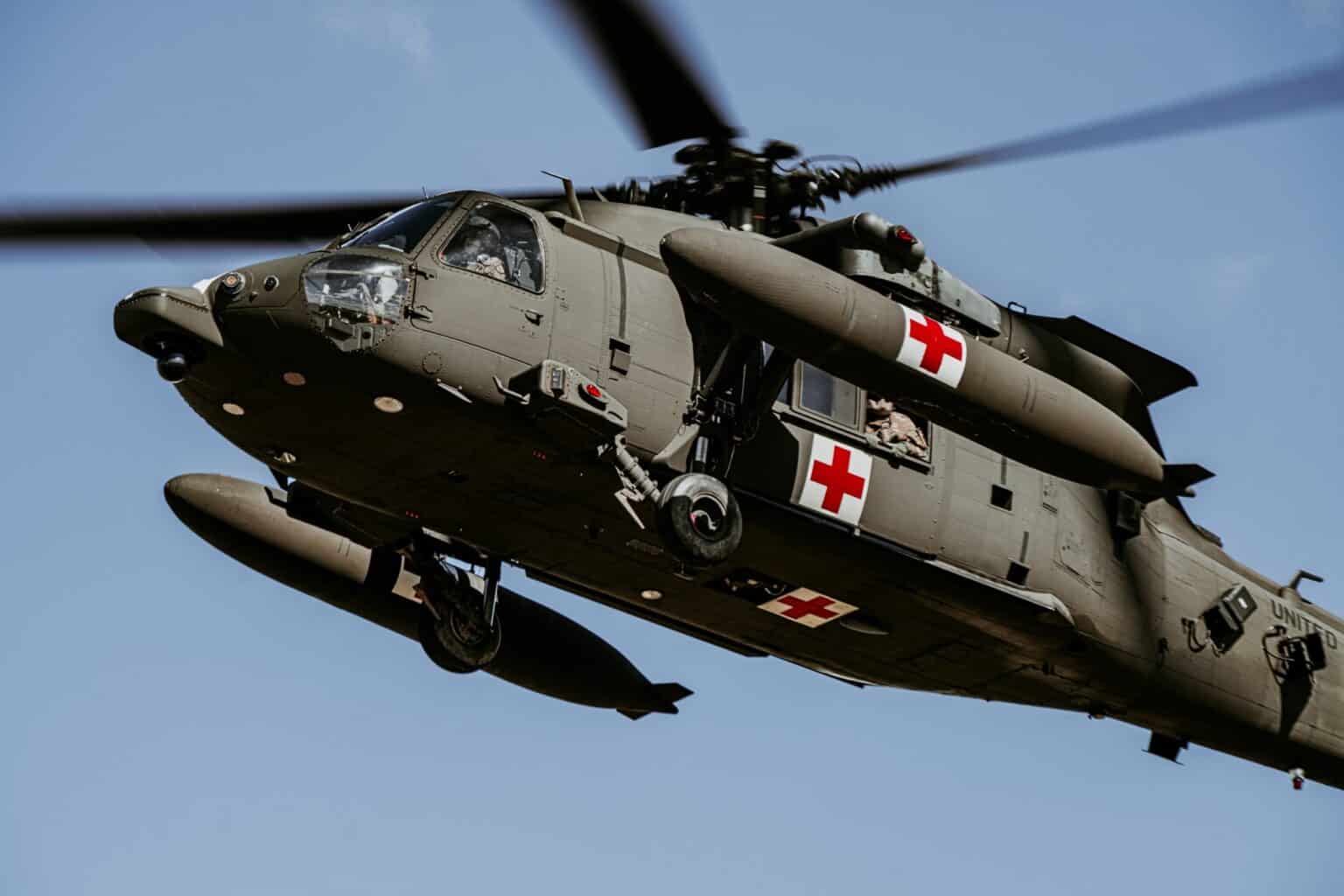
The US Army flies five helicopter families in 2026: the UH-60 Black Hawk, the AH-64 Apache, the CH-47 Chinook, the UH-72 Lakota and the special operations AH/MH-6M Little Bird. The Black Hawk is the backbone, with more than 2,000 in the fleet, more than every other Army helicopter type combined.
This list ranks them by how many the Army owns, using the Congressional Budget Office’s 2023 count and the Army’s FY2026 budget figures. A sixth aircraft, the MV-75 Cheyenne II tiltrotor, is being built now and is the biggest change to Army aviation in 40 years.
This page covers the Army alone. For every branch, sorted by role, see our guide to the types of military helicopters.
| Rank | Helicopter | Army role | Army fleet (approx.) | In Army service since |
|---|---|---|---|---|
| 1 | UH-60 Black Hawk (incl. HH-60M, MH-60M) | Utility, air assault, medevac | 2,000+ | 1979 |
| 2 | AH-64 Apache | Attack | 600 to 824 | 1986 |
| 3 | CH-47 Chinook (incl. MH-47G) | Heavy lift | About 500 | 1962 |
| 4 | UH-72 Lakota | Light utility, Guard, training | About 478 | 2007 |
| 5 | AH/MH-6M Little Bird | Special operations | 43 | Early 1980s |
| 6 | MV-75 Cheyenne II | Long-range assault tiltrotor | 0 (test aircraft in assembly) | First unit targeted for 2027 |
How this list works
Entries are ranked by the number of each type the Army owns, across the active Army, the National Guard and the Reserve. Fleet counts are rounded because the published figures come from different years and sources. Fixed-wing aircraft such as the C-12 Huron and drones such as the MQ-1C Gray Eagle are left out. The MV-75 is included because it is the Army’s next assault aircraft, but it ranks last because none has been delivered yet.
Helicopters make up most of the Army’s manned fleet. The CBO counted about 3,900 manned Army aircraft in 2023, down from nearly 5,000 in 2000, and the four big helicopter families account for the large majority of them.
1. UH-60 Black Hawk
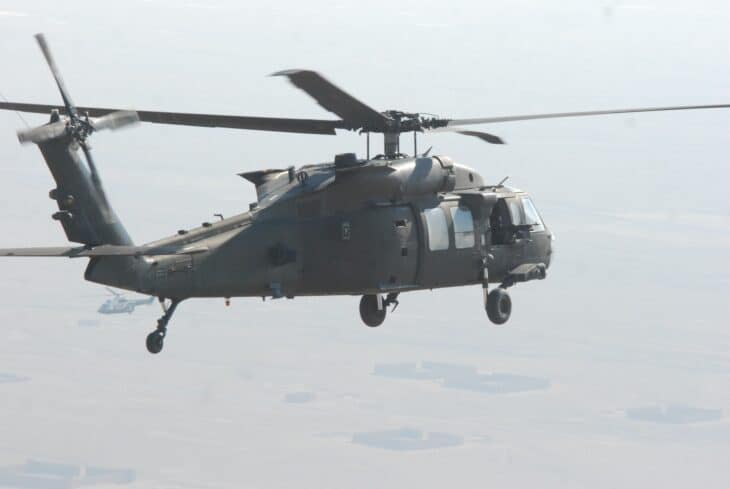

The Sikorsky UH-60 Black Hawk is the Army’s workhorse and its most numerous aircraft by a wide margin. The Army had fewer than 1,500 Black Hawks in 2000 and more than 2,000 by 2023, according to the CBO data.
It carries 11 seated troops or 6 stretchers inside, or up to 9,000 pounds (4,080 kg) on its cargo hook. Top speed is 159 knots (183 mph, 294 km/h). The prototype first flew on October 17, 1974, and the type entered service in 1979.
The Army flies several versions. The UH-60M is the current utility model, the HH-60M is the medevac version, and the MH-60M serves the 160th Special Operations Aviation Regiment. The older UH-60L is nearly gone from the active Army: the FY2026 budget request cuts it from 162 to 4 active aircraft while the UH-60M count rises from 338 to 393.
The Black Hawk ranks first because nothing else does as many jobs. It moves air assault troops, evacuates the wounded, hauls supplies and carries commanders, and the National Guard uses it for floods, wildfires and rescues at home.
An upgrade the Army walked away from
In February 2024 the Army ended production of the UH-60V, a digital-cockpit rebuild of older Black Hawks, citing cost growth. It chose to buy more new UH-60Ms instead. The FY2026 budget still lists 53 UH-60Vs in the active Army.
2. AH-64 Apache
.jpg)
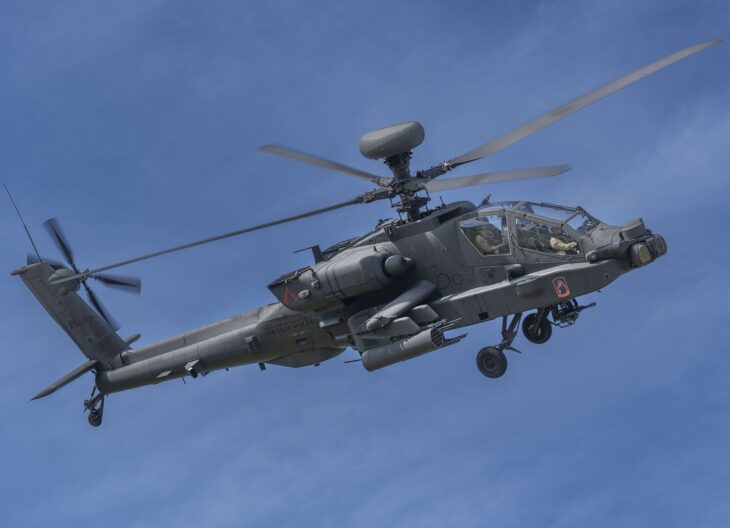
The Boeing AH-64 Apache is the Army’s only attack helicopter. A two-seat aircraft with a pilot and a copilot/gunner, it entered Army service in April 1986 and tops out at about 158 knots (182 mph, 293 km/h).
Fleet counts vary by source. The CBO data puts the Apache fleet at roughly 600 throughout 2000 to 2023, while FlightGlobal’s 2023 directory lists 824 AH-64D and AH-64E models. The difference likely comes down to what each count includes, so treat the Army fleet as somewhere in that range.
The fleet is shrinking. Under the 2025 Army Transformation Initiative, the Army is deactivating 11 air cavalry squadrons, most of them flying the older AH-64D. The FY2026 budget cuts active AH-64Ds from 120 to one residual battalion of 24, with full retirement expected by 2027.
The newer AH-64E Guardian stays, but active Army numbers fall from 408 in FY2025 to 240 in FY2026, with nearly half moving to the National Guard. The Army says those aircraft are being transferred, not retired. For how the Apache stacks up against foreign rivals, see our ranking of the best attack helicopters in the world.
3. CH-47 Chinook
.jpg)
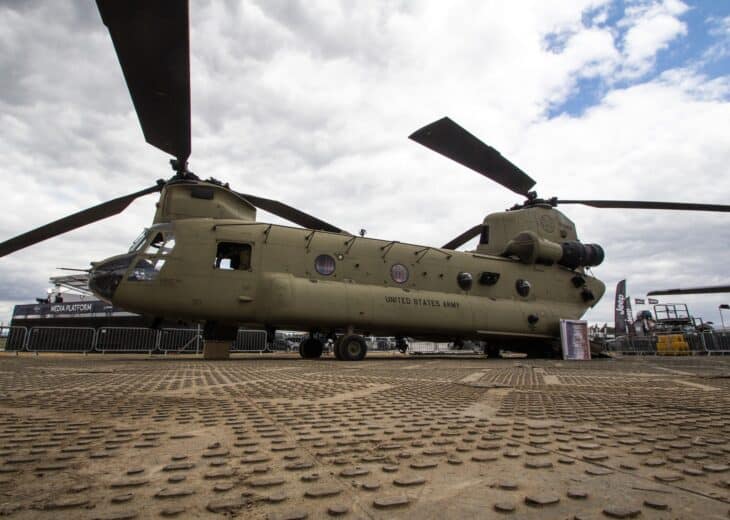
The Boeing CH-47 Chinook is the Army’s heavy lifter, easy to spot by its two tandem rotors. It has served since 1962, longer than any other Army helicopter, and reaches about 170 knots (196 mph, 315 km/h).
The Chinook fleet has held steady at roughly 500 since 2000, per the CBO data, and FlightGlobal’s 2023 directory counts 510, including the special operations MH-47G. Its crew of three carries troops, artillery and supplies that the Black Hawk cannot lift.
Unlike the Apache, the Chinook is growing. The FY2026 budget raises active Army Chinooks from 156 to 172, with 12 going to the 25th Infantry Division’s restructured aviation brigade, while the Guard keeps 156. The Army also kept funding the upgraded CH-47F Block II when it rebalanced its aviation budget in 2024.
The Chinook ranks third on numbers, but it is the one Army helicopter with no real substitute in sight. See where it sits among the heaviest-lifting helicopters in the world.
4. UH-72 Lakota
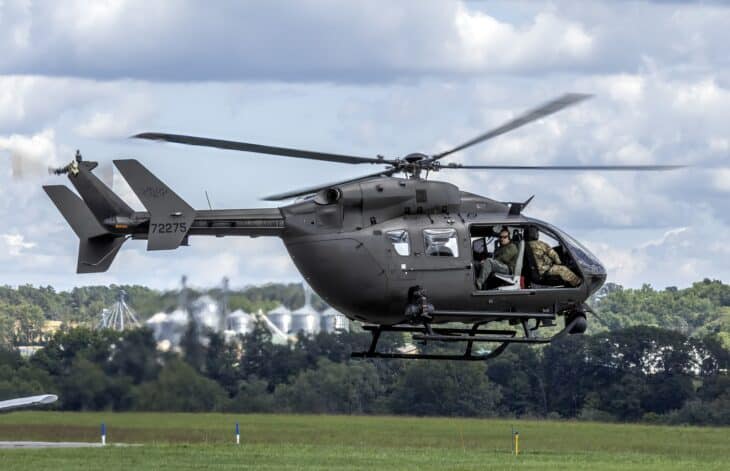

The UH-72 Lakota is a militarized version of the Airbus (formerly Eurocopter) EC145. It entered service in 2007 and carries 9 troops or 2 stretchers with a medical crew, at up to about 167 mph (268 km/h).
FlightGlobal’s 2023 directory lists 478 UH-72A and UH-72B Lakotas. They fly mostly stateside: National Guard missions, medevac and, above all, pilot training at Fort Rucker, Alabama, where the Army trains around 1,250 helicopter pilots a year on the Lakota.
The Lakota is still being bought. In mid-August 2026 the Army ordered 10 more UH-72Bs for the National Guard, with an option for 2 more, in a $115 million contract, and deliveries run from 2027 through 2029.
Its training role is ending, though. On August 13, 2026, the Army picked M1 Support Services for Flight School Next, a contractor-run program worth up to $10 billion over up to 26 years. Its plan centers on the civil Robinson R66, with a three- to four-year transition.
5. AH-6M and MH-6M Little Bird
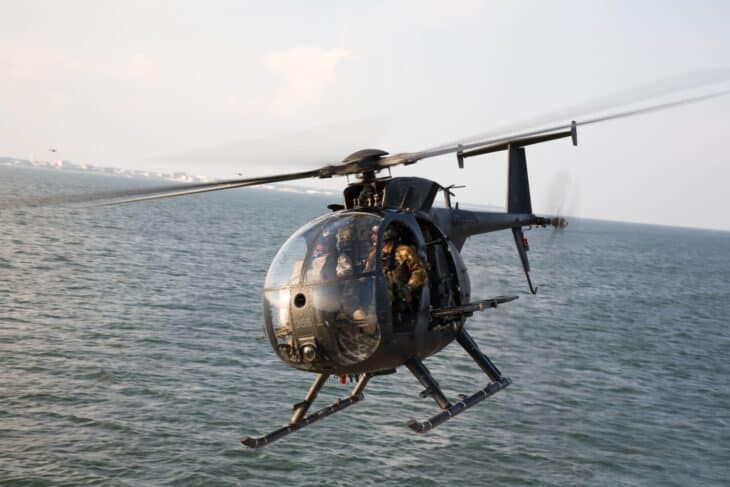

The MD Helicopters Little Bird is the smallest helicopter in the Army and the most specialized. FlightGlobal’s 2023 directory counts 43, and they are flown by the 160th Special Operations Aviation Regiment, the “Night Stalkers.”
It comes in two versions. The MH-6M carries up to six passengers, and the AH-6M is the armed version for close air support and escort. Both have a crew of two and a top speed of about 152 knots (175 mph, 282 km/h).
The Little Bird ranks fifth on numbers but punches far above them. Its small size lets it slip into landing spots too tight for a Black Hawk, which is why the special operations community has kept it flying since the early 1980s.
6. MV-75 Cheyenne II (coming next)


The MV-75 Cheyenne II is not a helicopter, strictly speaking. It is a tiltrotor, like the Marines’ Osprey, whose rotors tilt forward to fly like an airplane. The Army says it will fly roughly twice as fast and twice as far as the current fleet.
It grew out of the Bell V-280 Valor demonstrator, which first flew on December 18, 2017, and met its 280-knot (322 mph, 519 km/h) cruise target in January 2019. The Army picked Bell’s design in December 2022 for its Future Long-Range Assault Aircraft program.
The Army assigned the MV-75 designation in May 2025 and named it Cheyenne II on April 15, 2026, at the Army Aviation Association of America summit in Nashville. It is the first entirely new Army airframe since the 1980s.
Its schedule keeps moving earlier. In January 2026 the Army said it planned testing that year and fielding in 2027, about five years ahead of the original plan, and the 101st Airborne’s aviation brigade at Fort Campbell is expected to get the first aircraft. In April 2026, officials declined to commit to a first-flight date.
Why the name "Cheyenne II"
The original AH-56 Cheyenne was a 1960s Lockheed compound helicopter that hit 245 knots in a dive. Rotor vibration, rising costs and a fatal 1969 crash killed it, and the Army terminated the program in 1972. The attack mission it was built for went to the Apache.
As of mid-October 2026, Bell is assembling the first six test aircraft in Wichita, Kansas, and no MV-75 had been reported flying. It will take over a significant portion of Black Hawk missions, including some of the 160th’s MH-60Ms, though the Army says no existing type is being dropped because of it.
Retired and canceled Army helicopters
Several famous names are no longer on the list. The UH-1 Huey left active Army service in early 2005, and the National Guard flew its last ones a few years later as the Lakota arrived.

The OH-58D Kiowa Warrior scout performed its last live-fire exercise in January 2017 before retirement, and its armed reconnaissance job passed to Apaches. The Huey and the Kiowa also flew in large numbers over Vietnam, as our guide to the helicopters of the Vietnam War shows.
The Kiowa’s planned successor never came. The Army canceled the Future Attack Reconnaissance Aircraft program in February 2024 after spending more than $2 billion on it, and shifted money toward drones and the MV-75.


What about the Osprey and the Seahawk?
Neither is an Army aircraft. The V-22 Osprey belongs to the Marines, Air Force and Navy, and the MH-60R Seahawk is a Navy helicopter built on the Black Hawk airframe. The Marines also fly their own AH-1Z Viper and UH-1Y Venom, which the Army does not use. The Army’s tiltrotor will be the MV-75.
For the Marine side of the story, see our list of every US Marine Corps helicopter.
Why Army helicopters have tribal names
Army helicopters carry Native American names by tradition. It began in 1947, when Gen. Hamilton Howze wanted names that described what helicopters could do, and the H-13 became the Sioux.
Army Regulation 70-28 made the rule formal in 1969, calling for names of American Indian tribes and chiefs. The regulation has since been rescinded, but the custom continues: Apache, Black Hawk, Chinook, Kiowa, Lakota and now Cheyenne II all came from it.
FAQ
Sources and references used for research and fact-checking.
- Defense News, Report shows a smaller US Army aircraft fleet with fewer flying hours
- Wikipedia, List of active United States military aircraft (Army section)
- FW Magazine, The evolution of US Army Aviation: modernisation plans for 2026
- The War Zone, Army punches its MV-75 tiltrotor program into overdrive
- Breaking Defense, Army introduces MV-75 as Cheyenne II, won't commit to first flight, production dates
- Military.com, Army names new helicopter the MV-75 Cheyenne II, honoring the Plains Tribes
- The Aviationist, US Army cancels Future Armed Reconnaissance Aircraft program
- Military Times, Army shifts helicopter training to a contractor-run model
- Aviation News EU, Airbus secures $115 million US Army contract for up to 12 new UH-72B Lakota helicopters
- Wikipedia, Sikorsky UH-60 Black Hawk
- Wikipedia, Boeing AH-64 Apache
- Wikipedia, Boeing CH-47 Chinook
- Wikipedia, Eurocopter UH-72 Lakota
- Wikipedia, MD Helicopters MH-6 Little Bird
- Wikipedia, Bell UH-1 Iroquois
- Wikipedia, Bell OH-58 Kiowa
Get the Newsletter
The latest aviation news and stories sent to your inbox.
About the Author

Tim is the owner and lead editor of AeroCorner since 2019, overseeing aviation content covering aircraft, airlines, airports, and the broader aviation industry. Through years of researching, writing, editing, and publishing aviation-focused content, he has developed extensive practical knowledge of commercial aviation and air travel. Based in Asia and a frequent traveler himself, Tim also brings firsthand passenger experience to AeroCorner’s coverage. Outside of publishing, he has also explored aviation firsthand through hands-on flight training in New Zealand.