

Table of Contents
The biggest helicopter ever flown is the Soviet Mil V-12, which had a maximum takeoff weight of 231,485 pounds (105,000 kg). Only two were built, and neither entered service.
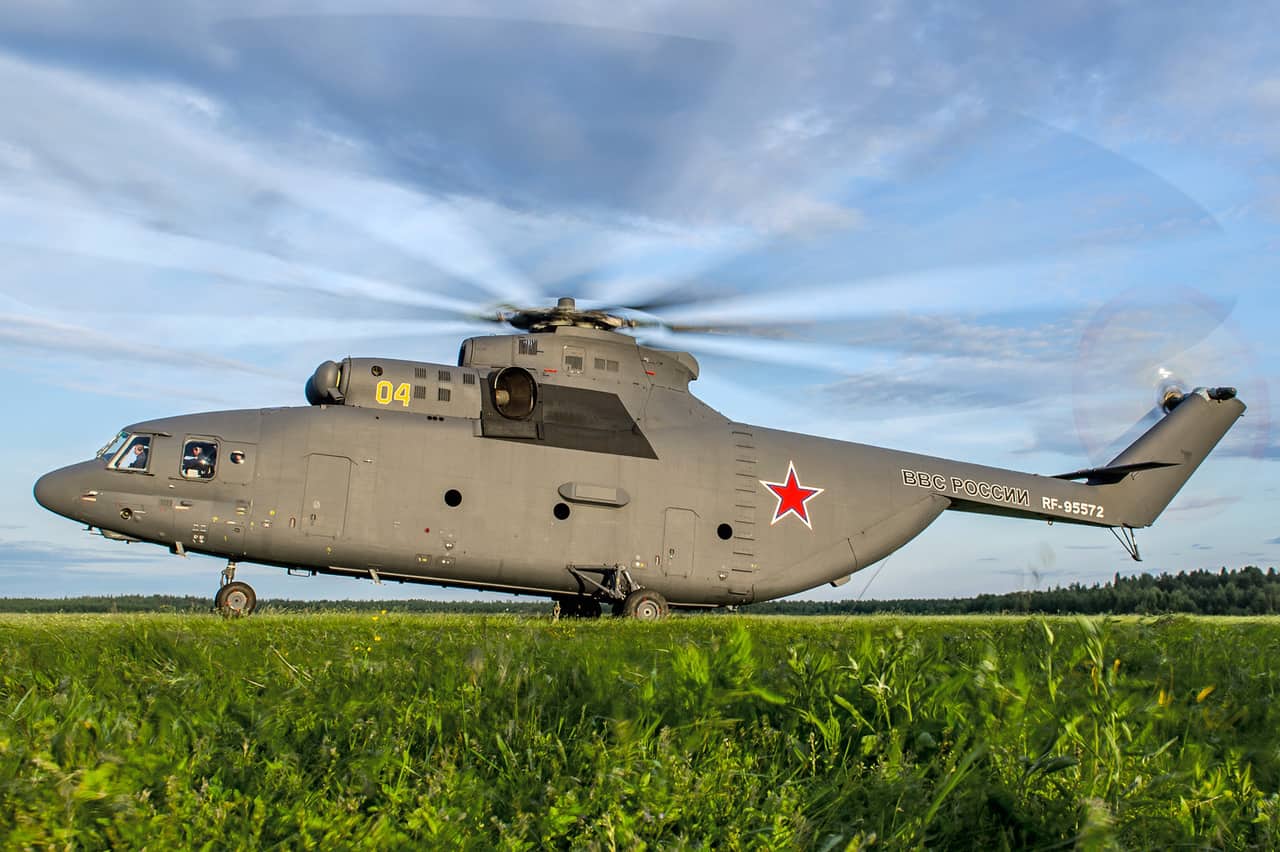
The biggest helicopter you can actually watch fly today is the Mil Mi-26, rated at 123,459 pounds (56,000 kg). It is the largest helicopter ever to reach serial production, and nothing built in the West comes close.
This list ranks helicopters by maximum takeoff weight, the total the aircraft is certified to lift off with. It is the one figure that settles a size argument, because rotor diameter and cabin length can each crown a different winner.
| Rank | Helicopter | Max takeoff weight | Rotor diameter | Status |
|---|---|---|---|---|
| 1 | Mil V-12 (Mi-12) | 231,485 lb (105,000 kg) | 219 ft 10 in across both rotors | Prototype, 2 built |
| 2 | Mil Mi-26 | 123,459 lb (56,000 kg) | 105 ft (32 m) | In service |
| 3 | Mil Mi-6 | 97,003 lb (44,000 kg) | 114 ft 10 in (35 m) | Retired 2002 |
| 4 | Mil Mi-10 | 96,342 lb (43,700 kg) | 114 ft 10 in (35 m) | Largely retired |
| 5 | Sikorsky CH-53K King Stallion | 88,000 lb (39,916 kg) | 79 ft (24.1 m) | In service |
| 6 | Sikorsky CH-53E Super Stallion | 73,500 lb (33,339 kg) | 79 ft (24.1 m) | In service |
| 7 | Boeing CH-47F Chinook Block II | 54,000 lb (24,494 kg) | 60 ft (18.3 m), twin rotors | In service |
| 8 | Sikorsky S-64 Skycrane | 42,000 lb (19,051 kg) | 72 ft (21.9 m) | In civil service |
| 9 | AgustaWestland AW101 | 34,392 lb (15,600 kg) | 61 ft (18.59 m) | In service |
| 10 | Changhe Z-18 | 30,360 lb (13,800 kg) | 62 ft 4 in (19 m) | In service |
How this ranking works
Every entry is ranked by maximum takeoff weight, the certified all-up weight including the airframe, fuel, crew and load. Retired types and prototypes are included and labelled, because a list of the biggest helicopters that quietly drops the biggest one ever built is not answering the question. Tiltrotors such as the V-22 Osprey are excluded: they take off on rotors but cruise on wings, and they are a separate class of aircraft.
1. Mil V-12 (Mi-12), 231,485 lb
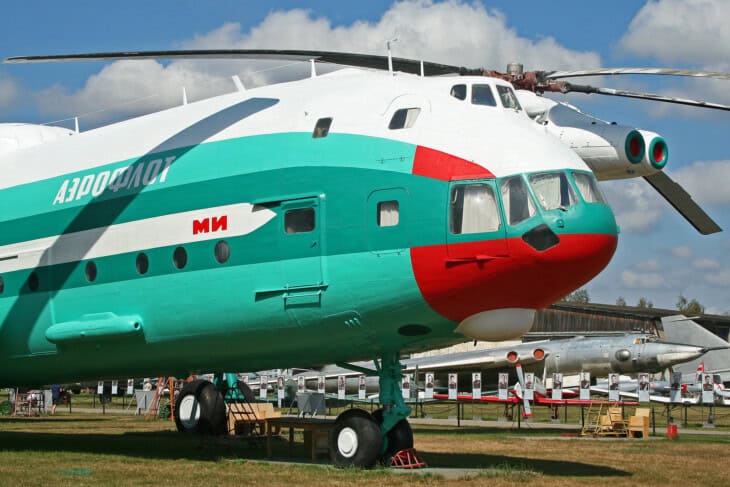
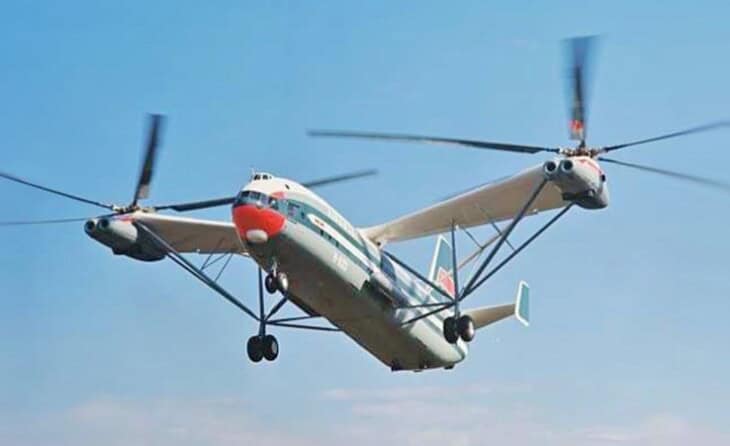
The V-12 is the largest helicopter ever built, and it is not a close contest. Its maximum takeoff weight of 231,485 pounds (105,000 kg) is nearly double that of the Mi-26 in second place.
Rather than one enormous rotor, the V-12 carried two rotor systems on outriggers, side by side, spanning 219 feet 10 inches (67 m) from tip to tip. That is wider than the wingspan of most airliners.
It first flew successfully on 10 July 1968, after an unsuccessful attempt in June 1967. Only two prototypes were completed.
The program died because its reason for existing did, namely the rapid deployment of heavy strategic ballistic missiles. Both airframes survive, one at the Mil plant near Moscow and one on display at the Central Air Force Museum.
A record that has stood since 1969
On 6 August 1969 the V-12 lifted 97,455 pounds (44,205 kg) to a height of 7,398 feet (2,255 m). No helicopter has lifted more in the 57 years since, and the two aircraft that could do it were both museum pieces before most of today’s pilots were born.
2. Mil Mi-26, 123,459 lb


The Mil Mi-26 is the largest helicopter ever to go into serial production, and the largest in service anywhere. Its maximum takeoff weight is 123,459 pounds (56,000 kg).
It carries 44,000 pounds (20,000 kg) of cargo, or 90 troops, or 60 stretchers. Two Progress D-136 turboshafts deliver 11,400 hp each, turning a 105-foot (32 m) eight-blade main rotor.
That payload is the part worth pausing on. The Mi-26 can lift more cargo than most of the entries below this line weigh empty, which is why it keeps appearing on heavy lift helicopter shortlists decades after it entered service in 1983.
More than 300 had been built as of 2015. It remains in military service with Russia, Algeria, Jordan and several other operators, alongside civil examples in Russia and China.
3. Mil Mi-6, 97,003 lb
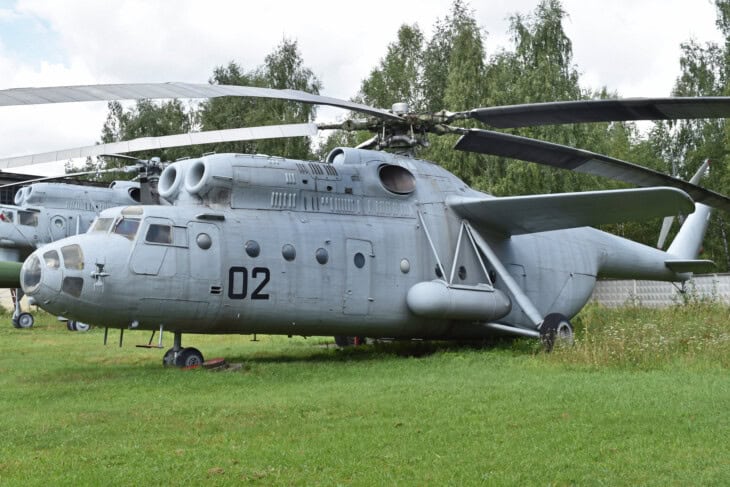
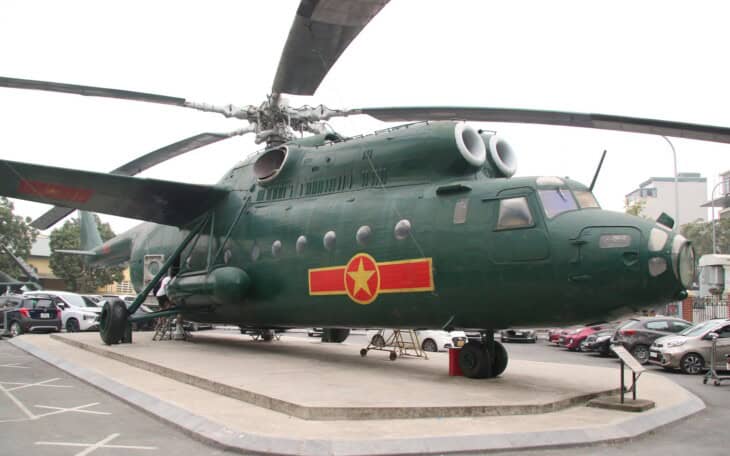
Before the Mi-26 there was the Mi-6, and for more than two decades it was the biggest helicopter in production anywhere in the world. Maximum takeoff weight was 97,003 pounds (44,000 kg).
It first flew on 5 June 1957 and carried up to 26,455 pounds (12,000 kg) internally, or 70 airborne troops. Its 114-foot 10-inch (35 m) rotor is still larger than anything Sikorsky has built.
The Mi-6 was also genuinely fast for its size, with a top speed of 190 mph (300 km/h). It held the record as the world’s fastest helicopter, and as of 2013 it still held the world record for the fastest five-tonne lift over 1,000 km, set in 1962.
A total of 926 were built between 1959 and 1980. The type was finally retired in October 2002 when its type certificate was withdrawn, which is why it appears here as history rather than hardware. These Russian helicopter designs dominate the top of this list for a reason.
4. Mil Mi-10, 96,342 lb
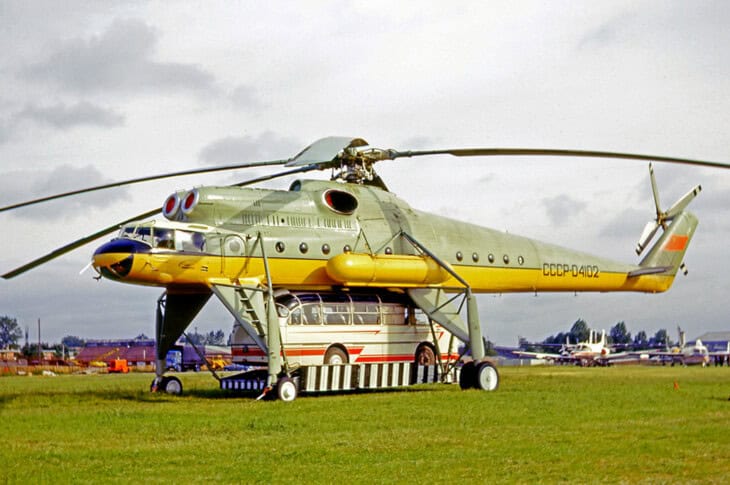
The Mi-10 is the Mi-6 reworked into a flying crane, and it is the strangest looking aircraft on this list. Maximum takeoff weight was 96,342 pounds (43,700 kg).
It kept the Mi-6 rotor system and engines but replaced the fuselage with a slender body on tall stilt landing gear, so a load could be rolled underneath and clamped on. It could carry up to 15 tonnes on a platform.
First flight was 15 June 1960, and only 55 were built across both versions. Most were retired by 2009, though the short-legged Mi-10K was still working as of 2014.
5. Sikorsky CH-53K King Stallion, 88,000 lb


The CH-53K King Stallion is the largest and most powerful helicopter built outside Russia, with a maximum gross weight of 88,000 pounds (39,916 kg). It is the biggest helicopter the US military operates.
Three General Electric T408 engines produce 7,500 shaft horsepower each, turning a seven-blade rotor 79 feet (24.1 m) across. Lockheed Martin states that the combined power lifts three times the load of the CH-53E it replaces.
It carries 36,000 pounds on the centre hook and up to 35,000 pounds internally. The cabin is 30 feet long, wide enough for 463L pallets and for a Humvee to be driven aboard.
Initial operational capability came on 22 April 2022, and it serves with US Marine Corps heavy helicopter squadrons. It is the only helicopter in the top five that is both new and getting more numerous.
The most powerful helicopter is not the biggest one
The CH-53K is routinely called the most powerful helicopter in the world, and by installed power per airframe that holds up. It is still 35,459 pounds lighter at maximum weight than the Mi-26, a design that first flew in 1977. Power and size are not the same ranking.
6. Sikorsky CH-53E Super Stallion, 73,500 lb
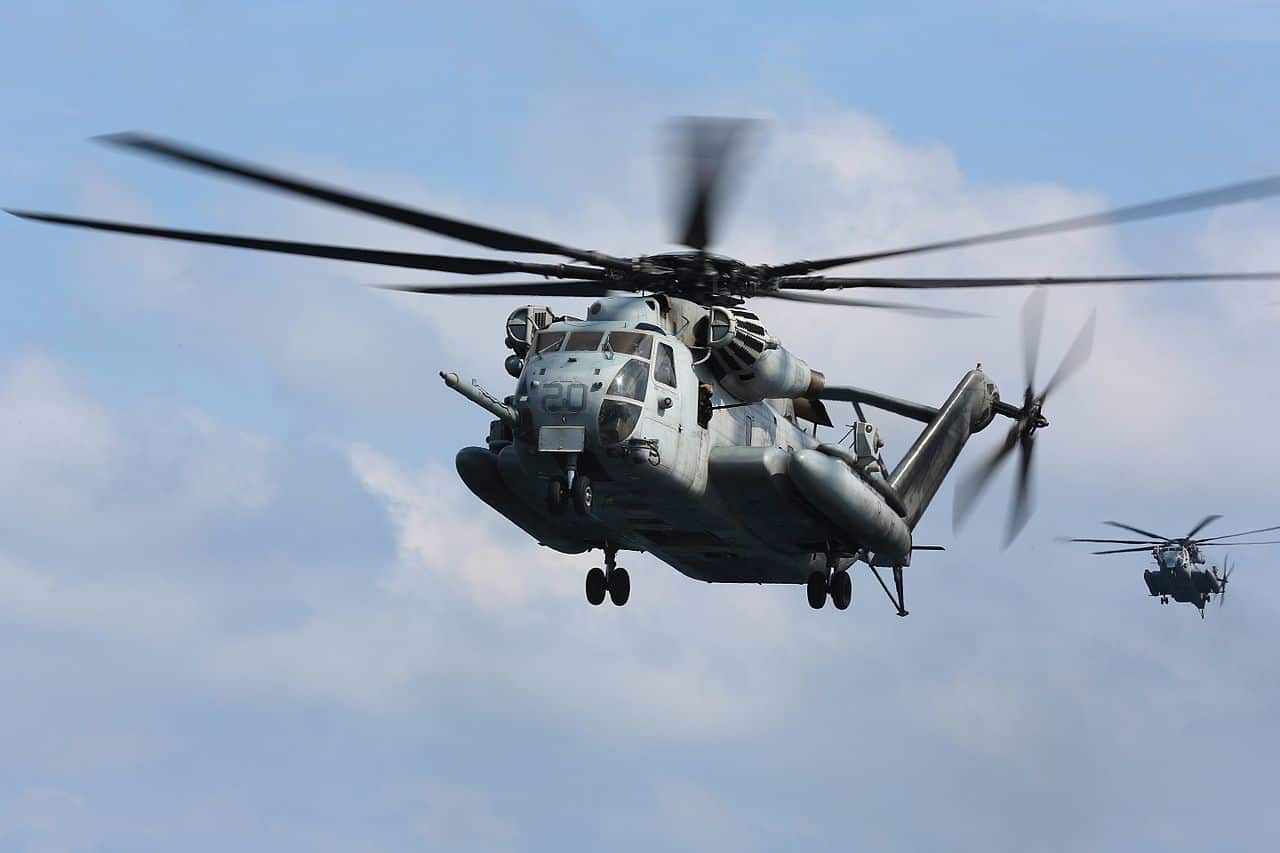
The CH-53E Super Stallion held the title of largest helicopter outside Russia until the King Stallion arrived. Maximum takeoff weight is 73,500 pounds (33,339 kg).
Three General Electric T64 turboshafts of 4,380 shp each drive the same 79-foot (24.08 m) rotor diameter as the CH-53K. It lifts 36,000 pounds externally and 32,000 pounds internally.
Roughly 172 were built. The fleet passed one million flight hours in 2019 and is planned to serve into the 2030s while the CH-53K takes over.
7. Boeing CH-47F Chinook, 54,000 lb
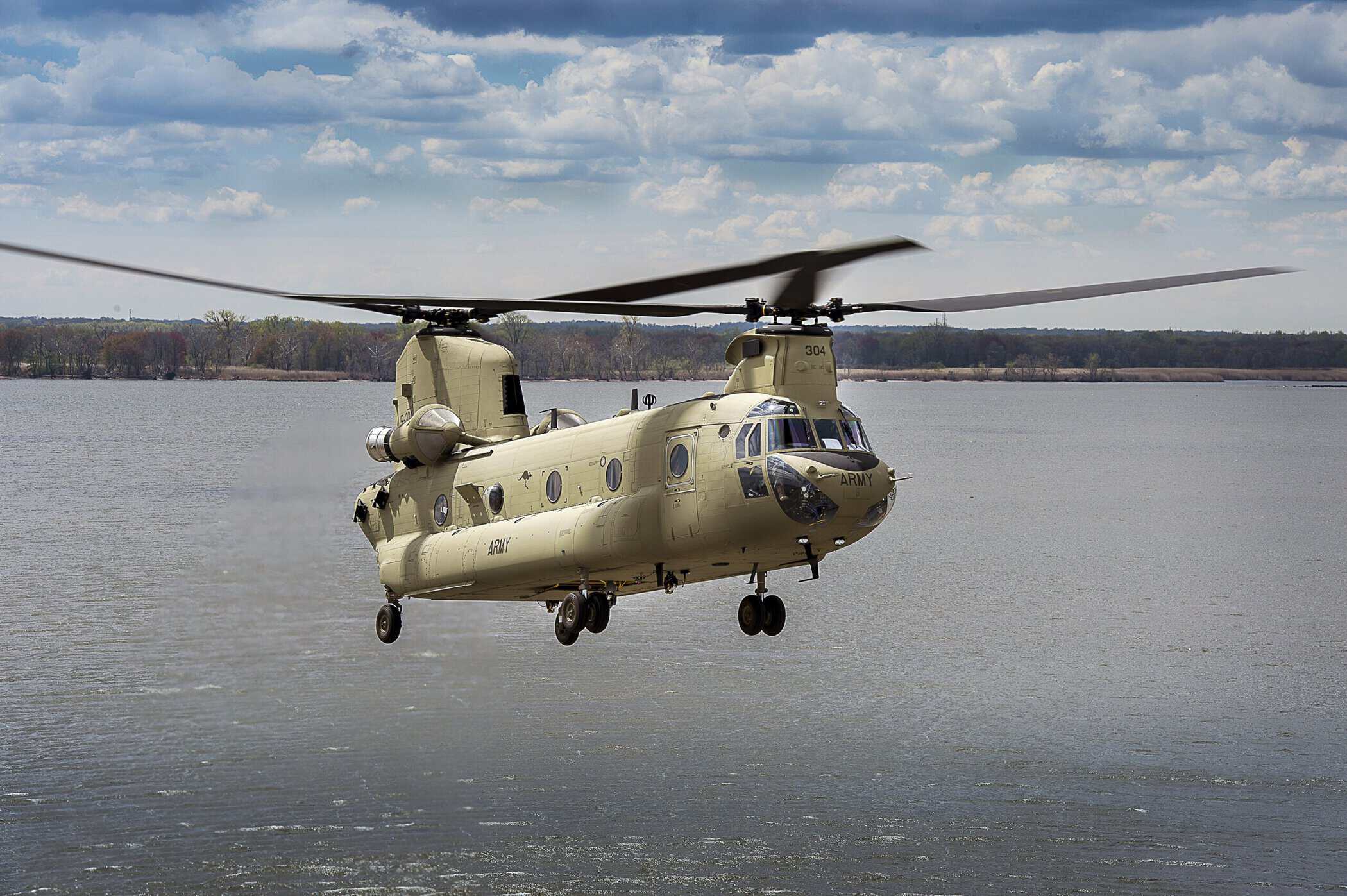
The CH-47F Chinook is the heaviest lifter in the US Army and the only tandem-rotor design in the top ten. Boeing lists the Block II at a maximum gross weight of 54,000 pounds (24,494 kg).
Instead of one large rotor and a tail rotor, it uses two 60-foot (18.3 m) rotors turning in opposite directions. Both rotors make lift, which is why the Chinook punches above its dimensions.
Two Honeywell T55 engines give 4,777 shaft horsepower each, for a maximum speed of 170 knots and a useful load of 27,700 pounds (12,565 kg). The fuselage is only 51 feet 2 inches long.
The original CH-47 first flew on 21 September 1961 and more than 1,200 had been built by 2012. It is the oldest design here still in production, which tells you how well the layout works.
8. Sikorsky S-64 Skycrane, 42,000 lb

The S-64 Skycrane, known in US Army service as the CH-54 Tarhe, is a flying crane with no cargo cabin at all. Maximum takeoff weight is 42,000 pounds (19,051 kg).
It carries 20,000 pounds (9,100 kg), which is close to half its own maximum weight, on a spine slung between tall main gear legs. Two Pratt and Whitney turboshafts of 4,500 shp each turn a 72-foot rotor.
The prototype first flew on 9 May 1962 and about 100 were built. The type certificate passed to Erickson in 1992, and the aircraft now fights fires with tanks holding up to 2,650 gallons.
9. AgustaWestland AW101, 34,392 lb
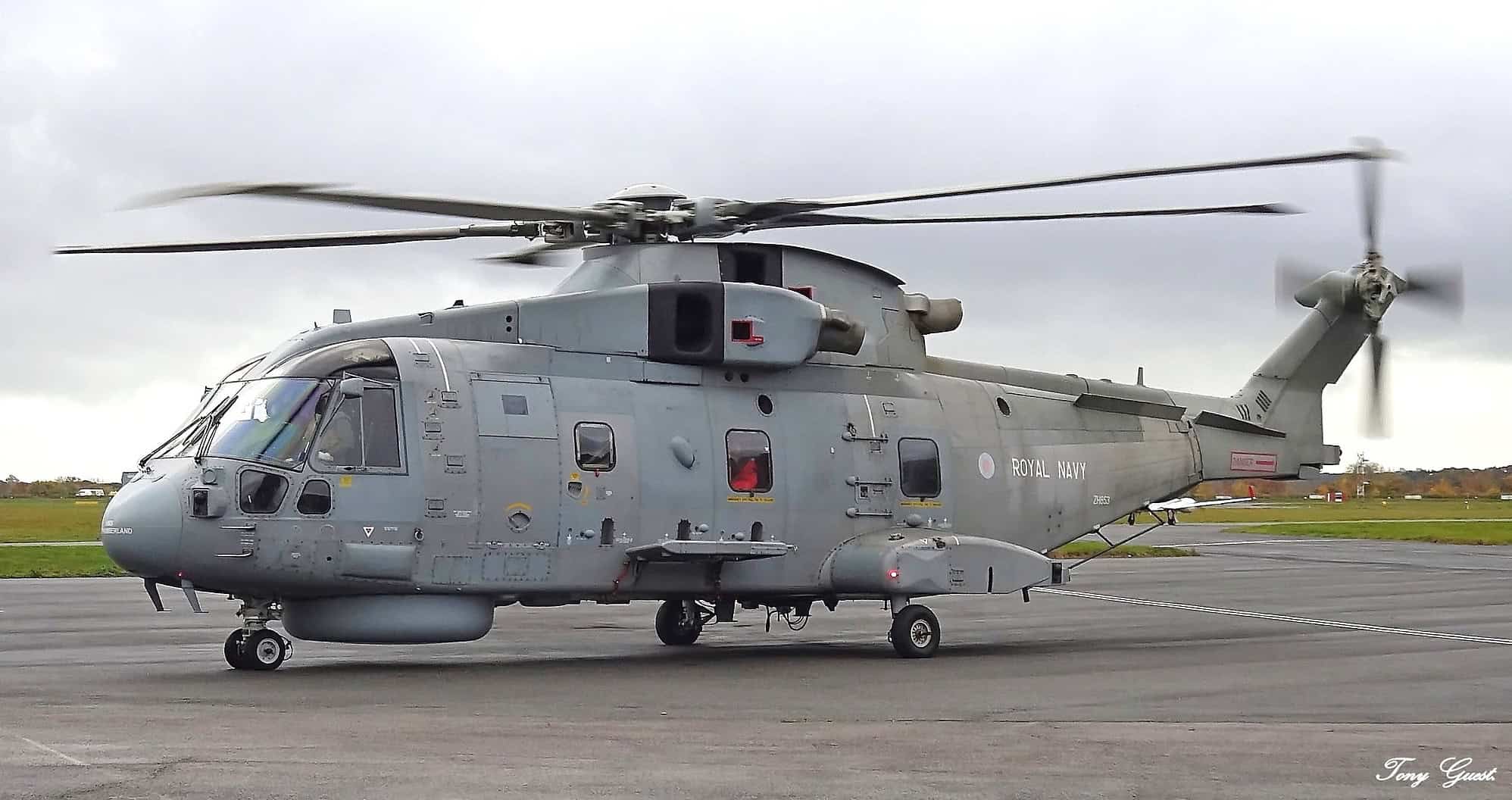
The AgustaWestland AW101, called the Merlin in British service, is the largest helicopter in widespread European use. Higher gross weight variants such as the Danish aircraft are rated at 34,392 pounds (15,600 kg).
Three turboshafts drive a five-blade rotor 61 feet (18.59 m) across. It carries 24 seated or 45 standing troops, and 11,990 pounds (5,440 kg) on the cargo hook.
More than 180 had been sold by 2009, and it flies with the Royal Navy, the Italian Navy, Canada, Denmark, Norway, Japan and others. Its three-engine layout is unusual in this weight class and is what makes it acceptable for long over-water search and rescue.
10. Changhe Z-18, 30,360 lb
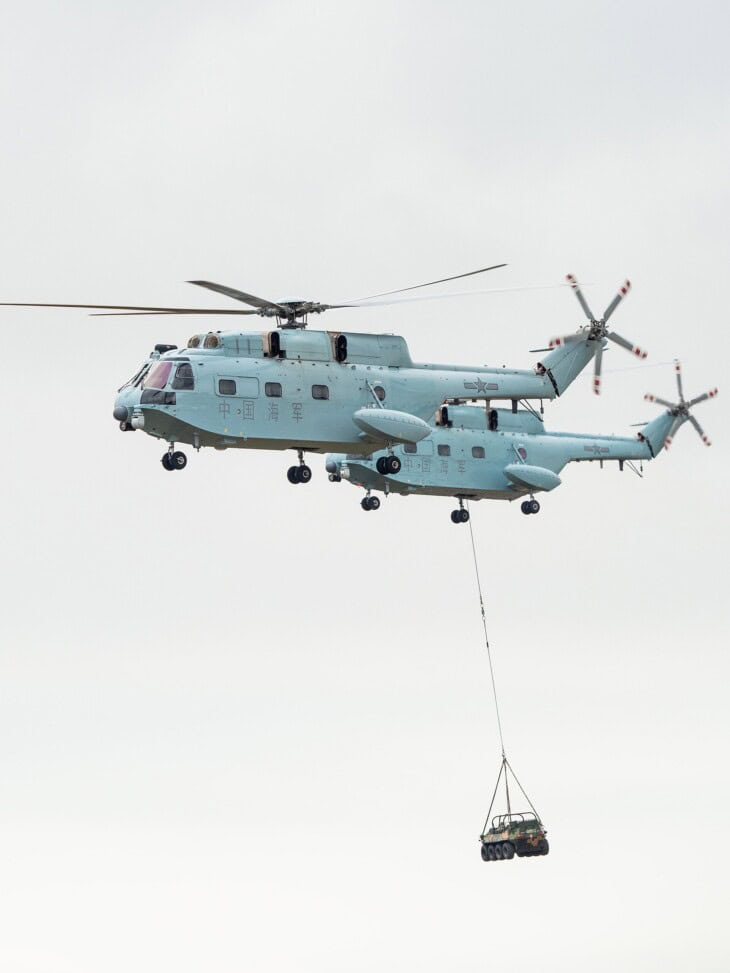
The Changhe Z-18 is the largest helicopter China has put into service, at a maximum takeoff weight of 30,360 pounds (13,800 kg). It rounds out the top ten.
It carries between 27 and 30 troops, or 15 stretchers, or five tonnes of cargo out to around 620 miles (1,000 km). The rotor is 19 m across and overall length with rotors turning is 75 feet 7 inches.
Its most interesting number is its service ceiling of 29,528 feet (9,000 m), which it reached during high-altitude testing over the Tibetan Plateau in January 2015. That is roughly the height of Everest, and it matters for a country with a long high-altitude border.
What about the V-22 Osprey?

The V-22 Osprey is usually the first aircraft readers ask about, and it is deliberately not ranked above. It is a tiltrotor, the world’s first production tiltrotor, not a helicopter.
It takes off vertically on two 38-foot rotors, then rotates them forward and flies on its wing like a turboprop. Including it in a helicopter ranking would be like ranking a seaplane among boats.
Three claims about big helicopters that are wrong
The CH-53K is not the biggest helicopter in the world. It is the most powerful one built outside Russia, and its 88,000 lb maximum weight is well short of the Mi-26’s 123,459 lb. The Mi-8 is not one of the biggest either, despite appearing on many such lists: at 28,660 lb it is roughly a quarter of the Mi-26, and it is famous for being the most-produced helicopter in history, not the largest. And no helicopter has ever beaten the V-12’s 1969 lift record, including every aircraft flying today.
The helicopters that did not make the list
Several aircraft that appear on other big helicopter lists are simply not big enough under a weight measure. The Mil Mi-8 tops out at 28,660 pounds (13,000 kg), and the NH90 and Eurocopter EC725 sit lower still.
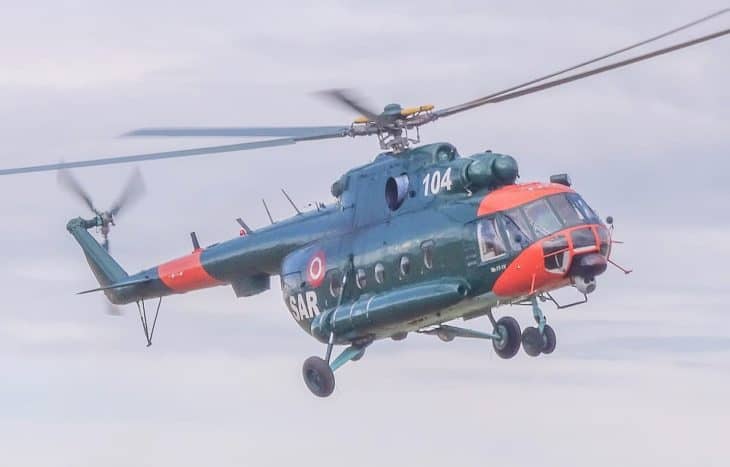
Those are excellent medium transports, and the Mi-8 in particular is the most-produced helicopter ever built, with more than 17,000 made. Ubiquity is not size.
If you are interested in what these machines can actually carry rather than what they weigh, that is a different ranking, covered in how much a helicopter can lift. For the wider picture across every category of aircraft, see the biggest aircraft in the world, and for a breakdown by role rather than size, see the types of military helicopters.
FAQ
Sources and references used for research and fact-checking.
- Wikipedia, Mil V-12
- Wikipedia, Mil Mi-26
- Wikipedia, Mil Mi-6
- Wikipedia, Mil Mi-10
- Wikipedia, Sikorsky CH-53K King Stallion
- Lockheed Martin, CH-53K King Stallion
- This Day in Aviation, Sikorsky CH-53K King Stallion
- Wikipedia, Sikorsky CH-53E Super Stallion
- Boeing, H-47 Chinook
- Wikipedia, Boeing CH-47 Chinook
- Wikipedia, Sikorsky S-64 Skycrane
- Wikipedia, AgustaWestland AW101
- Wikipedia, Changhe Z-18
- Wikipedia, Mil Mi-8
- Wikipedia, Bell Boeing V-22 Osprey
- Wikipedia, Aerospatiale SA 315B Lama
- Wikipedia, Didier Delsalle
- Russia Beyond, What means of transport does Putin have at his disposal?
Get the Newsletter
The latest aviation news and stories sent to your inbox.
About the Author

Tim is the owner and lead editor of AeroCorner since 2019, overseeing aviation content covering aircraft, airlines, airports, and the broader aviation industry. Through years of researching, writing, editing, and publishing aviation-focused content, he has developed extensive practical knowledge of commercial aviation and air travel. Based in Asia and a frequent traveler himself, Tim also brings firsthand passenger experience to AeroCorner’s coverage. Outside of publishing, he has also explored aviation firsthand through hands-on flight training in New Zealand.