Military Helicopters
MD 500 MG Defender
ICAO: H500
The Night Stalkers' rooftop helicopter, built on a civilian MD 530F.
Updated: by Tim de Vries
The latest aviation news and stories sent to your inbox.
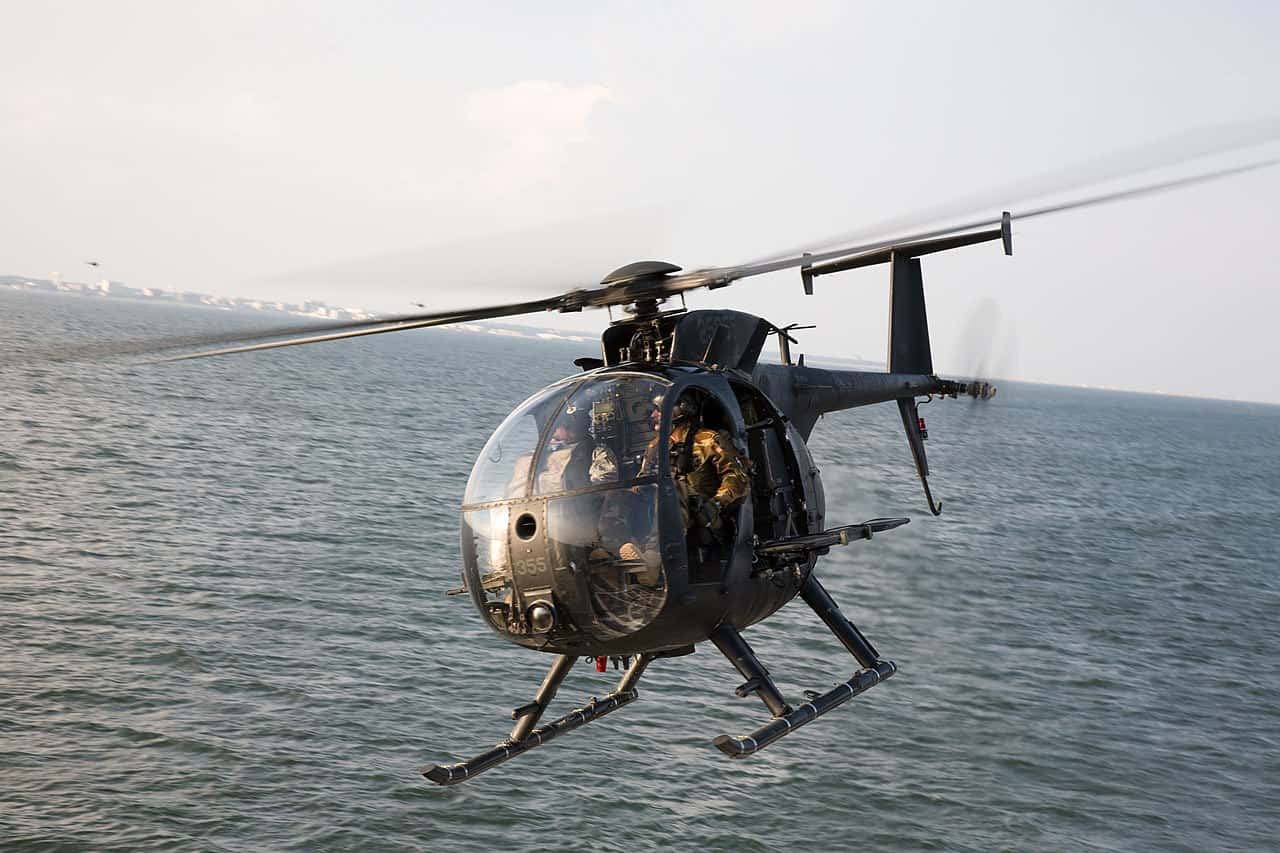
The MD MH-6M Little Bird is a light special operations helicopter flown in the U.S. military only by the Army’s 160th Special Operations Aviation Regiment, the Night Stalkers. Built on the civilian MD 530F airframe, it carries up to six operators on external benches and lands on rooftops, streets and ship decks too tight for larger helicopters. SOCOM’s MH-6R upgrade is planned to give the fleet new fuselages to keep it flying into the 2030s.



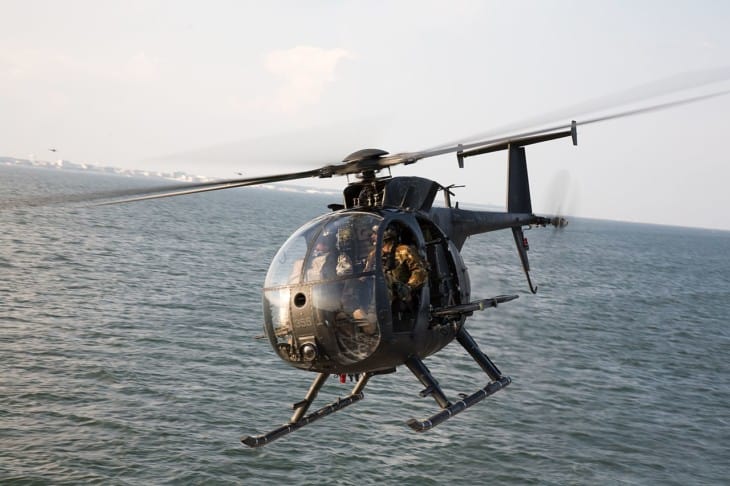
The MD MH-6M Little Bird is a light special operations helicopter flown by the U.S. Army’s 160th Special Operations Aviation Regiment, the Night Stalkers. Its job is to put small teams of special operators exactly where they need to be: a rooftop, a narrow street, a ship’s deck, or a clearing too tight for anything bigger.
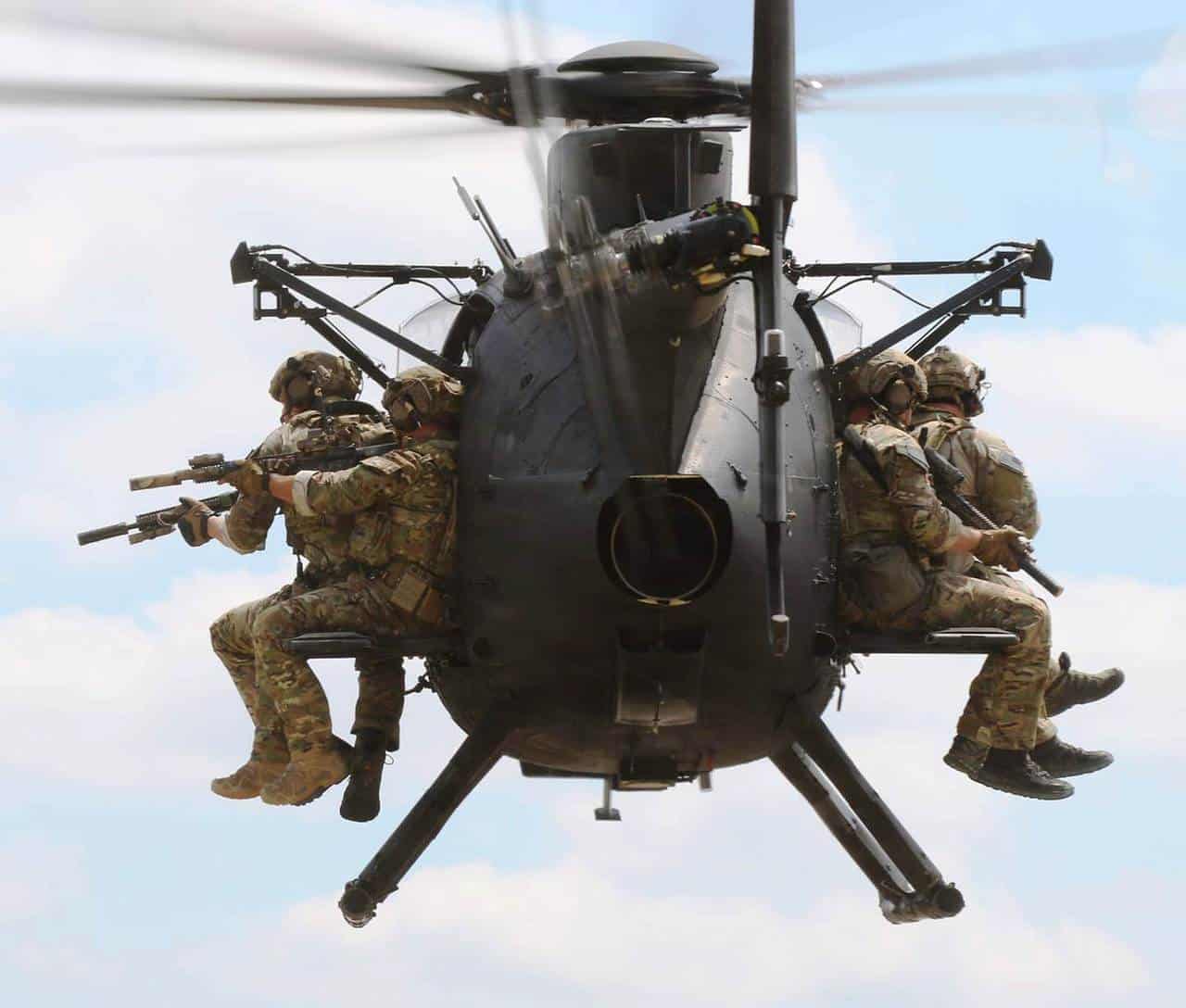
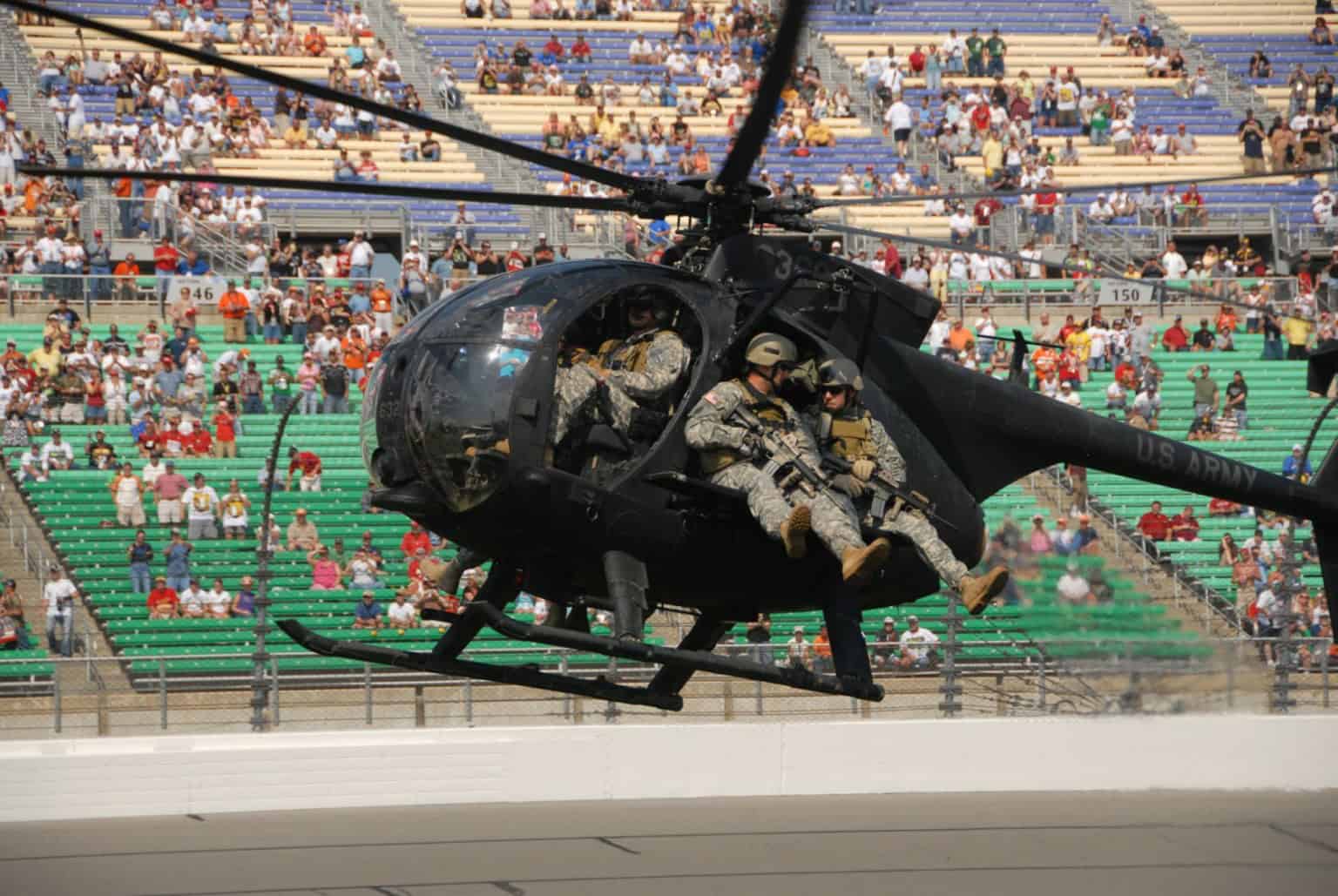
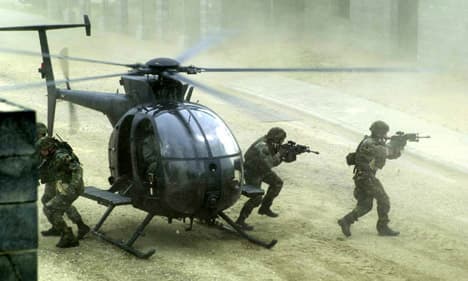
It carries them on the outside. Instead of a cabin full of troops, the MH-6M seats up to six operators on fold-down benches, or “planks,” along the fuselage, three on each side, so they can step off the moment the skids touch.
The operators ride strapped to those benches, the same principle behind why soldiers do not fall out of open helicopters.
The Night Stalkers are the only unit in the U.S. military that flies H-6 series helicopters. Its egg-shaped fuselage earned it the nickname “Killer Egg,” and its size is the point: it lands in places too confined for a Black Hawk or a Chinook.
The Little Bird started life as the Hughes OH-6 Cayuse, the Army’s light observation helicopter. Hughes built it as the Model 369, and the first prototype flew on February 27, 1963.
The Cayuse was among the helicopters the Army flew in Vietnam, where pilots nicknamed it the “Loach,” after the LOH (light observation helicopter) program that produced it.
Its second career began with a failure. After the April 1980 collapse of Operation Eagle Claw, the attempt to rescue the American hostages in Iran, the Army concluded it lacked aircraft and crews prepared for special operations and began building a dedicated aviation task force.
That task force wanted a small helicopter that could land in the most restrictive places and fit aboard Air Force transports. It chose the OH-6A, which became known as the Little Bird next to the UH-60A and CH-47C helicopters in the same unit.
The planned second rescue attempt, Operation Credible Sport, was canceled when the hostages were released on January 20, 1981. The Army kept the unit anyway: Task Force 158 became the 160th Special Operations Aviation Regiment, the transport OH-6As became MH-6s, and the armed ones became AH-6s.
The 160th flies the Little Bird in two configurations. The MH-6M is the unarmed light assault version, built to insert and extract special operations forces, and it can also fly reconnaissance.
Besides the planks, an MH-6M can carry a fast rope insertion and extraction system (FRIES) for roping a team onto a roof, a winch, or racks for up to two motorcycles.
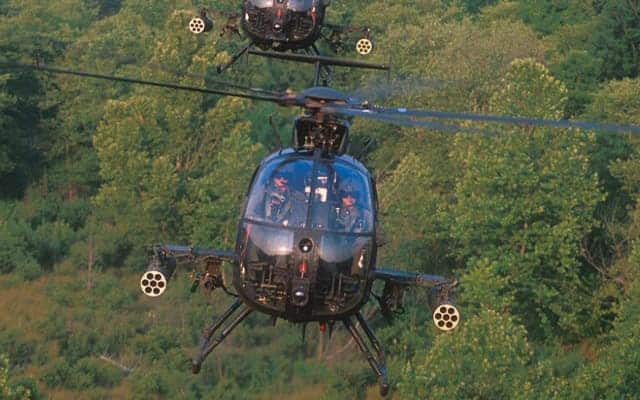
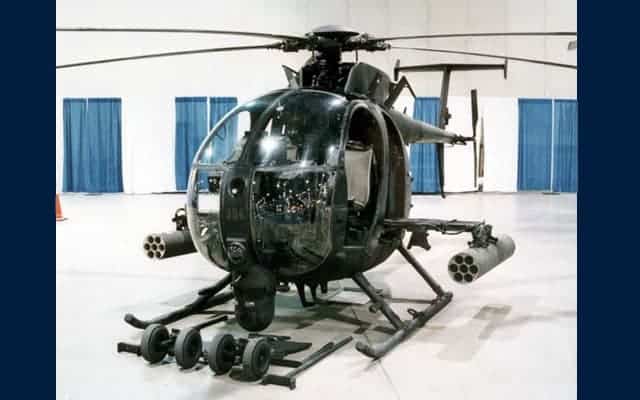
The AH-6M is the light attack version. It swaps the planks for weapon pylons carrying combinations of M134 7.62 mm miniguns, GAU-19 .50-caliber Gatling guns, 2.75-inch (70 mm) rocket pods, and AGM-114 Hellfire missiles.
That makes it a lightweight alternative to dedicated attack helicopters such as the AH-64 Apache. SOCOM’s product manager for the type calls it the special operators’ “street fighter,” built for surgical, precision attack.
Underneath, the two are the same helicopter. Crews can reconfigure an aircraft from one version to the other, and an AH-6M can fly escort for MH-6Ms going into an objective.
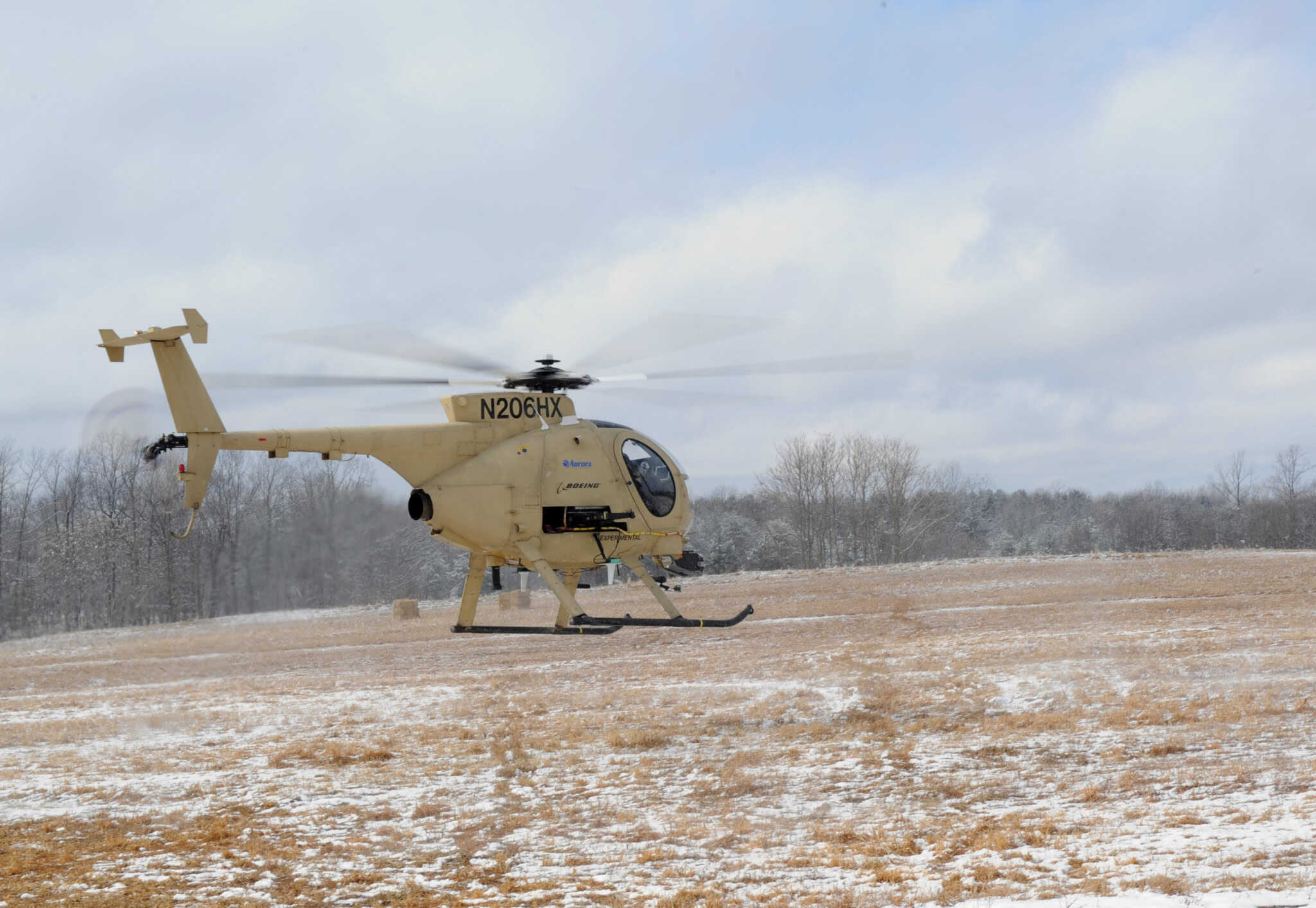
The MH-6M and AH-6M are Mission Enhanced Little Birds (MELB), built on the civilian MD 530F airframe with extensive military modifications. Fielding began in November 2003.
One fleet history says the last AH-6J and MH-6J aircraft had been upgraded to M standard by 2007, while other references date the completion of the MELB program to 2015.
The most visible change is the rotor. The M model uses the six-blade main rotor system of the MD 600 commercial helicopter and a noise-reducing four-blade tail rotor, where earlier Little Birds based on the MD 500E had five main blades.
The engine is a Rolls-Royce 250-C30R/3M turboshaft with full authority digital engine control (FADEC). An improved inlet with an inlet barrier filter keeps dust, sand and other particles out of the engine.
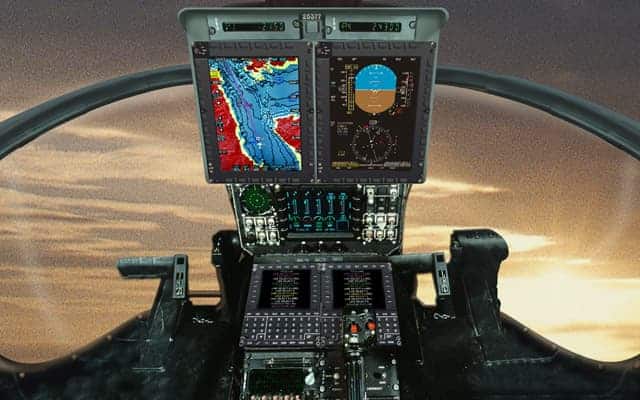
Crews fly a night-vision-compatible Rockwell Collins glass cockpit with two multifunction displays and a digital moving map. The screens also show video from the chin-mounted AN/ZSQ-3 infrared and electro-optical sensor turret.
The main fuel tanks are crashworthy and resistant to small arms fire up to .50 caliber, and extended-range external tanks can be added. Later block upgrades added fuel capacity and stronger landing skids.
The full specification table for the MH-6M is on this page. Three of its figures need context, because the Little Bird’s published numbers come from different versions and different sources.
The first is speed. The 152 knot (175 mph, 282 km/h) top speed comes from the standard published MH-6 figures, which Wikipedia’s spec block sources partly to MD 530F data; the same goes for the range, ceiling and climb rate.
SOCOM’s own rotary-wing program chief described the Little Bird in 2022 as “an aircraft that flies 80-90 knots,” too slow to keep up with a fleet SOCOM was modernizing toward 200-plus knots.
The second is range. This page lists the published 232 nm (270 mi, 430 km), while U.S. Special Operations Command’s 2025 Fact Book gives an unrefueled range of 250 miles (402 km), according to The War Zone.
Either way, the Little Bird cannot refuel in flight. Its reach comes from auxiliary fuel tanks and, above all, from the transport aircraft that carry it.
The third is weight. The 4,700 lb (2,150 kg) maximum gross weight on this page is the MH-6M figure; Wikipedia’s spec block gives 3,100 lb (1,406 kg), using MD 530F-based data for the earlier MH-6. The R-model rebuild now planned raises the design limit again, to 5,000 lb (2,268 kg).
The Little Bird’s real range is measured in cargo holds. An Air Force MC-130, a special operations version of the C-130J, can carry two in a near ready-to-fly configuration, and a C-17 can carry at least five.
Folding rotor blades and other design features let ground crews roll them off and have them flying in minutes rather than hours. Boeing says a trained crew can prepare its AH-6 for flight from transport configuration within seven minutes.
They also fit where other helicopters do not. Little Birds need much less deck space than most U.S. military helicopters, which let them fly from Navy warships and converted barges during the Persian Gulf “Tanker War” of 1987 and 1988.
The Little Bird’s first overt combat came in Grenada on October 25, 1983, when six MH-6s and two AH-6s were flown in aboard four Air Force C-130s. The secret unit’s existence became widely known afterward, because civilians photographed and filmed the helicopters in action.
In the Persian Gulf on September 21, 1987, a Little Bird team launched from USS Jarrett caught the Iranian ship Iran Ajr laying mines. The AH-6s opened fire, the crew abandoned the vessel, and it was boarded and captured.
During the December 1989 invasion of Panama, Little Birds landed a rescue team on the roof of the Cárcel Modelo prison in Operation Acid Gambit. One MH-6 lost power leaving the roof and crashed in the street below, with minor injuries to those aboard.
In Mogadishu in 1993, MH-6s put Delta Force soldiers onto rooftops at the start of the raid. After the Black Hawk “Super Six-One” was shot down, an MH-6 called “Star Four-One” landed in the street beside the wreck and flew out two soldiers under heavy fire.
In Iraq, an MH-6 flew Saddam Hussein out after his capture on December 13, 2003. On May 14, 2006, a Little Bird was shot down during a daylight raid at Yusufiyah, and both men aboard were killed.
In September 2009, AH-6 and MH-6 helicopters supported a Navy SEAL raid in Somalia, Operation Celestial Balance, that killed the al-Qaeda-linked militant Saleh Ali Saleh Nabhan.
Two operations in 2026 put the Little Bird back in the headlines. On January 7, images appeared to show an MH-6 approaching the Russian-flagged oil tanker Marinera during its seizure in the North Atlantic, and U.S. media reported that 160th helicopters had flown in the Navy SEALs who boarded it.
The ship was hundreds of miles from land and the Little Bird cannot refuel in flight, so it most likely launched from one of the vessels supporting the operation.
On April 5, 2026, during the war with Iran, Little Birds took part in the rescue of the weapons systems officer of an F-15E Strike Eagle shot down two days earlier. According to a U.S. official quoted by ABC News, four MH-6s ferried personnel from a makeshift landing strip, where two MC-130Js had landed, to the mountainous area where the airman was located.
The operation did not end cleanly. Both MC-130Js became stuck, which one official attributed to mechanical problems, and U.S. forces deliberately destroyed them so they would not fall into Iranian hands, according to U.S. officials.
A U.S. official said the four Little Birds were also intentionally destroyed by U.S. forces.
Iran’s military claimed it had shot down one of the MC-130Js, a claim that has not been independently verified. The improvised strip sat just south of Isfahan, roughly 200 miles (320 km) from the Iranian coast, and The War Zone judged it very unlikely the Little Birds had flown that far on their own.
Published counts for the 160th’s fleet sit around 50. A 2020 fleet summary put the regiment at 51 AH/MH-6Ms, the World Air Forces 2019 directory listed 47, and SOCOM’s rebuild program covers 52 aircraft.
Those counts predate the four Little Birds lost in Iran in April 2026.
Outside the U.S. Army, the military Little Bird line continues through Boeing’s export AH-6i, which Saudi Arabia ordered 24 of in 2014 and Thailand ordered eight of in 2022. MD Helicopters also builds its own military Model 500 derivatives, such as the MD 500MG Defender family.
For years the Little Bird looked close to the end. SOCOM had planned to replace roughly half of the fleet with a special operations version of the Army’s Future Attack Reconnaissance Aircraft (FARA), and for a time it appeared the rest might be retired entirely.
The Army canceled FARA in February 2024, and the Little Bird got a reprieve. SOCOM’s rotary-wing program executive officer, Steven Smith, called the resulting upgrade the Little Bird “resurrection.”
The upgraded aircraft are designated MH-6R and AH-6R. The effort gives the helicopter a new fuselage with a 5,000 lb (2,268 kg) design limit, a smaller mission computer, and interfaces for next-generation communications, and it is planned to run through the 2031 to 2032 timeframe.
SOCOM expects each new fuselage to last about 15 years. Smith said that buys time for the Army to decide how it will meet its scout requirement, whether with uncrewed systems or crewed and uncrewed aircraft working together.
Janes reported in 2024 that the first of 52 MELB-X, or MH-6R, aircraft was due for delivery in fiscal year 2025. In November 2025, Boeing, the prime contractor for the 160th’s Little Birds, received an $18.5 million contract for engineering and technical support to the program through November 2030.
SOCOM has also studied a hybrid-electric Little Bird. Its then program chief said in 2023 that studies showed a 25 to 100 percent speed increase was possible, taking the helicopter from 90 knots to 170 to 180 knots.
New-build Little Birds are a different story. In February 2025, Boeing said it would conclude production after completing its current AH-6 orders, for Thailand, and move to sustaining the existing fleet; MD Helicopters continues to build its own versions.
Not the military one. The MH-6M is an in-service special operations aircraft, and the Army is rebuilding its fleet rather than selling it off.
What you can buy is its civilian relative, the MD 530F, which MD Helicopters still builds. It uses a 650 shp Rolls-Royce 250-C30 engine and, in current production, a Garmin G500H TXi glass cockpit.
As of September 2026, used MD 530F listings on Controller.com ran from $2.25 million for a 2011 aircraft to $3.25 million for a 2023 example. A new-build delivery position for December 2026 was advertised with price on request.
Older members of the same family, the Hughes 500 and MD 500 series, remain in wide civilian and commercial use. The type’s best-known public role came in the 1980s TV series Magnum, P.I.
The civilian version, the MD 530F, is sold new by MD Helicopters with price on request. As of September 2026, used MD 530Fs listed on Controller.com ranged from $2.25 million to $3.25 million. Running costs come on top of the purchase price, as with any turbine helicopter; see why helicopters are so expensive.
The MH-6M carries up to six special operators on external benches, three on each side, plus its crew. A single pilot can fly it, but the 160th normally crews it with a pilot and a co-pilot.
The MH-6M is built on the MD 530F, a civilian light helicopter made by MD Helicopters, and earlier Little Birds were based on the MD 500E. The whole family descends from the Hughes Model 369, which the Army bought as the OH-6 Cayuse and which became the civilian Model 500.
Its size and its portability. The Little Bird is small enough to land on rooftops, in narrow streets, and on ship decks, and at least five fit inside a single C-17, flying within minutes of being unloaded. Its passengers ride outside on benches rather than in a cabin, which gets them onto the objective the moment it lands.
The name came from the task force formed after Operation Eagle Claw in 1980. Its OH-6As were called Little Birds compared with the UH-60A Black Hawks and CH-47C Chinooks in the same unit. The egg-shaped fuselage later earned it a second nickname, the “Killer Egg.”
They are the same helicopter in two configurations. The MH-6 is the unarmed assault version that carries operators on external benches, while the AH-6 swaps the benches for weapon pylons carrying miniguns, .50-caliber guns, rockets, or Hellfire missiles. An aircraft can be converted from one to the other.
The published top speed is 152 knots (175 mph, 282 km/h), from the standard MH-6 figures, which draw partly on MD 530F data. SOCOM’s rotary-wing program chief described it in 2022 as “an aircraft that flies 80-90 knots,” too slow to keep up with a special operations fleet moving toward 200-plus knots.
In the U.S. military, only the Army’s 160th Special Operations Aviation Regiment, the Night Stalkers, flies it. They use it to carry and support special operations units such as Delta Force and the Navy SEALs. Boeing’s export AH-6i variant was ordered by Saudi Arabia and Thailand.
Not in the near term, on current plans. After the Army canceled the FARA program in February 2024, SOCOM moved ahead with rebuilding its Little Birds as the MH-6R and AH-6R, with new fuselages expected to last about 15 years. That effort is planned to run through the 2031 to 2032 timeframe.
On April 5, 2026, four MH-6s used in the rescue of a downed F-15E crew member were destroyed inside Iran. According to a U.S. official quoted by ABC News, U.S. forces destroyed them intentionally. Two stuck MC-130J transports were also destroyed so they would not fall into Iranian hands.
Sources and references used for research and fact-checking.