

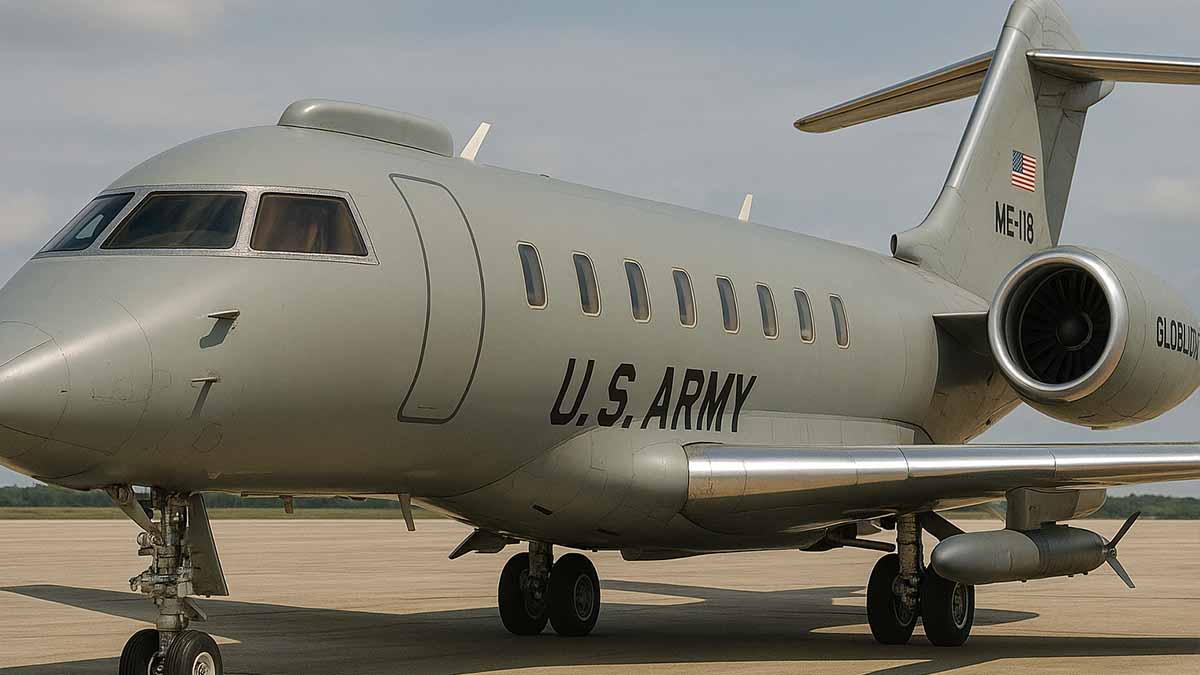
The aircraft meant to replace every manned surveillance plane the US Army owns is a Bombardier Global 6500. The Army has already scrapped the fleet it is supposed to succeed.
On September 7, 2026, President Donald Trump wrote that Bombardier should no longer be allowed to sell aircraft in the United States unless it builds them on American soil. The US Army is one of its customers.
The Army’s High Accuracy Detection and Exploitation System, known as HADES, is built on the Bombardier Global 6500, a long-range business jet. The service has designated it the ME-11B, and reporting on the program puts the planned fleet at 10 to 16 aircraft.
The first airframe was handed over on November 25, 2024, at Bombardier’s US headquarters in Wichita, Kansas. The turboprops it replaces are already gone.
The Army traded propellers for altitude
For four decades the Army listened to battlefields from the RC-12 Guardrail, a militarized Beechcraft King Air stuffed with signals intelligence receivers. It flew slowly, and it flew low.
The RC-12X cruised at about 310 knots with a ceiling near 35,000 feet and a range of roughly 1,720 nautical miles. Against a modern air defense network, that is close enough to the border to be a problem.
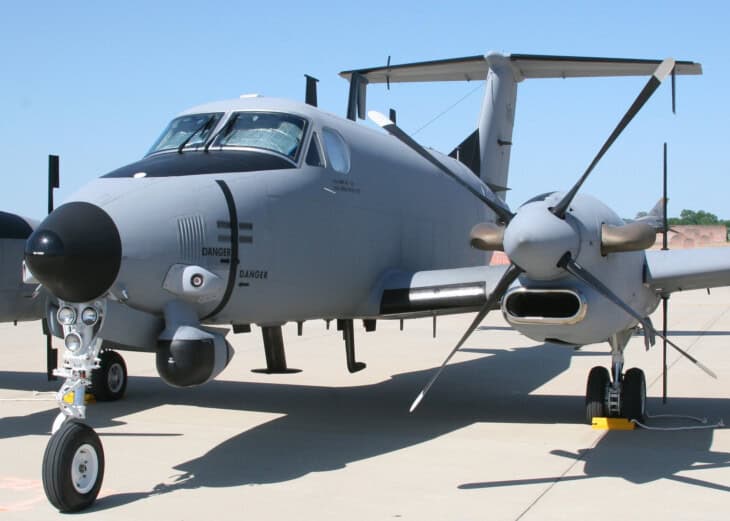
The Army’s own assessment was blunt. The legacy turboprop fleet had “limited speed, range, altitude, power, and payload carrying capacity for deep sensing,” the service wrote when it announced the fleet’s retirement in December 2025.
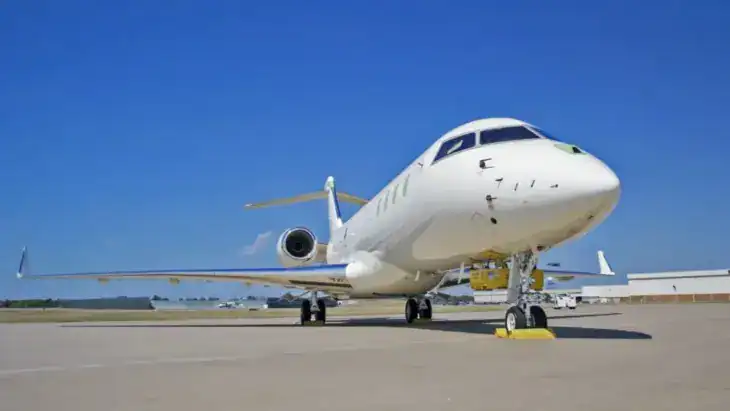
A Global 6500 fixes all five at once. It cruises at 504 knots, tops out at 51,000 feet, and carries 6,600 nautical miles of range, roughly four times the Guardrail’s legs and 16,000 feet more altitude.
Altitude is the part that matters most for intelligence work. Sitting 3 miles (5 km) higher pushes the sensor horizon much further out, which lets a jet collect deep inside another country’s airspace while staying in international or friendly airspace itself.
That is what the Army means by deep sensing, and its intelligence chief said so directly. HADES “allows the Army to fly higher, faster and farther, which directly impacts our ability to see and sense deeper,” Lt. Gen. Anthony Hale said in 2024.
A $991 million contract and three prototypes
The Army picked Sierra Nevada Corporation as lead system integrator on August 22, 2024. The initial award was $93.5 million, against a 12-year indefinite-delivery contract with a ceiling of $991.3 million.
A losing bidder’s protest paused the work almost immediately. It resumed in January 2025.
Bombardier’s role is to build and hand over green airframes. The Global 6500 delivered in Wichita in November 2024 went to the Army as government-furnished equipment, then straight to Sierra Nevada for conversion to ME-11B standard.
That first jet was redelivered to the Army in ME-11B configuration in January 2026. Flight testing was scheduled to begin in the summer of 2026, with formal delivery of the first prototype expected before the end of the year and the aircraft ready for service in 2027.
Three prototypes are planned, each one more capable than the last. The first carries legacy sensors, the second adds an advanced radar, and the third is meant to be what the Army calls a combat credible configuration.
“What we’re seeking in this portfolio is progress, not perfection,” Andrew Evans, the Army’s intelligence director, told reporters in April 2026. “We understand that HADES is going to be an iterative program.”
There is no turboprop left to fall back on
The Army did not wait for HADES before retiring what HADES replaces. Divestment of the RC-12 Guardrail, the ARL-M and the EMARSS-M began in fiscal 2023 and finished in fiscal 2025.
The last Guardrail and ARL-M missions were flown in Korea in July 2025. The final EMARSS-M sortie followed in September 2025.
What is covering the gap is a set of contractor-owned, contractor-operated jets: ARTEMIS, ARES and the ATHENA-R and ATHENA-S aircraft, the last of which was declared operational with the Army in April 2026. Several of those bridge platforms are Bombardier Globals too.
The bridge and the destination are the same airframe
The Army’s interim spy jets and its permanent replacement both fly on Bombardier Global airframes. A sales restriction would not just delay HADES. It would sit underneath the aircraft currently covering the capability HADES has not delivered yet.
The Air Force has the same exposure. Its E-11A Battlefield Airborne Communications Node, the flying relay that keeps radios talking across mountainous terrain, is also a Bombardier Global, and the service took delivery of its ninth in September 2025.
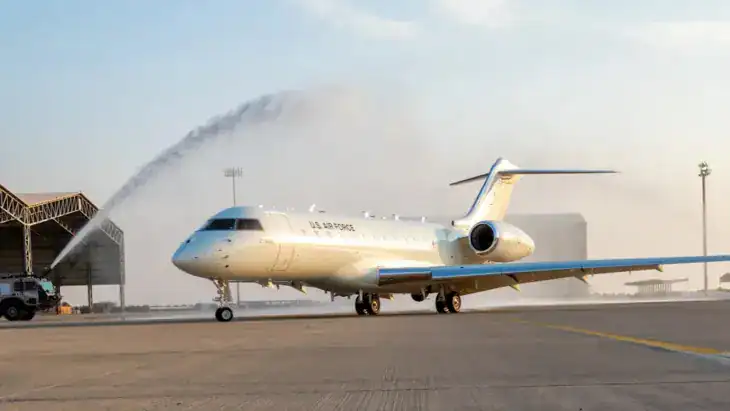
That matters more than it looks, because the US military is not in a position to absorb another delayed program. The Air Force fleet already averages more than 32 years old, and replacement schedules are what keep that number from climbing.
Nobody in Washington has said whether the ban would reach it
There is an obvious escape hatch, and it is a real one. Military aircraft are procured and airworthiness-certified through a separate process from civil business jets, so the administration could carve out defense programs without touching the threat’s stated target.
It has not said that it will. After the January 2026 threat to decertify Canadian-built aircraft, the White House indicated in-service aircraft would be exempted, but as The War Zone noted, it has never clarified whether future military purchases are protected.
The September post carried no executive order, tariff notice or rule behind it. It also drew immediate pushback from the senator whose state builds the jets.
“The presence of Bombardier in Wichita supports a local workforce of more than a thousand employees, who contribute their talent and expertise to our nation’s defense and aerospace capabilities,” Sen. Jerry Moran of Kansas wrote on September 8, saying he had contacted the administration.
Bombardier itself declined to comment on the September statement. It has kept delivering to US customers under its existing approvals, and its Global family jets remain among the most-ordered large-cabin aircraft in the country.
What is unresolved is narrower and stranger than a trade dispute. The Army’s top operational priority is deep sensing, the aircraft that delivers it is built near Montreal and finished in Kansas, and the fleet it replaced has already been sent to the boneyard.
Sources and references used for research and fact-checking.
- U.S. Army, Army selects Sierra Nevada Corporation as lead system integrator for its High Accuracy Detection and Exploitation System
- U.S. Army, Army completes A-ISR turboprop fleet divestment
- Bombardier, Bombardier Defense Delivers First Global 6500 Aircraft to the U.S. Army's HADES Program
- The War Zone, ME-11B Official Designation Of Army's New Intelligence Gathering Business Jets
- The War Zone, Trump Threatens Canadian Jets At The Center Of Army Aerial Surveillance Plans
- Defense One, Army's HADES spy plane on track for first delivery later this year
- DefenseScoop, Bombardier Defense delivers first HADES jet to Army
- NBC News, Trump calls for a Bombardier plane ban, drawing pushback from a GOP senator
- CNBC / Reuters, Trump says Bombardier can't sell in U.S. unless Canada aerospace giant builds there
- The Aviationist, SNC's ATHENA-S ISR Jets Are Now Operational with the U.S. Army
- The Aviationist, Ninth Bombardier Global 6000 Delivered to U.S. Air Force for BACN Program
Get the Newsletter
The latest aviation news and stories sent to your inbox.
About the Author

Tim is the owner and lead editor of AeroCorner since 2019, overseeing aviation content covering aircraft, airlines, airports, and the broader aviation industry. Through years of researching, writing, editing, and publishing aviation-focused content, he has developed extensive practical knowledge of commercial aviation and air travel. Based in Asia and a frequent traveler himself, Tim also brings firsthand passenger experience to AeroCorner’s coverage. Outside of publishing, he has also explored aviation firsthand through hands-on flight training in New Zealand.