

Table of Contents
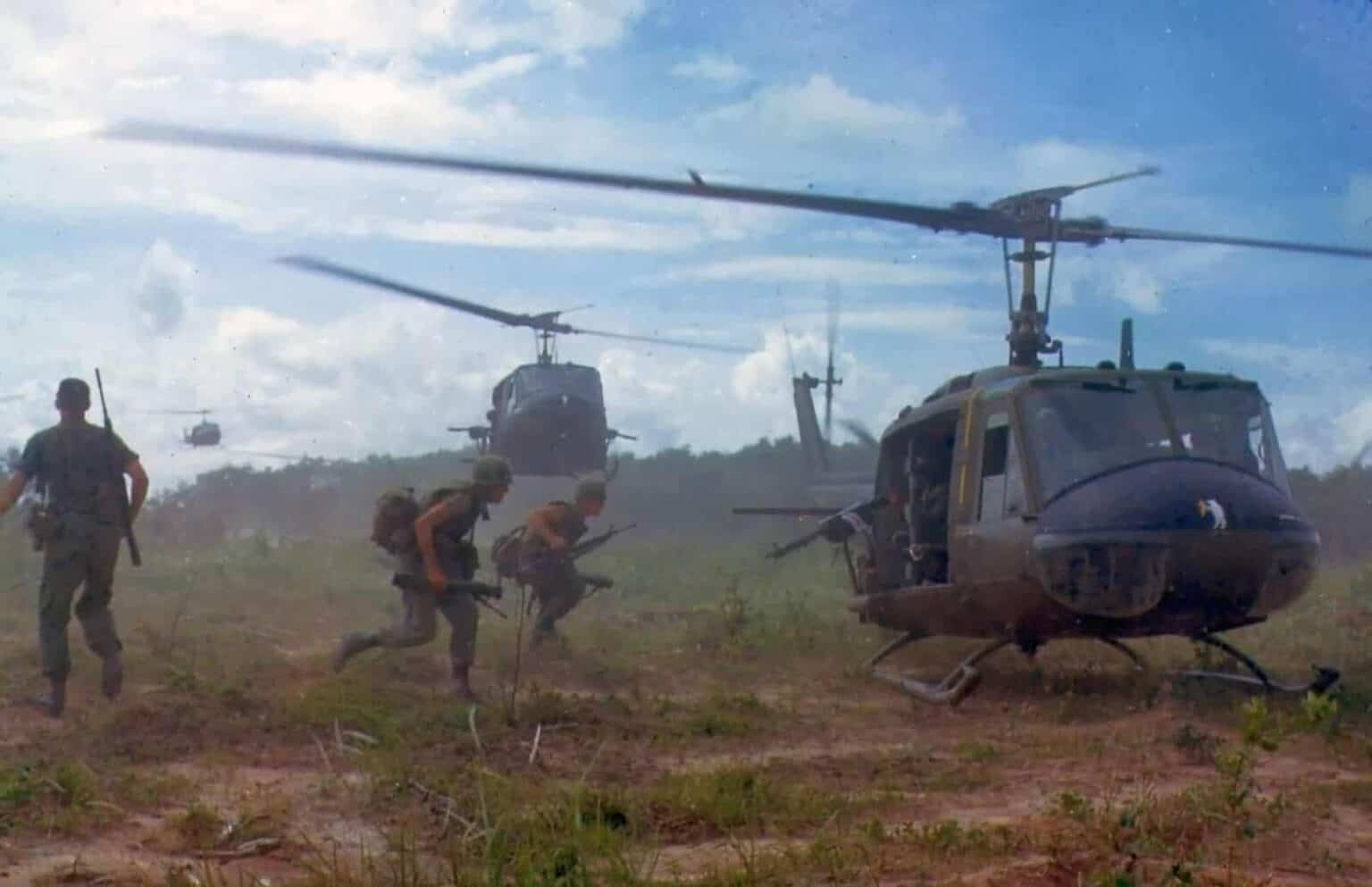
The helicopter most used in the Vietnam War was the Bell UH-1 Iroquois, the “Huey.” The Vietnam Helicopter Pilots Association (VHPA) holds tail numbers for 6,994 Hueys that served there, more than every other American helicopter combined.
Around the Huey, the US Army, Marine Corps, Air Force and Navy flew at least 18 other helicopter types between 1961 and 1975. They carried troops, scouted for gunships, recovered wrecked aircraft, rescued downed airmen and, at the very end, evacuated Saigon.
The cost was enormous. The VHPA counts about 12,000 helicopters that served in the war and 5,607 helicopter losses, roughly half the fleet, along with 2,165 helicopter pilots and 2,712 other crew members killed.
Below, every US type is grouped by the job it did, followed by the helicopters North and South Vietnam flew and a type-by-type look at the losses.
| Helicopter | Service | Main job in Vietnam | In Vietnam from |
|---|---|---|---|
| Piasecki CH-21 Shawnee | Army | Troop transport | December 1961 |
| Bell UH-1 Iroquois “Huey” | Army, Navy, Air Force, Marines | Troop lift, gunship, medevac | 1962 |
| Sikorsky UH-34D Seahorse | Marines | Troop transport, medevac | April 1962 |
| Sikorsky CH-37 Mojave | Army, Marines | Heavy lift, aircraft recovery | June 1963 |
| Bell OH-13 Sioux | Army | Scout | Early in the war |
| Hiller OH-23 Raven | Army | Scout, medevac | Early in the war |
| Kaman HH-43 Huskie | Air Force | Base rescue, firefighting | 1964 |
| Kaman UH-2 Seasprite | Navy | Rescue from destroyers | Mid-1960s (Gulf of Tonkin) |
| Sikorsky SH-3 Sea King | Navy | Combat rescue from carriers | Mid-1960s (Gulf of Tonkin) |
| Gyrodyne QH-50 DASH | Navy | Unmanned gunfire spotting | Mid-1960s (offshore) |
| Boeing CH-47 Chinook | Army | Medium lift, aircraft recovery | 1965 |
| Sikorsky CH-54 Tarhe | Army | Flying crane, aircraft recovery | 1965 |
| Sikorsky CH-3C / HH-3E | Air Force | Transport, then combat rescue | 1965 (CH-3C) |
| Boeing Vertol CH-46 Sea Knight | Marines | Assault transport | March 1966 |
| Hughes OH-6 Cayuse | Army | Scout | 1966 to 1967 |
| Sikorsky CH-53A Sea Stallion | Marines | Heavy lift, aircraft recovery | January 1967 |
| Bell AH-1G HueyCobra | Army | Attack | Late summer 1967 |
| Sikorsky HH-53 Super Jolly Green Giant | Air Force | Long-range combat rescue | 1967 to 1968 |
| Bell OH-58 Kiowa | Army | Scout | August 1969 |
Where it started: the CH-21 Shawnee
The first American helicopter units arrived on 11 December 1961, when a ship docked in downtown Saigon with 32 Army H-21s and 400 men of the 57th and 8th Transportation Companies. The H-21, later redesignated CH-21 Shawnee, was a piston-engined tandem-rotor transport.
Twelve days later, on 23 December 1961, the same helicopters flew Operation Chopper, which the Army’s official history calls the first airmobile combat action in Vietnam. They lifted South Vietnamese paratroopers into battle.
The VHPA records 159 CH-21Cs in Vietnam, of which 18 were lost.
Troop transport and medevac: the UH-1 Huey
The Bell UH-1 Iroquois first flew as the XH-40 on 20 October 1956. The Army named it Iroquois after its practice of naming helicopters for Native American nations, but its first designation, HU-1, gave it the nickname everyone actually used: Huey.
The first Hueys reached Vietnam in the spring of 1962 with the 57th Medical Detachment. In 1963 that unit took the radio call sign “Dustoff,” which became the name for helicopter medical evacuation in Vietnam.
A UH-1D or UH-1H was rated for 11 passengers, and up to 14 troops in a pinch. Hueys often flew with the cabin doors open, which is why people still ask how soldiers did not fall out of helicopters.

Bell built 10,005 Hueys between 1957 and 1975, according to the VHPA. The slick (unarmed) transport version flew troops into landing zones, while the older UH-1B and UH-1C models were turned into gunships with machine guns and rocket pods.
Hueys also account for the most deaths. The VHPA lists 1,151 pilots and 1,231 other crew members killed in Hueys, and Wikipedia’s type history gives 3,305 Hueys destroyed out of 7,013 that served.
Gunships and attack helicopters: the AH-1G Cobra
Armed Hueys worked, but a Huey gunship was still a transport with guns bolted on. Bell’s answer was the Model 209, which first flew on 7 September 1965 and became the AH-1G HueyCobra.
The Cobra kept the Huey’s engine, transmission and rotor system but wrapped them in a fuselage barely wide enough for two crew sitting in tandem. The gunner sat in front and the pilot behind, which made it a far narrower target than the Huey it escorted.
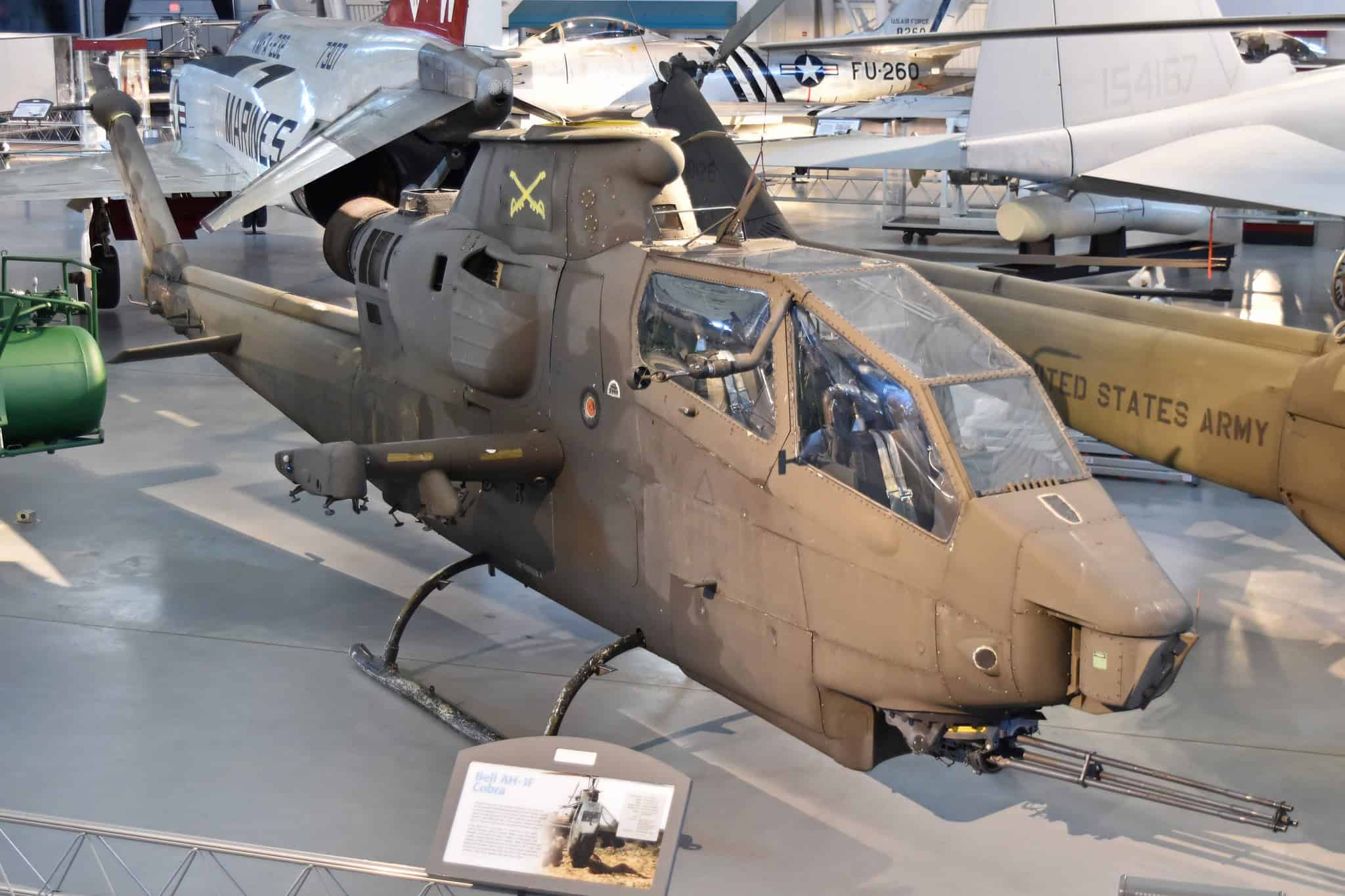

The Army ordered it as a stopgap while it waited for the far more ambitious Lockheed AH-56 Cheyenne. The first Cobras arrived in South Vietnam in late summer 1967, the Cheyenne’s production contract was cancelled in May 1969, and the stopgap stayed.
Bell built 1,116 AH-1Gs for the Army between 1967 and 1973. The VHPA records 824 in Vietnam and 303 lost, and the Cobra’s descendants are still flying, as our ranking of the best attack helicopters in the world shows.
The Army even tried a gunship Chinook. Three armed test CH-47s, the “Go-Go Birds,” went to Vietnam carrying twin 20 mm cannon, 40 mm grenade launchers and .50-caliber machine guns, but the Army’s official history records that two of the three were lost.
Scouts: the OH-13, OH-23, OH-6 Cayuse and OH-58 Kiowa
Scout helicopters found the enemy so the gunships could hit him. Early in the war that job fell to two piston-engined scouts, the Bell OH-13 Sioux, with its bubble canopy and open steel-tube tail, and the Hiller OH-23 Raven.

The Hughes OH-6A Cayuse replaced both. Its nickname, “Loach,” came from the Army’s Light Observation Helicopter (LOH) program. It replaced the OH-13 from 1966 and the OH-23 by early 1968.
The Army’s air cavalry paired one OH-6A with one AH-1G in a “Pink Team.” The Loach flew low to find the enemy, and the Cobra above it attacked what the Loach found.

Two out of three Loaches never came home
The VHPA lists 1,422 OH-6A Cayuse helicopters in Vietnam and 964 of them lost, a loss rate of 68 percent. That is the highest rate in the loss table below, and the price of scouting at treetop height.
The Bell OH-58A Kiowa reached Vietnam in August 1969. It was armed with an M134 minigun on the M27 mount, the same system the OH-6A carried. Missile-armed Kiowas came only with later models.
The Kiowa arrived later in the war. The VHPA lists 312 OH-58As in Vietnam and 48 lost, a far lower rate than the Loach.
Cargo and heavy lift: the Chinook, Tarhe and Mojave
The Boeing CH-47 Chinook first flew on 21 September 1961. The 1st Cavalry Division brought its own Chinook battalion, the 228th Assault Support Helicopter Battalion, when it arrived in 1965, and the 147th followed on 29 November 1965.
The CH-47A carried 33 passengers or a payload of 10,114 pounds (4,588 kg). According to the Museum of Flight, Chinooks also recovered about 11,500 disabled aircraft during the war.

For loads too heavy for the Chinook, the Army had the Sikorsky CH-54 Tarhe, a flying crane with almost nothing behind the cockpit but an engine deck and a hook. Preproduction machines went to Vietnam in 1965 with the 1st Cavalry’s 478th Aviation Company.
The Tarhe could lift an external load of about 20,700 pounds (9,400 kg). HistoryNet credits it with recovering more than 380 downed aircraft, and a detachable “people pod” turned it into a troop carrier that lifted 87 combat-equipped soldiers in one test.
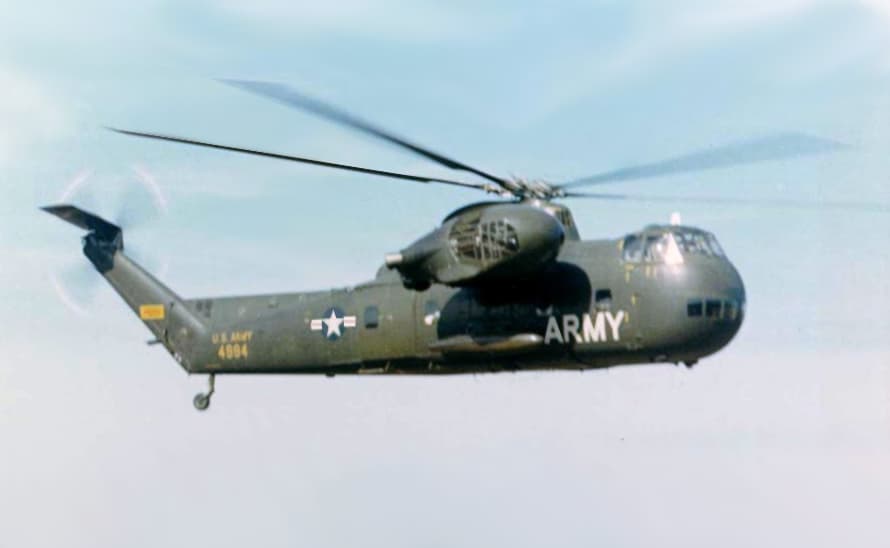
Before the Tarhe there was the Sikorsky CH-37 Mojave, a piston-engined giant with its engines in pods on stub wings. The first four Army CH-37Bs arrived in Saigon on 3 June 1963, and they spent the war’s early years hauling home damaged helicopters with an external load of up to 10,000 pounds (4,540 kg).
The Skycrane did not come from the CH-53
A common claim is that the Sikorsky S-64 Skycrane grew out of the CH-53 Sea Stallion. It ran the other way. The S-64, flown by the Army as the CH-54, was an enlarged version of the S-60 flying crane, which used the rotor system and transmission of the CH-37 Mojave, and the CH-53 later borrowed many of the CH-54’s proven systems.
The biggest of their descendants appear in our list of the top heavy lift helicopters.
Marine Corps helicopters: the UH-34D, CH-46 and CH-53A
The Marines arrived with the Sikorsky UH-34D Seahorse. Marine Medium Helicopter Squadron 362 (HMM-362) flew its UH-34s ashore at Soc Trang in the Mekong Delta on 15 April 1962, the first Marine aircraft unit in South Vietnam, in an operation called Shufly.
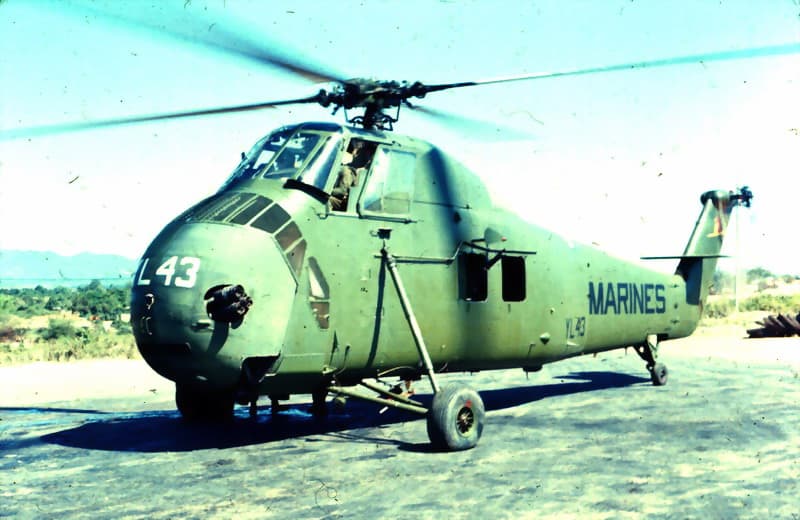
Sikorsky rated the UH-34 for 16 troops or six litters. The Army flew the same helicopter as the CH-34 Choctaw, but Army Choctaws did not deploy to Vietnam; their part of the story is the batch handed to the South Vietnamese air force.
The Boeing Vertol CH-46 Sea Knight replaced the UH-34 from 8 March 1966, when its first squadron flew ashore at Marble Mountain near Da Nang. The CH-46A carried up to 17 passengers, and its rear ramp let Marines run straight out into a landing zone.
Its war started badly. In 1967 several CH-46As lost their rear pylon, which holds the engines and the aft rotor, in flight, and the fleet was grounded for all but emergencies, cutting Marine airlift in half until modified aircraft returned between December 1967 and February 1968.
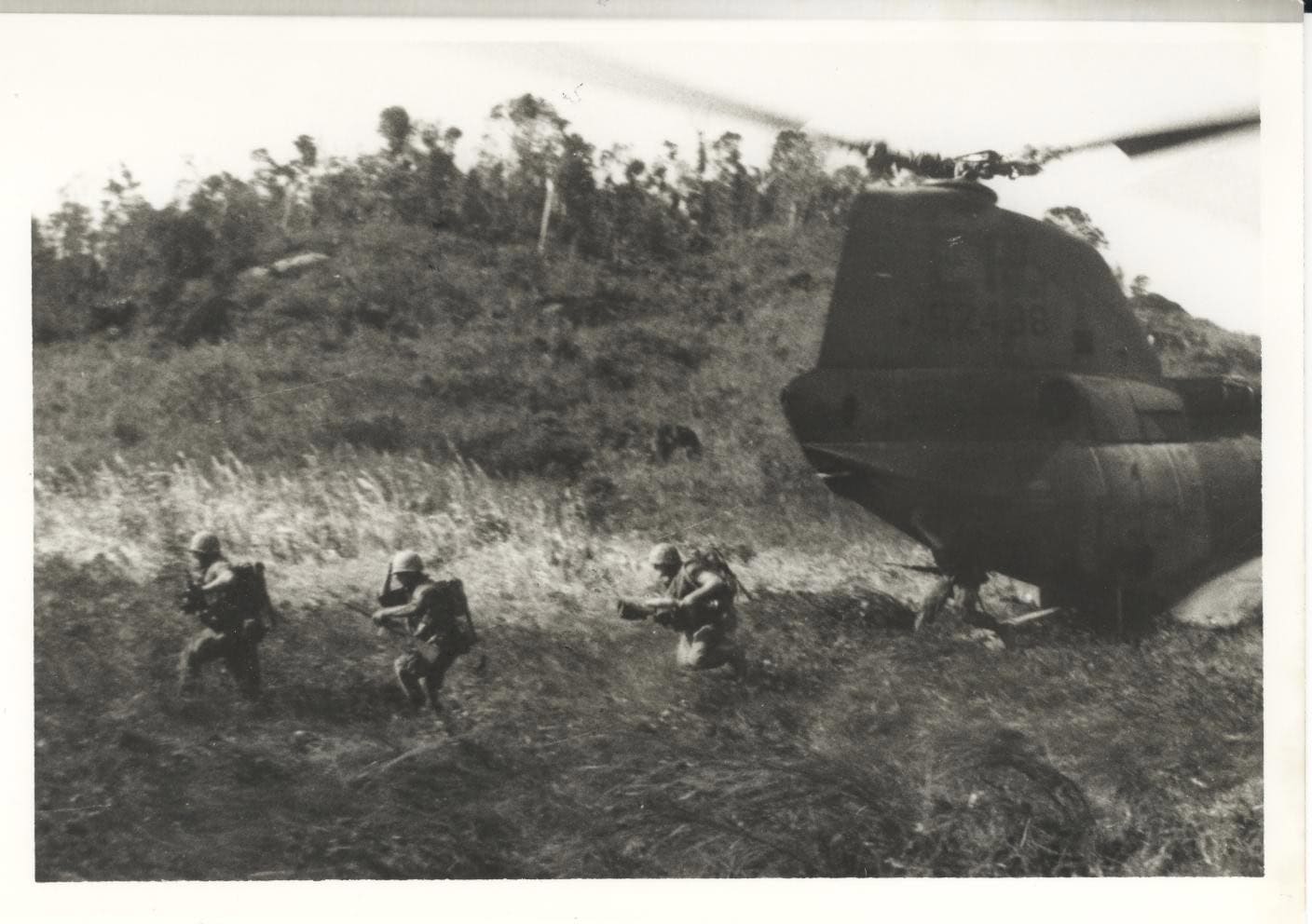
The Marines’ heavy lifter was the Sikorsky CH-53A Sea Stallion. A detachment from HMH-463 brought the first four to Marble Mountain in January 1967.
The CH-53A carried 38 troops, 8,000 pounds (3,630 kg) of cargo inside or 13,000 pounds (5,900 kg) slung underneath. It ended up recovering more downed aircraft than the Army’s CH-54.
Air Force rescue: the Huskie and the Jolly Green Giants
The Air Force’s first rescue helicopter in Southeast Asia was the Kaman HH-43 Huskie, with two intermeshing wooden rotors and no tail rotor. Bought for local base rescue and fighting aircraft fires, it went to Da Nang, Bien Hoa and Nakhon Phanom in 1964.
Known by its call sign “Pedro,” the Huskie was the first USAF rescue helicopter to arrive in Southeast Asia and the last to leave. The National Museum of the US Air Force credits HH-43 crews with 888 combat saves between 1966 and 1970.
Longer missions needed a bigger helicopter. The first CH-3C transports, a Sikorsky S-61R development of the Sea King with a new rear fuselage and loading ramp, arrived in 1965.

The Air Force modified 50 CH-3Es for combat rescue with armor, guns, self-sealing fuel tanks, a rescue hoist and a retractable refueling probe. As the HH-3E “Jolly Green Giant,” arriving in Vietnam in 1967, it was the first helicopter to be produced with air-to-air refueling.
HC-130P tankers refueled them in flight. The Air Force retired its last HH-3Es by 1995.

The bigger Sikorsky HH-53 “Super Jolly Green Giant,” which crews nicknamed “BUFF,” entered rescue service in 1967; the first HH-53B flew on 15 March that year. The HH-53C followed in August 1968.
On 21 November 1970, five HH-53Cs and one HH-3E flew the raid on the Son Tay prison camp in North Vietnam, landing 56 Army Special Forces soldiers.
Navy helicopters: rescue at sea, Seawolves and a drone
Off the coast, the Navy kept rescue helicopters on station for pilots who ditched in the Gulf of Tonkin. One armed and armored Kaman UH-2 Seasprite sat on a ship at each rescue station, and four armed Sikorsky SH-3A Sea Kings, the primary rescue helicopter, flew from a carrier on Yankee Station.

The Seasprite first flew on 2 July 1959, built for a 1956 Navy competition for a ship-based utility helicopter. From 1 September 1967 the dedicated combat rescue squadron HC-7 flew both types and rescued 150 people, 130 of them in the combat zone, before it was disbanded in 1975.
Inland, the Navy flew its own Hueys. Helicopter Attack (Light) Squadron 3, the “Seawolves,” formed at Vung Tau on 1 April 1967 with UH-1B gunships to give fire support, observation and medical evacuation to the Navy’s river patrol force in the Mekong Delta.
The oddest Navy helicopter had no one aboard. The Gyrodyne QH-50 DASH, a small coaxial-rotor drone built to carry anti-submarine torpedoes, was fitted with a TV camera from January 1965 under a program called “Snoopy” to spot naval gunfire for destroyers off Vietnam.
The Navy ordered DASH off its FRAM I destroyers in December 1967 and cancelled the program in November 1970. Today’s fleet is covered in our guide to US Navy helicopters.
Did the Vietnamese have helicopters?
Both Vietnams did. North Vietnam’s air force formed its 919th transport regiment on 1 May 1959 with about 10 aircraft, Mil Mi-4 helicopters among them; the Mi-4 was the Soviet answer to the Sikorsky H-19.
The giant Mil Mi-6 arrived in 1964 and flew its first operational missions in mid-1965. According to HistoryNet, it could carry a fully fueled and armed MiG-17, MiG-19 or MiG-21 between dispersal airfields, and made more than 400 lifts of MiG-17s alone.
The Mi-6 also hauled SA-2 surface-to-air missiles and anti-aircraft guns inside North Vietnam and supplies into Laos. Hanoi never used it for air assault, and no source we found shows a North Vietnamese helicopter flying a combat mission.
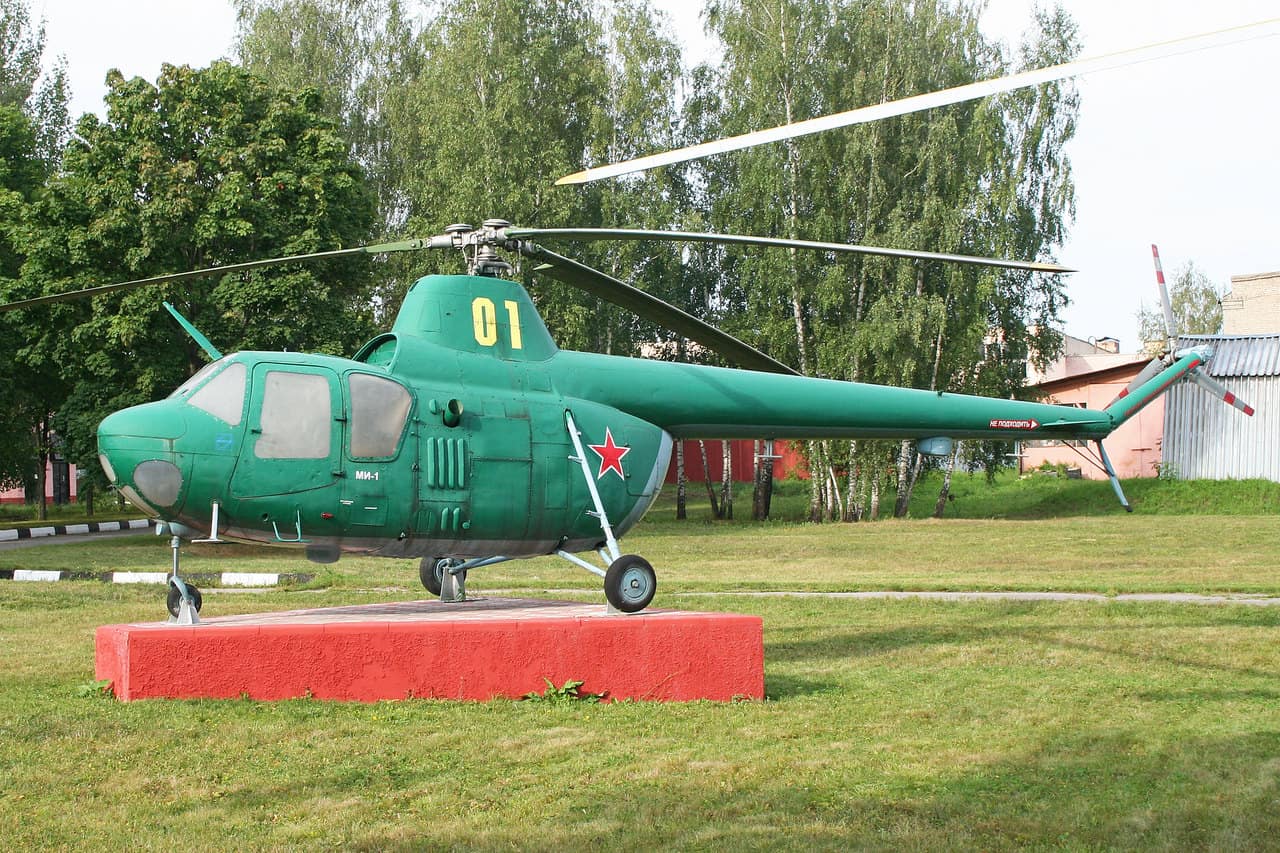
The Mil Mi-8 is often listed as a Vietnam War helicopter, but North Vietnam received its first five in January 1973, after US forces had left. Ironically, the Soviet military had shown little interest in the Mi-8 until the Huey’s role in Vietnam was widely publicized.
South Vietnam’s air force inherited 10 H-19s from the French in 1958, took H-34s from late 1960, and converted to UH-1s from 1968 and CH-47s from 1970. By the 1972 Easter Offensive it had 620 helicopters in 17 squadrons, 367 of them combat-ready.
When Saigon fell, North Vietnam captured 877 South Vietnamese aircraft and helicopters, including 430 UH-1s and 36 CH-47s. The victorious air force flew captured Hueys for years afterward.
How many helicopters were lost in Vietnam?
The VHPA has tail numbers for 11,846 US helicopters from all services that served in Vietnam and records 5,607 helicopter losses, about half.
The rate varied enormously by job. Scouts that flew low on purpose lost most of their fleets, while heavy lifters working behind the lines lost far fewer.
| Type | Served in Vietnam | Lost | Loss rate | Pilots killed | Other crew killed |
|---|---|---|---|---|---|
| OH-6A Cayuse | 1,422 | 964 | 68% | 233 | 251 |
| OH-13S Sioux | 275 | 173 | 63% | 21 | 16 |
| OH-23G Raven | 231 | 97 | 42% | 12 | 14 |
| AH-1G Cobra | 824 | 303 | 37% | 235 | 12 |
| CH-47A Chinook | 327 | 91 | 28% | 33 | 87 |
| CH-54A Tarhe | 42 | 9 | 21% | 5 | 7 |
| OH-58A Kiowa | 312 | 48 | 15% | 19 | 22 |
| CH-21C Shawnee | 159 | 18 | 11% | 9 | 11 |
The Huey is missing from the table only because its many variants are counted separately. Together they account for 1,151 pilots and 1,231 other crew members killed, nearly half of the war’s 2,165 helicopter pilots and 2,712 helicopter crew members killed.

About these numbers
The VHPA compiles its loss list tail number by tail number and warns that its figures will continue to change a small amount over time. Treat small differences between sources, such as the 6,994 Hueys the VHPA counts against the 7,013 other histories give, as record-keeping noise, not contradictions.
The last helicopters out: Operation Frequent Wind
The war’s helicopter story ended on 29 and 30 April 1975 with Operation Frequent Wind, the evacuation of Saigon. Marine CH-53s and CH-46s, with Air America Hueys, lifted 1,373 Americans and 5,595 Vietnamese and third-country nationals out of the city.
South Vietnamese pilots flew their own helicopters out to the US fleet, and the ships ran out of deck space. USS Blue Ridge alone took 15 that were all ditched or pushed into the sea, and some 45 UH-1s and at least one CH-47 went over the side in total.
On USS Midway, sailors pushed helicopters overboard to clear the deck for a South Vietnamese major landing a Cessna O-1 Bird Dog. The last helicopter to leave the US embassy roof was a CH-46 of HMM-164, the squadron that had brought the Sea Knight to war nine years earlier.
Fixed-wing combat over the North is a different story, told in our guide to the best fighter jets of the Vietnam War. For how today’s rotorcraft are sorted by mission, see our overview of the types of military helicopters.
FAQ
Sources and references used for research and fact-checking.
- Vietnam Helicopter Pilots Association, Helicopter Losses During the Vietnam War (updated 31 December 2018)
- US Army Center of Military History, Airmobility 1961-1971 (CMH Pub 90-4), John J. Tolson
- Texas Tech University Vietnam Center, Dustoff: the beginning
- Wikipedia, Bell UH-1 Iroquois
- Wikipedia, Bell AH-1 Cobra
- Wikipedia, Lockheed AH-56 Cheyenne
- Wikipedia, Hughes OH-6 Cayuse
- Wikipedia, Bell OH-58 Kiowa
- Wikipedia, U.S. helicopter armament subsystems
- Wikipedia, Bell H-13 Sioux
- Wikipedia, Hiller OH-23 Raven
- Wikipedia, Boeing CH-47 Chinook
- The Museum of Flight, CH-47D Chinook
- HistoryNet, Skycrane: the war's heavy hauler
- Wikipedia, Sikorsky CH-54 Tarhe
- Wikipedia, Sikorsky S-64 Skycrane
- Wikipedia, Sikorsky S-60
- HistoryNet, CH-37 Mojave: the Deuce helicopter
- Wikipedia, Operation Chopper (Vietnam War)
- Wikipedia, Operation Shufly
- Sikorsky Archives, Sikorsky S-58
- Wikipedia, Sikorsky H-34
- Wikipedia, Boeing Vertol CH-46 Sea Knight
- Sikorsky Archives, Sikorsky S-65
- Wikipedia, Sikorsky CH-53 Sea Stallion
- National Museum of the US Air Force, Kaman HH-43B Huskie
- National Museum of the US Air Force, Sikorsky CH-3E
- National Museum of the US Air Force, Sikorsky HH-3E Jolly Green Giant
- National Museum of the US Air Force, Chariots of the Rescue Service
- Wikipedia, Lockheed HC-130
- Wikipedia, Sikorsky MH-53
- Wikipedia, Operation Ivory Coast
- Naval History and Heritage Command, By Sea, Air, and Land, chapter 3: The Years of Combat, 1965-1968
- Wikipedia, Kaman SH-2 Seasprite
- Wikipedia, Helicopter Combat Support Squadron Seven
- Air & Space / Smithsonian, DASH goes to war
- Gyrodyne Helicopter Historical Foundation, QH-50D
- Naval History and Heritage Command, Frequent Wind delivered thousands to freedom
- Naval History and Heritage Command, Humanitarian operations, 1970-1979
- Wikipedia, Operation Frequent Wind
- HistoryNet, Arsenal: North Vietnam's Mi-6 Hook
- Wikipedia, Vietnam People's Air Force
- Wikipedia, Republic of Vietnam Air Force
- Saigon Giai Phong, Doan bay 919 va qua khu hao hung chua tung cong bo
- Thanh Nien, Truc thang vu trang cua Khong quan VN: Mi-8
- Wikipedia, Mil Mi-8
- Wikipedia, Mil Mi-4
- Wikipedia, Mil Mi-1
Get the Newsletter
The latest aviation news and stories sent to your inbox.
About the Author

Tim is the owner and lead editor of AeroCorner since 2019, overseeing aviation content covering aircraft, airlines, airports, and the broader aviation industry. Through years of researching, writing, editing, and publishing aviation-focused content, he has developed extensive practical knowledge of commercial aviation and air travel. Based in Asia and a frequent traveler himself, Tim also brings firsthand passenger experience to AeroCorner’s coverage. Outside of publishing, he has also explored aviation firsthand through hands-on flight training in New Zealand.