

Table of Contents
China has about 2,200 fighter jets. That is the Pentagon’s estimate in its annual report to Congress on China’s military, released on December 23, 2025, and it counts the PLA Air Force and Navy together.
Count every two-seat fighter trainer as well and the Pentagon’s figure rises to 3,100. FlightGlobal’s 2026 directory, which lists each type by name, finds only 1,485 jets it can confirm.
Those numbers are not contradictions. They draw the line in different places, and one of them still counts hundreds of a 1960s fighter that China began retiring in 2018.
How Many Fighter Jets Does China Have?
About 2,200, as of the Pentagon’s December 2025 report. The figure covers fighters flown by the PLA Air Force and PLA Navy Aviation, and it includes two-seat trainer versions that are able to fight.
About 850 of them sit in the Eastern and Southern Theater Commands, the two that face Taiwan. Taiwan’s own air force has about 350 fighters, by the same report.
The count leaves out bombers and dedicated attack aircraft, which the Pentagon puts at 550 more. It also leaves out drones, transports, tankers and 300 special mission aircraft.
The count at a glance
About 2,200 fighters across the PLA Air Force and Navy, counting combat-capable trainer variants (Pentagon, December 2025). 3,100 with every fighter trainer included. 850 in the two theater commands facing Taiwan. Not counted: 550 bombers and attack aircraft, transports, tankers, special mission aircraft and drones.
China’s fighter fleet, type by type
The Pentagon gives a total but no breakdown. FlightGlobal’s World Air Forces 2026, with fleet data drawn on October 1, 2025, does list each type, and adding up its fighter rows gives the table below.
| Type | Era | Air Force | Navy | Training units | Total |
|---|---|---|---|---|---|
| J-7 | MiG-21 derivative, 1960s | 387 | 30 | 0 | 417 |
| J-11, J-16, Su-27, Su-30, Su-35 | Flanker family, fourth generation | 319 | 0 | 39 | 358 |
| J-10 | Fourth generation | 243 | 25 | 3 | 271 |
| J-20 | Fifth generation, stealth | 250 | 0 | 0 | 250 |
| J-8 | 1960s design | 96 | 47 | 0 | 143 |
| J-15, Su-30, Su-33 | Naval Flankers | 0 | 46 | 0 | 46 |
| Total | 1,295 | 148 | 42 | 1,485 |
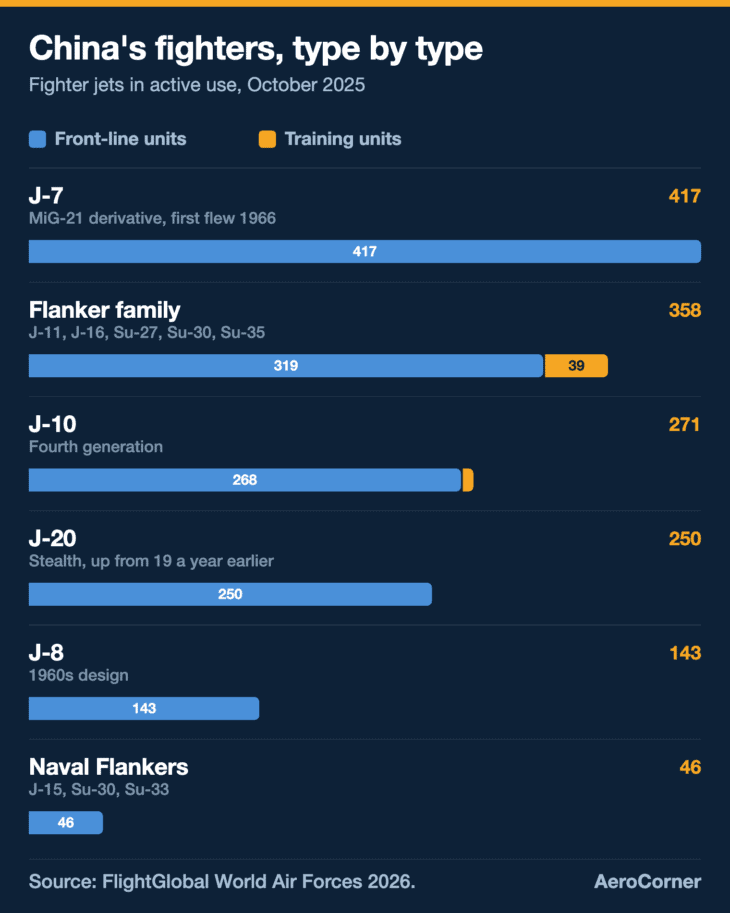
The modern core is 925 jets: the J-10, the Flanker family led by the J-16, the carrier-based J-15 and the stealthy J-20. That is 62 percent of FlightGlobal’s list.
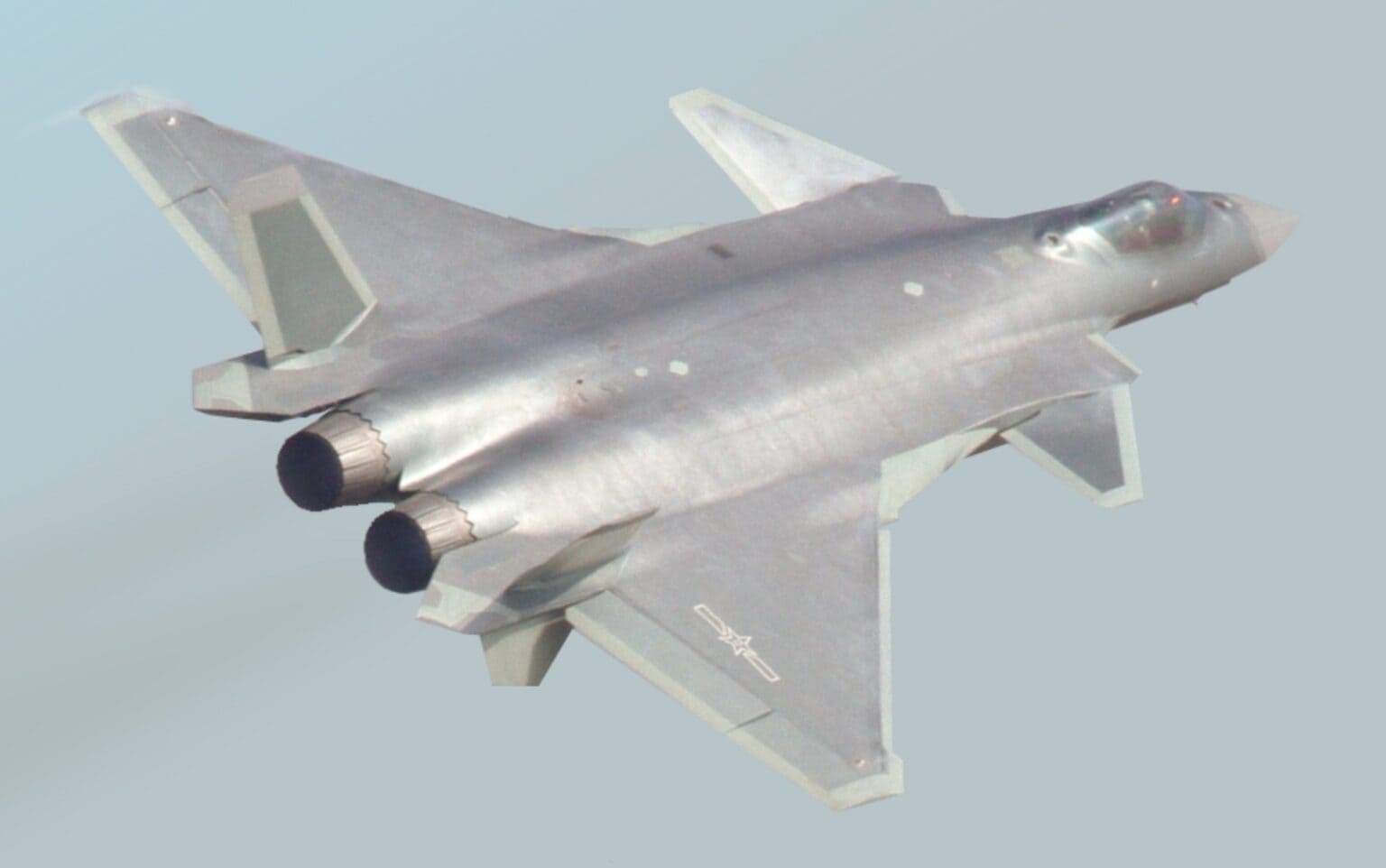
The J-20 is the jump. FlightGlobal raised its estimate to 250 operational J-20s in the 2026 edition, up from 19 the year before, after multiple sources indicated around 300 had been built.
That is more than the 177 F-22 Raptors the same directory lists for the US Air Force. Which types matter most in a fight is covered in our ranking of the best Chinese fighter jets.
Why the numbers differ
Search this question and you will see answers from about 1,400 to more than 3,500. Most of them are honest. They are counting different things, at different dates, with different access to a secretive air force.
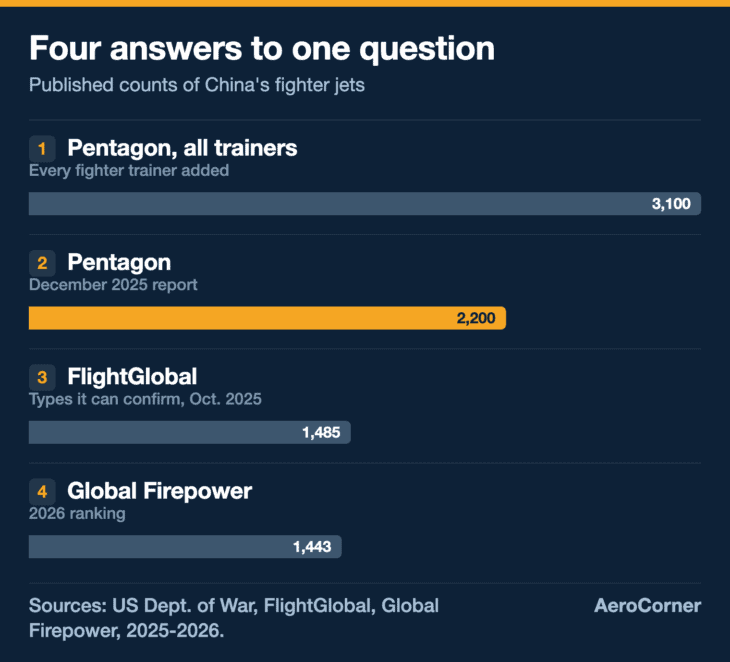
3,529 is not a fighter count at all. It is FlightGlobal’s total for every Chinese military aircraft, helicopters and transports included, which is 7 percent of the world’s military fleet.
China does not have 3,500 fighter jets
Figures of 3,500 and up are China’s whole military fleet, helicopters, transports and trainers included. Even FlightGlobal’s broader combat aircraft count, which adds bombers and attack jets to the fighters, is 1,814.
3,100 is the Pentagon’s count with every fighter trainer added. The Pentagon gave the same figure in its 2024 report.
2,200 is the Pentagon’s headline for 2025. A year earlier it said 1,900, but that figure left trainers out, while the 2025 one includes trainer versions able to fight, so the two are not a like-for-like rise of 300.
1,443 is Global Firepower’s 2026 figure. It matches FlightGlobal’s front-line fighter rows exactly, before the 42 jets in training units are added.
Then there is the problem inside FlightGlobal’s own list. It still shows 417 J-7s, a license-built derivative of the MiG-21 that first flew in 1966 and ended production in May 2013.
China began decommissioning the J-7 in 2018, with the whole fleet set to retire in 2023. A July 2025 National Defense University study, using IISS data, says almost all of the Air Force’s J-7s and J-8s have now gone.
Yet the same study counts 2,065 Air Force fighters, multirole fighters and ground-attack aircraft in 2025. If the old jets are gone, newer types the directory has not caught up with would have to fill that gap, which would explain why the IISS and Pentagon totals run hundreds above FlightGlobal’s.
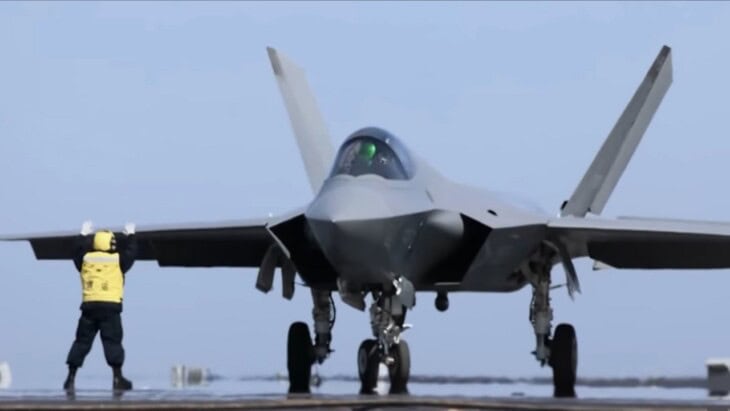
The newest type is missing from the directory. FlightGlobal has not yet added the Shenyang J-35, the carrier stealth fighter, or its Air Force version, citing a lack of confirmed details on their operational status.
How the number got here, and where it is going
China’s fighter force is smaller than it was, and far more capable. The IISS-based study counts 2,453 Air Force fighters and ground-attack aircraft in 2007, against 2,065 in 2025.
1966
The J-7 first flies. China’s license-built MiG-21 derivative enters service.
2007
2,453 fighters and ground-attack aircraft. The IISS count of the Air Force, before most of its second- and third-generation jets retired.
2013
J-7 production ends. Almost 50 years of manufacturing close in May.
2018
J-7 retirement begins. The whole fleet is set to go by 2023.
2023
Navy jets move to the Air Force. PLA Navy Aviation hands its land-based aircraft, including 300 fighter jets, to the Air Force.
December 2024
Two sixth-generation prototypes fly. The Pentagon expects them to be operational by 2035.
October 2025
250 J-20s. FlightGlobal raises its operational estimate from 19.
December 2025
About 2,200 fighters. The Pentagon’s latest count, combat-capable trainers included.
That 2023 transfer is another reason counts by service disagree. The Pentagon says PLA Navy Aviation gave 300 fighter jets to the Air Force, but FlightGlobal still lists 148 land-based fighters under the Navy, so this article’s table is best read by type.
The next changes are the J-35 entering service and the sixth-generation programs. Both will push the modern share of the fleet up, whatever the headline total does.
How many fighter jets does China have compared to the US?
Fewer, on every count that measures both countries the same way. On FlightGlobal’s numbers, the US flies about 2,900 fighter jets to China’s 1,485, as our count of how many fighter jets the US has shows by service.
Global Firepower’s 2026 ranking puts the US first with 1,791 fighters and China second with 1,443, ahead of Russia’s 861. FlightGlobal’s broader combat aircraft count gives the US 2,718 and China 1,814.
The gap matters less in one place. The 850 Chinese fighters in the two theater commands facing Taiwan are concentrated in one region, while US fighters are based around the world, a point our US vs China fighter jet comparison works through type by type.
The rest of China’s air power, from H-6 bombers to tankers and early warning jets, is in our guide to China’s air force by the numbers.
FAQ
Sources and references used for research and fact-checking.
- US Department of War, Military and Security Developments Involving the People's Republic of China 2025
- US Department of Defense, Military and Security Developments Involving the People's Republic of China 2024
- FlightGlobal, World Air Forces 2026
- Global Firepower, Fighter Fleet Strength by Country (2026)
- National Defense University Press, Joint Force Quarterly 118, Rightsizing the PLA Air Force: Revisiting an Analytic Framework
- Wikipedia, Chengdu J-7
Get the Newsletter
The latest aviation news and stories sent to your inbox.
About the Author

Tim is the owner and lead editor of AeroCorner since 2019, overseeing aviation content covering aircraft, airlines, airports, and the broader aviation industry. Through years of researching, writing, editing, and publishing aviation-focused content, he has developed extensive practical knowledge of commercial aviation and air travel. Based in Asia and a frequent traveler himself, Tim also brings firsthand passenger experience to AeroCorner’s coverage. Outside of publishing, he has also explored aviation firsthand through hands-on flight training in New Zealand.