

Table of Contents
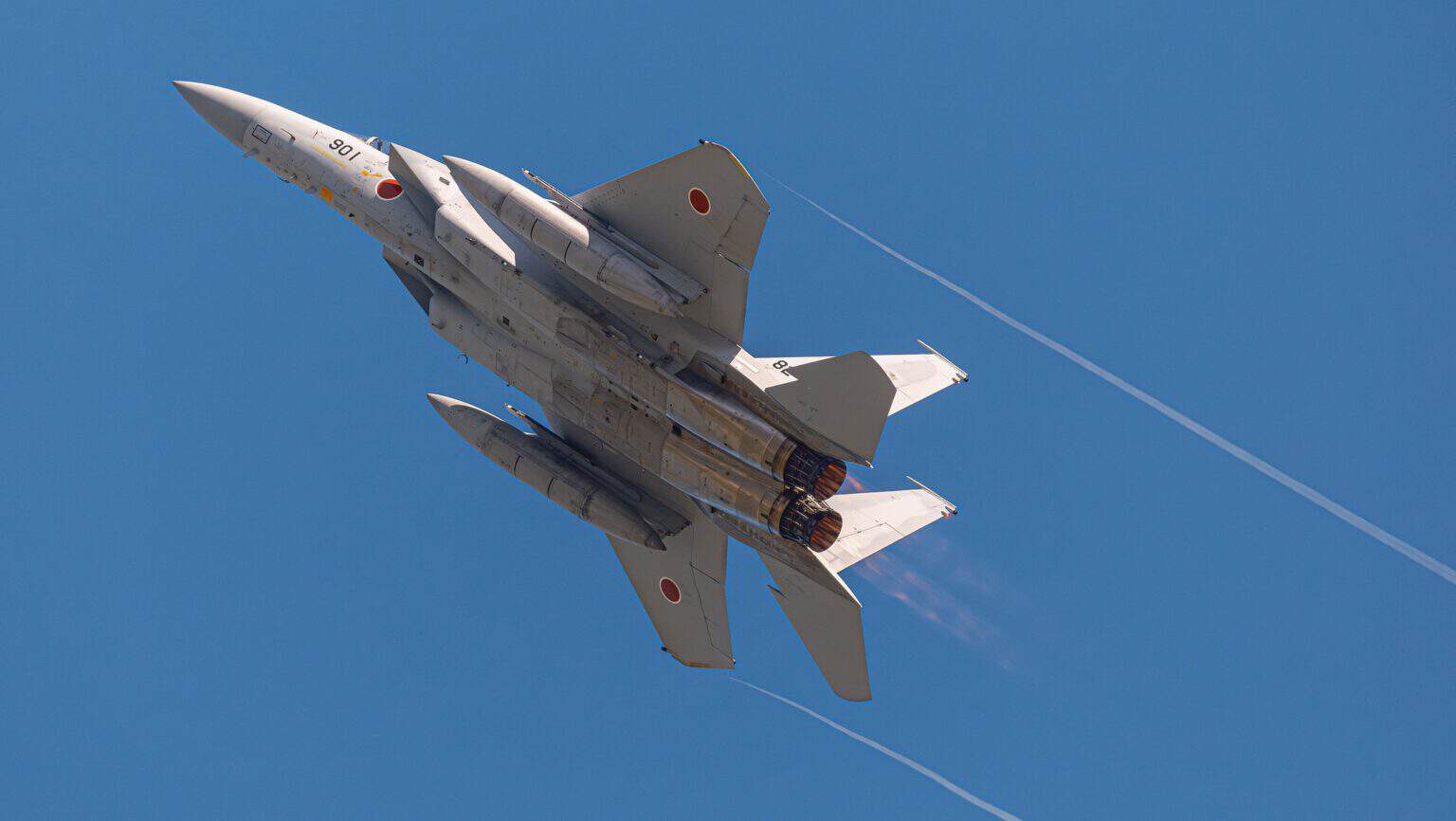
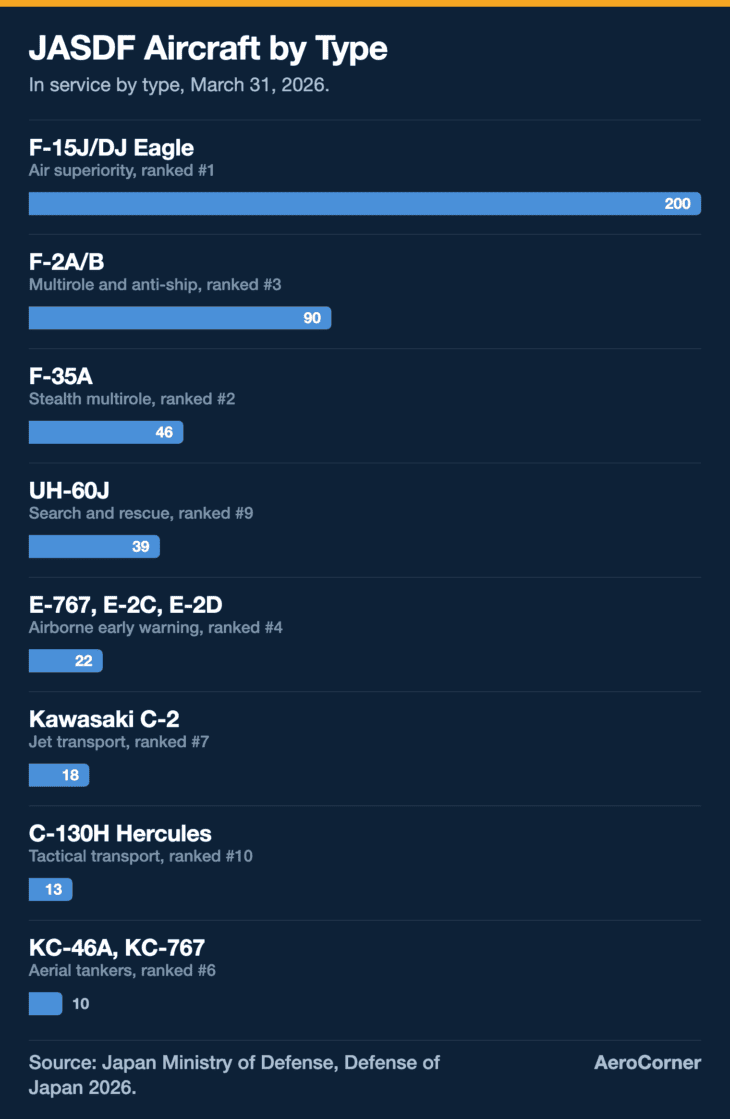
Japan’s air force is officially the Japan Air Self-Defense Force (JASDF), and its backbone is still the F-15J. Japan’s Ministry of Defense counted 200 F-15J and F-15DJ fighters on March 31, 2026, more than the F-2 and F-35 fleets combined.
The force it is turning into looks different. Japan plans to buy 147 F-35s, and it is building a new fighter with the UK and Italy for the 2030s.
This list ranks every type the JASDF flies by fighting value as of October 2026: what it adds in a war, weighed against how many Japan actually has. Counts come from the 2026 Defense of Japan white paper, with FlightGlobal’s World Air Forces 2026 directory for the types the white paper leaves out.
| Rank | Aircraft | Role | In service | On order or planned |
|---|---|---|---|---|
| 1 | F-15J/DJ Eagle | Air superiority fighter | 200 | JSI upgrade, first 20 by FY2029 |
| 2 | F-35A Lightning II | Stealth multirole fighter | 46 | 105 planned |
| 3 | F-2A/B | Multirole and anti-ship fighter | 90 | Missile upgrade |
| 4 | E-767, E-2C, E-2D | Airborne early warning | 22 | 7 more E-2D |
| 5 | F-35B Lightning II | STOVL stealth fighter | 8 | 42 planned |
| 6 | KC-46A, KC-767 | Aerial tanker | 10 | 2 more KC-46A funded |
| 7 | Kawasaki C-2 | Jet transport | 18 | More on order |
| 8 | RQ-4B Global Hawk | High-altitude spy drone | 3 (one lost Sept. 2026) | None |
| 9 | UH-60J | Search and rescue helicopter | 39 | More on order |
| 10 | C-130H Hercules | Tactical transport | 13 | None |
How this ranking works
Each type is ranked by the fighting value it adds in October 2026: sensors, weapons and upgrade state, weighed against the number in service. Counts are the Ministry of Defense’s property-register figures for March 31, 2026. Trainers, transports and VIP jets follow the ranking. Helicopters flown by the Ground and Maritime Self-Defense Forces are left out, and so are aircraft still on order.
1. F-15J/DJ Eagle: The Interceptor Japan Still Leans On
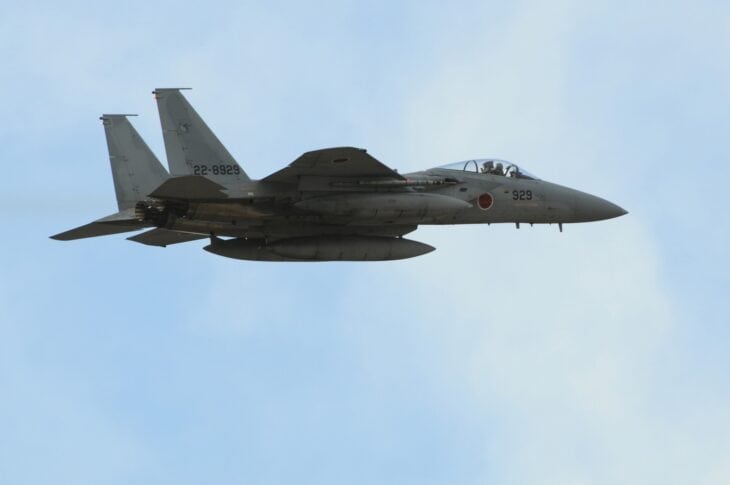

Japan’s F-15 Eagle fleet is 200 strong: single-seat F-15Js and two-seat F-15DJs on the Defense Ministry’s books. Its top speed is Mach 2.5, the fastest of any JASDF type.
They do most of the daily work. The F-15J handles most of Japan’s air defense identification zone intercepts, and Okinawa-based squadrons fly most of the scrambles, mostly against Chinese aircraft.
The best of them are being rebuilt. The Japan Super Interceptor (JSI) program covers 68 F-15Js already modernized under an earlier upgrade, starting with 20, and Japan’s acquisition agency moved completion of those 20 from the end of FY2027 to the end of FY2029.
The upgraded jets will carry the JASSM long-range cruise missile, according to the FY2026 defense budget. That gives an air-defense fighter a strike role it never had.
595 scrambles in a year
JASDF fighters scrambled 595 times in fiscal 2025, down from 704 the year before, according to Japan’s Joint Staff. About 61% were against Chinese aircraft and 36% against Russian ones. The record was 1,168 scrambles in fiscal 2016.
2. F-35A Lightning II: The Future Front Line
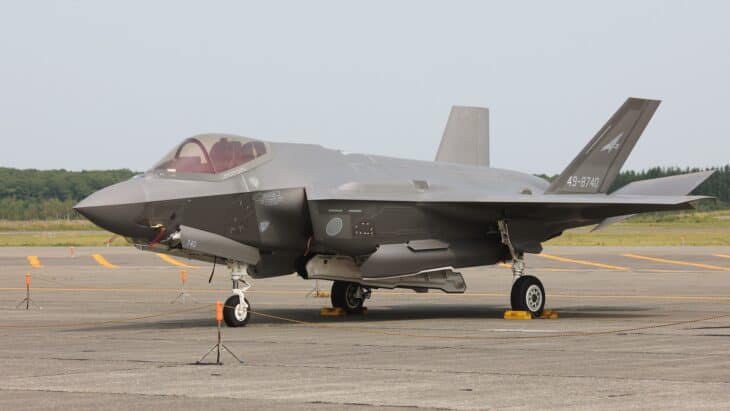
Japan had 46 F-35A stealth fighters on March 31, 2026. It plans to buy 105, and the FY2026 budget pays for eight more at ¥149.3 billion.
Misawa, in the north, was the only F-35A base until April 1, 2025, when the first three jets in the newer Technology Refresh-3 configuration arrived at Komatsu on the Sea of Japan coast. That gave Japan 41 F-35As at the time, Janes reported.
It ranks below the F-15J only on numbers. Stealth, sensor fusion and the Joint Strike Missile make it Japan’s most capable fighter jet, and by the time all 105 are delivered it will be the backbone. For the full fighter ranking, see our list of the best fighter jets of Japan.
3. F-2A/B: Japan’s Ship Killer
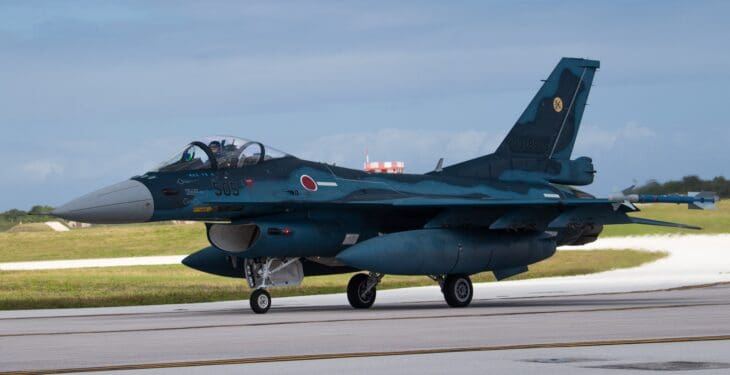

The Mitsubishi F-2 is a Japanese fighter developed from the F-16, and its signature job is attacking ships heading for Japan’s islands. The ministry counts 90 F-2A and F-2B jets.
That job is getting a longer reach. The FY2026 budget spends ¥9.7 billion to fit nine F-2s with the air-launched version of the upgraded Type-12 anti-ship missile.
The F-2 is the jet Japan’s next fighter is meant to replace. That fighter is the Global Combat Air Programme (GCAP), shared with the UK and Italy, and its joint agency signed a contract with the industry venture Edgewing on July 3, 2026, covering work through the end of 2027.
4. E-767 and E-2C/D: The Eyes Over the East China Sea
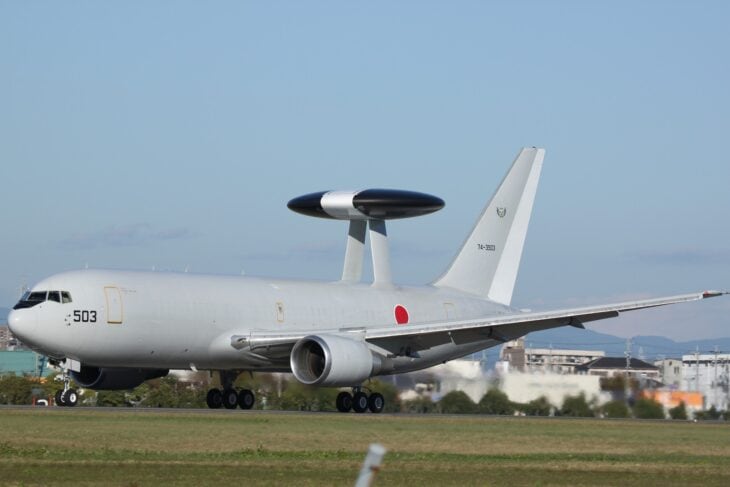

Japan flies four E-767s, airborne warning and control aircraft built on the Boeing 767 airliner. They are the largest radar planes in the fleet.
Below them sits a bigger fleet of propeller-driven radar planes: 7 older E-2C Hawkeyes and 11 newer E-2Ds, with 7 more E-2Ds on order, according to FlightGlobal. Together they spot the Chinese and Russian aircraft that trigger the scrambles.
5. F-35B Lightning II: Stealth Jets for Japan’s Carriers
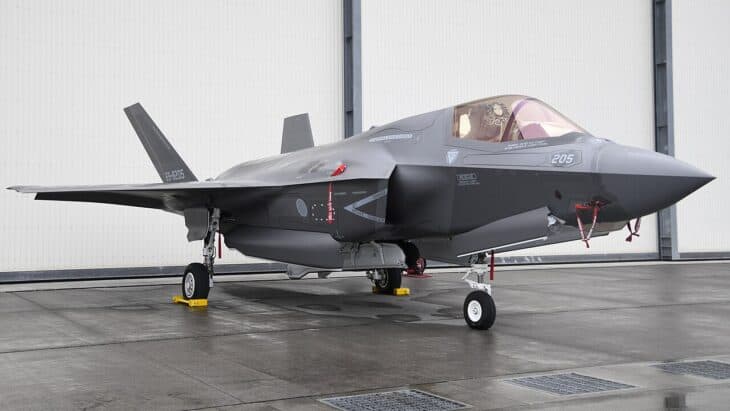
The first three F-35Bs, the short-takeoff, vertical-landing version, arrived at Nyutabaru Air Base on August 7, 2025. The ministry counted eight on March 31, 2026, the full number planned for that fiscal year.
Japan plans 42 in all, and the FY2026 budget buys three more for ¥72.5 billion. The same budget funds the work to fly them from the Navy’s Izumo-class ships.
An air base for F-35B vertical landings is being built on the uninhabited island of Mageshima, 100 miles (160 km) south of Nyutabaru, and was expected to be ready by 2030.
6. KC-46A and KC-767: The Tankers
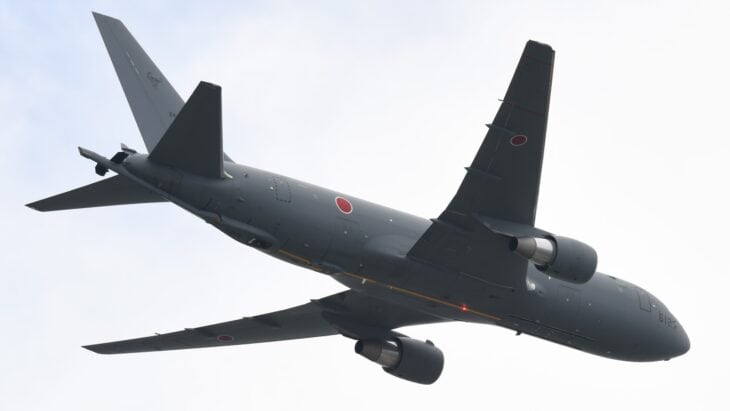

Japan’s fighters patrol a long chain of islands, and tankers keep them there. The ministry counts six KC-46A Pegasus tankers and four older KC-767s, plus three propeller-driven KC-130Hs.
The FY2026 budget buys two more KC-46As for ¥87.7 billion. FlightGlobal’s late-2025 count was lower, at four KC-46As, which shows how fast the fleet is growing.
7. Kawasaki C-2: The Homegrown Airlifter
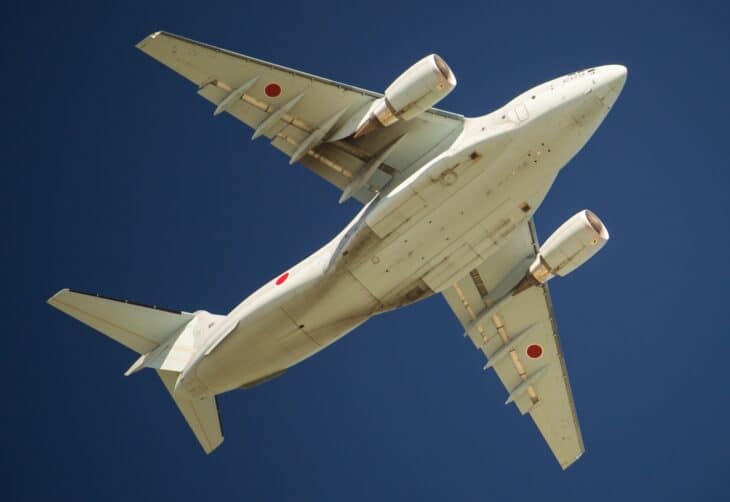

The Kawasaki C-2 is a Japanese-designed jet transport with a top speed of Mach 0.82, against about 320 knots for the propeller-driven C-130H. The ministry counts 18, and the white paper lists it among the transports Japan is buying to move troops to its southwest islands.
It replaced the Kawasaki C-1. The last transport C-1s flew on March 14, 2025, and the one-off EC-1 electronic warfare version retired the day before.
A spy version, the RC-2, flies too: FlightGlobal counts one, and the FY2026 budget buys a second for ¥50.3 billion.
8. RQ-4B Global Hawk: Down to Two
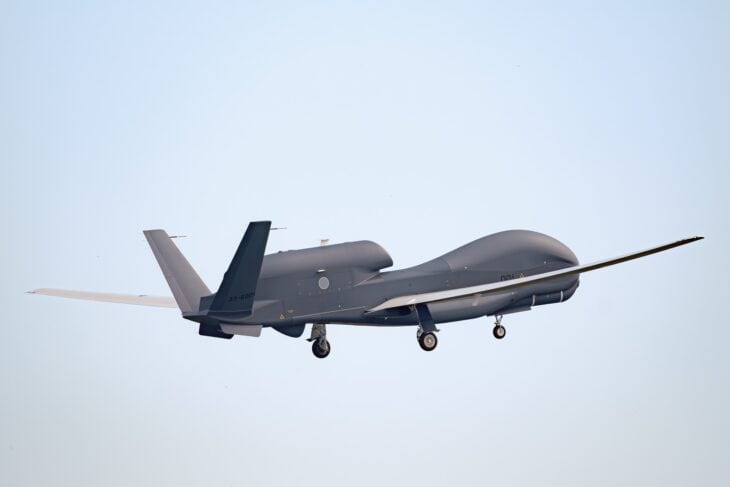
Japan bought three RQ-4B Global Hawk drones for long, high-altitude surveillance flights from Misawa. The white paper still lists three, but that count is out of date.
On September 15, 2026, Global Hawk 23-6003 lost contact about two hours and 20 minutes after taking off from Misawa and crashed in the Sea of Japan, about 31 miles (50 km) off Tottori Prefecture. That leaves two.
The search showed the whole air force
The JASDF sent two F-15Js, a U-125A rescue jet, a UH-60J helicopter and a KC-46 tanker to look for the crashed Global Hawk, alongside two navy ships. The wreckage was found within an hour of the search starting.
9. UH-60J: The Rescue Fleet
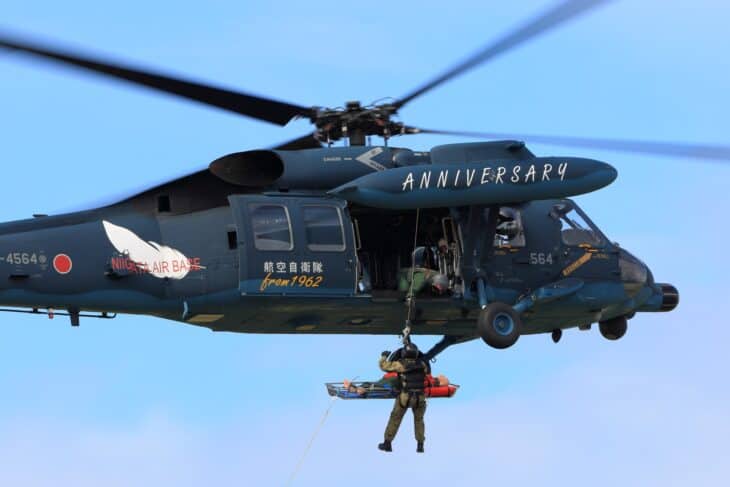

The JASDF’s rescue squadrons fly the UH-60J, a long-range rescue version of the Black Hawk. The ministry counts 39.
Sources differ here more than anywhere else: FlightGlobal counts 61 UH-60Js. They fly with the U-125A, a Hawker 800 business jet converted to find people from the air, of which FlightGlobal counts 25.
10. C-130H Hercules: The Workhorse
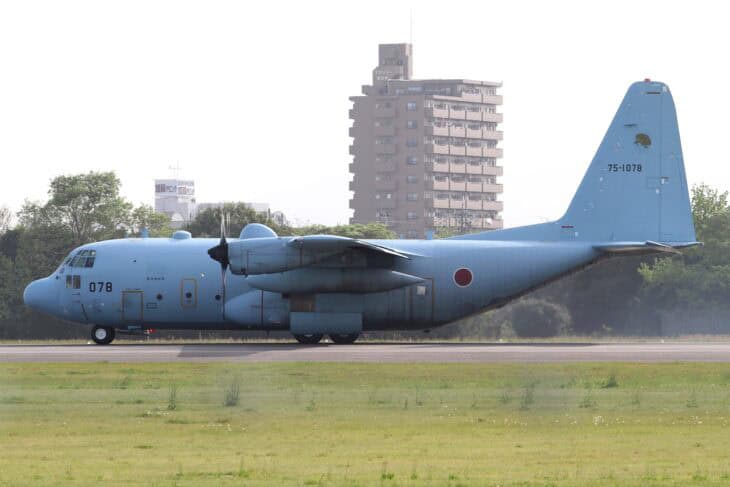
Japan flies 13 C-130H Hercules transports for short, rough runways and airdrops. They round out a transport force the C-2 is slowly taking over.
The Rest of the Fleet: Trainers, Helicopters and Japanese Air Force One
Behind the ranked types sits a large training and support fleet. The white paper does not count most of it, so these figures come from FlightGlobal’s late-2025 directory.
| Aircraft | Role | In service |
|---|---|---|
| Kawasaki T-4 | Jet trainer, Blue Impulse | 178 |
| Fuji T-7 | Basic trainer | 49 |
| T-400 (Beechjet 400) | Multi-engine trainer | 13 |
| CH-47J Chinook | Transport helicopter | 15 (ministry count) |
| U-125A (Hawker 800) | Search and rescue jet | 25 |
| U-4 (Gulfstream IV) | Utility and liaison | 5 |
| YS-11EB | Electronic intelligence | 3 |
| Boeing 777-300ER | Government transport | 2 |
The Kawasaki T-4 is the most numerous JASDF type after the F-15, and more than 200 have entered service since 1988. Japan has chosen the T-6 Texan II to replace the T-7, but it has not yet picked a successor for the T-4.
Six T-4s fly with Blue Impulse, Japan’s display team, formally the 11th Squadron of the 4th Air Wing at Matsushima. The current team has flown the T-4 since December 1995.
Japan’s equivalent of Air Force One is a pair of Boeing 777-300ERs flown by the JASDF’s Special Airlift Group from Chitose. They were received in August and December 2018 and took over from two 747-400s in April 2019.
Why It Is a Self-Defense Force, and Its New Name
Japan’s postwar constitution renounces war, so its air arm was founded on July 1, 1954, as a self-defense force rather than an air force. It had 42,324 personnel in 2026, against an authorized strength of 47,131.
It is about to change its name. On June 26, 2026, the Diet passed a law making it the Japan Aerospace Self-Defense Force, still abbreviated JASDF, to reflect its growing space role.
Is it already the Aerospace Self-Defense Force?
Not yet. The JASDF says the change happens within fiscal 2026, and Breaking Defense reports it takes effect on April 1, 2027, the start of the next fiscal year. Until then the official English name is still the Japan Air Self-Defense Force.
Japan also hosts major US air bases. Kadena, on Okinawa, home of the 18th Wing, is the largest US installation in the Asia-Pacific, and Yokota, near Tokyo, is headquarters for US Forces Japan and the Fifth Air Force.
For how the JASDF compares with its neighbors, see China’s air force, the force behind most of those scrambles, and South Korea’s air force.
FAQ
Sources and references used for research and fact-checking.
- Ministry of Defense of Japan, Defense of Japan 2026, reference volume, table 9: major aircraft holdings and specifications
- FlightGlobal, World Air Forces 2026
- Ministry of Defense of Japan, Defense Programs and Budget of Japan, FY2026
- Joint Staff, Ministry of Defense of Japan, Annual Report on JASDF fighters scramble (FY2025)
- EurAsian Times, Japan's F-15 Super Interceptor Program Slips to 2029
- Janes, Japan ramps up F-35 force posture
- The Aviationist, First Japanese F-35Bs Arrive to Nyutabaru Air Base
- Ministry of Defense of Japan, Signing of a Contract between GIGO and Edgewing
- The Aviationist, JASDF RQ-4B Crashes in the Sea of Japan
- The Aviationist, End of an Era: JASDF Dismantles C-1 Prototype 002
- Defense News, Vendors line up to fill Japan's F-35 pilot training gap
- Japan Air Self-Defense Force, About Blue Impulse
- Japan Air Self-Defense Force, Special Airlift Group history
- Japan Air Self-Defense Force, JASDF history
- Ministry of Defense of Japan, Self-Defense Forces personnel status
- Japan Air Self-Defense Force, Renaming to the Japan Aerospace Self-Defense Force
- Breaking Defense, Japan to rename air force in nod to growing space capabilities
- US Air Force, About Kadena Air Base
- US Air Force, About Yokota Air Base
Get the Newsletter
The latest aviation news and stories sent to your inbox.
About the Author

Tim is the owner and lead editor of AeroCorner since 2019, overseeing aviation content covering aircraft, airlines, airports, and the broader aviation industry. Through years of researching, writing, editing, and publishing aviation-focused content, he has developed extensive practical knowledge of commercial aviation and air travel. Based in Asia and a frequent traveler himself, Tim also brings firsthand passenger experience to AeroCorner’s coverage. Outside of publishing, he has also explored aviation firsthand through hands-on flight training in New Zealand.