Military Transport Planes
Kawasaki C-1
ICAO: C1
Japan's home-built twin-jet airlifter, big enough to carry a UH-60J helicopter.
Updated: by Tim de Vries

The latest aviation news and stories sent to your inbox.
The Kawasaki C-2 is Japan’s home-built strategic airlifter, a twin-engine jet that carries heavy vehicles, helicopters and relief cargo for the Japan Air Self-Defense Force. It first flew in January 2010 and replaces the older Kawasaki C-1. The same airframe now also flies as an electronic-intelligence aircraft, and an electronic-warfare version began flight testing in March 2026.


The Kawasaki C-2 is a twin-engine, long-range military transport built by Kawasaki Aerospace for the Japan Air Self-Defense Force (JASDF). It replaces the smaller Kawasaki C-1, the transport the JASDF had been operating before it.
Japan’s defense procurement agency says the C-2 has roughly quadruple the flying range of the C-1 and can carry approximately triple the payload. Kawasaki describes it as a domestically developed and manufactured aircraft that flies faster and farther than the C-1.
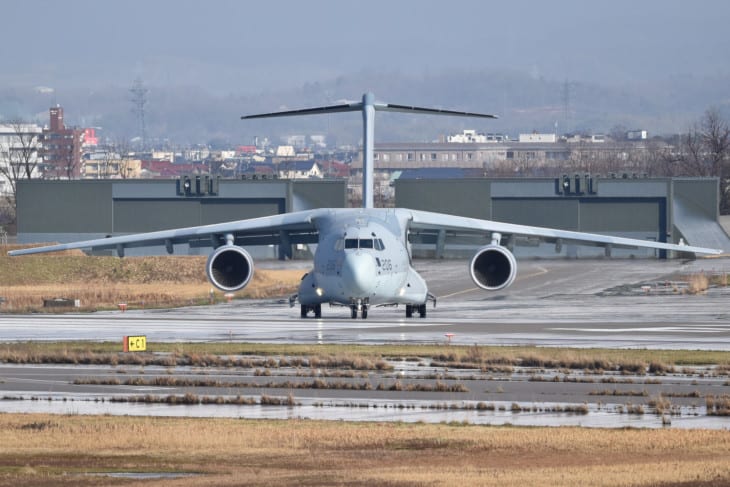
It is a high-wing jet with a T-tail, a rear cargo ramp and a crew of three. The same airframe now also flies as an electronic-intelligence aircraft, and an electronic-warfare version began flight testing in March 2026.
Around 2000, the Japanese Ministry of Defense set out a list of demands: turbofan engines, enough range to fly from Japan to Hawaii, and twice the payload of a C-130. It studied the C-130J, the C-17 and the A400M and concluded that no aircraft in production had the capabilities the JASDF required.
A request for proposals followed in May 2001, planning for 40 aircraft to replace the C-1 and C-130 fleets. Kawasaki was chosen as prime contractor in December 2001, and it developed the transport alongside the Kawasaki P-1 maritime patrol aircraft so the two could share major parts.
Development ran well behind schedule. The first airframe rolled out on July 4, 2007, after a rivet problem delayed it, and structural testing then found deformation in the horizontal stabilizer and cracks in an undercarriage trunnion.
In 2014 the rear cargo door failed pressure testing, which added about ¥40 billion to the program. Defense News put the total development cost at about ¥260 billion (U.S. $2.3 billion) in 2017.
The XC-2 prototype made its first flight at Gifu on January 26, 2010. The JASDF announced formal entry into operational service in March 2016, and the ministry declared development complete on March 27, 2017. The first three aircraft reached the 403rd Tactical Airlift Squadron at Miho the next day.
The full specification table for the aircraft is on this page. These are the figures that need context, because the same aircraft is quoted with several different payloads, ranges and speeds.
The panel lists a maximum payload of 79,500 lb (36,000 kg). That is the figure on the official Japanese specification sheet, which ties it to a 2.25 g load limit. At the stricter 2.5 g limit the same sheet lists 32 tonnes.
The 37.6 tonnes often quoted online comes from the original design requirement, which assumed maximum takeoff weight and a 2,300 m (about 7,500 ft) runway. Treat it as a design target, not the number on the datasheet.

The cargo compartment is 13 ft 1 in (4.00 m) wide and 51 ft 4 in (15.65 m) long, not counting the ramp. Cabin height is 13 ft 4 in (4.07 m) aft of the wing’s rear spar and 13 ft (3.95 m) forward of it.
That space takes eight 463L pallets, a UH-60JA helicopter, a Type 16 combat vehicle or a truck crane.
The panel’s range of 5,292 nm (6,090 mi, 9,800 km) is the ferry range, flown with no payload. Japan’s official sheet, which applies MIL-C-5011A fuel reserves, shows how fast range falls as the load rises.
With the full payload the C-2 flies 2,400 nm (4,500 km). Wikipedia’s specification block also lists 7,600 km with a 20-tonne load, a point the official sheet does not publish.
Japan’s official sheet gives Mach numbers rather than knots: 0.82 for maximum horizontal speed and 0.81 for maximum cruise. The panel’s maximum speed is 500 kt (575 mph, 926 km/h).
Its cruise speed is listed as 481 kt (554 mph, 891 km/h). Both knot figures are taken from published km/h values.
The same Mach number means a different true airspeed at different altitudes, so treat the knots as approximate.
Maximum takeoff weight is 311,000 lb (141,000 kg). The Japanese sheet gives that one figure for both maximum takeoff weight and maximum design landing weight.
Short-field performance was a core requirement. The ministry asked for takeoff and landing on short runways, with a 500 m requirement close to the C-1’s, and the panel lists a takeoff distance of 1,640 ft (500 m). The ceiling in normal operation is 43,000 ft (13,100 m).
Two General Electric CF6-80C2K1F turbofans power the C-2, each rated at 59,740 lbf (266 kN). GE says it supplied 26 CF6-80C2K1F propulsion systems after development ended in 2017, then won a 12-engine order from Japan’s defense ministry in June 2020 worth 18.8 billion yen (about $203 million).

The forward fuselage and horizontal stabilizer use the KMS6115 composite. The C-2 shares major components with the P-1, but its fuselage is substantially larger.
The crew is three: two pilots and a loadmaster. The cockpit is a glass design with fly-by-wire flight controls, a head-up display and a tactical flight management system.

Cargo loading and unloading is automated, and the aircraft carries self-protection systems. The ministry’s requirements also called for in-flight refueling and forward-looking infrared.
The JASDF is the only operator. Defense News reported in March 2026 that Kawasaki had built 18 C-2s for the service, with 16 in transport configuration after one was converted to the EC-2 and another became an RC-2.
Wikipedia’s tally of Japan’s budget documents counts aircraft ordered rather than built, and shows 21: 17 transports, three RC-2s and one stand-off jammer.
The C-2 flies with the 403rd Tactical Airlift Squadron at Miho and, since 2021, the 402nd Tactical Airlift Squadron. A C-2 made its first deployment to Japan’s base in Djibouti in November 2017.
On August 23, 2021, Japan sent one C-2 from Iruma Air Base to support the Afghanistan evacuation airlift at the request of the United States.
The fleet has no recorded hull losses as of May 2024. On June 9, 2017, a C-2 carrying six people slid off the runway at Yonago when its steering and brakes failed, and the investigation blamed pilot error. Nobody was hurt.
On May 9, 2024, a C-2 with eight aboard made an emergency landing at Niigata after a cockpit window slid open during training. Again there were no injuries.
The RC-2 is an electronic-intelligence version. A prototype was converted at Gifu in February 2018, and the type entered JASDF service at Iruma in October 2020.
The EC-2 stand-off jammer is the electronic-warfare version, built to replace the lone EC-1 that served from 1986 until it retired in 2025. It made its first flight on March 17, 2026, and Defense News says fielding is planned for March 2027.
Kawasaki also studied a civil freighter, the YC-X, with a heavier payload. No civil version has entered service.
Japan relaxed its defense export rules and began promoting the C-2 in 2015, showing it at the Dubai Airshow in November 2017, the Royal International Air Tattoo in July 2018 and the Australian International Airshow in 2019. Defense News reported in 2017 that Japan was in talks with several potential customers, with New Zealand and the UAE rumored to be interested.
New Zealand’s cabinet approved five C-130J-30 Super Hercules aircraft in May 2020 to replace its aging C-130H fleet. As of October 2026 the JASDF is still the only C-2 operator, and no export contract has been reported.
The closest rival by payload is the Airbus A400M, whose spec block lists 37,000 kg (81,600 lb) of capacity. That is within a tonne of the C-2’s 79,500 lb (36,000 kg), though the A400M is a turboprop and the C-2 is a jet.
The C-17 Globemaster III is in a heavier class, with 170,900 lb of cargo. The Japanese requirement was written around twice the payload of a C-130, so the C-2 sits between the C-130J Super Hercules and the C-17.
The Embraer C-390 Millennium lists 26,000 kg of capacity, the same figure as the C-2’s minimum payload requirement. For more heavy lifters, see our guide to the largest cargo planes.
The Kawasaki C-2 is a twin-engine strategic transport built in Japan for the Japan Air Self-Defense Force. It first flew on January 26, 2010, and replaces the Kawasaki C-1.
The JASDF was paying about ¥20 billion, or $176 million, per aircraft in November 2017, according to Defense News. The article does not say what that price includes.
The listed price on this page is $176 million (2017). Development cost about ¥260 billion on top, and prices for an export customer would differ.
The only operator of the Kawasaki C-2 is the JASDF, Japan’s air force, so no navy flies it. The question usually refers to the U.S. Navy’s Grumman C-2A Greyhound, a carrier delivery aircraft, which is a different airplane.
The Navy flew its last Greyhound on July 28, 2026, to NAS Pensacola, where it will go on display at the National Naval Aviation Museum. The CMV-22B Osprey has taken over carrier onboard delivery.
The listed takeoff distance is 1,640 ft (500 m), which matches the ministry’s short-runway requirement. Heavier loads need more: the 37.6-tonne design payload assumed a 2,300 m (about 7,500 ft) runway.
It uses two General Electric CF6-80C2K1F turbofans, each rated at 59,740 lbf (266 kN).
The A400M lists 37,000 kg (81,600 lb) of capacity against the C-2’s 79,500 lb (36,000 kg), so they are close. The C-17 lists 170,900 lb of cargo, roughly double.
Not yet. As of October 2026 the JASDF is the only operator and no export order has been reported.
Sources and references used for research and fact-checking.