

Table of Contents
The Blue Angels are the U.S. Navy and Marine Corps demonstration team, flying six twin-engine F/A-18 Super Hornet fighters from Pensacola, Florida. The Red Arrows are the Royal Air Force Aerobatic Team, flying single-engine BAE Hawk T1 trainers from RAF Waddington in Lincolnshire, England.
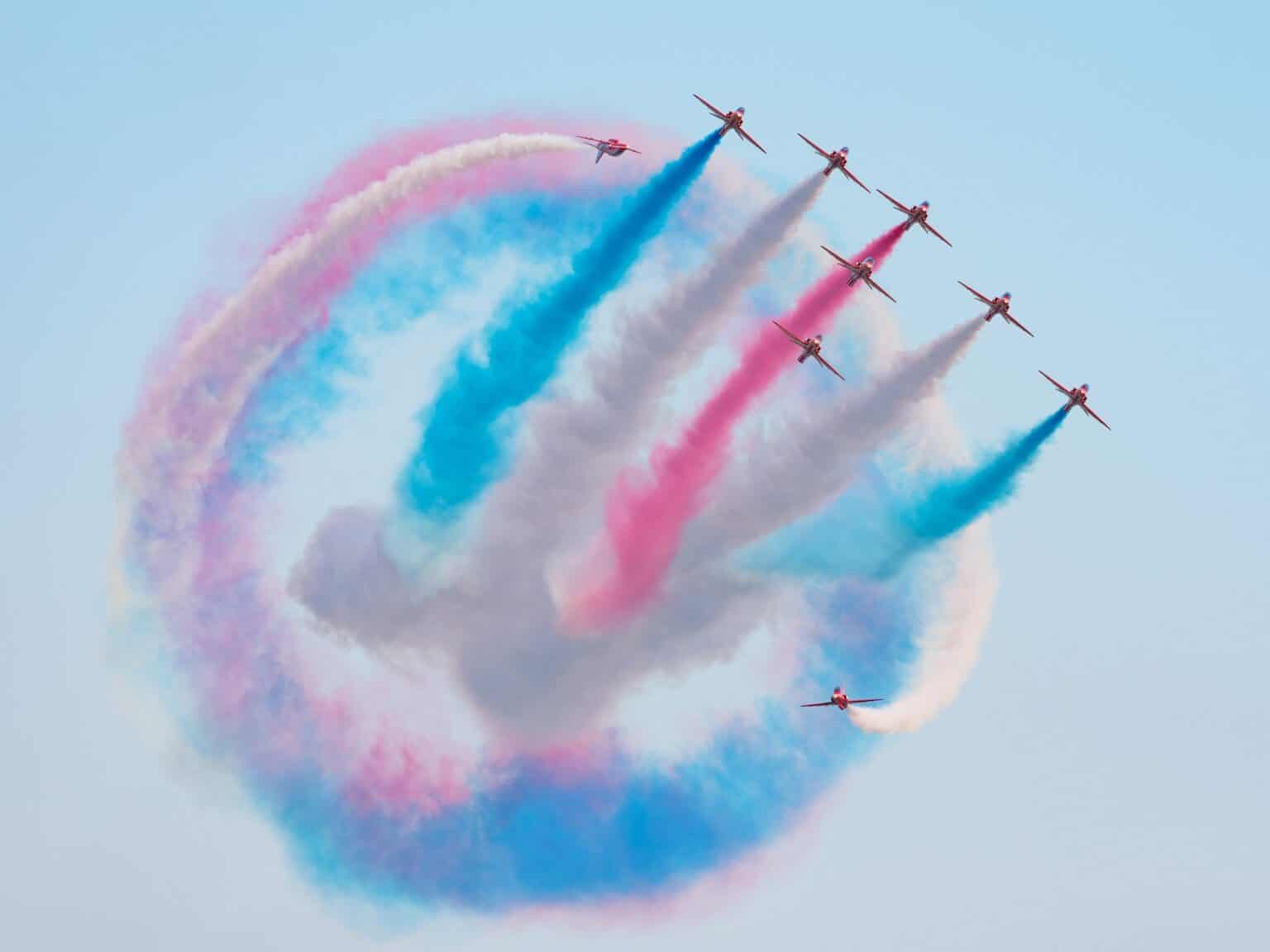
That is the real difference: a small group of frontline fighters flown very close against a bigger formation of light trainers. The Blue Angels fly as close as 18 inches apart, while the Red Arrows’ trademark is the big shape, flown with seven jets in 2026 instead of the usual nine.
Below, the two teams are compared on the figures each service publishes, as of October 2026: the jets, the size of the show, the spacing, the smoke, the pilots, and the 2026 season, when both teams shared three American airshows. For each team’s full story, see our guides to the Blue Angels and the Red Arrows.
| Criterion | Blue Angels | Red Arrows |
|---|---|---|
| Service | U.S. Navy and Marine Corps | Royal Air Force |
| Formed | 1946 (first show June 15, 1946) | 1964 (displaying since 1965) |
| Home base | NAS Pensacola, Florida | RAF Waddington, Lincolnshire |
| Show jet | Boeing F/A-18E/F Super Hornet, twin-engine fighter, since November 2020 | BAE Hawk T1, single-engine two-seat trainer, since 1979 |
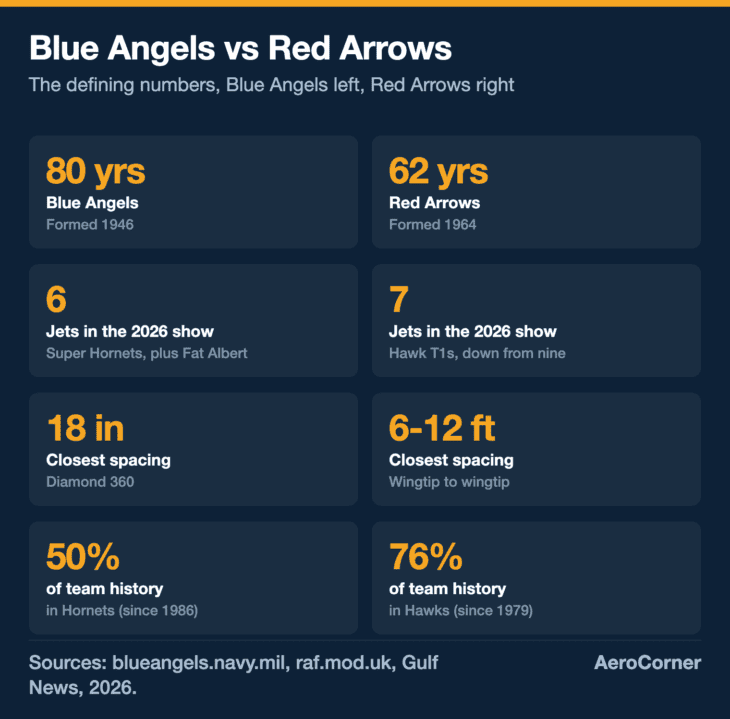
| Jets in the 2026 display | 6, plus the C-130J Fat Albert | 7 (9 kept for major flypasts) |
| Jet’s top speed | About 1,400 mph, just under Mach 2 | Mach 1.2 |
| Fastest speed in the show | About 700 mph (Sneak Pass), just under Mach 1 | 700 to 800 mph closing speed for the two Synchro Pair jets combined |
| Closest spacing | 18 inches (Diamond 360) | About 6 to 12 feet, wingtip to wingtip |
| Smoke | Biodegradable paraffin-based oil | Hydrotreated vegetable oil since 2025, with dye for red and blue |
| Team size | 158 Sailors and Marines (2026) | About 150 people (2026) |
| 2026 season | 32 show sites, March 14 to November 7 | Nearly 40 displays in 11 countries, late May to early October |
How we compared
Figures come from the Blue Angels’ own FAQ, team page and 2026 show schedule, and from the RAF’s Red Arrows pages and 2026 news releases, all opened on October 26, 2026. The RAF publishes no spacing or display-speed figures, so those come from Wing Commander David Montenegro, then the Red Arrows’ commander, in a 2021 Gulf News interview. Shared airshows: the Red Arrows flew five US airshows in 2026, and three of them (Baltimore, Jones Beach and Brunswick) are also on the Blue Angels’ published schedule, so 3 of 5, or 60%. Share of team history in the current jet family: Hawks since 1979 is 47 of the Red Arrows’ 62 years since 1964, or 76%; Hornets since 1986 is 40 of the Blue Angels’ 80 years, or 50%.
The jets: a carrier fighter vs a trainer
The Blue Angels fly the Boeing F/A-18 Super Hornet, which became the team’s jet in November 2020. It has two General Electric F414 engines of 22,000 pounds of thrust each, and the team puts its top speed at about 1,400 mph, just under Mach 2.
The show jets are fleet jets with three changes: the nose cannon comes out, a smoke-oil tank goes in, and a spring is fitted to the control stick. The Navy says each one can be back on combat duty aboard an aircraft carrier within 72 hours.

The Red Arrows fly the BAE Hawk T1, a two-seat jet built to train fighter pilots, with one Rolls-Royce Turbomeca Adour Mk 151 turbofan. The team took delivery of its first Hawks in 1979, replacing the Folland Gnat it was founded with.
Its top speed is Mach 1.2, Gulf News reported in 2021, and it cruises at around 400 mph, according to Wing Commander David Montenegro, who then led the team. Since 2022 the Red Arrows have been the last UK operator of the Hawk T1, which is due to leave service in March 2030, and the Ministry of Defence has not yet picked a successor.
The fleet’s age shows. After a Hawk T2 trainer crashed near RAF Valley on September 23, 2026, the RAF paused all Hawk T1 and T2 flying as a precaution, and the Red Arrows were back in the air for their season finale at IWM Duxford in early October.

The takeaway: the Blue Angels show off a frontline carrier fighter, while the Red Arrows show off pilots in a light, forgiving trainer that has flown with the team for 47 years.
How many jets fly in each show
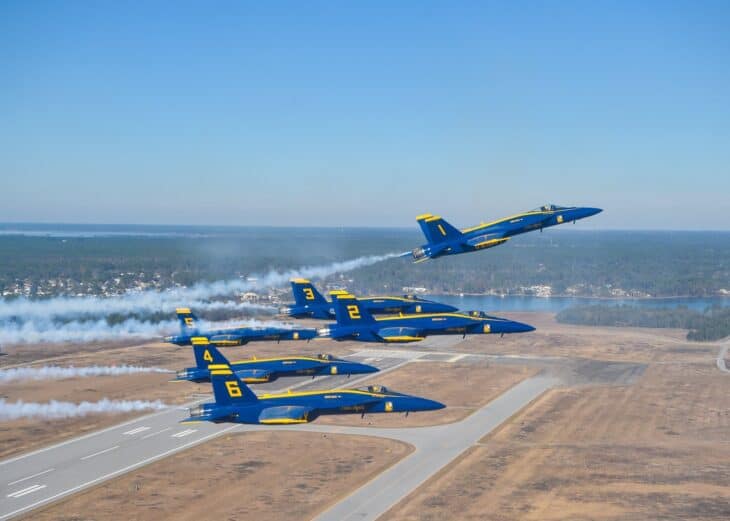
The Blue Angels fly six jets: a four-ship Diamond and two solos. A seventh performer joins the act, Fat Albert, a C-130J Super Hercules flown by seven Marines, and the team has flown a C-130 since 1970.

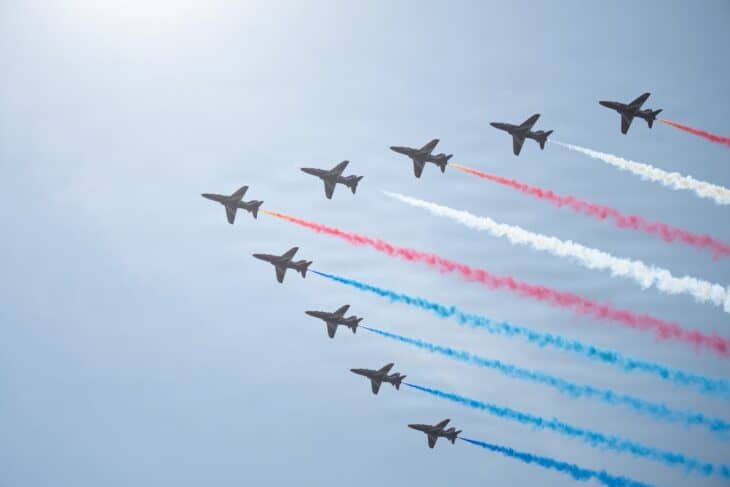
The Red Arrows have flown nine display jets for most of their history, and the Diamond Nine is their trademark shape. In the traditional nine-jet show, Reds 1 to 5 fly close formation in the second half, while Reds 6 to 9 fly the more dynamic moves, including the Synchro Pair’s head-on passes.
That changed in 2026. On May 23, the RAF said the team would fly seven jets for most displays to conserve Hawk T1 spares and flight hours, keeping all nine for big occasions such as commemorative flypasts.
What I’m particularly proud of from the 2026 season is that we didn’t stand still, despite reducing aircraft numbers in the formation to seven jets.
Wing Commander Jon Bond, Red 1 in 2026, Royal Air Force, October 2026
The 2026 show brought back maneuvers not flown for 30 years, including a finale called Cascade, last flown in 1997: a loop to around 6,500 feet in front of the crowd that fans out into a wall formation.
The takeaway: even cut to seven, the Red Arrows’ formation is bigger than the Blue Angels’ six, and only the Navy brings a cargo plane into the act.
Speed and spacing: 18 inches vs six feet
The Blue Angels’ closest flying is the Diamond 360, with 18 inches between jets. Their fastest pass is the Lead Solo’s Sneak Pass at about 700 mph, just under Mach 1, and the team says it is not authorized to break the sound barrier at a show.
The RAF does not publish spacing or speed figures for the Red Arrows. Montenegro told Gulf News in 2021 that the formation flies about 6 to 12 feet apart, wingtip to wingtip, in the first half of the show.
The Red Arrows’ fastest moment is the Synchro Pair’s head-on cross, at a closing speed of around 700 to 800 mph. That is two jets combined, so each Hawk flies at roughly half the speed of a Blue Angels solo on the Sneak Pass.
The takeaway: the Blue Angels fly faster and closer, while the Red Arrows trade speed and spacing for bigger shapes in the sky.
The smoke: white oil vs red, white and blue
The Blue Angels make their smoke by pumping biodegradable, paraffin-based oil into the engine exhausts, where it vaporizes at once. Their smoke is white, and the team says it lets the crowd trace the flight path and helps the solos see each other during opposing maneuvers.
The Red Arrows carry a pod under each Hawk with three tanks, and dye in two of them gives the team its red, white and blue trails. For decades the fuel was road diesel. In June 2025 the team began using hydrotreated vegetable oil instead, a world first in this use, according to its senior engineering officer, Squadron Leader Andy King.
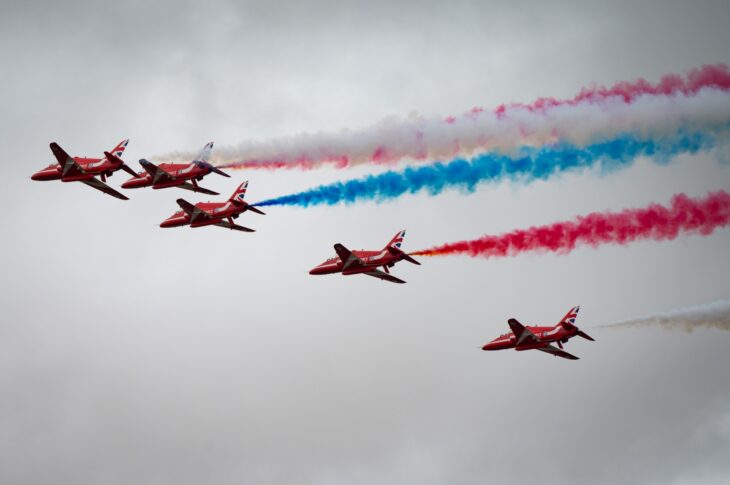

The takeaway: if the trails are colored, you are watching the Red Arrows.
The pilots and the people
Every Blue Angels demonstration pilot must be a career-oriented, carrier-qualified, active-duty Navy or Marine Corps pilot. More than 260 have flown with the team, and officers serve two to three years before returning to the fleet.
Red Arrows pilots need at least 1,500 flying hours, a completed frontline operational tour and an above-average assessment, and they serve three years. All of them have flown frontline aircraft such as the Typhoon, so the trainer they fly at shows is a step down in performance, not in skill.
The Red Arrows’ leader, Red 1, must be a former team display pilot. Squadron Leader James Turner took over in October 2026 as the 25th leader since 1964, and in January 2026 Wing Commander Sasha Nash became the first woman to command the team.
Both teams are mostly ground crew. The Blue Angels number 158 Sailors and Marines in 2026, and the RAF puts the whole Red Arrows team at about 150 people.
The takeaway: two teams of about the same size, each drawing pilots from its own service’s frontline squadrons for short tours.
Getting to the show: why the Red Arrows got stuck in Canada
Blue Angels pilots fly their own jets to each show site. The team says an F/A-18 can cover about 1,000 miles on a full load of fuel without external tanks, so even a coast-to-coast move takes only a few fuel stops.
The Red Arrows’ Hawks have a limited range and cannot refuel in the air. To reach the United States in 2026, the team flew in stages through Scotland, Iceland, Greenland and Canada, with two A400M Atlas transports, a P-8 Poseidon for search-and-rescue cover and an Envoy for command and control.
On the way home, prolonged bad weather held the jets at Canadian Forces Base Goose Bay, in Newfoundland and Labrador. The team missed three UK events in August, including the Eastbourne airshow, before landing back at RAF Waddington on August 17.
Safety is the only factor that will determine the timing of the team’s return from Canada.
Wing Commander Sasha Nash, Officer Commanding, Royal Air Force Aerobatic Team, Royal Air Force, August 2026
Myth: the Red Arrows fly fighter jets like the Blue Angels
The Hawk T1 is a two-seat advanced trainer, the jet the RAF used to teach students before they moved on to fighters. It has one engine, a top speed of Mach 1.2 and no air-to-air refueling, which is why the 2026 US tour crossed the Atlantic in hops and waited out the weather at Goose Bay. The pilots are frontline fighter pilots; the jet is not a fighter.
The takeaway: the Blue Angels can go almost anywhere in the US on short notice, while every Red Arrows trip across an ocean is a planned operation.
The 2026 season, and the three shows they shared
The Blue Angels’ 2026 schedule lists 32 show sites, from MCAS Yuma, Arizona, on March 14 to the homecoming show at NAS Pensacola on November 6 and 7. The team marks its 80th year in 2026.
The Red Arrows’ season ran from late May, with the first UK show at the English Riviera Airshow, to a finale at IWM Duxford in early October: nearly 40 displays in 11 countries. It was the team’s 62nd season.
The US tour, called Operation Eagle Hawk, marked 250 years of American independence. The Red Arrows flew five airshows and closed the July 4 international flypast over the Hudson River in New York, then made their first-ever appearance at EAA AirVenture Oshkosh.

Three of the Red Arrows' five US airshows had the Blue Angels too
Put the two 2026 schedules side by side and three dates match: Airshow Baltimore on June 27 and 28, the Jones Beach air show in New York on July 5 and 6, and the Great State of Maine Air Show in Brunswick on July 11 and 12, where the Blue Angels headlined. By contrast, the Blue Angels say Defense Department policy usually keeps them at least 150 miles from the Air Force Thunderbirds, because both teams recruit for the U.S. military.
The takeaway: the Blue Angels fly a long American season, while the Red Arrows fly a shorter, more international one, and 2026 was the rare year American crowds could see both on the same day.
Eighty years vs sixty-two: how each team began
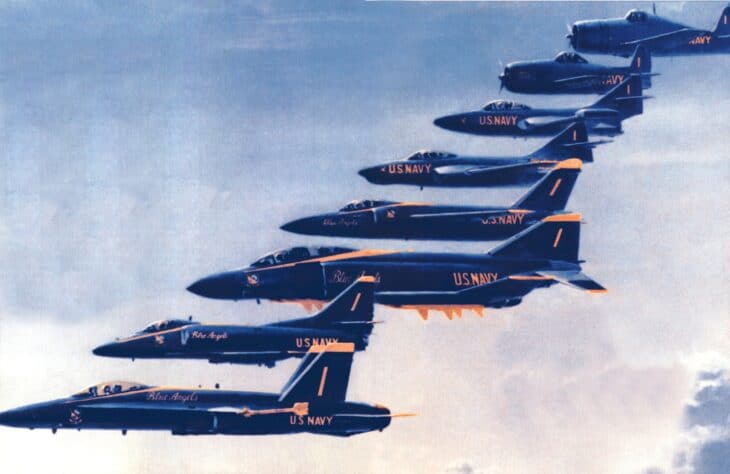
The Blue Angels are the older team by 18 years. Admiral Chester Nimitz ordered the team formed on April 24, 1946, and it flew its first show at Craig Field in Jacksonville, Florida, on June 15, 1946, in propeller-driven F6F Hellcats.

The Red Arrows were formed in late 1964 as an all-RAF team, replacing several unofficial squadron teams, and started with seven Folland Gnat trainers. They grew to nine jets within a few seasons and moved to the Hawk in 1979.
The Blue Angels have flown nine aircraft types, ending with the Hornet family since 1986: 40 of their 80 years, or 50%. The Red Arrows have flown just two, and the Hawk accounts for 47 of their 62 years, or 76%.
The takeaway: the Navy team is older and changes jets with the fleet, while the RAF team has built its identity on one British trainer.
The difference in one sentence
The Blue Angels are the Navy and Marine Corps flying six Super Hornet fighters 18 inches apart with white smoke, and the Red Arrows are the Royal Air Force flying seven to nine Hawk trainers a few feet apart in red, white and blue.
Neither is better, because they are built to show different things: the Blue Angels show off a combat jet, the Red Arrows show off a formation. If you want the closest comparison with another American team, see Blue Angels vs Thunderbirds.
FAQ
Sources and references used for research and fact-checking.
- U.S. Navy Blue Angels, Frequently Asked Questions
- U.S. Navy Blue Angels, The Team
- U.S. Navy Blue Angels, 2026 Show Schedule
- Royal Air Force, Red Arrows overview
- Royal Air Force, Red Arrows to tour US during 2026 season
- Royal Air Force, Busy 2026 season begins for Red Arrows
- Royal Air Force, Return of Red Arrows from North America and recommencement of season
- Royal Air Force, Red Arrows home after successful US tour
- Royal Air Force, Final 2026 Red Arrows display concludes busy season
- Royal Air Force, Record-breaking Red 1 among 2026 pilots saying farewell
- Royal Air Force, New Team Leader 'excited' to start work on 2027 display
- The Aviationist, Ageing Hawk T1s Force Red Arrows Down to Seven Jet Formation for Most Displays
- Gulf News, Watch the Red Arrows fly over Expo 2020 Dubai as a pilot narrates his journey
- IOM3, Flying the flag
- Wikipedia, Red Arrows
- Aerospace Global News, RAF grounds Hawk T1 and T2 fleets after trainer crash in Wales
- WGME, Blue Angels set to soar over Brunswick during Great State of Maine Air Show
Get the Newsletter
The latest aviation news and stories sent to your inbox.
About the Author

Tim is the owner and lead editor of AeroCorner since 2019, overseeing aviation content covering aircraft, airlines, airports, and the broader aviation industry. Through years of researching, writing, editing, and publishing aviation-focused content, he has developed extensive practical knowledge of commercial aviation and air travel. Based in Asia and a frequent traveler himself, Tim also brings firsthand passenger experience to AeroCorner’s coverage. Outside of publishing, he has also explored aviation firsthand through hands-on flight training in New Zealand.