

Table of Contents
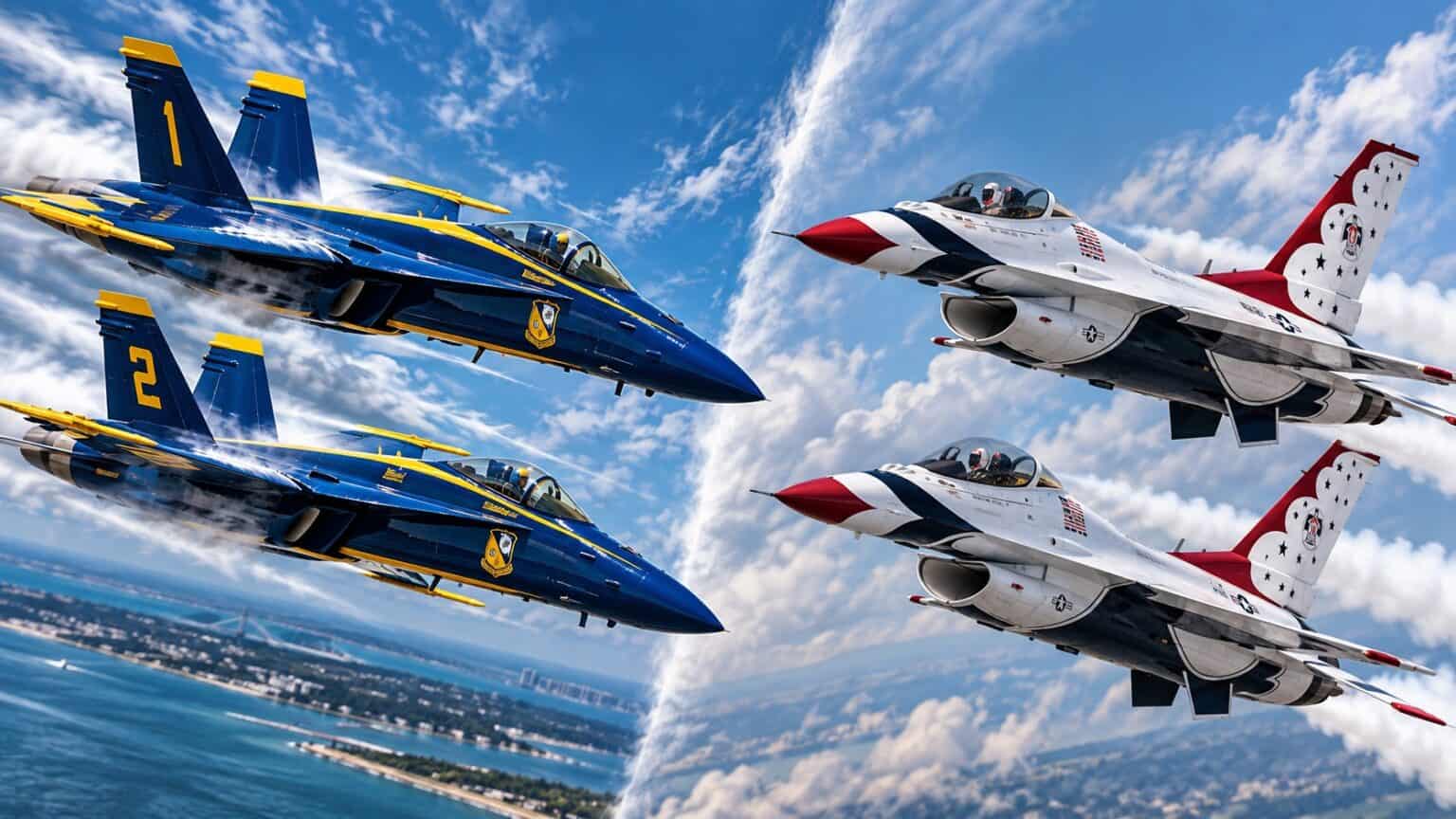
The Blue Angels are the Navy and Marine Corps demonstration team, flying twin-engine F/A-18 Super Hornets from Pensacola, Florida. The Thunderbirds are the Air Force team, flying single-engine F-16 Fighting Falcons from Nellis Air Force Base, Nevada.
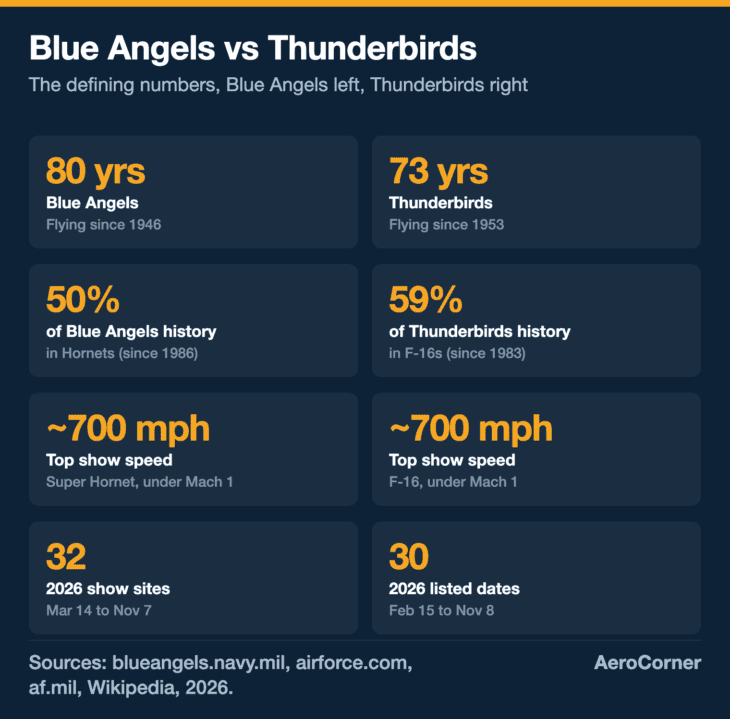
That is the real difference: the service and the jet. Neither team is faster at a show, because both top out around 700 mph, just under the speed of sound, and both fly as close as 18 inches apart.
Below, the two are compared on the figures each service publishes, as of September 2026: the jets, the speed, the show, the pilots, the bases and schedules, and the safety record. For each team’s full story, see our guides to the Blue Angels and the Thunderbirds.
| Criterion | Blue Angels | Thunderbirds |
|---|---|---|
| Service | U.S. Navy and Marine Corps | U.S. Air Force |
| Founded | 1946 (first show June 15, 1946) | 1953 |
| Home base | NAS Pensacola, Florida; winter training at NAF El Centro, California | Nellis AFB, Nevada |
| Show jet | Boeing F/A-18E/F Super Hornet, twin-engine, since November 2020 | Lockheed Martin F-16C/D Fighting Falcon, single-engine; F-16s since 1983 |
| Jet’s published top speed | Mach 1.8+ | 1,500 mph (Mach 2 at altitude) |
| Top speed in a show | About 700 mph, just under Mach 1 | About 500 to 700 mph for the solos, just under Mach 1 |
| Support aircraft in the show | C-130J Fat Albert, flown by Marines | None |
| G-suits | Not worn | Worn |
| 2026 season | 32 show sites, March 14 to November 7 | 30 listed dates, February 15 to November 8 |
| Team size | 158 Sailors and Marines (2026) | About 145: 8 pilots, 4 support officers, 3 civilians, 130+ enlisted |
How we compared
Figures come from each team’s official pages, the Air Force fact sheets for the Thunderbirds and the F-16, and the Navy’s F/A-18 fact file, all opened on September 27, 2026. The 2026 counts are the listings on each team’s published schedule: 32 Blue Angels show sites, and 30 Thunderbirds dates including the Daytona 500 flyover. Show speed as a share of top speed: 700 / 1,500 = 47% for the F-16, and 700 / 1,400 = 50% for the F/A-18, using the roughly 1,400 mph the Blue Angels give for their jet. Share of team history in the current jet family: Hornets since 1986 is 40 of 80 years, or 50%; F-16s since 1983 is 43 of 73 years, or 59%. Accident counts come from Wikipedia’s team histories, because we found no single official tally from either service.
The jets: Super Hornet vs F-16
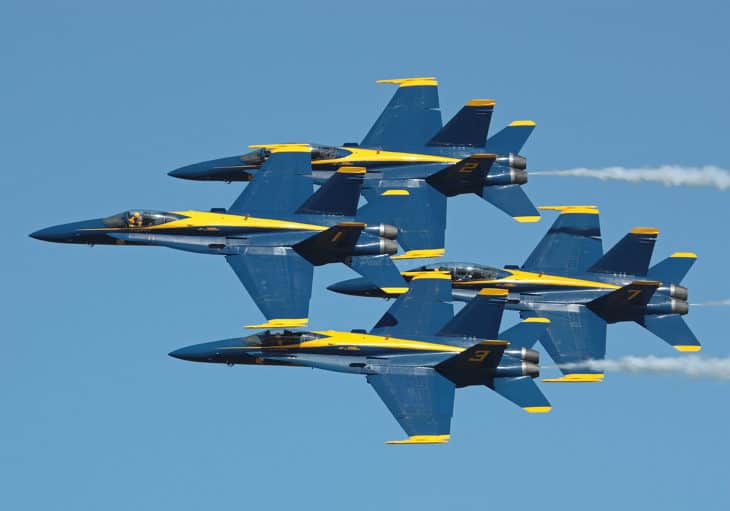
The Blue Angels fly the Boeing F/A-18 Super Hornet, which replaced the older Hornet as the team’s jet in November 2020. It has two General Electric F414 engines of 22,000 pounds of thrust each, and it is built to fly off an aircraft carrier.
The show jets are close to fleet standard. The Navy removes the nose cannon, adds a smoke-oil tank and fits a spring to the control stick, and says each jet can be back on combat duty aboard a carrier within 72 hours.
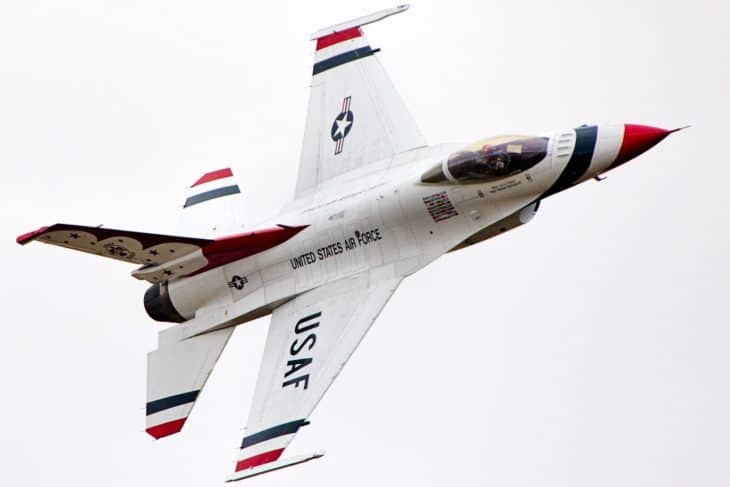
The Thunderbirds fly the Lockheed Martin F-16 Fighting Falcon: six single-seat F-16Cs and two two-seat F-16Ds. The team has flown some version of the F-16 since 1983, and the current F-16C since 1992.
The Air Force says the only changes are a smoke system in the space normally used for the 20mm cannon and the red, white and blue paint. Like the Blue Angels’ jets, the Thunderbirds’ F-16s can be made combat-ready in less than 72 hours.
The takeaway: two engines and a carrier jet for the Navy, one engine and a land-based fighter for the Air Force, both flown almost exactly as the fleet flies them.
Who flies faster, the Blue Angels or the Thunderbirds?
On paper, the F-16 is the faster jet. The Air Force lists it at 1,500 mph, Mach 2 at altitude, while the Navy lists the Super Hornet at Mach 1.8 and up.
At an air show, that gap disappears. The Blue Angels’ fastest pass is about 700 mph, just under Mach 1, flown by the Lead Solo on the Sneak Pass, and the team says it is not authorized to exceed the speed of sound at a show.
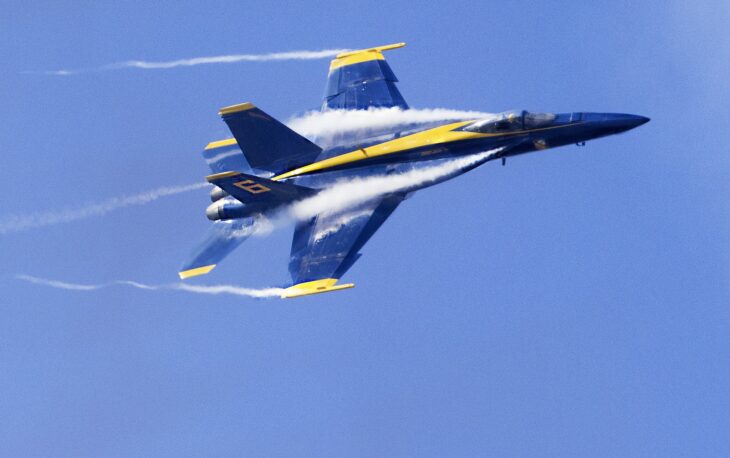
The Thunderbirds’ solos fly their passes at about 500 to 700 mph, also just under the speed of sound. So both teams fly their fastest pass at roughly half of what the jet can do: about 47% for the F-16 and 50% for the F/A-18.
Myth: the Thunderbirds are faster because the F-16 is a Mach 2 jet
The F-16’s 1,500 mph top speed is a figure at altitude, and no air show crowd ever sees it. Both teams cap their fastest pass at about 700 mph, just below the speed of sound, so a sonic boom is not part of either show. What spectators sometimes take for a boom is engine noise at high power close to the speed of sound, according to the Blue Angels.
The takeaway: the F-16 wins the spec sheet, but in front of a crowd the two teams fly at the same top speed.
The show: formations, G-suits and Fat Albert
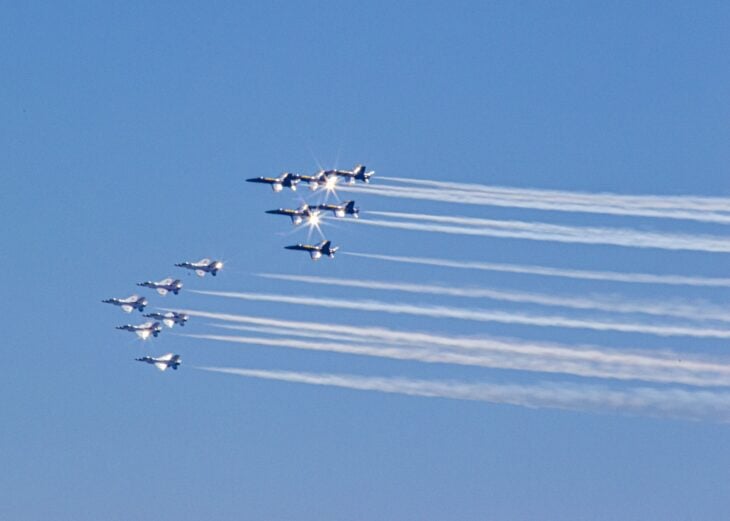
Both shows use the same six-jet format: a four-ship Diamond, numbers 1 through 4, and two solos, numbers 5 and 6. The Diamond shows off precision, and the solos show off what the jet can do alone.
Both teams also fly as close as 18 inches apart. For the Blue Angels that is the Diamond 360; for the Thunderbirds it is the Arrowhead loop, with 18 inches between one jet’s fuselage and the next jet’s canopy.
.jpg)
The biggest difference in the cockpit is the G-suit. Blue Angels pilots do not wear one, because the Hornet’s stick sits between the pilot’s legs with a 40-pound spring on it, and the pilot’s right arm rests on the thigh for stability.
An inflating G-suit would move that arm and, with it, the jet. The F-16 has a side stick instead of a center stick and a seat reclined to 30 degrees for G tolerance, and Thunderbirds pilots do wear G-suits.
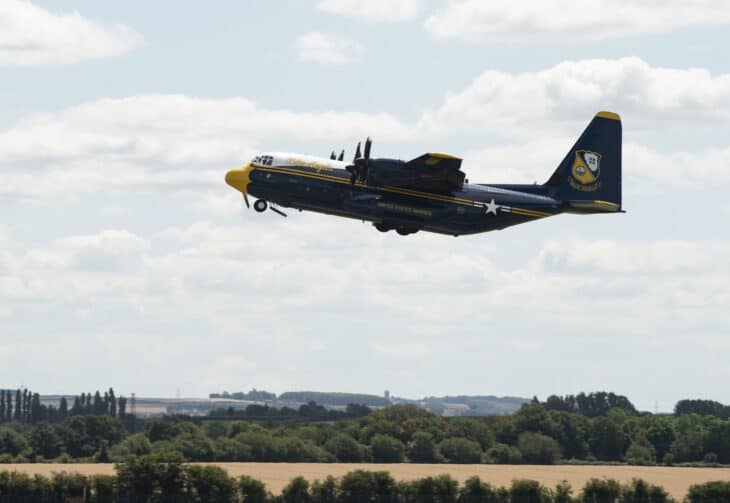
The Blue Angels also bring a seventh performer: Fat Albert, a C-130J Super Hercules flown by an all-Marine crew of seven, which is part of the show. The team has flown a C-130 since 1970, when it joined the demonstration as the opener, and the current C-130J since 2020. The Thunderbirds have nothing like it in their demonstration.
.jpg)
A Thunderbirds show runs about 30 maneuvers and about an hour and fifteen minutes including the ground show, according to the Air Force. The Blue Angels fly a high, low or flat show depending on the clouds, and need an 8,000-foot ceiling for the full high show.
The takeaway: the format and the spacing match, but the Navy adds a cargo plane and flies without G-suits.
Do the Blue Angels and Thunderbirds ever fly together?
Rarely, and by design. Defense Department policy treats both teams as recruiting tools, so they usually do not fly within 150 miles of each other without special permission, according to the Blue Angels.
The best-known exception came on April 28, 2020, when the two teams flew together over New York City, Newark, Trenton and Philadelphia to salute health care workers during the COVID-19 pandemic.
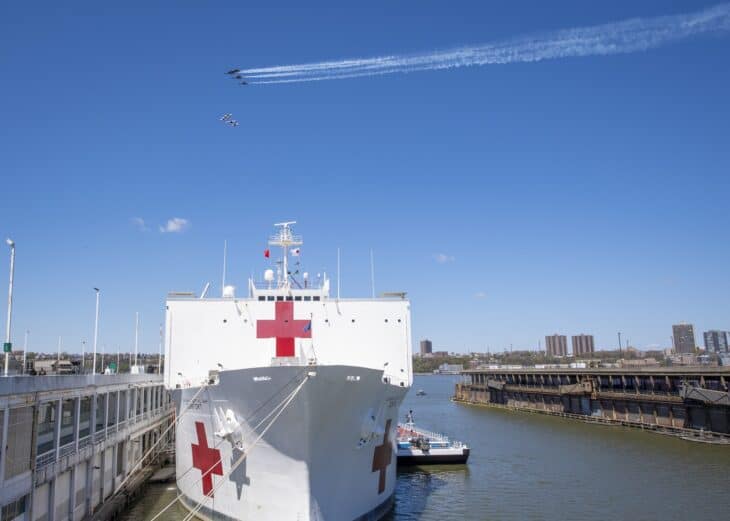
We are incredibly honored to have the opportunity to salute those working on the frontline of the COVID-19 response, we are in awe of your strength and resilience.
Cmdr. Brian Kesselring, then commanding officer of the Blue Angels, Military Times, April 2020
In 2026, the two teams share a bill twice. Both schedules list Luke Days at Luke Air Force Base, Arizona, on March 21 and 22, and the NAS Jacksonville Air Show in Florida on October 17 and 18.
Where to see both teams in 2026
The NAS Jacksonville Air Show on October 17 and 18 has both the Blue Angels and the Thunderbirds on the program, though NAS Jacksonville says the teams will perform separately. It lands in the city where the Blue Angels flew their first show, at Craig Field on June 15, 1946.
The takeaway: joint appearances happen only by exception, and even then the two teams usually fly their own shows.
The pilots and the people
Blue Angels pilots come from the Navy and the Marine Corps, and every applicant must be a carrier-qualified, active-duty pilot. Marines hold two of the six jet seats in 2026: the Slot and the Opposing Solo.
F/A-18 applicants need at least 1,250 tactical jet hours, and the team picks new pilots by unanimous vote. More than 260 demonstration pilots have flown with the team, and the 2026 squadron numbers 158 Sailors and Marines.
Thunderbirds pilots all come from the Air Force, and candidates need at least 1,000 hours in a fighter and must be current in the F-16. The squadron has eight pilots, six of them demonstration pilots, plus four support officers, three civilians and more than 130 enlisted Airmen in 25 career fields.
Tours are short on both teams. Thunderbirds officers serve two years and Blue Angels officers two to three, while enlisted members of both serve three to four.
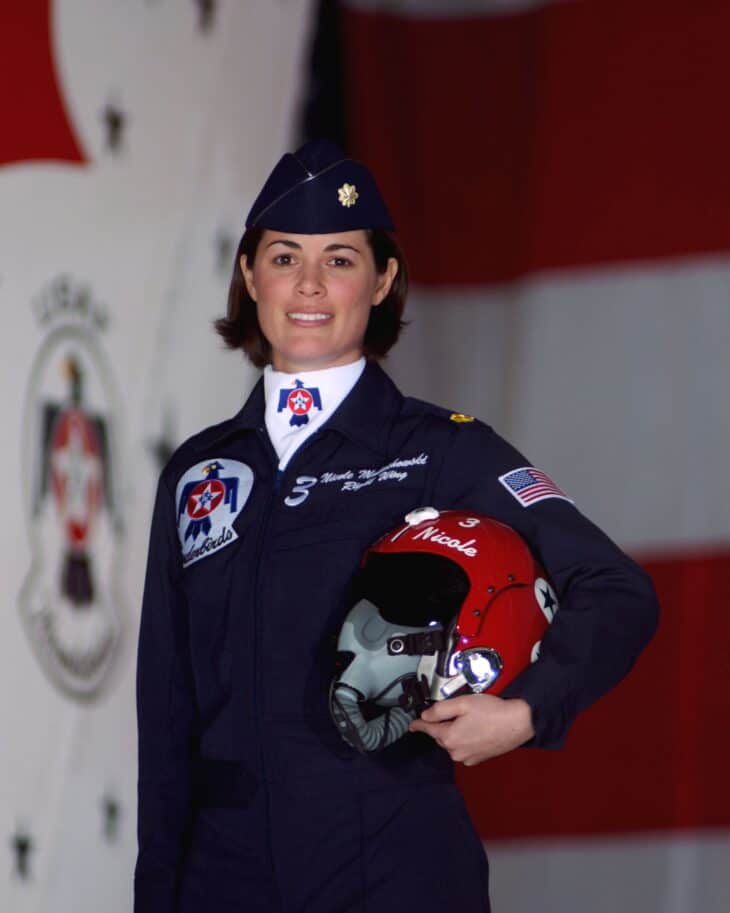
The Thunderbirds selected their first woman pilot, Maj. Nicole Malachowski, in 2005. The Blue Angels’ first woman demonstration pilot, Lt. Cmdr. Amanda Lee, flew with the team from 2022 to 2024.

The takeaway: similar-sized teams on similar short tours, with the Blue Angels drawing on two services and asking for more jet hours.
Home base and the 2026 season
The Blue Angels spend the show season at Naval Air Station Pensacola, Florida, and January through March training at Naval Air Facility El Centro, California. When the team is home, it usually practices on Tuesday and Wednesday mornings, and the public can watch from the National Naval Aviation Museum.
The Thunderbirds formed at Luke Air Force Base, Arizona, in 1953 and moved to Nellis Air Force Base, outside Las Vegas, in June 1956. Their season runs from March to November, with winter spent training new members.
The Blue Angels’ 2026 schedule lists 32 show sites, from MCAS Yuma, Arizona, on March 14 to the homecoming show at NAS Pensacola on November 6 and 7. The team marks its 80th anniversary this year.
The Thunderbirds’ 2026 schedule lists 30 dates, from the Daytona 500 flyover on February 15 to Kennedy Space Center, Florida, on November 7 and 8. The fall dates are still ahead as of late September.
The takeaway: a Gulf Coast team and a desert team, each with about 30 show dates a year.
The safety record: how many pilots have died
Twenty Blue Angels pilots and one crew member have died while assigned to the team, according to Wikipedia’s team history. The most recent was Capt. Jeff Kuss, killed on June 2, 2016, during a practice for an air show in Smyrna, Tennessee.
Twenty-one Thunderbirds pilots have been killed, by the same count. The worst accident was the Diamond Crash of January 18, 1982, when four pilots died practicing a diamond loop in T-38s in Nevada, and the most recent death was Maj. Stephen Del Bagno in April 2018.
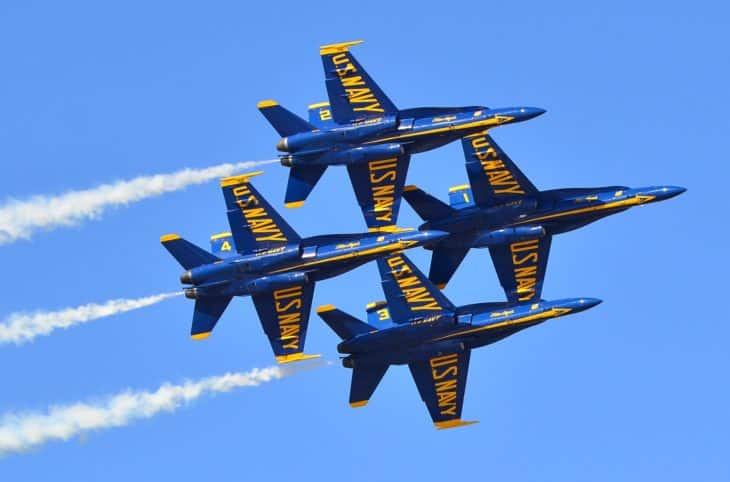
On the same day Kuss died, a Thunderbirds F-16 crashed near Colorado Springs after a flyover at the Air Force Academy graduation. That pilot ejected unhurt.
The Thunderbirds’ latest loss was an F-16C that went down near Trona, California, on December 3, 2025. The pilot ejected, and the Air Force’s report, released in September 2026, traced the crash to turned compressor vanes in an engine stage field maintainers cannot inspect.
The takeaway: the two records are almost level, and most deaths on both teams came in training, not in front of a crowd.
Eighty years vs seventy-three: the aircraft each team has flown
The Blue Angels are the older team by seven years. Adm. Chester Nimitz ordered the team formed on April 24, 1946, and it has flown nine aircraft types since, starting with the propeller-driven F6F Hellcat.
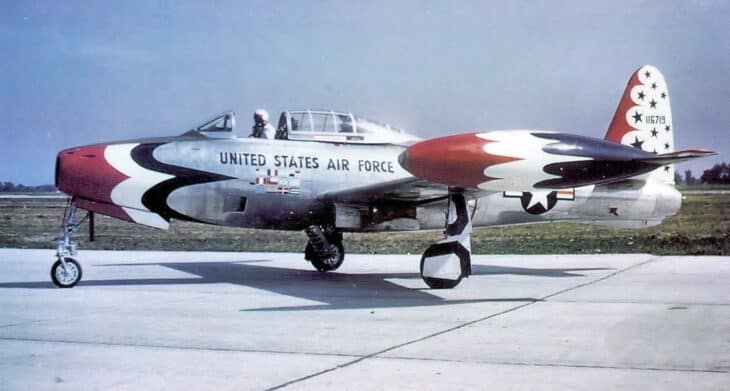
The Thunderbirds started in 1953 with the straight-winged F-84G Thunderjet, a fighter-bomber that had flown in Korea. For the second half of the 1970s both teams flew smaller jets, the A-4 Skyhawk for the Navy and the T-38 Talon for the Air Force.

| Era | Blue Angels | Thunderbirds |
|---|---|---|
| 1940s | F6F Hellcat (1946), F8F Bearcat (1946 to 1949), F9F Panther (from 1949) | Not yet formed |
| 1950s | F9F Panther (to winter 1954-55), F9F-8 Cougar (winter 1954-55 to 1957), F11F Tiger (from 1957) | F-84G Thunderjet (1953), F-84F Thunderstreak (1955), F-100 Super Sabre (from 1956) |
| 1960s | F11F Tiger (to 1969), F-4J Phantom II (from 1969) | F-100 Super Sabre (to 1968; F-105 for six shows in 1964), F-4E Phantom II (from 1969) |
| 1970s | F-4J Phantom II (to 1974), A-4F Skyhawk II (from 1974) | F-4E Phantom II (to 1973), T-38 Talon (from 1974) |
| 1980s | A-4F Skyhawk II (to 1986), F/A-18 Hornet (from 1986) | T-38 Talon (to 1981), F-16A Fighting Falcon (from 1983) |
| 1990s to today | F/A-18 Hornet (to 2020), F/A-18 Super Hornet (from November 2020) | F-16C/D Fighting Falcon (from 1992) |
Put the two histories side by side and the Thunderbirds turn out to be the more loyal team. They have flown F-16s for 43 of their 73 years, or 59%, while the Blue Angels have flown the Hornet family for 40 of their 80 years, or 50%.
The takeaway: the Navy team is older and has changed jets more often, and the Air Force team has built its modern identity on one fighter.
The difference in one sentence
The Blue Angels are the Navy and Marine Corps flying twin-engine Super Hornets and a C-130J from Pensacola, and the Thunderbirds are the Air Force flying single-engine F-16s from Las Vegas.
Everything a spectator can measure, the 700 mph fast pass, the 18-inch spacing and the six-jet show, is the same. If you want to settle which team is better, the fairest test is to see both, and the NAS Jacksonville Air Show in October is the one weekend left on both 2026 schedules.
FAQ
Sources and references used for research and fact-checking.
- U.S. Navy Blue Angels, Frequently Asked Questions
- U.S. Navy Blue Angels, U.S. Navy Blue Angels home page
- U.S. Navy Blue Angels, Team
- U.S. Navy Blue Angels, 2026 Show Schedule
- U.S. Air Force, Thunderbirds Schedule
- U.S. Air Force, Thunderbirds
- U.S. Air Force, Thunderbirds fact sheet
- U.S. Air Force, F-16 Fighting Falcon fact sheet
- U.S. Navy, F/A-18A-D Hornet and F/A-18E/F Super Hornet Strike Fighter
- Wikipedia, United States Air Force Thunderbirds
- Wikipedia, Blue Angels
- Aerobatic Teams, USAF Demonstration Squadron Thunderbirds
- Jacksonville Today, Thunderbirds will join Blue Angels for air show at NAS Jax
- Military Times, Blue Angels, Thunderbirds pay tribute to first responders in NYC flyover
- Air & Space Forces Magazine, Thunderbirds, Blue Angels Kick Off America Strong Tour with Tri-State Area Flyovers
- Air & Space Forces Magazine, Investigators Blame F-16 Thunderbird Crash on Turned Fan Blade Deep in Engine
Get the Newsletter
The latest aviation news and stories sent to your inbox.
About the Author

Tim is the owner and lead editor of AeroCorner since 2019, overseeing aviation content covering aircraft, airlines, airports, and the broader aviation industry. Through years of researching, writing, editing, and publishing aviation-focused content, he has developed extensive practical knowledge of commercial aviation and air travel. Based in Asia and a frequent traveler himself, Tim also brings firsthand passenger experience to AeroCorner’s coverage. Outside of publishing, he has also explored aviation firsthand through hands-on flight training in New Zealand.