

Table of Contents
Pick the Air Force if you want to sleep in the same bed most nights: its basic training runs 7.5 weeks against the Navy’s 9, and its deployment model puts you in a six-month deployable window once every two years.
Pick the Navy if you want to go to sea, or if you scored low on the entrance test. The Navy will enlist an applicant with no high school diploma who scores 50 on the AFQT.
Pay does not decide it. Both services draw from the same Defense Department table, so an E-4 with more than two years of service earns $3,303.00 a month in either uniform in 2026. The money that actually separates them is Career Sea Pay, which the Navy pays and the Air Force almost never does.
This comparison uses official figures only, as of September 2026: the Defense Finance and Accounting Service pay tables, the Defense Department’s own pay regulation, Navy and Air Force recruiting and training commands, and the Congressional Research Service. For the other branch pairing readers ask about most, see our Air Force vs Army comparison.
| Criterion | Navy | Air Force | Edge |
|---|---|---|---|
| Basic pay, E-4 over 2 years (2026) | $3,303.00 a month | $3,303.00 a month | Even |
| Basic training | 9 weeks, Great Lakes, Illinois | 7.5 weeks | Air Force |
| Oldest age to enlist | 41 | Before your 42nd birthday | Even |
| Minimum AFQT score | 31, or 50 with no diploma | 31 to 65, depending on education | Navy |
| Career Sea Pay, E-5 over 4 years of sea duty | $375 a month | $170 a month | Navy |
| Sea duty in a 30-year career, sea-intensive ratings | Up to 216 months (18 years) | Not part of the career path | Air Force |
| Deployment length | Carrier deployments planned at 7 months | About 6 deployable months in each 24-month cycle | Air Force |
| Education needed to fly | Bachelor’s degree plus a commission | Bachelor’s degree plus a commission | Even |
| Service owed after earning wings | 8 years from designation | 10 years after pilot training | Navy |
| The service’s own college | Civilian schools via the Navy College Program | Community College of the Air Force associate degree | Air Force |
| Active-duty strength (FY2026) | 344,600 | 321,500 | Navy (larger) |
How we compared
Every number here comes from an official source: the DFAS 2026 pay tables, DoD Financial Management Regulation Volume 7A Chapter 18, Navy Recruit Training Command, Officer Training Command Newport, Navy Program Authorization 106 of March 2025, the Chief of Naval Air Training, airforce.com, Congressional Research Service reports and the Air and Space Forces Almanac. Pay is basic pay only, before allowances and before any bonus. The annual sea pay figures are the monthly rate multiplied by 12, which assumes a full year of continuous sea duty. Entry and training rules are for active duty, and every job, bonus and flight slot is subject to the needs of the service.
Pay: one table for both services
Military basic pay is set by rank and years of service, not by branch. The 2026 tables took effect on January 1 and apply to the Navy, Air Force, Army, Marine Corps, Space Force and Coast Guard alike.
A new E-1 with less than four months of service earns $2,225.70 a month. An E-4 with more than two years earns $3,303.00, and an E-5 with more than two years earns $3,598.20.
Flying adds to that in both services under the same federal law. For what that does to a fighter pilot’s paycheck, see what a fighter pilot earns.
Edge: even. Any gap between two paychecks comes from rank, time in service and job-specific extras, not from the uniform.
Getting in: age, test scores and diplomas
The two doors are almost the same width on age. The Air Force enlists from 17 until your 42nd birthday, and the Navy’s limit is 41.
The entrance test is where they part. Both set a floor of 31 on the AFQT, the score drawn from the ASVAB, but the Air Force’s minimum rises with your education level and runs as high as 65, and applicants with no education credential need 65.
The Navy went the other way. In January 2024 it began enlisting applicants with no high school diploma and no GED, provided they score 50 or higher on the AFQT. Check the current rules on the Navy’s own requirements page before you plan around any of this, because recruiting policy moves.
Edge: Navy. A diploma is not a hard requirement, and its test floor does not climb with your education.
Boot camp: 9 weeks against 7.5
Navy boot camp runs 9 weeks at Recruit Training Command in Great Lakes, Illinois, the Navy’s only enlisted training facility. Recruits learn seamanship, firefighting and marksmanship, and finish with Battle Stations, a capstone that tests them against shipboard scenarios.
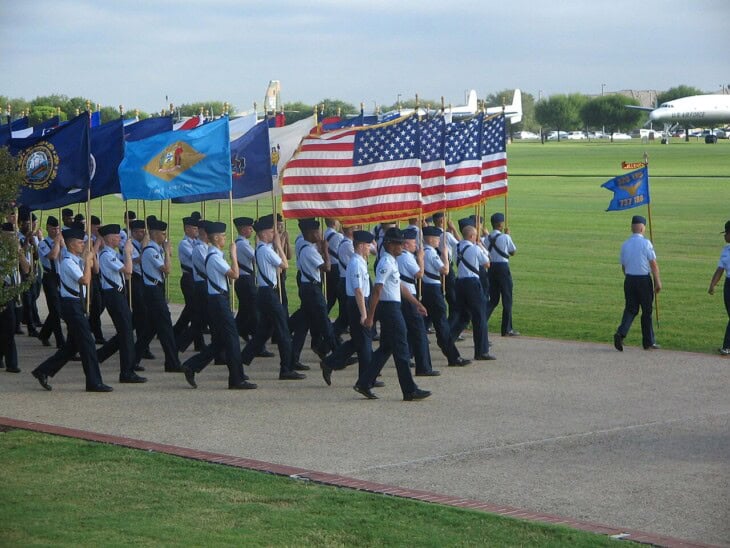
Air Force Basic Military Training runs 7.5 weeks, a week and a half less, and carries no shipboard content at all.
The Navy’s is not just longer, it is wetter. Recruits take a swim test, because a sailor who ends up in the water is a scenario the Air Force does not have to train for.
Edge: Air Force. Its basic training is a week and a half shorter.
Sea duty: the difference nobody prices
This is the real split, and it is the one the forums argue about without numbers. The Navy’s Sea Shore Flow policy sets how long sailors spend afloat, and in the ratings it calls sea-intensive the career path runs to 216 months of sea duty across a 30-year career.
That is 18 years at sea. Single sea tours in those ratings can run to 60 months for a sailor with under 20 years of service, with 36-month shore tours between them.
Eighteen years afloat
In the Navy ratings classified as sea-intensive, the published career path adds up to 216 months of sea duty over a 30-year career, which is 18 years afloat. The Air Force has no equivalent: its enlisted career paths are built around home stations, and its own sea pay table excludes every enlisted grade below E-4.
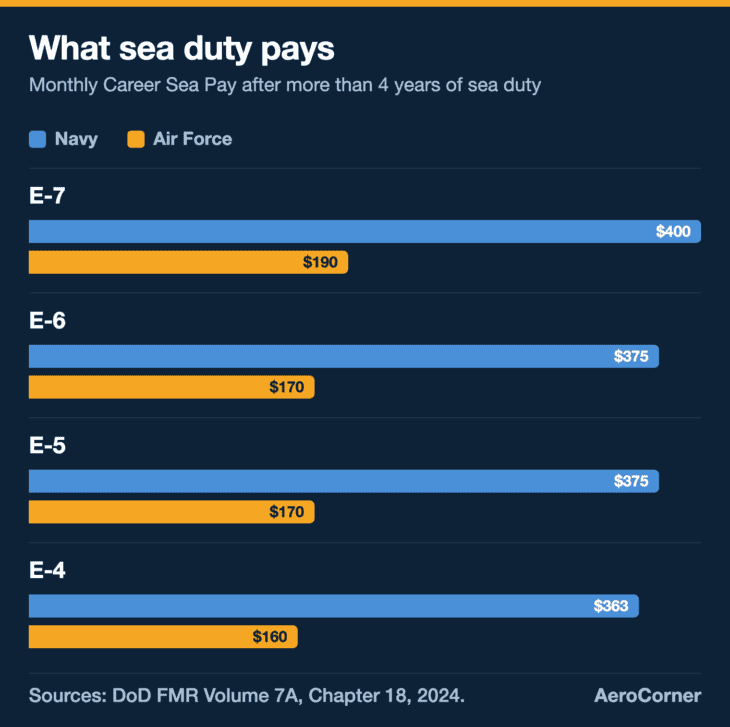
The Defense Department pays for that time, and the rate is the clearest money difference between the two services. A Navy E-5 with more than four years of cumulative sea duty draws $375 a month in Career Sea Pay, which is $4,500 over a full year on top of identical basic pay.
The Air Force has its own sea pay table, and it pays less than half as much: $170 a month at the same grade and sea time, or $2,040 a year. That table has not been updated since May 1988, and the regulation bars Air Force enlisted members below E-4 from sea pay altogether.
Edge: Navy for the money, Air Force for the time at home. Sea pay is real income that an Air Force career effectively does not include, and it is paid for exactly the thing that makes sea duty hard.
Deployments: seven months, or six in every twenty-four
Navy carrier deployments are planned to last seven months. They have not been holding to that: the USS Gerald R. Ford’s 2025 to 2026 deployment was extended to roughly 11 months, which the Vice Chief of Naval Operations told the Senate Armed Services Committee in March 2026 would come to about 334 days.
For scale, the longest deployment since Vietnam before that was the USS Abraham Lincoln’s 294 days in 2019 and 2020. For what the carriers themselves are doing, see how many aircraft carriers the US has.
The Air Force runs on a different clock. Its AFFORGEN model is a 24-month cycle of four six-month phases, reset, prepare, ready and available to commit, and airmen are deployable during the six-month available phase.
Edge: Air Force. A predictable six months of deployability in every 24 beats a seven-month deployment that can stretch to eleven.
Flying: two routes into a cockpit
Neither service will put you in a cockpit without a degree, which is the first thing to know if flying is the whole reason you are choosing. Both require a bachelor’s degree and a commission.
The Navy’s terms are set out in Program Authorization 106, signed in March 2025. A student naval aviator must be a US citizen, hold a bachelor’s degree, be at least 18 and not past their 32nd birthday at commissioning, and clear the Aviation Selection Test Battery. Selectees go to the 13-week Officer Candidate School at Naval Station Newport, Rhode Island.
The Air Force asks for a bachelor’s degree in any major with a GPA of at least 2.5, a commission through the Academy, ROTC or Officer Training School, and that you start pilot training before your 33rd birthday. Undergraduate Pilot Training takes about a year.
What happens after the wings differs more than what happens before them. A Navy strike pilot trains through primary flight training in the T-6B and then intermediate and advanced training in the T-45C Goshawk, ending in carrier qualification. Air Force pilots are trained to fly from runways, and that one phase shapes everything about how a naval aviator flies.
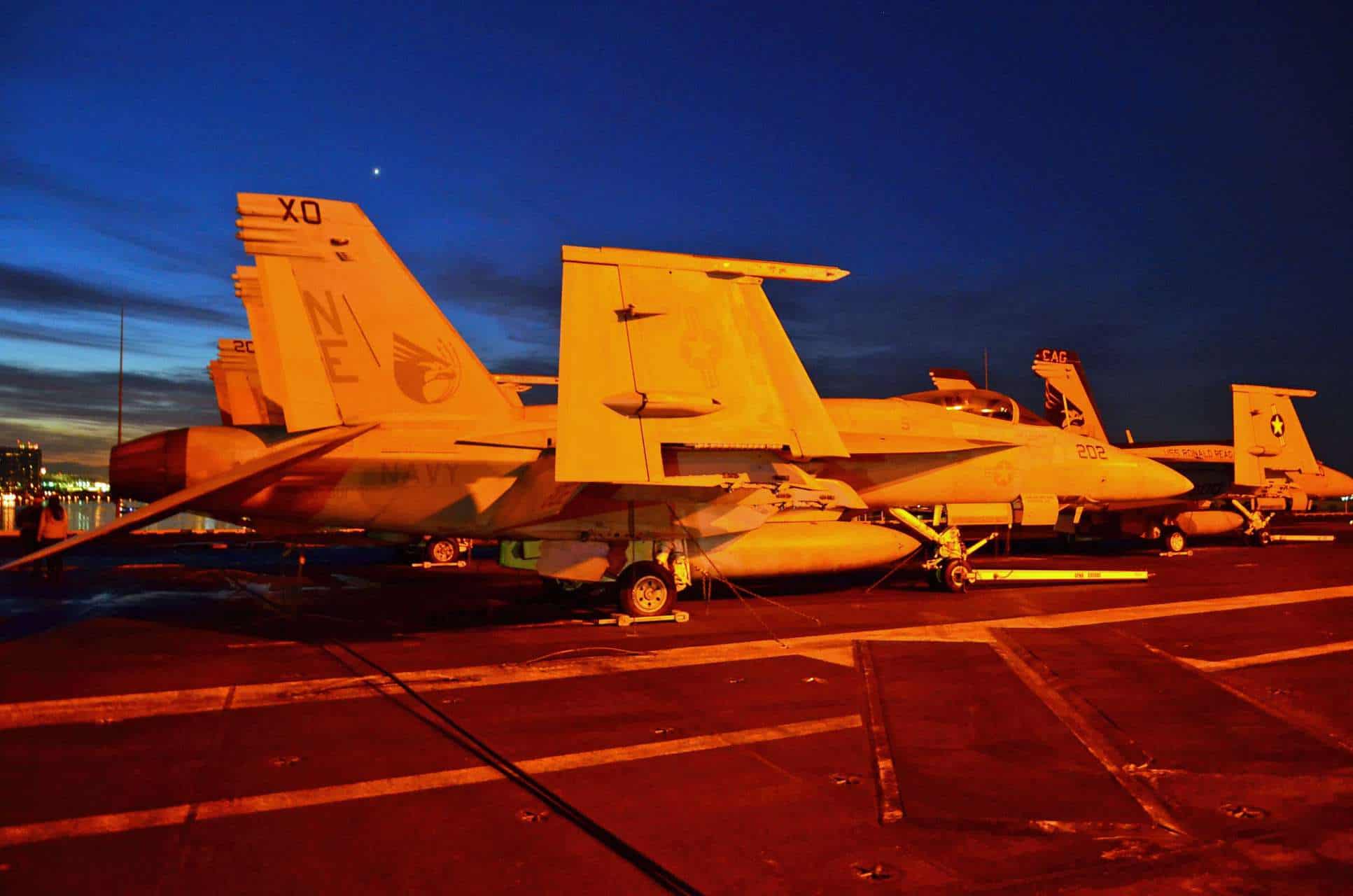
That strike pipeline fills the seats in the F/A-18E/F Super Hornet and the EA-18G Growler, and Navy F-35C pilots come from it too. The wider Navy fleet runs well beyond fighters, as our guide to types of Navy planes sets out.
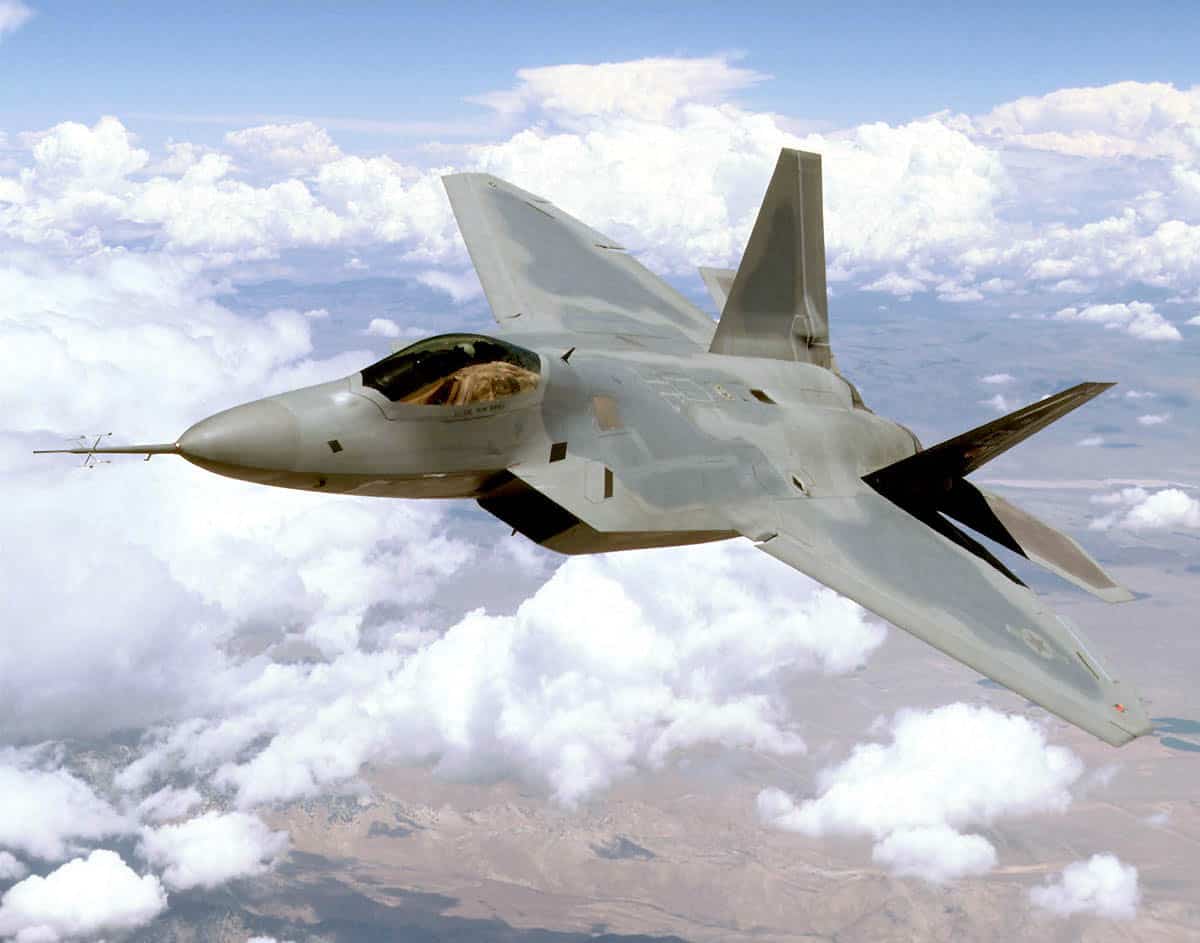
The Air Force side is bigger and lands on runways. Its total inventory was 4,865 aircraft as of September 30, 2025, including 1,978 fighter and attack aircraft such as the F-22 Raptor.
The commitment afterward favors the Navy, narrowly. A student naval aviator owes 8 years of active duty from the date of designation, while the Air Force asks for 10 years after pilot training. If flying is your only criterion, read which military branch is best for pilots.
Edge: Navy for the shorter commitment, Air Force for the odds of flying a jet. Both demand a degree, but the Air Force has far more fighter cockpits to fill.
Education: the Air Force’s built-in degree
The Air Force runs its own accredited college. The Community College of the Air Force awards an Associate of Applied Science in the field of your Air Force job, and it is the only two-year institution that exists solely for enlisted service members.
The Navy has no equivalent school of its own. Sailors take courses at civilian colleges through the Navy College Program instead, which is a real benefit but not a degree that arrives with the job.
Edge: Air Force. An associate degree tied to your specialty is a credential the Navy cannot match in-house.
Who should pick which
| If you… | Pick | Because |
|---|---|---|
| Want to be home most nights | Air Force | Six deployable months in every 24, and no sea duty |
| Have no diploma or a low AFQT | Navy | It enlists applicants with no diploma who score 50 |
| Want to fly fighters | Air Force | The Air Force counted 1,978 fighter and attack aircraft in its inventory |
| Want to land on a carrier | Navy | Carrier qualification is built into the Navy strike pipeline |
| Want the shortest commitment after wings | Navy | 8 years from designation against 10 |
| Want a degree out of your day job | Air Force | The Community College of the Air Force awards an associate degree |
| Want to maximize pay and do not mind sea duty | Navy | Career Sea Pay adds up to $4,500 a year at E-5 on top of the same basic pay |
| Care only about basic pay | Either | Both use the same pay table |
If none of that decides it, compare the specific jobs rather than the services. Both list their careers by field on their recruiting sites, and the rating or specialty you hold will shape your days more than the uniform does.
The Navy has more planes than the Air Force
It does not. The Air Force counted 4,865 aircraft in its total inventory as of September 30, 2025. The Congressional Research Service put the Air Force at roughly 5,000 aircraft and the Navy at roughly 4,000, and that Navy figure already includes the Marine Corps. The claim survives because the Navy owns aircraft carriers and people picture the decks, but the Air Force flies more airframes even when the Marines are counted on the other side.
FAQ
Sources and references used for research and fact-checking.
- Defense Finance and Accounting Service, Basic Pay: Enlisted, Effective January 1, 2026
- Office of the Under Secretary of Defense (Comptroller), DoD Financial Management Regulation, Volume 7A, Chapter 18: Special Pay - Career Sea Pay
- U.S. Navy (navy.com), Navy Boot Camp
- U.S. Navy (navy.com), Requirements to Join
- Military.com, How to Join the U.S. Navy: Eligibility and Requirements Guide
- U.S. Air Force (airforce.com), Join the Active Duty Air Force
- U.S. Air Force (airforce.com), Military Training
- U.S. Air Force (airforce.com), Pilot
- U.S. Navy, Office of the Chief of Naval Operations (N13), Program Authorization 106: Officer Candidate Indoctrination and Training, Student Naval Aviator and Student Naval Flight Officer, March 2025
- U.S. Navy (MyNavy HR), Sea Shore Flow Rating Notes
- U.S. Navy, Naval Education and Training Command, Officer Candidate School
- Chief of Naval Air Training, Student Naval Aviator (SNA) Training
- Legal Information Institute, Cornell Law School, Minimum Service Requirement for Certain Flight Crew Officers, 10 U.S. Code 653
- U.S. Air Force (myairforcebenefits), Enlisted Developmental Education
- U.S. Navy, Navy College Program
- Congressional Research Service, FY2026 NDAA: Active Component End-Strength
- Congressional Research Service, Defense Primer: United States Military Aviation
- Air and Space Forces Magazine, 2026 USAF and USSF Almanac Equipment: Total Aircraft Inventory
- Air and Space Forces Magazine, How USAF and USSF's Force Generation Models Overlap
- Breaking Defense, Navy's Kilby Signals USS Ford Could See 11-Month Deployment, Approaching Record Length
Get the Newsletter
The latest aviation news and stories sent to your inbox.
About the Author

Tim is the owner and lead editor of AeroCorner since 2019, overseeing aviation content covering aircraft, airlines, airports, and the broader aviation industry. Through years of researching, writing, editing, and publishing aviation-focused content, he has developed extensive practical knowledge of commercial aviation and air travel. Based in Asia and a frequent traveler himself, Tim also brings firsthand passenger experience to AeroCorner’s coverage. Outside of publishing, he has also explored aviation firsthand through hands-on flight training in New Zealand.