

Table of Contents
Pick the Marines if you are 28 or younger and want land combat to be the job: boot camp runs 13 weeks and every enlisted Marine is trained as a rifleman. Pick the Navy if you are older, want a shipboard or technical trade, or want the shorter road to a cockpit.
Basic pay does not decide it. Both draw from the same Defense Department table, so an E-4 with more than two years of service earns $3,303.00 a month in either uniform in 2026.
This comparison uses official figures as of October 2026: the pay tables, the Defense Department’s pay regulation, both recruiting commands and the Congressional Research Service. It covers the whole service, so if you are weighing a third branch, start with our Navy vs Air Force comparison.
| Criterion | Navy | Marines | Edge |
|---|---|---|---|
| Basic pay, E-4 over 2 years (2026) | $3,303.00 a month | $3,303.00 a month | Even |
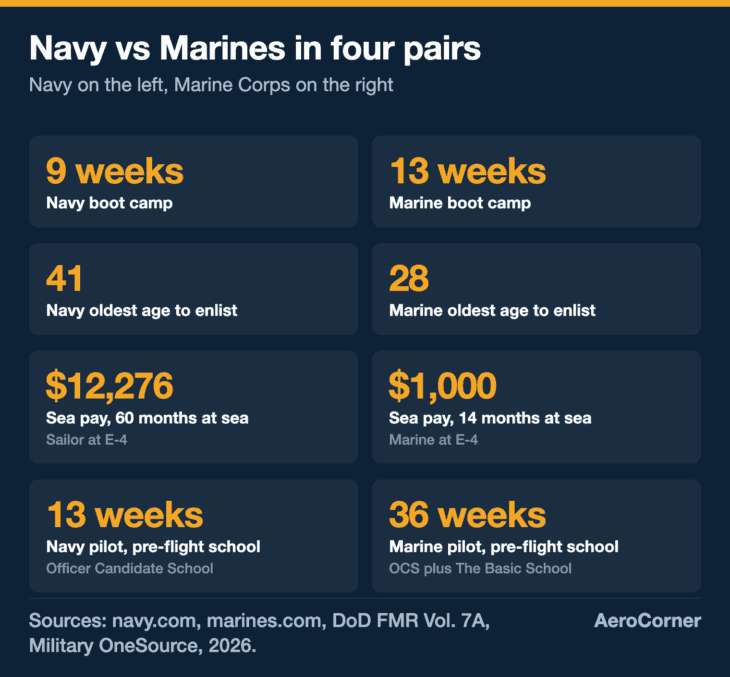
| Oldest age to enlist | 41 | 28 | Navy |
| Minimum AFQT score | 31, or 50 with no diploma | 31, or 50 with a GED or nontraditional diploma | Navy |
| Fitness test before you ship (men’s standard) | None outside special operations jobs | 3 pull-ups or 34 push-ups, 1.5 miles in 13:30, 40-second plank | Navy |
| Boot camp | 9 weeks, Great Lakes, Illinois | 13 weeks, Parris Island or San Diego | Navy |
| Career Sea Pay at E-4 (our math) | $12,276 over a 60-month sea tour | $1,000 over two seven-month deployments | Navy |
| Longest recent deployment | More than 320 days (USS Gerald R. Ford, 2025 to 2026) | About 10 months (22nd MEU, 2025 to 2026) | Even |
| First-term reenlistments per 100 authorized troops, FY2025 (our math) | 6.1 (20,290 sailors) | 4.8 (8,228 Marines) | Navy |
| Officer training before flight school | 13 weeks | About 36 weeks | Navy |
| Land combat as the core job | Not the service’s mission | At least 3 combat divisions, set by federal law | Marines |
How we compared
Pay is basic pay only, before allowances and bonuses. Sea pay holds an E-4 flat on the shared Table 18-3 rates of $70, $80, $160, $350 and $363 a month across cumulative sea years. The sailor serves 60 months: $840 + $960 + $1,920 + $4,200 + $4,356 = $12,276. The Marine serves 14 embarked months: $840 + $160 = $1,000. Both are illustrations, not career averages, because promotions change the rate and not every Marine deploys aboard ship. Reenlistment rates divide first-term reenlistments by FY2025 authorized strength of 332,300 and 172,300, a rough scale measure because the two services count first-term troops slightly differently. Officer weeks add a 10-week OCS to a six-month Basic School, counted as 26 weeks. Every job, bonus and flight slot is subject to the needs of the service.
Which is harder: boot camp and fitness
Marine boot camp is longer and it starts with a test. Recruits spend 13 weeks at Parris Island, South Carolina, or San Diego, and must pass an Initial Strength Test before shipping.


For men, that test is 3 pull-ups or 34 push-ups in two minutes, a 1.5-mile run in 13:30 and a 40-second plank. For women, it is 1 pull-up or 15 push-ups, the same run in 15:00 and the same plank.
Navy boot camp runs 9 weeks at Great Lakes, Illinois, and most enlisted applicants face no fitness requirement before joining. Recruits still have to pass a fitness test at boot camp, along with a swim test.
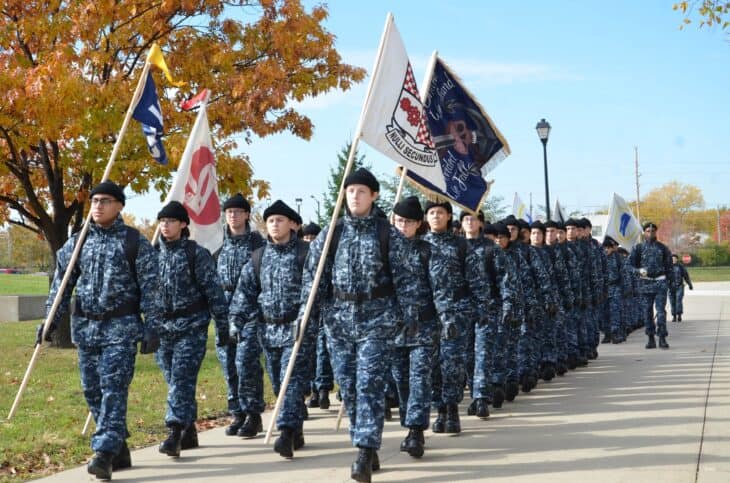

The Navy’s boot camp minimum is not soft on paper. A man aged 17 to 19 needs 46 push-ups and a 1.5-mile run in 12:15, which is tougher than the Marine entry test, though the two measure different points in training.
Graduation is not the end for a new Marine. After up to 10 days of leave, Parris Island graduates report to the School of Infantry or Marine Combat Training, and non-infantry Marines get 29 training days of rifleman skills.
Edge: Navy, if the easier start is what you want. Four more weeks, a test before you ship and a combat course afterward make the Marine route the harder entry.
Getting in: age and test scores
Age is the biggest gap between the two doors. The Navy enlists from 17 to 41, while the Marine Corps takes applicants from 17 to 28, and anyone 29 or older has to ask for a waiver that is not guaranteed.
Test scores are closer. Both set a floor of 31 on the AFQT, the score drawn from the ASVAB, and the Marines ask for 50 or higher if you hold a GED or a nontraditional diploma.
Military.com reports that the Navy has accepted applicants with no diploma or GED since January 2024 if they score 50 or higher, but navy.com still lists a diploma or GED. Confirm it on the Navy’s requirements page or the Marines’ requirements page, because recruiting policy moves.
Edge: Navy. Thirteen extra years of eligibility is the widest gap in this comparison, and the diploma rule is looser if the reported policy still applies to you.
Pay: same table, different sea pay
Military basic pay is set by rank and years of service, not by branch. A new E-1 with less than four months of service earns $2,225.70 a month in 2026, and an E-5 with more than two years earns $3,598.20.
Career Sea Pay also comes from one shared table for both services. An E-4 with a year or less of cumulative sea duty draws $70 a month, rising to $363 a month after four years.
What differs is the time at sea. A Marine in a unit based ashore earns sea pay from embarkation to debarkation, so two seven-month deployments come to about $1,000 at E-4.
A sailor on a 60-month sea tour at the same grade would collect about $12,276, more than 12 times as much. That is pay for hard time away from home, so treat it as compensation and not as a bonus.
Edge: Navy. The rates are the same, but the Navy’s career paths put far more people at sea for far longer.
Jobs: what the service is built to do
Federal law spells out the Marine Corps mission. It must include at least three combat divisions and three air wings, and it exists to provide fleet marine forces of combined arms for naval campaigns, including seizing and defending advanced naval bases.
That shows up in the training. Even a Marine headed for a desk or a shop goes through Marine Combat Training, which the commander of School of Infantry West described in 2021 as teaching Marines to survive as riflemen on the battlefield.
The Navy’s job list points the other way, toward ships and machinery. Its careers page includes submarine missile technicians, shipboard electronics and nuclear programs, plus Seabee builders and hospital corpsmen.
The two services also work inside each other. Hospital corpsmen are Navy sailors, and a 24th MEU account says those assigned to a Marine unit first take about two extra months of field medicine school.
Edge: Marines for land combat, Navy for a technical trade. Neither job list is better in the abstract, so this one comes down to what you want to do all day.
Deployments: both can run long
Navy carrier deployments are planned at seven months, but plans have not been holding. The USS Gerald R. Ford left Norfolk on June 24, 2025, and had passed 320 days at sea by May 2026, beating the post-Vietnam record of 294 days.
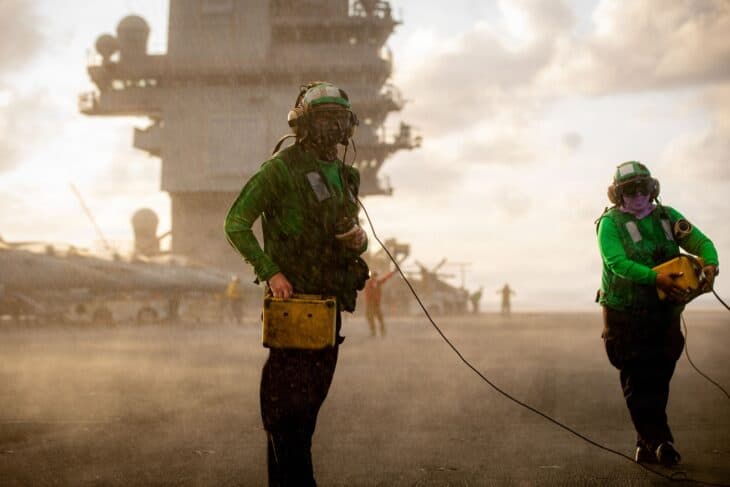

Marines deploy aboard Navy amphibious ships and face the same stretch. The 22nd Marine Expeditionary Unit came home in June 2026 after about 10 months, while the 31st MEU’s return to Okinawa in July 2026 closed a six-month deployment.
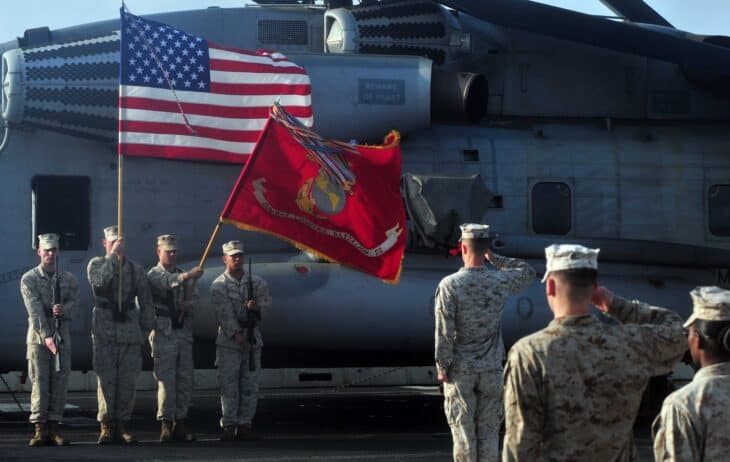

Edge: even. Sailors on sea-intensive career paths can reach 216 months afloat over 30 years, but single deployments have run long in both services and neither length is a promise.
Flying: one school, two routes
Marine pilots and Navy pilots learn to fly in the same system. The Chief of Naval Air Training runs the Navy and Marine Corps pipelines, starting in the T-6B, and graduates of both are designated naval aviators.
Both require a bachelor’s degree and a commission, and the difference comes before flight school. Navy candidates attend a 13-week Officer Candidate School at Newport, Rhode Island, and normally go on to flight training after commissioning.
Marine candidates attend a 10-week Officer Candidates School at Quantico, Virginia. Then every new Marine officer, future pilots included, spends six months at The Basic School, which puts about 36 weeks of officer training ahead of the cockpit.
The commitment afterward is the same. Navy Program Authorization 106 sets 8 years of active duty from the date you earn your wings, and the Marine Corps student naval aviator agreement sets 96 months from the same point.
The aircraft differ more than the schoolhouse. The Navy’s strike pilots fly jets like the F/A-18 Super Hornet from carriers, and the Department of the Navy as a whole operates about 4,000 aircraft, including the Marines.
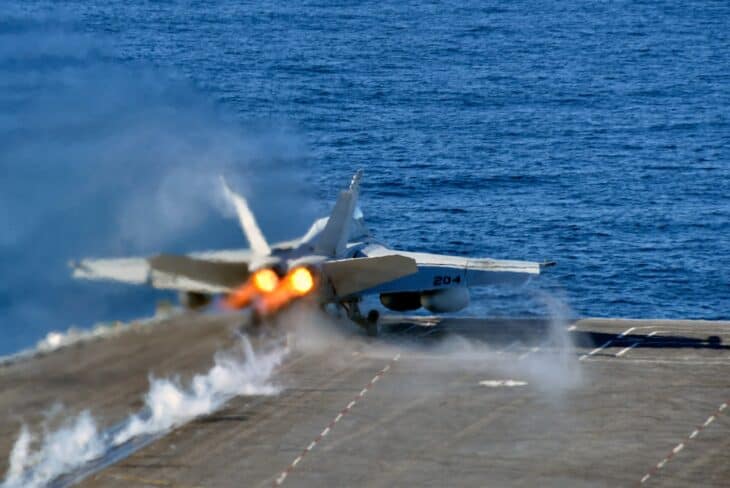

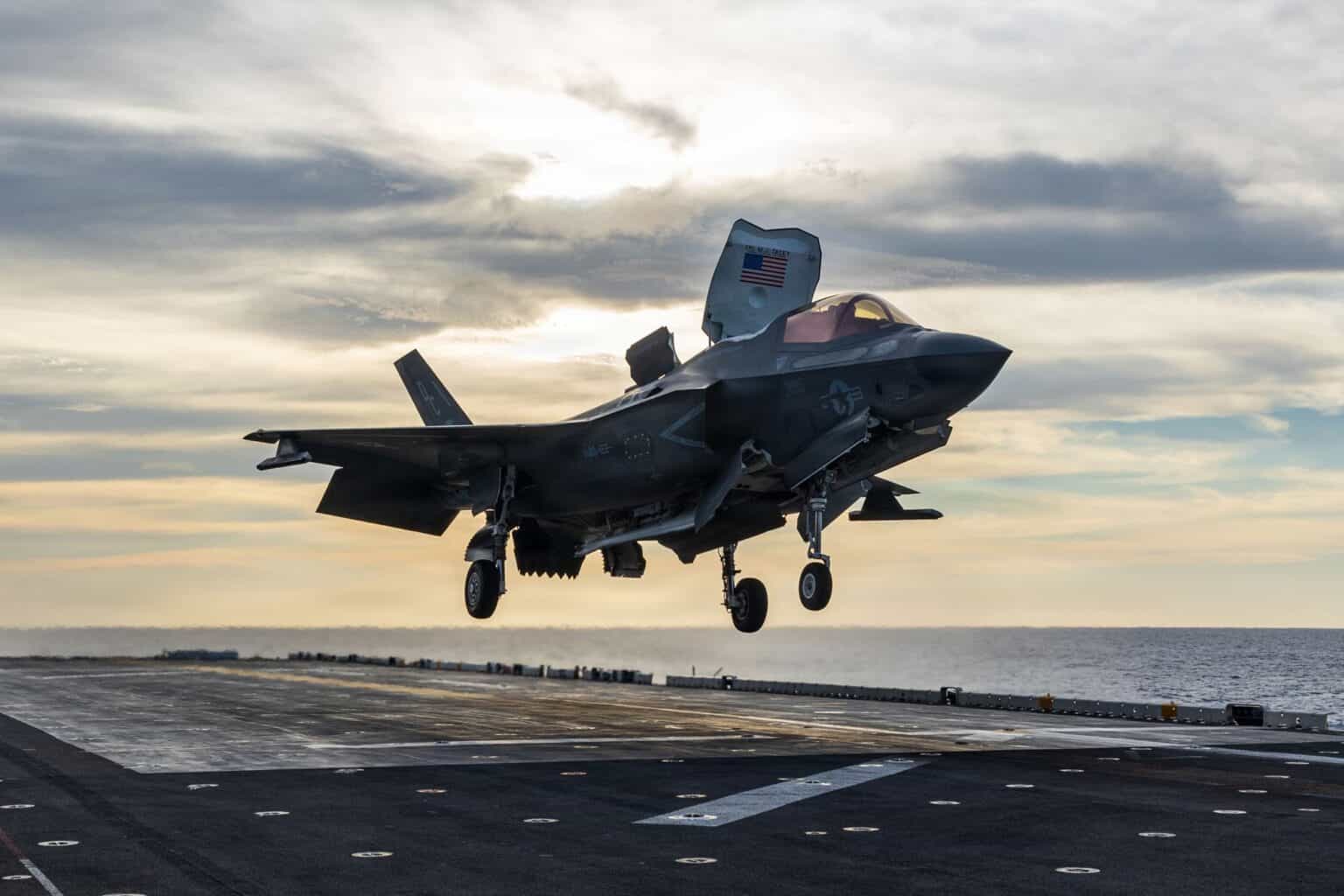
Marine aviation exists to give Marine forces fire support and mobility, with 1,262 aircraft in its 2022 Aviation Plan. Its fleet runs from the F-35 Lightning II to the V-22 Osprey, and our guide to every US Marine Corps aircraft lists them all.
The Corps has also just retired the AV-8B Harrier, which made its final flight at Cherry Point on June 3, 2026, as the Marines move toward an all fifth-generation tactical fleet. For the wider choice, read which military branch is best for pilots.
Edge: Navy. The same flight school is about 23 weeks closer, and the Navy has more aircraft to fill.
Staying in: the career odds
The Marine Corps has long run a recruit-and-replace model, and Military Times reports it has historically kept the fewest first-term members of any service. If you picture a 20-year career, that history matters.
It is changing. The Corps reenlisted 8,228 first-term Marines in FY2025, or 107% of its goal, while the Navy reenlisted 20,290 sailors in its first zone, or 99% of its goal.
Set against authorized strength, that is about 4.8 first-term reenlistments per 100 Marines and 6.1 per 100 sailors. It is a rough measure of scale and not a true retention rate, but it points the same way as the Corps’ history.
Edge: Navy. More room to stay, even as the Marines work to close the gap.
Who should pick which
| If you… | Pick | Because |
|---|---|---|
| Want land combat to be the job | Marines | Its core mission is fleet marine forces of combined arms, with at least 3 combat divisions |
| Are 29 or older | Navy | It enlists up to 41, while the Marines need a waiver after 28 |
| Want a technical or shipboard trade | Navy | Its career list runs through ships, submarines and nuclear programs |
| Want the hardest entry you can find | Marines | 13 weeks of boot camp, a test before you ship and combat training afterward |
| Want to reach flight school sooner | Navy | 13 weeks of officer training against about 36 |
| Want to fly in support of troops on the ground | Marines | That is what Marine aviation exists to do |
| Want a medical job alongside Marines | Navy | Hospital corpsmen are sailors assigned to Marine units |
| Care only about basic pay | Either | Both use the same table |
If none of that decides it, compare specific jobs and not uniforms. Your rating or specialty will shape your days more than the branch name will, and a recruiter can only promise what your signed contract says.
The Marines are part of the Navy
They are not. The Marine Corps sits within the Department of the Navy, but federal law defines the Navy and the Marine Corps separately, and the Commandant of the Marine Corps sits on the Joint Chiefs of Staff. The two share a civilian department, a pay table and a flight school. They are still two separate armed services with their own chiefs, recruiters and boot camps.
FAQ
Sources and references used for research and fact-checking.
- Defense Finance and Accounting Service, Basic Pay: Enlisted, Effective January 1, 2026
- Office of the Under Secretary of Defense (Comptroller), DoD Financial Management Regulation, Volume 7A, Chapter 18: Career Sea Pay (June 2026)
- U.S. Marine Corps (marines.com), Eligibility Requirements
- Marine Corps Recruit Depot Parris Island, Recruit Training
- U.S. Navy (navy.com), Requirements to Join
- U.S. Navy (navy.com), Navy Boot Camp
- Military.com, How to Join the U.S. Navy: Eligibility and Requirements Guide
- Military Times, Corps Looking to Refine Marine Combat Training to Prepare for a Future Battlefield
- Military Times, Army Raises Maximum Enlistment Age to 42
- Legal Information Institute, Cornell Law School, 10 U.S. Code 8001: Definitions
- Legal Information Institute, Cornell Law School, 10 U.S. Code 8063: United States Marine Corps, Composition and Functions
- Legal Information Institute, Cornell Law School, 10 U.S. Code 151: Joint Chiefs of Staff
- Legal Information Institute, Cornell Law School, 10 U.S. Code 653: Minimum Service Requirement for Certain Flight Crew Positions
- U.S. Navy, Office of the Chief of Naval Operations (N13), Program Authorization 106, March 2025
- U.S. Navy, Naval Education and Training Command, Officer Candidate School
- Military OneSource, Marine Corps Officer Candidates School
- Marine Corps Recruiting Command, Officer Programs
- Marine Corps Recruiting Command, Service Agreement: Officer Candidate Class Student Naval Aviator (rev. 11/22)
- Marine Corps Recruit Depot Parris Island, The Crucible
- Chief of Naval Air Training, Student Naval Aviator (SNA) Training
- Congressional Research Service, Defense Primer: United States Military Aviation
- Breaking Defense, Marine Corps' Harrier Completes Final Flight Following SOUTHCOM Deployment
- Breaking Defense, Gerald R. Ford to Return From Historic Deployment on Saturday, CNO
- Breaking Defense, Navy's Kilby Signals USS Ford Could See 11-Month Deployment
- DVIDS, 31st MEU Returns to Okinawa After Six-Month Deployment
- U.S. Navy (MyNavy HR), Sea Shore Flow Rating Notes
- 24th Marine Expeditionary Unit, Corpsmen Experience Challenges of Assignment With Marines
- U.S. Navy (navy.com), Navy Careers
- U.S. Marine Corps, Marine Forces Special Operations Command
- Congressional Research Service, Defense Primer: Active Component Enlisted Retention
- Congressional Research Service, FY2026 NDAA: Active Component End-Strength
- Military Times, How the Marine Corps Is Retaining a Lot of Its First-Term Marines
Get the Newsletter
The latest aviation news and stories sent to your inbox.
About the Author

Tim is the owner and lead editor of AeroCorner since 2019, overseeing aviation content covering aircraft, airlines, airports, and the broader aviation industry. Through years of researching, writing, editing, and publishing aviation-focused content, he has developed extensive practical knowledge of commercial aviation and air travel. Based in Asia and a frequent traveler himself, Tim also brings firsthand passenger experience to AeroCorner’s coverage. Outside of publishing, he has also explored aviation firsthand through hands-on flight training in New Zealand.