

Table of Contents
Africa now has a second Su-35 air force on paper. How many of the jets Ethiopia actually has depends on whose statement you read.
On Oct. 28, 2026, Ethiopian Prime Minister Abiy Ahmed said his country had received 12 Sukhoi Su-35 fighters from Russia, a year earlier than scheduled. He posted the news on X during the Russia-Africa Summit in Moscow, as Al Jazeera reported, and added that four S-400 air defense batteries would follow.
Russia’s state arms exporter tells a smaller story. Rosoboronexport told Reuters that the first batch handed to the Ethiopian Air Force that day was two aircraft, and the photos released so far show exactly two.
Two Jets at Zhukovsky, Twelve in the Announcement
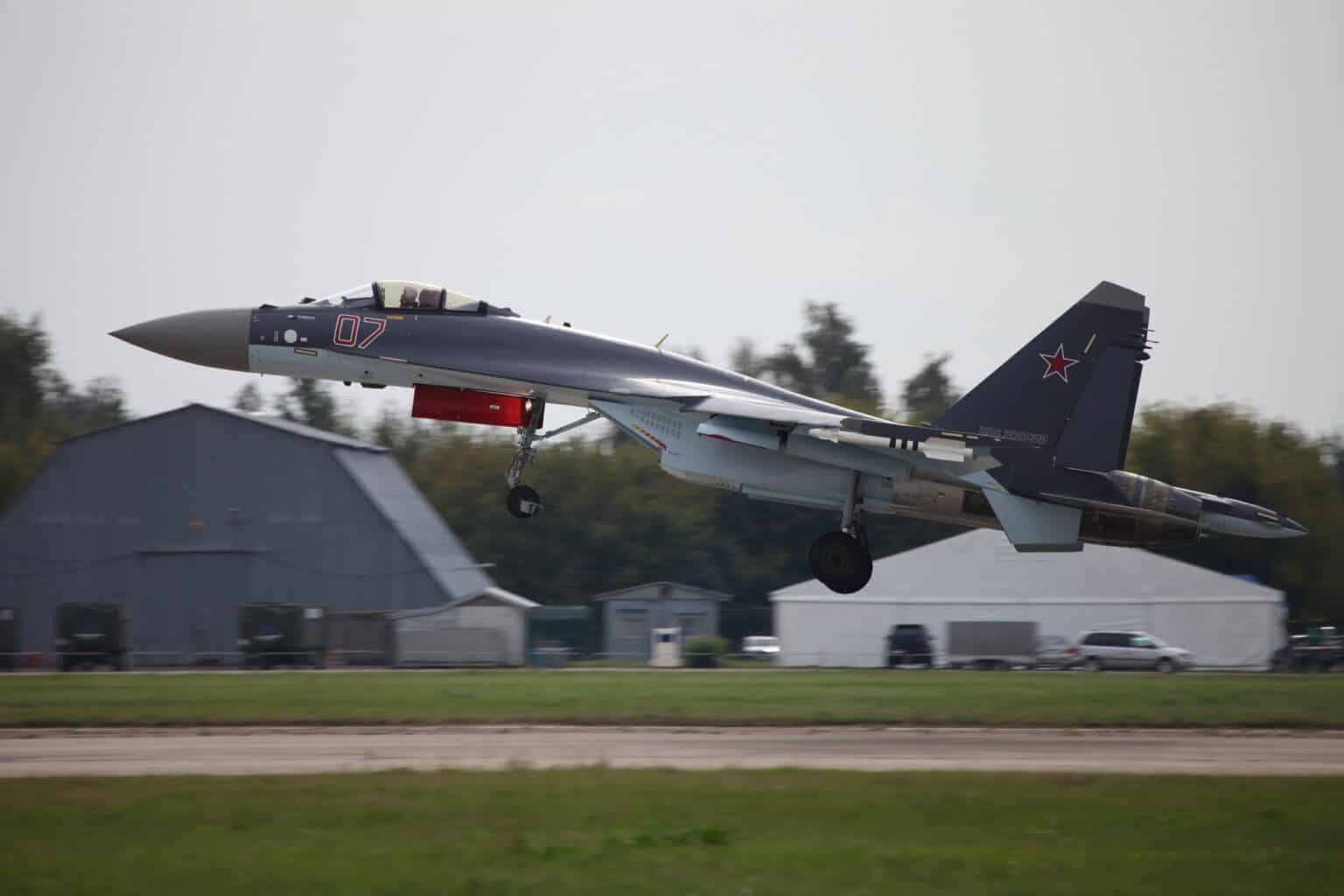
The handover happened at Zhukovsky airfield outside Moscow, not in Ethiopia. According to The Aviationist, Abiy’s photos and video show two Su-35s in Ethiopian markings, tail numbers 2551 and 2552, in a light-gray, dark-gray and white geometric camouflage.
Aviation Week also reported two jets. Russia’s Interfax news agency, as quoted by The Aviationist, said the aircraft were “demonstrated” to the Ethiopian delegation, wording that suggests the fighters had not yet left Russia.
Even the Russian side was vague on the number in its own media. Rosoboronexport chief Alexander Mikheyev told TASS only that the company had “delivered the first batch of Su-35 aircraft to the Ethiopian Air Force,” with no count attached.
Abiy’s own post was written in Amharic, and outlets read it differently. Reuters and Al Jazeera reported 12 jets received, while AIN reported two delivered as the first of 12 planned.
Neither government has published the contract value, the delivery schedule or where the jets will be based. So the only firm number is the one in the pictures: two.
A Leaked Contract Said Six. The Jets May Have Been Built for Egypt
The deal was not secret for long. On Oct. 3, 2025, the hacker group Black Mirror published documents it said came from Russia’s Rostec defense conglomerate, and The Defense Post reported that they listed Ethiopia under its own customer code for six Su-35s.
AIN and the Ukrainian outlet Militarnyi describe it as a reported 2022 contract. The documents have never been independently verified, and neither Moscow nor Addis Ababa has confirmed them.
Six is half of 12. Either the order grew after 2022, or Abiy’s figure counts jets that are still on the way.
Then there is the question of where the airframes came from. TWZ suggests the Ethiopian jets could be left over from Egypt’s abandoned Su-35 order, and Militarnyi notes their camouflage resembles a scheme seen on jets reportedly built for Egypt.
That would fit the early delivery. A fighter that is already built and parked at the factory needs new paint and a buyer, not a production slot.
The Su-35 Export Record Behind the Deal
The Su-35S is a deep rework of the Soviet-era Su-27 Flanker. It first flew in February 2008 and entered Russian service in February 2014, according to its Wikipedia entry.
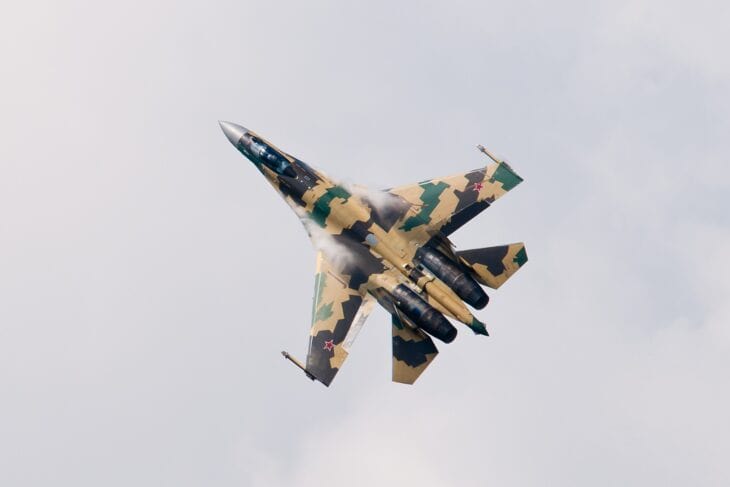

It pairs two Saturn AL-41F1S thrust-vectoring engines with an N035 Irbis-E radar. AeroCorner’s spec panel lists a top speed of 1,491 mph (2,400 km/h), a range of 2,240 miles (3,600 km) and a unit price of $85 million at 2020 prices.
For a jet Russia has pushed hard abroad, it has sold poorly. China signed for 24 in November 2015 in a deal worth about $2 billion, and took them between 2016 and 2018.
Egypt reportedly agreed to buy more than two dozen for about $2 billion in late 2018. Production started in May 2020, and 17 had been built by June 2021, before the deal collapsed under the threat of US sanctions under the CAATSA law.
Indonesia signed for 11 in 2018 and has not received one. Algeria began taking Su-35s in March 2025, and at least four of its jets have been seen that appear to be ex-Egyptian airframes.
Iran has said repeatedly since 2022 that it bought the type, and the same Rostec leak listed 48 for Tehran. No Iranian delivery has been independently confirmed, and the jets built for Tehran were reportedly still sitting in Russia as of mid-2026, which is why The Aviationist counts Ethiopia as the Su-35’s third foreign operator, after China and Algeria.
Why Even Two Su-35s Change Ethiopia’s Air Force
Ethiopia’s fighter force is old and secondhand. The Aviationist puts it at about 16 Su-27SKs, nine MiG-23s, three Su-25UBs and six Su-30Ks, while TWZ counts closer to 10 to 15 Su-27s and just two Su-30Ks.
The Su-30Ks were built for India, stored in Belarus and refurbished, and Ethiopia received the first two in January 2024. The Su-35 is a generation newer than all of them, with a radar and long-range missiles TWZ calls a major step up for finding and engaging hostile aircraft.
The timing is not subtle. Ethiopia has cut diplomatic ties with Eritrea, which it accuses of backing rebels in Tigray. Tigrayan forces seized Mekelle airport in September, and government troops entered the city on Oct. 4, 2026.
Abiy framed the purchase as a way to “pre-emptively deter aggression.” For Moscow, the payoff is money and influence: Mikheyev said African countries now account for more than 30% of Rosoboronexport’s order book.
The jets alone do not make a capability. TWZ points out that the Su-35 needs trained pilots, maintenance infrastructure, integrated weapons and a reliable flow of spare parts, and that Russia, at war in Ukraine and under sanctions, has not always delivered the last of those.
What to Watch for Next
The first real test is simple: an Su-35 landing in Ethiopia. As of Nov. 3, 2026, we could find no photos of the jets at an Ethiopian air base, and Ethiopia had not said where they will be based.
The second is the count. If 12 Ethiopian-marked Su-35s turn up, Abiy’s number holds and the leaked six-jet contract was out of date. If the fleet stays at two for months, his “twelve” was the order, not the delivery.
The S-400 is the larger, slower part of the package, with no delivery date given, and our S-400 explainer covers what the system does. The fighter is the headline, and it puts a small African air force in a club whose only confirmed members had been Russia, China and Algeria.
Whether it can hold its own there is another matter. The Su-35 ranks No. 10 in our ranking of the best fighter jets in the world, nine places below the stealth jet it is most often measured against, as our F-22 vs Su-35 comparison lays out.
Sources and references used for research and fact-checking.
- Al Jazeera, Ethiopia receives 12 Russian Su-35 jets, plans S-400 acquisition
- Al Jazeera, Why is Russia sending fighter jets and air defences to Ethiopia?
- Reuters (via Internazionale), Ethiopia says it has taken delivery of 12 Russian Su-35 fighter jets
- TASS, Rosoboronexport delivers first batch of Su-35 fighter jets to Ethiopian Air Force
- The Aviationist, Ethiopia Receives First Su-35 Fighters
- AIN, Ethiopia Receives First Russian Su-35 Fighters
- Militarnyi, Ethiopia receives first batch of Su-35 fighter jets from Russia
- TWZ, Ethiopia Gets 12 Russian Su-35 Fighters, Eyes S-400 Air Defenses
- The Defense Post, Leaked documents point to Russian jet deals with Iran, Algeria, Ethiopia
- Wikipedia, Sukhoi Su-35
Get the Newsletter
The latest aviation news and stories sent to your inbox.
About the Author

Tim is the owner and lead editor of AeroCorner since 2019, overseeing aviation content covering aircraft, airlines, airports, and the broader aviation industry. Through years of researching, writing, editing, and publishing aviation-focused content, he has developed extensive practical knowledge of commercial aviation and air travel. Based in Asia and a frequent traveler himself, Tim also brings firsthand passenger experience to AeroCorner’s coverage. Outside of publishing, he has also explored aviation firsthand through hands-on flight training in New Zealand.