

Table of Contents
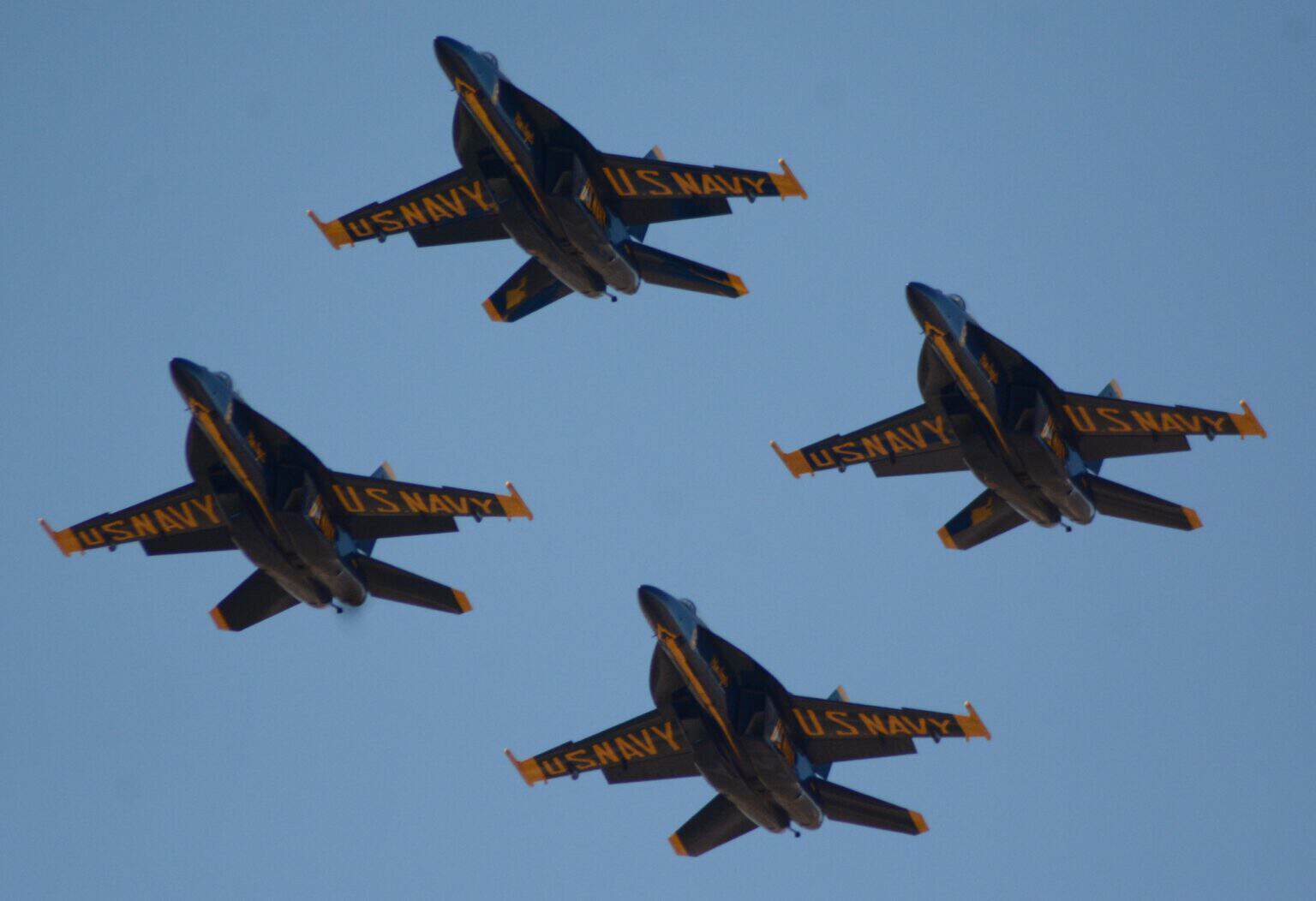
The Blue Angels fly six F/A-18 Super Hornets in a show: four in the Diamond formation and two solos. A seventh jet, a two-seater, carries the show’s narrator to each site.
The whole squadron has about 11 Super Hornets, as of October 2026. That is the number in the Navy’s 2018 conversion contract with Boeing, and the one reporting still gave in August 2025. Yet a 2020 Navy story says 18.
How Many Jets Do the Blue Angels Fly?
Six at a time, all of them single-seat F/A-18Es numbered 1 to 6. Numbers 1 to 4 fly the Diamond, and numbers 5 and 6 are the solos, who join the Diamond near the end of the show.
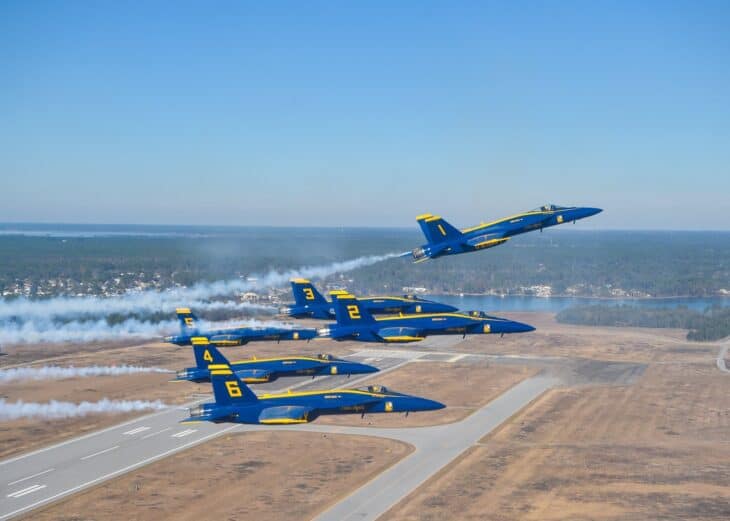

Blue Angel No. 1 is the flight leader and the squadron’s commanding officer. Pilots 2 through 7 are Navy lieutenant commanders or lieutenants, or Marine majors or captains, and they serve two to three years.
Count the whole squadron and the answer is about 11. The team’s own site gives its head count but no aircraft total on the pages we could open, so that figure comes from the contract and from later reporting.
The count at a glance
6 jets fly the demonstration. 1 more, a two-seat F/A-18F, carries the narrator. About 11 Super Hornets belong to the squadron: nine single-seat F/A-18Es and two F/A-18Fs. Fat Albert, the team’s C-130J, is a turboprop and is not one of the 11.
What is inside the squadron’s 11 Super Hornets
The split below starts from the contract: nine F/A-18Es and two F/A-18Fs. Take the six demonstration jets from the nine single-seaters and three remain.
| Group | Jets | What they do |
|---|---|---|
| Demonstration F/A-18Es | 6 | Blue Angels No. 1 to 6: the Diamond and two solos |
| Spare F/A-18Es | 3 | Single-seat backups |
| Two-seat F/A-18Fs | 2 | The No. 7 narrator jet, backups and demonstration rides |
| Total | 11 | As of October 2026, based on the 2018 contract |
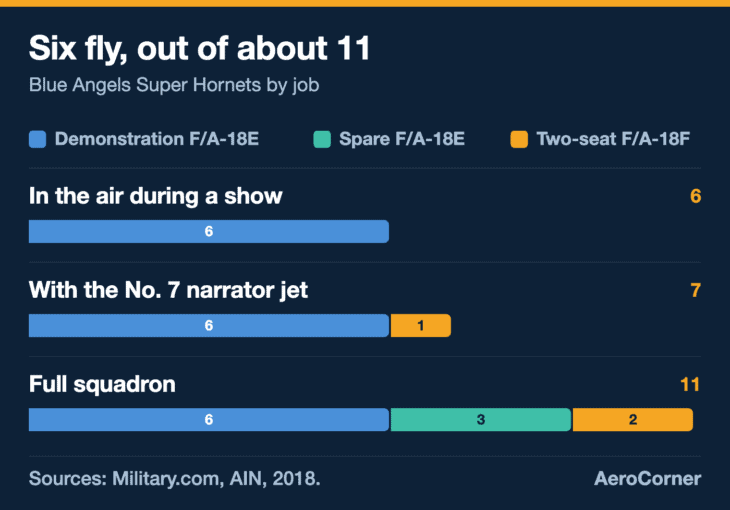
Those five extra jets are the surprise in the split. Almost half the squadron’s Super Hornets are outside any one six-ship show, working as backups or two-seat transport.
They are not new aircraft, either. The Super Hornets are early production jets taken from Navy squadrons and refurbished by Boeing at Cecil Field near Jacksonville, Florida. They gained a smoke system, civilian-compatible navigation gear and cameras, and lost the M61A2 cannon.
Those changes mean a Blue Angels jet is not ready for combat as it stands. SlashGear reported in August 2025 that the display jets carry a smoke oil tank and a control stick spring for tighter formation flying, and that a return to combat would take about 72 hours.
The two-seaters earn their place away from the show as well. Usually two back-seat rides are offered at each air show, and one goes to a member of the press.
That small fleet has a long year to cover. The team’s published 2026 schedule lists 32 show sites, from MCAS Yuma, Arizona, on March 14 to the Homecoming Air Show at NAS Pensacola, Florida, on November 6 and 7.
Why the numbers differ
Search this question and you will see 6, 7, 11 and 18. Three of them are correct answers to slightly different questions.
Six counts the jets in the demonstration. Seven usually adds the No. 7 narrator jet, though it can also mean the six jets plus Fat Albert. Eleven counts the full Super Hornet fleet, and Military.com said in 2018 that the squadron typically maintains 11 aircraft.
Treat 18 with caution
A July 2020 Navy supply command story described the first of 18 F/A-18E Super Hornets arriving at Pensacola. The War Zone and The Aviationist also reported 18. No source we opened shows 18 in service or explains the gap with the 11 in the contract, and a 2025 report still put the team at about 11.
That gap is unresolved, and we would rather say so than pick a winner we cannot prove. If the Navy publishes an inventory, the figure on this page will change to match it.
The aircraft type trips people up too. Some air show pages still call the team’s jets Hornets, but the Blue Angels moved to the Super Hornet on November 4, 2020.
How many Blue Angels are there?
If you meant people, the team’s site says 158 active-duty Sailors and Marines in 2026. Wikipedia’s entry breaks the team into 13 Navy officers, 4 Marine officers and more than 100 enlisted personnel.
Only six of them fly the demonstration. A seventh pilot flies the narrator jet, a naval flight officer serves as No. 8, the events coordinator, and three Marine pilots fly the C-130.
Pilots do not simply step into a jet. New officers report in September for a two-month turnover, then start a five-month training program at NAS Pensacola and Naval Air Facility El Centro, California, once the season ends in November.
Not every officer flies, either. The seven officers picked for 2026 were three Super Hornet pilots, one C-130J pilot, an assistant maintenance officer, a supply officer and a public affairs officer.
Other pages quote 126 or 110 people. Those are different counts from other sources and seasons, so go with the team’s own 158 for 2026.
The team's most famous plane sat out 2026
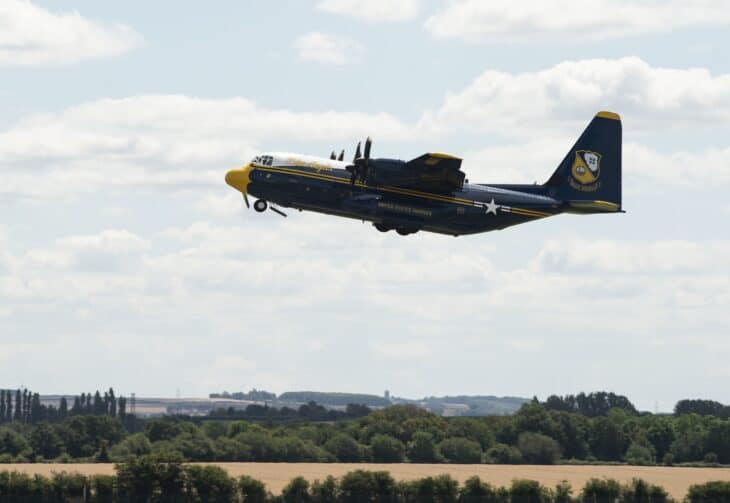
Fat Albert arrived at Marshall in Cambridge, England, in November 2025 for a new center wing box. In July 2026, local station WEAR reported that a replacement C-130 was carrying the squadron this season. Marshall expected Fat Albert back for the 2027 show season.
The regular aircraft is a C-130J Super Hercules the Navy acquired from the Royal Air Force in 2019. It covers over 100,000 miles (160,000 km) each season, carrying up to 45 personnel.

How the fleet got here, and how it compares
1986
The Hornet arrives. The team starts flying the F/A-18A/B, moving to the F/A-18C/D in 2010.
August 2018
The contract. A $17 million order covers nine F/A-18Es and two F/A-18Fs.
July 27, 2020
First delivery. The first Super Hornet lands at NAS Pensacola.
November 4, 2020
The switch. The team transitions to the Super Hornet.
November 2025
Fat Albert leaves. The C-130J goes to England for structural work.
2027
The next season. The team’s published schedule opens March 13 at NAF El Centro, California.
The Air Force’s team looks similar from the crowd. Wikipedia lists six F-16Cs and two two-seat F-16Ds for the Thunderbirds, and both teams fly a six-jet show.
The head counts are closer than the jets suggest. Wikipedia lists the Thunderbirds at 12 officers, 132 enlisted personnel and 3 civilians, which is about 147 people against 158 Blue Angels.
So when six blue jets pass overhead, you are watching a little over half of the fleet. The others are the reason a broken jet does not have to mean a five-ship show.
FAQ
Sources and references used for research and fact-checking.
- U.S. Navy Blue Angels, Team
- U.S. Navy Blue Angels, Show Information
- Military.com, Boeing Gets Contract to Upgrade Navy's Blue Angels to Super Hornets
- AIN, New Wings for the Blue Angels
- DVIDS, NAVSUP WSS supports Blue Angels transition to Super Hornets
- The War Zone, The Blue Angels Have Officially Received Their First F/A-18E Super Hornet
- The Aviationist, The Blue Angels Have Received Their First F/A-18E Super Hornet
- SlashGear, Are The Blue Angels' Fighter Jets Combat-Ready?
- Stars and Stripes, Blue Angels select new officers for 2026
- Aerobatic Teams, Blue Angels US Navy Flight Demonstration Squadron
- Thunder Over New Hampshire, United States Navy Blue Angels
- Wikipedia, Blue Angels
- Wikipedia, United States Air Force Thunderbirds
- Wikipedia, Amanda Lee (pilot)
- WEAR, Blue Angels' 'Fat Albert' sidelined for UK maintenance, expected back for 2027 season
- AeroTime, Blue Angels C-130 'Fat Albert' to head to UK for winter heavy maintenance
Get the Newsletter
The latest aviation news and stories sent to your inbox.
About the Author

Tim is the owner and lead editor of AeroCorner since 2019, overseeing aviation content covering aircraft, airlines, airports, and the broader aviation industry. Through years of researching, writing, editing, and publishing aviation-focused content, he has developed extensive practical knowledge of commercial aviation and air travel. Based in Asia and a frequent traveler himself, Tim also brings firsthand passenger experience to AeroCorner’s coverage. Outside of publishing, he has also explored aviation firsthand through hands-on flight training in New Zealand.