

Table of Contents
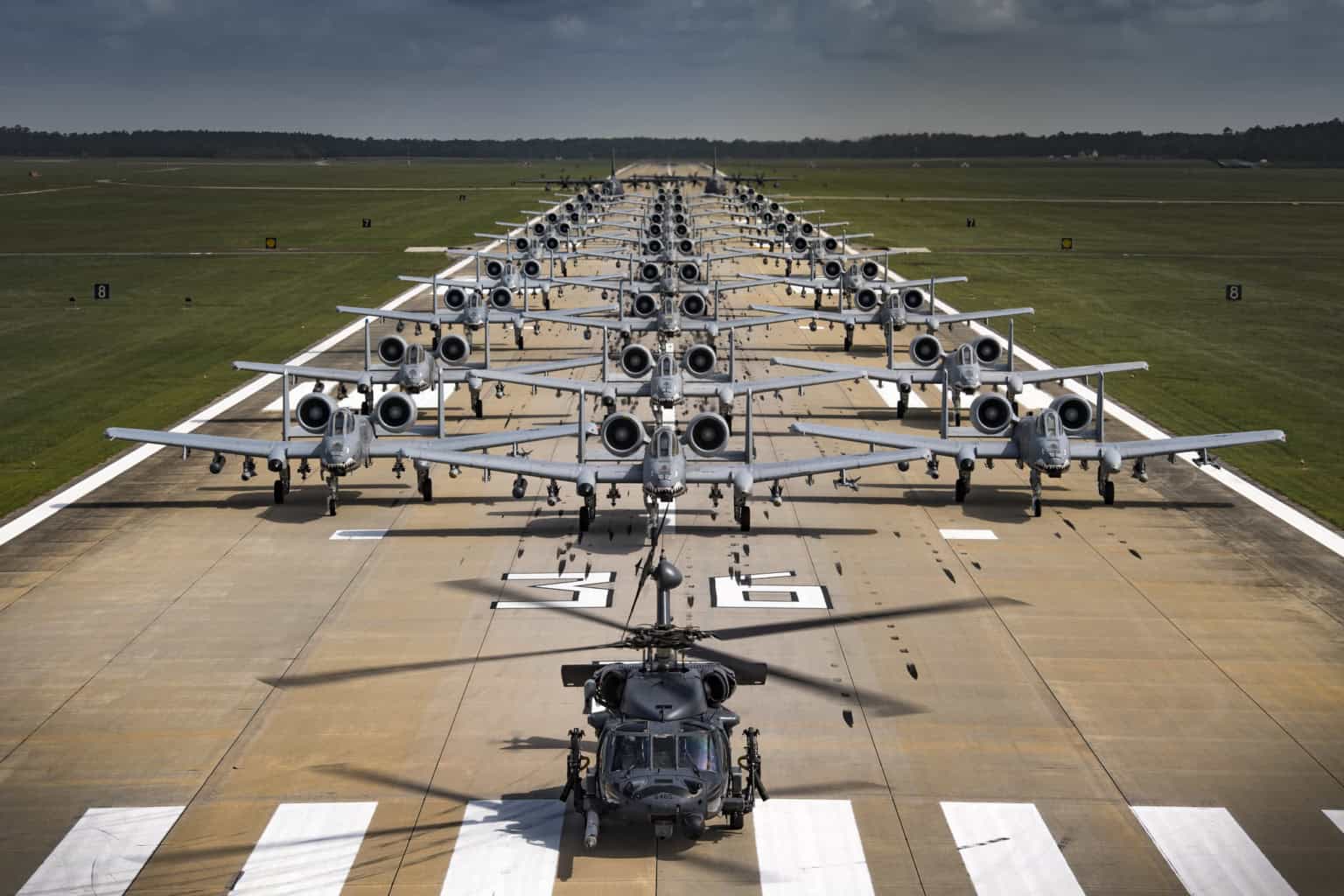
A military squadron usually holds 12 to 24 aircraft. A US Air Force fighter squadron sits at the top of that range with 18 to 24 jets, while a US Navy or Marine Corps squadron rarely exceeds 12.
There is no single fixed number, and that is the honest answer. Squadron size moves with the service, the aircraft type, and the era.
The pattern behind the variation is simple: the heavier the aircraft, the smaller the squadron. Fighters come in dozens, bombers and transports in single digits and low teens.
| Squadron type | Typical aircraft |
|---|---|
| US Air Force fighter squadron (F-16, F-15E, F-22, F-35A) | 18 to 24 |
| US Air Force bomber, tanker or airlift squadron | Fewer than a fighter squadron, no single published standard |
| US Navy strike fighter squadron (F/A-18E/F) | 10 to 14 |
| US Navy F-35C squadron | 10, rising to 16 |
| US Navy maritime strike helicopter squadron (MH-60R) | 11 |
| US Navy sea combat helicopter squadron (MH-60S) | 8 |
| US Marine Corps F-35 squadron | 12 |
| US Marine heavy helicopter squadron (CH-53) | 16 |
| US Army attack reconnaissance battalion (AH-64) | 24 |
| Royal Air Force frontline combat squadron | About 12 |
| Indian Air Force fighter squadron | 18 |
How to read these numbers
Militaries count “primary aircraft assigned,” the airframes a unit owns on paper. On any given day some are in maintenance, so the number a squadron can actually launch is always lower than the number it holds.
Why There Is No Single Number
Air forces deliberately avoid locking squadron size to one figure. Units have to stay flexible enough to absorb new aircraft, surge for a deployment, or shrink as a type retires.
Aircraft size drives most of the difference. A fighter needs one pilot and a modest maintenance footprint, so an air base can support two dozen of them under one commander.
A heavy jet cannot be stacked the same way. Bombers, cargo planes, and the tankers that handle aerial refueling each demand far more ground crew, hangar space, and ramp real estate per airframe.
The result is that “squadron” describes a level of command, not a headcount of aircraft. Two units with the same name can differ by a factor of three.
How Many Planes Are in a US Air Force Squadron?
USAF fighter squadrons support 18 to 24 aircraft. That makes them the largest flying squadrons in regular American service.
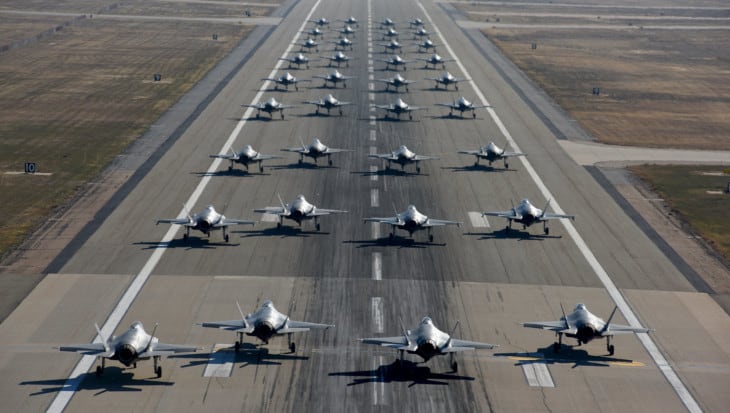
The upper end is real, not theoretical. Each of the three F-35A squadrons assigned to Tyndall Air Force Base is built around 24 aircraft.
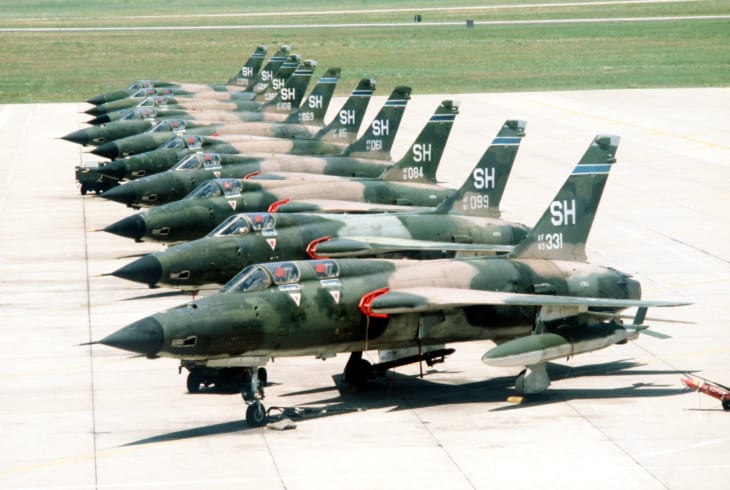
Squadrons flying larger aircraft carry fewer of them, and the Air Force does not publish a standard figure for bomber, tanker, or airlift units the way it effectively does for fighters. Expect numbers well below 18 rather than a fixed count.
Scale helps put the fighter number in context. The Air Force and Space Force together held 4,865 aircraft as of September 30, 2025, of which 1,978 were fighter or attack aircraft and only 141 were bombers.
Not every squadron flies. Missile, intelligence, maintenance, and civil engineering squadrons all carry the designation with no aircraft assigned at all.
The same jet, half the squadron
An Air Force F-35A squadron is built around 24 aircraft. A Marine Corps F-35 squadron is built around 12. Same manufacturer, same programme, and one squadron holds twice what the other does, purely because the two services organise their aviation differently.
How Many Aircraft Are in a Navy Squadron?
US Navy tactical squadrons usually hold no more than 12 aircraft. They are smaller than their Air Force equivalents because they have to fit on a carrier deck.
A recent USS Carl Vinson deployment shows the spread in practice: one 10-aircraft F-35C squadron, two 10-aircraft F/A-18E squadrons, and one 14-aircraft F/A-18F squadron.
Those four units add up to 44 strike fighters, and that total is the number the Navy protects. The planned future wing keeps the same 44 by growing the F-35C squadron to 16 aircraft and trimming the Super Hornets to 28 across three squadrons.
A carrier air wing is more than its fighters. Alongside the strike fighters it carries five to seven EA-18G Growlers, five E-2D Advanced Hawkeyes, six to ten MH-60 Seahawks, three CMV-22B Ospreys, and a growing number of MQ-25 Stingray tankers.
Helicopter units follow the same compact pattern. The rotary element of a carrier air wing nominally holds 11 MH-60R Seahawks in the maritime strike squadron and eight MH-60S in the sea combat squadron.
How Many Aircraft Are in a Marine Corps Squadron?
The Marine Corps standardised on 12 aircraft per F-35 squadron in its 2025 aviation plan. That single figure now applies across the fleet, to both the F-35B and the carrier-capable F-35C.
It is a deliberate reversal. An earlier plan had cut F-35B squadrons to 10 aircraft, and the 2025 revision pushed them back up to 12.
The Marines expect to field 12 F-35B squadrons and eight F-35C squadrons out of a total programme of 420 aircraft. Their older squadron types ran larger, with heavy helicopter squadrons at 16 CH-53s and light attack units at 18 AH-1s plus nine UH-1s.
How Many Helicopters Are in a Squadron?
Helicopter squadron sizes run from eight to about 18, depending on the service and the mission. Naval and Marine units cluster at the low end, and the biggest counts belong to the assault and heavy-lift roles.
The extremes are worth knowing. Marine heavy helicopter squadrons are authorised 16 CH-53s, while Marine light attack squadrons combine 18 AH-1s with nine UH-1s in one unit.
The US Army is the exception that trips people up. It fields military helicopters in battalions rather than aviation squadrons, and an attack reconnaissance battalion is built around 24 AH-64 Apaches.
The Army does use the word “squadron,” but it means something else entirely. In Army usage a squadron is a cavalry unit at battalion level, not a formation defined by its aircraft.
Flight, Squadron, Group, Wing: How the Ladder Works
A squadron is one rung on a ladder, and the rungs above and below it are where most confusion starts. In the US Air Force the order runs from flight up to major command.
| Unit | What it contains | Typical commander |
|---|---|---|
| Flight | Two to six aircraft, the smallest unit | Captain or major |
| Squadron | Two to six flights, 12 to 24 aircraft, 35 to 700 people | Lieutenant colonel |
| Group | Two or more squadrons | Colonel |
| Wing | About four groups | Colonel or brigadier general |
| Numbered air force | Wings, groups and squadrons in a region or role | Major general or lieutenant general |
| Major command | Numbered air forces | General |
The squadron is the basic building block of the Air Force. It is the smallest unit with its own commander, its own designation, and its own history.
Flights divide a squadron into working sections. An operational squadron is normally split into lettered flights, so a unit might run an A, B, C, and D flight of four aircraft each.
The group and wing trap
In the US Air Force a group sits below a wing. In the Royal Air Force it is the reverse: squadrons form wings, and wings sit under a much larger group. Reading a British and an American order of battle with the same assumptions will give you the hierarchy upside down.
How Many Squadrons Make Up a Wing?
A US Air Force wing typically contains about four groups, and the flying squadrons sit inside one of them, the operations group. Two or more squadrons form a group, and two or more groups form a wing.
In practice that means a wing usually owns two to four flying squadrons, with the rest of its groups handling maintenance, mission support, and medical work.
Squadron Sizes in Other Air Forces
Royal Air Force frontline combat squadrons commonly field around 12 aircraft. The modern RAF has also largely dropped the old A and B flight structure inside its squadrons.
The Indian Air Force is more prescriptive than most. A standard IAF fighter squadron is 18 aircraft, mixing operational and reserve airframes.
That fixed number is why Indian squadron counts make headlines. The IAF is sanctioned for 42 squadrons but has been operating closer to 31, a shortfall measured in whole units rather than individual jets.
How Many Planes Were in a Squadron in World War II?
Wartime squadrons were smaller than their modern counterparts and grew steadily as production caught up. A US heavy bomb group was authorised 35 aircraft in 1941 and 72 by March 1945, with 96 crews.
Those groups were built from four bombardment squadrons, a structure adopted in 1942 and kept for the rest of the war. Divided across four units, the 1945 authorisation works out to roughly 18 bombers per squadron.
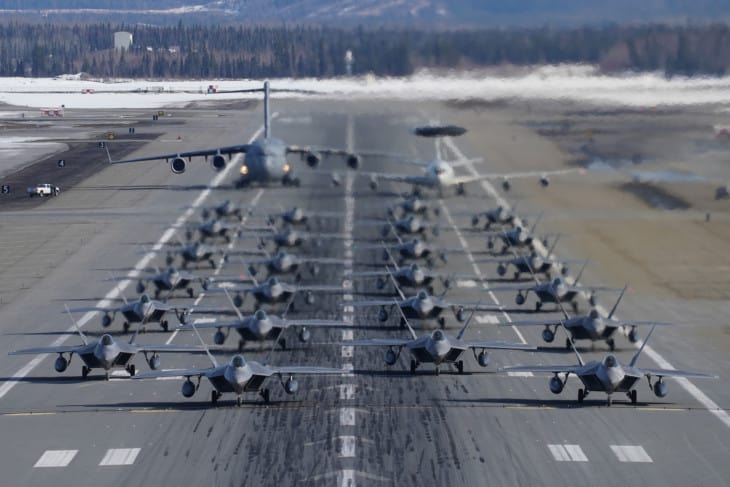
The Royal Air Force worked to a different standard. A British fighter squadron had a fighting strength of 12 aircraft, achieved by assigning about 16 aircraft and 20 pilots to each unit.
The gap between 12 and 16 is the whole point. Combat losses and battle damage meant a squadron had to hold more aircraft than it intended to fly.
Who Commands a Squadron?
In the US Air Force a squadron is normally commanded by a lieutenant colonel, though some are led by majors or captains. This applies to flying and non-flying squadrons alike.
US Navy flying squadrons are commanded by an officer with the rank of commander. The commanding officer is supported by an executive officer of the same rank who acts as second in command.
Personnel numbers vary far more than aircraft numbers. Air Force squadrons range from about seven people to well over 600.
How Squadrons Are Named and Designated
US Navy and Marine Corps squadron designations follow a letter code. The first letter identifies the broad type of aircraft the unit flies.
- V: fixed-wing aircraft, meaning jets and propeller planes
- H: rotorcraft, meaning helicopters
- Z: lighter-than-air aircraft such as blimps and balloons
Class letters follow to indicate the mission. “F” marks a fighter unit and “A” an attack unit, which is how VFA becomes a strike fighter squadron and HSC a helicopter sea combat squadron.
A dash and a number close the designation. That final numeral is the unique identifier for the squadron within its class, which is what separates VFA-137 from VFA-122.
Attack Aircraft Versus Fighters
The two words are easy to mix up, and the distinction shapes what a squadron is for. An attack aircraft is built to hit ground targets and support troops, like the A-10C Thunderbolt II.
A fighter is built for air-to-air combat, though most modern fighter jets also carry ground-attack weapons. The F-15E Strike Eagle and F-16 Fighting Falcon are the familiar examples.
Squadrons are almost always single-type units. Grouping one aircraft model under one commander keeps training, spare parts, and tactics consistent, which is why the types of military planes a service flies map so closely onto how it organises its squadrons.
Sources and references used for research and fact-checking.
- Air & Space Forces Magazine, 2026 USAF & USSF Almanac Equipment: Total Aircraft Inventory (TAI)
- Aerospace Security Project, Center for Strategic and International Studies, Air Force Organization 101
- Wikipedia, Squadron (aviation)
- Seapower Magazine, Navy's Future Carrier Air Wing Configuration Coming into Focus
- Naval News, U.S. Marine Corps Reshuffles F-35 Plans In Latest AVPLAN
- Wikipedia, Bombardment group
- Defense Advancement, RAF Squadrons and Typhoon Squadrons: Squadron Size, Aircraft Info
Get the Newsletter
The latest aviation news and stories sent to your inbox.
About the Author

Articles credited to the AeroCorner Editorial Team are created or maintained by multiple aviation contributors working under a shared editorial framework. Content is researched using authoritative aviation sources and reviewed to ensure clarity, technical accuracy, and consistency across AeroCorner.