


Table of Contents
| Measure | F-22A Raptor | Su-35S Flanker-E |
|---|---|---|
| Generation | Fifth; stealth designed in from the start | 4.5, a deep upgrade of the Su-27 Flanker |
| First flight, service entry | September 1997; December 2005 | February 2008; February 2014 |
| Radar cross-section | 0.0001 sq m from some angles, per Lockheed Martin | Reportedly 1 to 3 sq m |
| Supercruise | Mach 1.76 published; above Mach 1.5 per the US Air Force | Limited, just above Mach 1.1 |
| Thrust vectoring | Pitch only, up to 20 degrees | Canted nozzles that also roll and yaw the jet |
| Sensors | AN/APG-77 AESA radar; no IRST | N035 Irbis-E PESA radar plus OLS-35 infrared search and track |
| Air-to-air load | Six AIM-120 and two AIM-9, all internal | 12 external hardpoints for R-77, R-73/74, R-27 and R-37M missiles |
| Gun | M61A2 20 mm, 480 rounds | GSh-30-1 30 mm, 150 rounds |
| Air-to-air kills | A balloon and two unidentified objects (February 2023) | At least seven Ukrainian fighters confirmed by September 2022 |
| Cost | $143 million unit cost; $55,051 per flight hour (FY2026 DoD rate) | No official price; about $104 million a jet in China’s package deal |
| In service | 184 (June 2026) | About 155 in Russia (end-2025 estimate), plus exports |
| Exported | No, barred by US law since fiscal 1998 | China (24), Algeria, and Iran from September 2026 (unconfirmed) |
| Production | Ended; last jet delivered May 2012 | Ongoing; an estimated 15 to 18 delivered in 2025 |
How we compare the F-22 and the Su-35
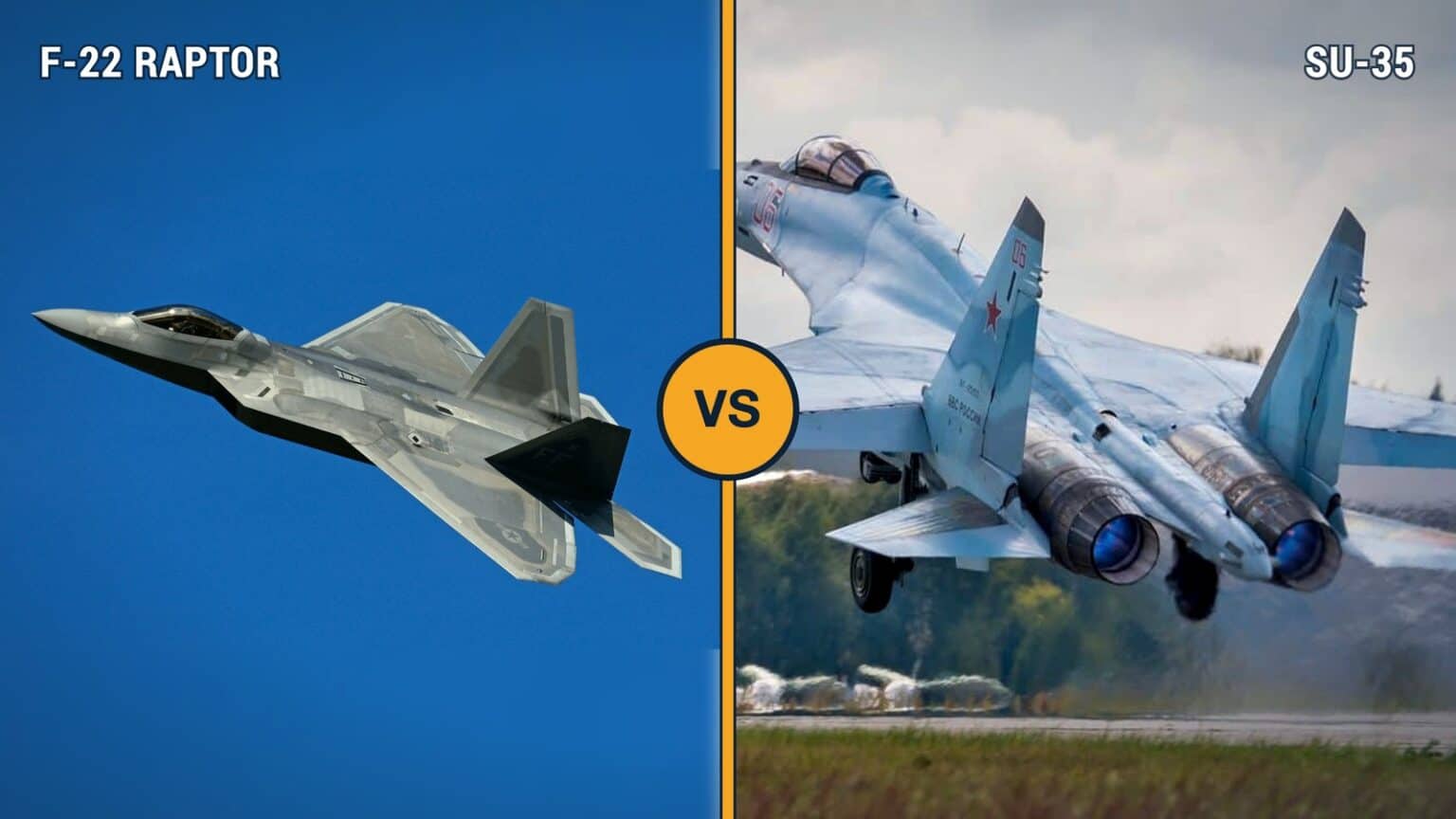
These two jets are a generation apart. The F-22 is a fifth-generation stealth fighter, the class our guide to the five generations of fighter planes explains. The Su-35 is a 4.5-generation fighter, sometimes billed as 4++.
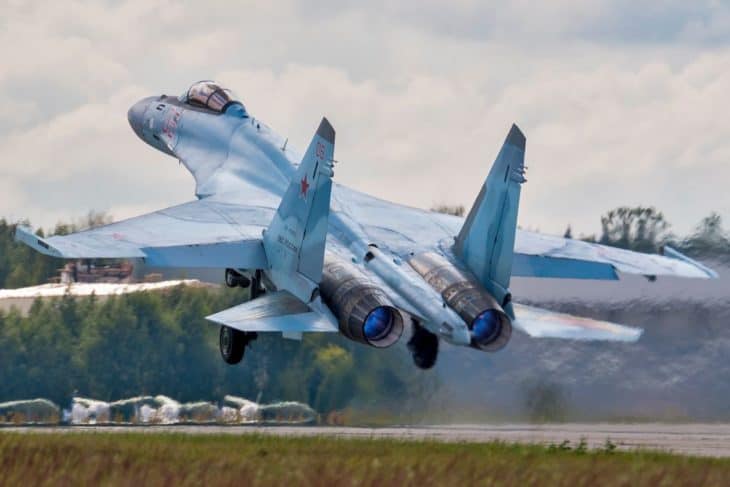
Sukhoi began the Su-35 in 2003 as a deep modernization of the Su-27, meant as an interim fighter while the PAK FA program, today’s Su-57, was developed. It borrows technology from that program, but it is not a stealth design.
We rank them on four measures: who sees and shoots first, raw performance, combat record, and numbers. Full specifications for the Lockheed Martin F-22 Raptor and the Sukhoi Su-35 sit in our aircraft database.
The measure decides the winner
On range, payload, gun size and close-in agility, the Su-35 holds its own or wins. On stealth, supercruise and internal weapons, the F-22 wins, and those are the measures that decide who fires first in a modern air fight.
Where the F-22 Raptor wins
Stealth: the gap that decides the fight
The F-22’s exact radar cross-section, the size it appears to a radar, is classified. In 2009 Lockheed Martin released figures indicating that from certain angles it is 0.0001 square meters, about the radar reflection of a steel marble.
The Su-35’s is reportedly 1 to 3 square meters. Sukhoi applied radar-absorbent material to the engine inlets and front compressor stages to halve its frontal signature, but it still carries its weapons outside the airframe.
That gap matters more than any other row in the table. Our guide to stealth fighter jets shows how far ahead of the Flanker family the F-22’s design sits.
What the Su-35's radar sees
The Su-35’s Irbis-E radar is credited with detecting a 3-square-meter target at up to 249 miles (400 km) in a narrow search, and 124 miles (200 km) otherwise. Detection range grows with the fourth root of radar cross-section, so the Raptor’s best published figure cuts those to roughly 19 miles and 9 miles. Lockheed’s number holds only from some angles, so treat this as a rough scale, not a measurement.
Supersonic without afterburner
On top speed the two are level. Both are rated at Mach 2.25 at altitude, about 1,500 mph (2,414 km/h) for the F-22 and 1,490 mph (2,400 km/h) for the Su-35.
The difference is supercruise, flying faster than sound without afterburner. The Air Force says the F-22 does it above Mach 1.5, and published figures put it at Mach 1.76, about 1,162 mph (1,870 km/h).
The Su-35 has only a limited ability to hold speeds just above Mach 1.1 without afterburner. The Air Force says the F-22’s stealth and supercruise together shrink missile engagement envelopes and minimize an enemy’s ability to track it. See where both sit in our ranking of the fastest fighter jets.
Eight missiles inside, and an AESA radar
In its air-to-air loadout the F-22 carries six AIM-120 AMRAAMs in its main bays and two AIM-9 Sidewinders in its side bays. Everything rides inside, so the jet stays stealthy while armed.

Its AN/APG-77 is an active electronically scanned array (AESA) radar that changes frequency more than 1,000 times a second to make its emissions hard to intercept. The Su-35’s Irbis-E is an older passive array on a hydraulic mount.
The Air Force says the F-22’s sensors let its pilot “track, identify, shoot and kill air-to-air threats before being detected.” Against a Su-35, that is the whole plan.
Where the Su-35 wins
Thrust vectoring in every axis
The F-22’s nozzles vector thrust up and down by up to 20 degrees, which helps it point its nose in pitch. The Su-35’s nozzles are canted at an angle, so vectoring each one differently also rolls and yaws the jet.

With its integrated flight and engine controls, that lets the Su-35 pull 9 g and fly post-stall maneuvers at low speed. Its maker’s brochure bills it as a super-maneuverable fighter.
More range and a heavier load
Compared like for like, the Su-35 goes much farther. With two external tanks its ferry range is 2,796 miles (4,500 km), against more than 1,850 miles (2,980 km) for the F-22 with two tanks, per the Air Force.
On internal fuel alone, Sukhoi gives the Su-35 about 2,237 miles (3,600 km) at altitude. The F-22’s published combat radius, clean and subsonic, is 595 nautical miles (685 miles).
The Su-35 carries up to 17,630 pounds (8,000 kg) on 12 hardpoints, including the heavy Oniks anti-ship cruise missile. The F-22’s strike load is two 1,000-pound JDAM bombs, or four small GBU-39s, alongside its missiles.
The Su-35 has the heavier gun as well: a 30 mm GSh-30-1 with 150 rounds, against the F-22’s 20 mm M61A2 with 480.
A heat-seeking sensor the Raptor lacks
Ahead of the Su-35’s cockpit sits the OLS-35 infrared search and track (IRST) system, which finds aircraft by their heat rather than by radar.
The F-22’s design once included a dedicated IRST, but it was removed during development as the jet was trimmed for weight and cost, with space and cooling kept for a later fit. The Aviationist’s David Cenciotti has argued the Su-35’s IRST could threaten a Raptor when tight rules of engagement force a close look first.
Cheaper, and still in production
The Air Force lists the F-22’s unit cost at $143 million. The Pentagon’s fiscal 2026 reimbursement rates bill an F-22A at $55,051 per flight hour.
No official price exists for the Su-35. China paid $2.5 billion for 24 in 2015, about $104 million a jet, but that package also covered spare engines and ground support equipment.
The bigger advantage is that Russia can still build them. The F-22 line closed with the last delivery in May 2012, while Russia received an estimated 15 to 18 new Su-35S fighters in 2025 alone.
F-22 vs Su-35 in a dogfight: who would win?
They have never fought, so any verdict is an argument, not a result. Up close, the Su-35’s all-axis thrust vectoring is its best card. Its post-stall agility reflects a different school from Western doctrine, which stresses keeping a fighter’s energy.
The F-22 is no pushover there. With half its internal fuel, published figures give it a thrust-to-weight ratio of 1.25, against 1.13 for the Su-35, and it can hold a trimmed angle of attack above 60 degrees while keeping roll control.
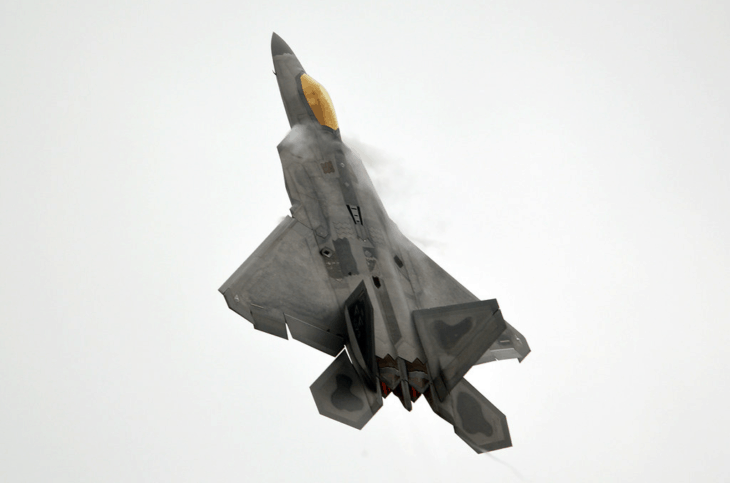
Both are rated to 9 g. The F-22 can pull it at takeoff gross weight with full internal fuel.
The Raptor’s training record points one way. At Northern Edge in June 2006 and Red Flag 07-2 in February 2007, F-22s flew against aggressor F-15s and F-16s with a simulated kill ratio of 108 to 0.
A handful of Raptors have been “lost” in close-in training fights, where stealth and sensors count for little. The National Interest notes that in the same exercises, no aircraft managed to engage an F-22 beyond visual range.
That is the fight that matters most now. The National Interest points out that most aircraft are shot down beyond visual range, and a pilot who cannot find the Raptor never gets to turn with it.
Myth check: the Su-35 is not a fifth-generation stealth fighter
The old claim that both jets are fifth-generation stealth fighters is wrong. The Su-35 is a 4.5-generation Flanker with a frontal radar cross-section reportedly 1 to 3 square meters and its weapons carried outside. Nor is either jet slower: both top out at Mach 2.25. The F-22’s speed edge is in supercruise.
Have the F-22 and Su-35 ever met?
Yes, though never in combat. On December 13, 2017, two F-22s intercepted two Russian Su-25 attack jets that had crossed the Euphrates deconfliction line in Syria, and fired warning flares and chaff.
A Russian Su-35 also crossed the river and was shadowed closely by one of the F-22s, according to US Air Forces Central Command. The encounter lasted nearly 40 minutes before the Russian jets flew back west.
Russia’s Defense Ministry had earlier claimed that on November 23, 2017, a Su-35S chased an F-22 away from Russian Su-25s. US Central Command said its flight logs showed the incident did not take place.
The two meet off Alaska too. On June 10, 2020, F-22s intercepted two Tu-95 bombers escorted by two Su-35s and an A-50 radar plane, which came within 20 nautical miles of the coast but stayed in international airspace.
Combat record: the Su-35 has fought, and lost jets
The F-22 flew its first combat sorties over Syria on September 22, 2014, dropping bombs on Islamic State targets. On February 4, 2023, one shot down a suspected Chinese spy balloon off South Carolina, and F-22s downed high-altitude objects near Alaska and over Yukon later that month.
On February 28, 2026, F-22s deployed to Israel for Operation Epic Fury, a large-scale US-Israeli operation against Iran.
The Su-35’s first combat deployment came in January 2016, when Russia sent four to Syria. Over Ukraine it has flown air superiority missions since 2022, and by September 2022 at least seven of its air-to-air victories over Ukrainian fighters had been confirmed.
The Su-35 has the fighter kills
The F-22 is the better fighter, yet its only shootdowns are a balloon and two unidentified objects. The Su-35 is the one with confirmed kills of crewed fighters, at least seven over Ukraine by September 2022.
It has also taken losses. The open-source tracker Oryx counted eight Su-35S losses as of February 25, 2026, starting with a jet shot down near Izyum on April 3, 2022.
Ukrainian Patriot missiles downed two over Russia’s Bryansk region in May 2023. That September, a Russian S-300 battery shot down one of its own Su-35s.
On July 8, 2026, Ukraine said it shot down a Su-35 about 26 miles (42 km) from the front line near Mostky, in Luhansk, and the pilot survived. Later that month Gen. Dan Caine told the Senate a Ukrainian F-16 had downed a Russian fighter, without naming the type.
Ukraine’s Militarnyi linked his remarks to the July 8 Su-35, while Russian military bloggers blamed a Patriot missile. The weapon that downed it is still unconfirmed.
On September 7, 2026, two Su-35S fighters reportedly collided over Russia’s Kursk region, killing one pilot. Russian authorities have not confirmed it.
How many F-22s and Su-35s are there?
The US built 195 F-22s, including eight test aircraft. Air & Space Forces Magazine counted 184 in service in June 2026.
None will be exported. Every annual defense appropriations act since fiscal 1998 has barred its sale to any foreign government.
Russia publishes no Su-35 count. Defence Security Asia estimated its operational fleet at about 155 at the end of 2025, which puts the Raptor and the Su-35 fleets roughly level in size.

China was the first export customer, and Russia completed delivery of its 24 Su-35s in April 2019. Algeria took delivery of Su-35s in 2025 that were originally built for Egypt, which dropped its order.
Iran is next. In mid-September 2026, Militarnyi reported footage of at least three Su-35s arriving in Iran, one landing at Tehran’s Mehrabad airport, though neither government had confirmed it.
Rostec files leaked in October 2025 describe an Iranian order for 48 Su-35s, delivered from 2026 to 2028. The files have not been authenticated.
F-22 vs Su-35 size
The Su-35 is the bigger jet. It is about 71 feet 10 inches (21.9 m) long with a 50-foot-2-inch (15.3 m) wingspan, against 62 feet 1 inch (18.9 m) and 44 feet 6 inches (13.6 m) for the F-22.
The F-22 is the heavier one. Its maximum takeoff weight is 83,500 pounds (38,000 kg), against 76,060 pounds (34,500 kg) for the Su-35.
The full side-by-side dimensions sit in the database comparison at the top of this page. Our list of the biggest fighter jets shows how both measure up against the field.
What is Russia’s F-22, and America’s Su-35?
Russia’s answer to the F-22 is the Su-57 Felon, its fifth-generation stealth fighter. The Su-35 was the stopgap built while the Su-57 was developed, and we weigh the Raptor against the newer jet in our F-22 vs Su-57 comparison.
America has no exact Su-35. Its closest counterpart in size and role is the F-15 family, a heavy twin-engine air superiority fighter built for range and a big weapons load, including the new F-15EX.
For how the Su-35 grew out of the original Flanker, see our Su-27 vs Su-35 comparison. Its main European rival is covered in our Eurofighter Typhoon vs Su-35 page.
What comes next for both jets
US law bars the Air Force from retiring any F-22 before September 30, 2027. In June 2026 the House Armed Services Committee voted to extend that bar to September 30, 2032.
The House passed its defense bill on July 22, 2026, by 216 votes to 212. In the Senate a motion to take up its version failed on July 14, and the bill was not law as of September 1, 2026.
Russia is upgrading the Su-35. The planned Su-35SM gets the N036 Byelka AESA radar from the Su-57 in place of the Irbis-E, plus a new electronic warfare suite.
For the Raptor against America’s newest stealth jet, see our F-22 vs F-35 comparison.
Sep 1997
The first F-22 flies. It is the first engineering and manufacturing development aircraft.
Dec 2005
The F-22 enters service. It reaches initial operational capability with the 94th Fighter Squadron.
Feb 2007
108 to 0. After Northern Edge in 2006, Red Flag 07-2 ends the F-22’s first big exercises with a simulated kill ratio of 108 to 0.
Feb 2008
The Su-35S flies. Test pilot Sergey Bogdan makes a 55-minute first flight from Zhukovsky on February 19.
May 2012
The last F-22 is delivered. Production ends at 195 aircraft.
Feb 2014
The Su-35S enters service. The 23rd Fighter Aviation Regiment in Russia’s Far East receives its first jets.
Sep 2014
The F-22’s first combat. It flies opening strikes over Syria on September 22.
Jan 2016
The Su-35’s first combat deployment. Russia sends four to Syria.
Dec 2017
Face to face over Syria. An F-22 shadows a Su-35 that crossed the Euphrates deconfliction line.
Jun 2020
Off Alaska. F-22s intercept Tu-95 bombers escorted by two Su-35s.
Apr 2022
The first Su-35 lost over Ukraine. It is shot down near Izyum on April 3 and its pilot is captured.
Feb 2023
The F-22’s first air-to-air kill. It shoots down a suspected Chinese spy balloon off South Carolina.
Jul 2026
A Su-35 falls near Mostky. Ukraine says it shot the jet down on July 8; the weapon is disputed.
Sep 2026
Iran’s first Su-35s. Footage shows at least three arriving, days after two Russian Su-35S fighters reportedly collide over Kursk.
The verdict
Take the F-22. It is a stealth fighter facing one that is not, it supercruises faster, and it carries its missiles where enemy radar cannot see them.
The Su-35 is still a dangerous fighter. It goes farther, lifts more, turns in ways the Raptor cannot, and unlike the F-22 it is still being built and sold.
For the wider field, see our guide to the best Russian fighter jets and our ranking of the best fighter jets in the world.
FAQ
Sources and references used for research and fact-checking.
- U.S. Air Force, F-22 Raptor Fact Sheet
- Wikipedia, Lockheed Martin F-22 Raptor
- Wikipedia, Sukhoi Su-35
- Wikipedia, Irbis-E
- Wikipedia, Radar cross section
- Office of the Under Secretary of Defense (Comptroller), Fiscal Year 2026 DoD Fixed Wing and Helicopter Reimbursement Rates
- Air & Space Forces Magazine, House Panel Votes to Prohibit F-22 Retirements Through 2032
- Congressional Research Service, FY2027 NDAA: Status of Legislative Activity
- Air Force Times, US F-22s intercept Russian fighter jets, fire warning flares
- The Aviationist, U.S. F-22 Raptor Allegedly Interfered With Russian Su-25s Over Syria And Chased Away By Su-35S, Russian MoD Claims
- The Aviationist, U.S. F-22s Intercept Russian Tu-95 bombers, Su-35 fighters and A-50 AEW Aircraft Entering Alaskan ADIZ
- The National Interest, F-22 Raptor vs. Su-35: Which Stealth Fighter Is Better in a Dogfight?
- The National Interest, Ukrainian F-16 Fighter Jet Shot Down Russian Su-35 Flanker-E/M, Caine Says
- Aerospace Global News, Four years of war: Counting Russian and Ukrainian aircraft losses
- The Kyiv Independent, 2 Russian Su-35S fighter jets collide over Kursk Oblast, Russian media reports
- Militarnyi, Iran started receiving Russian Su-35 fighter jets
- Iran International, Leaked Russian files show Iran's €6bn plan to buy 48 Russian fighter jets
- The Diplomat, Russia Completes Delivery of 24 Su-35 Fighter Jets to China
- Defence Security Asia, Russia Defies Sanctions as UAC Delivers Seventh Su-35S Batch to VKS in Record-Breaking 2025 Fighter Production Surge
About the Author

Tim is the owner and lead editor of AeroCorner since 2019, overseeing aviation content covering aircraft, airlines, airports, and the broader aviation industry. Through years of researching, writing, editing, and publishing aviation-focused content, he has developed extensive practical knowledge of commercial aviation and air travel. Based in Asia and a frequent traveler himself, Tim also brings firsthand passenger experience to AeroCorner’s coverage. Outside of publishing, he has also explored aviation firsthand through hands-on flight training in New Zealand.