



Table of Contents
| Measure | F-22A Raptor | Su-57 Felon |
|---|---|---|
| First flight | September 1997 | January 2010 (T-50 prototype) |
| Entered service | December 2005 | December 2020 |
| Stealth | Shaped for every angle; 0.0001 sq m from some angles, per Lockheed Martin | Strongest from the front; Sukhoi’s patent target 0.1 to 1 sq m on average |
| Supercruise | Mach 1.76 published; above Mach 1.5 per the US Air Force | Mach 1.3 by Russian figures; India cited a lack of supercruise in 2018 |
| Thrust vectoring | Pitch only, up to 20 degrees | Canted nozzles that also roll and yaw the jet |
| Radar | AN/APG-77 AESA, 1,956 modules | N036 AESA, 1,514 modules in the nose plus two side-looking arrays |
| Internal air-to-air load | Six AIM-120 and two AIM-9 | Four long-range and two short-range missiles |
| Gun | M61A2 20 mm, 480 rounds | GSh-30-1 30 mm, 150 rounds |
| Air-to-air kills | A balloon and two unidentified objects (February 2023) | Russia’s own S-70 drone (October 2024); claims against Ukrainian jets unproven |
| Unit cost | $143 million (US Air Force) | Under $34 million implied by the 2019 order, widely doubted |
| Built | 195, including 8 test aircraft; last delivered 2012 | 44 or more, including 10 test aircraft |
| Exported | No, barred by US law since fiscal 1998 | Algeria: 14 ordered, first 2 delivered November 2025 |
| Status, September 2026 | 184 in service; retirement barred to September 2027 | In slow production; about 4 delivered January to August 2026 |
How we compare the F-22 and the Su-57
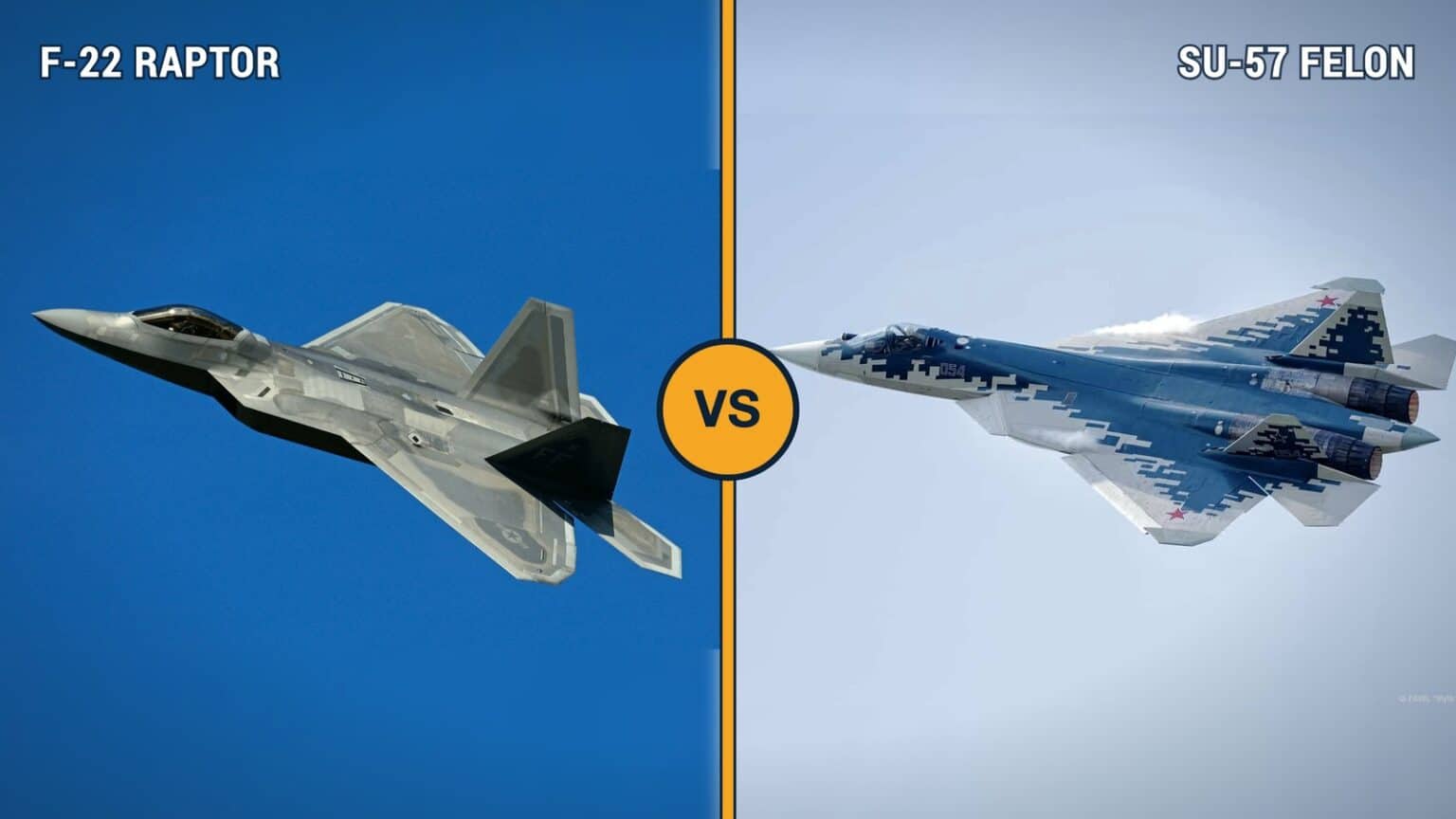
The Su-57 was designed with the F-22 in mind. Sukhoi cited the Raptor as its baseline for a supermaneuverable stealth fighter, then set out to fix what it saw as its limits: thrust vectoring that could not help roll or yaw the jet, and weapons bays too small for a multirole payload.
So the two answer different questions. The F-22 was built to win control of the air by seeing and shooting first. The Su-57 trades some stealth for agility, range and a heavier strike load, and Russia plans to fly it under the cover of its own air defenses.
Both are fifth-generation fighters, the class our guide to the five generations of fighter planes explains. We rank them on four measures: who sees and shoots first, raw performance, combat record, and whether the jet exists in useful numbers.
Full specifications for the Lockheed Martin F-22 Raptor and the Sukhoi Su-57 Felon sit in our aircraft database.
The measure decides the winner
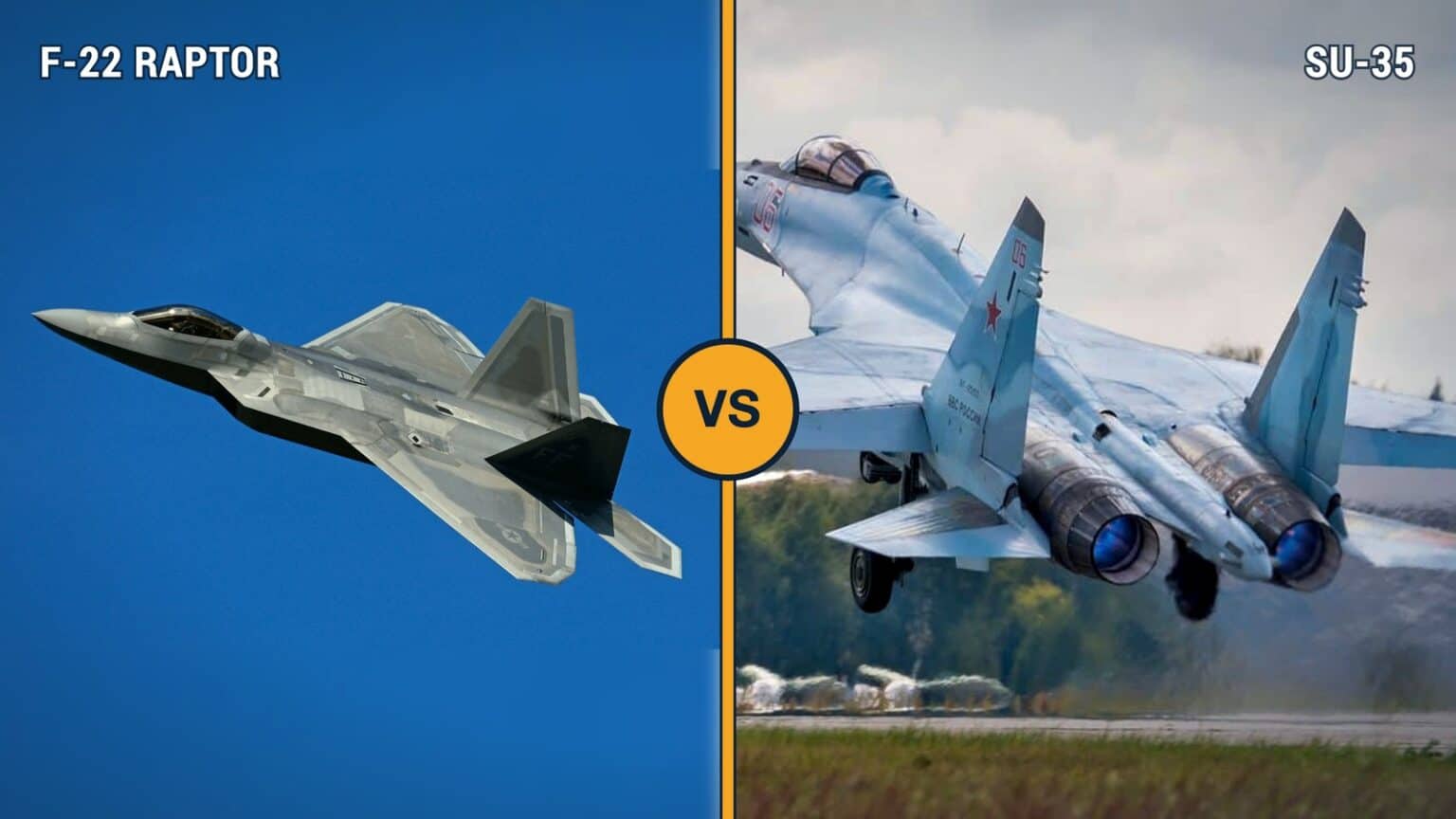
On range, strike payload and all-axis thrust vectoring, the Su-57 comes out ahead. On stealth, speed, internal missiles, sensors and numbers, the F-22 wins, and those are the measures that decide who fires first in a fight between stealth fighters.
Where the F-22 Raptor wins
Stealth from every angle
The F-22’s exact radar cross-section, the size it appears to a radar, is classified. In 2009 Lockheed Martin released figures indicating that from certain angles it is 0.0001 square meters, about the radar reflection of a steel marble.
Sukhoi’s patent for the Su-57 set a far more modest goal: an average of 0.1 to 1 square meter, against 10 to 15 for the Su-27 it descends from.
The Su-57’s stealth is also strongest from the front. Its rear fuselage is less shaped for stealth than the F-22’s, which reference sources put down to cost and to a Russian doctrine of flying under friendly air defenses. Our guide to stealth fighter jets shows how each design handles the trade.
The steel marble and the radar range rule
The distance at which a radar detects a target grows with the fourth root of its radar cross-section. Put the best published figure for each jet through that rule, and a radar that finds a Su-57 at 100 miles would pick up an F-22 at under 18 miles. Lockheed’s number applies only from some angles and Sukhoi’s is an average target, so treat this as a rough scale, not a measurement.
Faster, with supercruise nobody disputes
The F-22 is the faster jet. Published figures give it Mach 2.25, about 1,500 mph (2,414 km/h), at altitude, against Mach 2, about 1,327 mph (2,135 km/h), for the Su-57.
The bigger gap is in supercruise, flying supersonic without afterburner. The Air Force says the F-22 cruises above Mach 1.5 this way, and published figures put it at Mach 1.76, about 1,162 mph (1,870 km/h).
Russian figures give the Su-57 Mach 1.3, about 870 mph (1,400 km/h), in supercruise. India, Russia’s former partner on the jet, listed a lack of supercruise among its reasons for leaving the program in 2018.
See where both sit in the wider field in our ranking of the fastest fighter jets.
Eight missiles inside, and a bigger radar
In its air-to-air loadout the F-22 carries six AIM-120 AMRAAMs in its main bays and two AIM-9 Sidewinders in its side bays, all internal. The Su-57 carries four long-range missiles in its main bays and two short-range missiles in side bays.
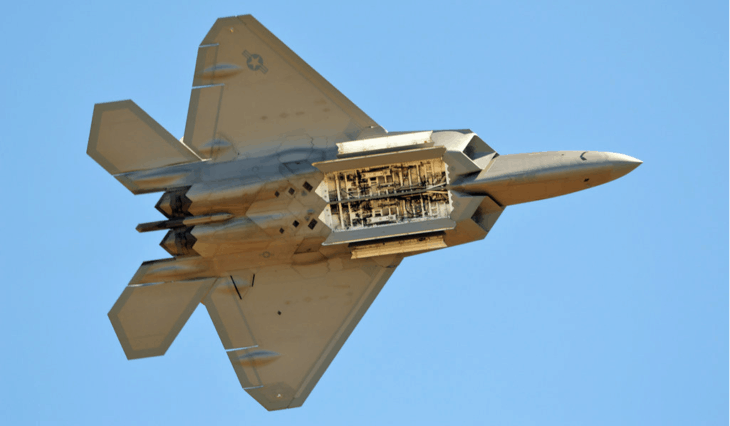
The Raptor’s AN/APG-77 radar has 1,956 transmit-receive modules. The Su-57’s N036 has 1,514 in the nose, plus two side-looking arrays of 404 modules each that widen its field of view.
The Air Force says the F-22’s sensors let its pilot “track, identify, shoot and kill air-to-air threats before being detected.” That sentence is the whole design.
Where the Su-57 Felon wins
Thrust vectoring in every axis
The F-22’s nozzles vector thrust up and down by up to 20 degrees, which helps it point its nose in pitch. The Su-57’s nozzles are each canted at an angle, so vectoring them differently also rolls and yaws the jet.
With its flight control system and a design deliberately unstable in pitch and yaw, that makes the Su-57 highly maneuverable in all axes. Its life-support system lets pilots pull 9 g for up to 30 seconds.

More range and a heavier strike load
The Su-57 is the bigger jet and goes farther. Russian figures give it about 2,175 miles (3,500 km) of subsonic range and a combat radius of 777 miles (1,250 km), with no mission profile given.
The Air Force lists the F-22 at more than 1,850 miles (2,980 km) of ferry range, and that is with two external tanks. Its published combat radius, clean and subsonic, is 595 nautical miles (685 miles).
Its main bays are larger, too. Each is sized for two missiles just under 14 feet long, and they carry guided bombs and cruise missiles such as the Kh-69 as well as air-to-air weapons.
Sukhoi judged the F-22 unsuitable as a multirole fighter because its payload was too focused on air-to-air missiles. The Raptor’s strike load is two 1,000-pound JDAM bombs, carried alongside two AIM-120s and two AIM-9s.
The Su-57 has the heavier gun as well: a 30 mm GSh-30-1 with 150 rounds, against the F-22’s 20 mm M61A2 with 480.
The longest reach, on paper
For long shots the Su-57 can carry the izdeliye 810, a development of Russia’s R-37M missile with shorter control surfaces and an updated motor and seeker, two to each main bay. The R-37M itself can be carried externally.
Janes credits the R-37M with a range of 186 to 249 miles (300 to 400 km) using its jettisonable booster. That is the “250-mile missile” that comes up in almost every F-22 vs Su-57 debate.
Myth check: the 250-mile missile
The top figure belongs to the R-37M with its booster, and that version rides outside the jet, not in the stealthy internal bays. The missile was designed to kill tankers and airborne radar planes from beyond the reach of their fighter escorts. Against a fighter the Su-57’s radar struggles to see, reach only matters once there is a track to fire at.
Cheaper, if the price is real
The Air Force lists the F-22’s unit cost at $143 million. When Russia ordered 76 Su-57s in 2019, the reported value was more than $2.6 billion, or under $34 million a jet.
The War Zone noted at the time that this was less than the estimated unit cost of the Su-30MKK Flankers Russia sold to China nearly two decades earlier. Treat it as an announced state price, not an audited cost.
F-22 vs Su-57 in a dogfight: who would win?
They have never met, so any dogfight verdict is an argument, not a result. Up close, the Su-57’s all-axis thrust vectoring is its best card, and it is the fight Sukhoi designed it for.
The F-22 is no pushover in a turning fight. Its two engines are each in the 35,000-pound thrust class, against 31,970 pounds for each of the Su-57’s AL-41F1s, and published figures give it a thrust-to-weight ratio of 1.08 at gross weight.
It is rated to 9 g and can hold a trimmed angle of attack above 60 degrees while keeping roll control.
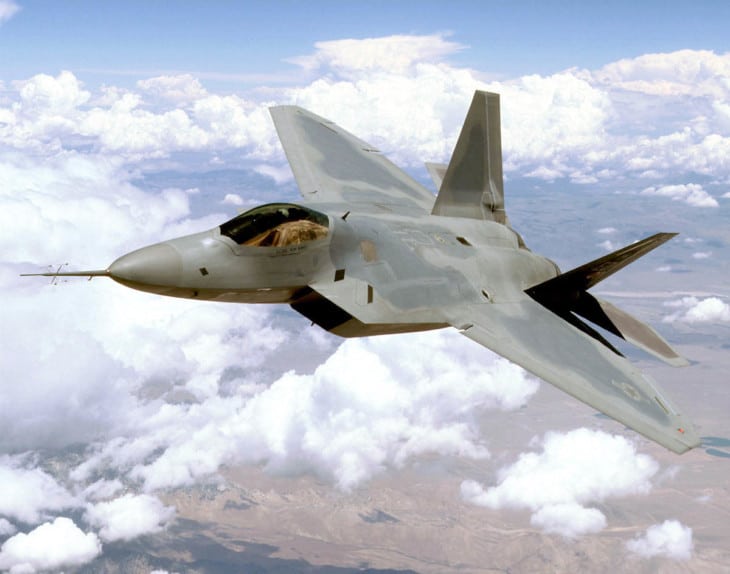
The best public evidence is the Raptor’s record in training. At Northern Edge in June 2006 and Red Flag 07-2 in February 2007, F-22s flew against aggressor F-15s and F-16s with a simulated kill ratio of 108 to 0.
The F-22 is also built so the fight never gets that close. The Air Force says its stealth and supercruise minimize an enemy’s ability to track and engage it, and a pilot who cannot find the Raptor cannot turn with it.
Has the F-22 ever lost a dogfight?
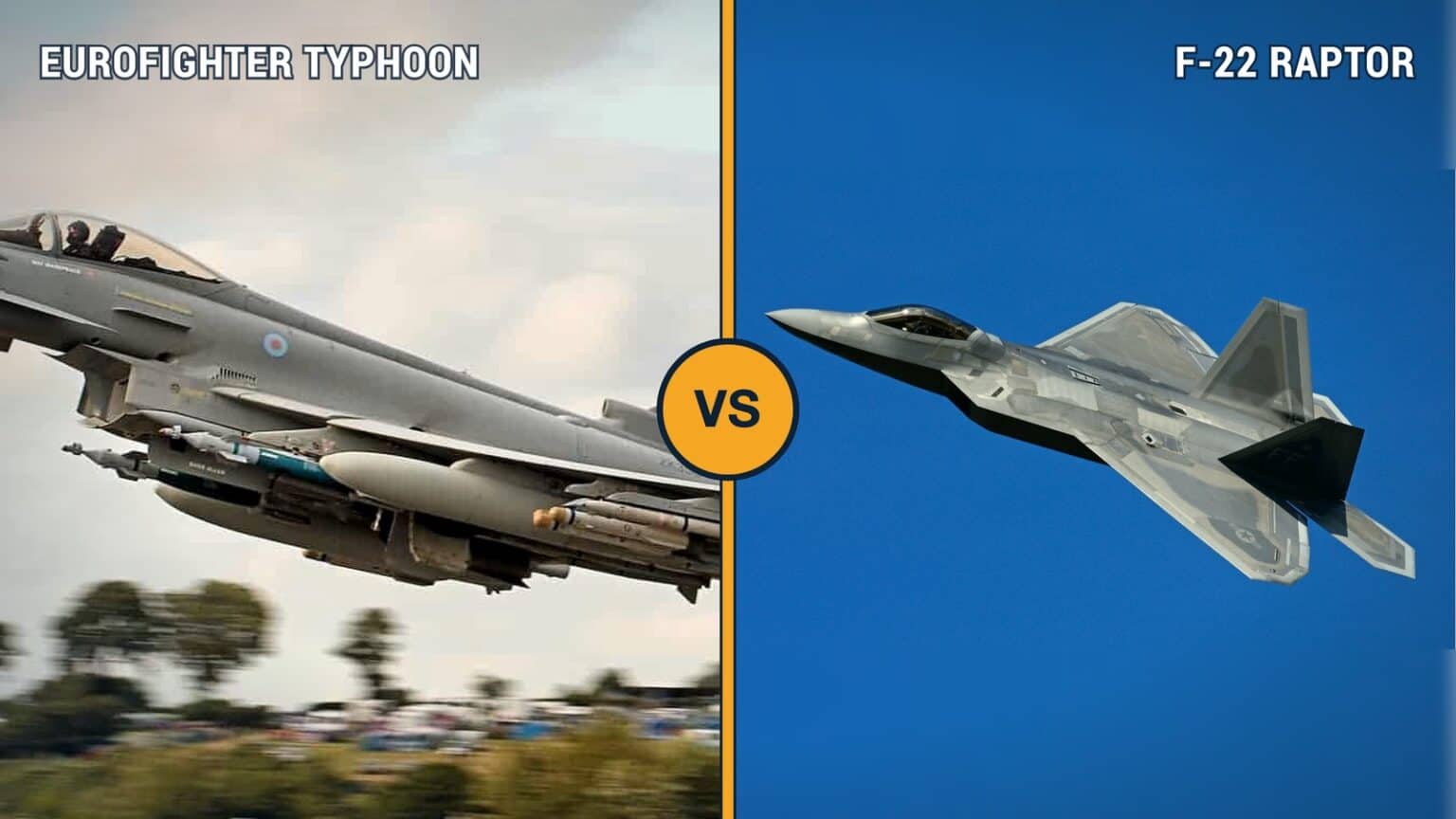
Never in combat, because it has never fought one. In training, yes: at Red Flag Alaska in 2012, German Eurofighter Typhoons flying without external tanks scored simulated kills on F-22s in close-in dogfight drills.
One German pilot joked that “yesterday, we have had a Raptor salad for lunch.” The Aviationist, which reported it, cautioned that such kills mean little without the rules of engagement, and that F-22 pilots argue a stealth fighter would not choose a close-range fight in real combat.
F-22 vs Su-57 size
The Su-57 is the bigger jet. It is about 66 feet (20.1 m) long with a 46-foot (14.1 m) wingspan, against 62 feet 1 inch (18.9 m) and 44 feet 6 inches (13.6 m) for the F-22.
The F-22 is the heavier one. It weighs 43,340 pounds (19,700 kg) empty and 83,500 pounds (38,000 kg) at maximum takeoff weight, against about 40,800 pounds (18,500 kg) and 75,000 to 77,000 pounds (34,000 to 35,000 kg) for the Su-57, depending on the source.
The full side-by-side dimensions sit in the database comparison at the top of this page, and our list of the biggest fighter jets shows how both measure up.
Combat record: no crewed kill for either
The F-22 flew its first combat sorties over Syria on September 22, 2014, dropping bombs on Islamic State targets. It flew 204 sorties there by July 2015.
Its first air-to-air kill came on February 4, 2023, when an F-22 shot down a Chinese surveillance balloon off South Carolina with an AIM-9X Sidewinder. F-22s downed two more high-altitude objects near Alaska and over Yukon later that month.
In June 2025, according to US officials, F-22s helped draw surface-to-air missile fire ahead of B-2 strikes on Iran’s nuclear sites. On February 28, 2026, they deployed to Israel for Operation Epic Fury, a large-scale US-Israeli operation against Iran.
The Su-57’s first combat was in Syria in February 2018, when two jets deployed to Khmeimim and fired a cruise missile. Over Ukraine its reported missions have mostly been cruise missile strikes launched from outside Ukrainian air defenses, including at least ten launches in May 2026.
In October 2022 a Russian general claimed Su-57 kills in the air, and Russian sources named a Su-27 and a Su-24 downed with R-37 missiles. No hard evidence for those claims has surfaced.
The Su-57's documented shootdown was Russian
On October 5, 2024, a Su-57 used an air-to-air missile to shoot down an S-70 Okhotnik, Russia’s own stealth combat drone, after it went out of control over Ukraine about 10 miles behind Ukrainian lines. With Russia’s claims against Ukrainian jets unproven, that is the Su-57 shootdown on the record.
The Su-57 has taken losses on the ground. A June 2024 drone strike on Akhtubinsk air base damaged one with shrapnel.
On April 25, 2026, Ukrainian drones struck Shagol airfield, about 1,050 miles (1,700 km) from Ukraine’s border, and Ukraine’s General Staff said several Su-57s were hit. Polish analysts at Defence24 count at least one Su-57 destroyed in the first eight months of 2026.
How many F-22s and Su-57s are there?
The US built 195 F-22s, eight of them test aircraft, and the last was delivered in May 2012. Air & Space Forces Magazine counted 184 in service in June 2026.
It will never be exported under current law. Every annual defense appropriations act since fiscal 1998 has barred its sale to any foreign government.
Russia publishes no Su-57 count. Open-source tallies put the total built at 44 or more, including 10 test aircraft, against a 76-jet order signed in June 2019 for delivery by 2028.
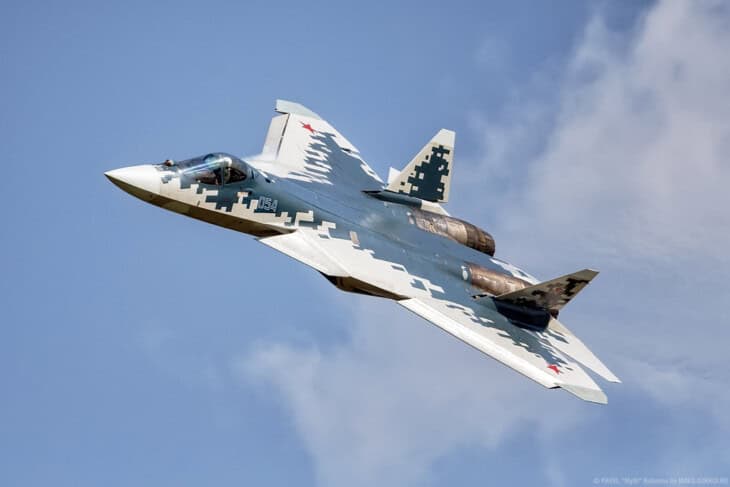
Deliveries remain slow. Defence24 estimates that four Su-57s reached Russia’s air force in the first eight months of 2026, and Algeria, its first export customer, received its first two in November 2025.
Can the Su-57 beat the F-35?
On stealth, it is unlikely. Reference estimates put the F-35’s radar cross-section near 0.005 square meters, well under the 0.1 to 1 Sukhoi set as the Su-57’s target.
The two have never been reported fighting each other. We weigh speed, sensors, cost and numbers in our full F-35 vs Su-57 comparison.
What comes next for both jets
US law bars the Air Force from retiring any F-22 before September 30, 2027. In June 2026 the House Armed Services Committee voted to extend that bar to September 30, 2032.
The House passed its defense bill on July 22, 2026, by 216 votes to 212. The Senate had not taken it up, and the bill was not law as of early September 2026.
The Raptor’s successor is the Boeing F-47, announced on March 21, 2025, and the Air Force expects its first flight in 2028. For the Raptor against its stablemates, see our F-22 vs F-35 and F-22 vs F-15 comparisons.
Russia is still developing the Su-57. The improved Su-57M is meant to get the new izdeliye 30 engine, whose testing has moved slowly, and a two-seat version first flew on May 19, 2026.
Sep 1997
The first F-22 flies. It is the first flight of the engineering and manufacturing development aircraft.
Dec 2005
The F-22 enters service. It reaches initial operational capability with the 94th Fighter Squadron.
Feb 2007
108 to 0. After Northern Edge in 2006, Red Flag 07-2 ends the F-22’s first big exercises with a simulated kill ratio of 108 to 0.
Jan 2010
The T-50 prototype flies. The first flight of the jet that became the Su-57 takes place on January 29.
May 2012
The last F-22 is delivered. Production ends at 195 aircraft.
Sep 2014
The F-22’s first combat. It flies opening strikes over Syria on September 22.
Feb 2018
The Su-57’s first combat deployment. Two jets fly to Syria and fire a cruise missile.
Jun 2019
Russia signs for 76 Su-57s. Delivery is due by 2028.
Dec 2020
The Su-57 enters service. The first production jet crashed in 2019, so the second became Russia’s first delivery.
Feb 2023
The F-22’s first air-to-air kill. It shoots down a Chinese surveillance balloon off South Carolina.
Oct 2024
A Su-57 downs a Russian drone. It shoots down an out-of-control S-70 Okhotnik over Ukraine.
Feb 2026
F-22s deploy to Israel. They take part in Operation Epic Fury against Iran.
Apr 2026
Drones strike Su-57s at Shagol. Ukraine says several are hit, about 1,050 miles from its border.
May 2026
A two-seat Su-57 flies. Its first flight is on May 19.
The verdict
Take the F-22. It is far harder to see, faster at the top end and in supercruise, carries more missiles inside, and exists in numbers the Su-57 has not come close to.
The Su-57 is a real fighter, not a paper one. It flies farther, carries a heavier strike load and maneuvers in ways the Raptor cannot, which is exactly what Sukhoi set out to build.
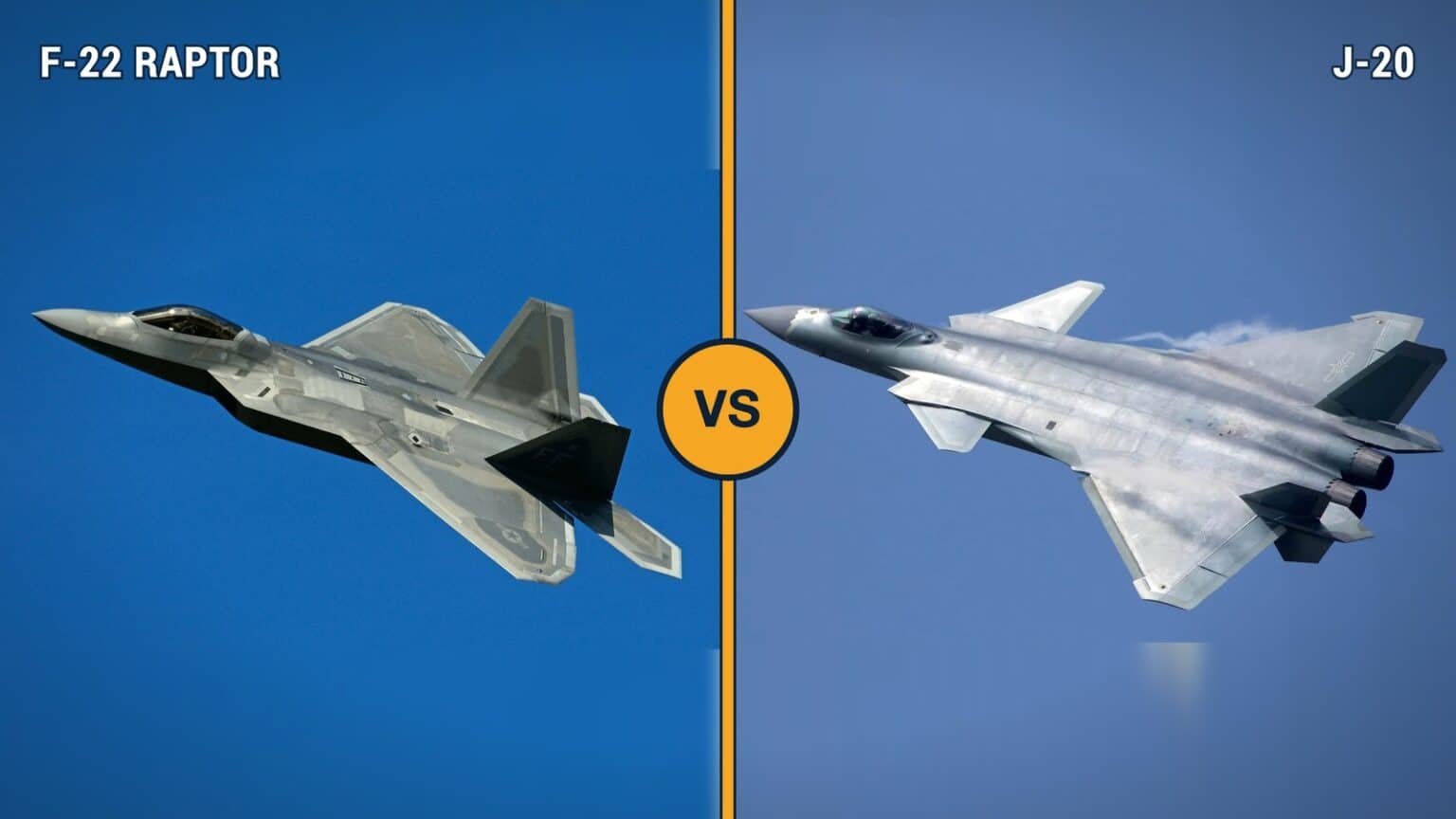
But the F-22 fleet still flying is more than four times every Su-57 Russia has built. For the wider field, see our ranking of the best fighter jets in the world, our guide to the best Russian fighter jets, and our F-22 vs J-20 comparison.
FAQ
Sources and references used for research and fact-checking.
- U.S. Air Force, F-22 Raptor Fact Sheet
- Wikipedia, Lockheed Martin F-22 Raptor
- Wikipedia, Sukhoi Su-57
- Wikipedia, R-37 (missile)
- Wikipedia, AN/APG-77
- Wikipedia, Radar cross section
- Wikipedia, 2023 Chinese balloon incident
- Wikipedia, Boeing F-47
- Army Recognition, Su-57 Felon
- The War Zone, Su-57 Felon Brandishes Its Loaded Weapons Bays For The First Time
- The War Zone, Russia Now Claims It Will Buy 76 Su-57 Advanced Fighter Jets By 2028
- Air & Space Forces Magazine, House Panel Votes to Prohibit F-22 Retirements Through 2032
- Congressional Research Service, FY2027 NDAA: Status of Legislative Activity
- The Aviationist, Yesterday we had Raptor salad for lunch: Typhoon pilot said after dogfighting with the F-22 at Red Flag Alaska
- Ukrinform, General Staff confirms destruction of Su-57 and Su-34 aircraft in strikes on Shagol airfield
- Defense Express, Russia Delivered Only 14 Combat Aircraft in 8 Months of 2026 While Losing 10
About the Author

Tim is the owner and lead editor of AeroCorner since 2019, overseeing aviation content covering aircraft, airlines, airports, and the broader aviation industry. Through years of researching, writing, editing, and publishing aviation-focused content, he has developed extensive practical knowledge of commercial aviation and air travel. Based in Asia and a frequent traveler himself, Tim also brings firsthand passenger experience to AeroCorner’s coverage. Outside of publishing, he has also explored aviation firsthand through hands-on flight training in New Zealand.