


Table of Contents
| Measure | F-22 Raptor | Chengdu J-20 |
|---|---|---|
| Design problem | Get inside defended airspace and own it | Reach far out and kill what supports the fight |
| Stealth optimization | All-aspect | Optimized head-on; canards and nozzles believed to cost side and rear aspect |
| Combat radius, internal fuel | 460 to 600 nm | 1,100 to 1,200 nm |
| Internal air-to-air load | 6 AIM-120C/D plus 2 AIM-9 | 4 long or medium-range plus 2 PL-10 |
| Internal gun | 20 mm M61A2, 480 rounds | None |
| Thrust vectoring | Yes, 20 degrees in pitch | On WS-15 aircraft only |
| Built | 195 total, about 143 combat-coded | About 500 by mid-2026 |
| Production | Ended 2011 | Running, 100 to 120 a year |
| Combat use | Syria 2014 onward | None publicly reported |
| Export | Prohibited by US appropriations law | Not offered |
Two aircraft, two different problems
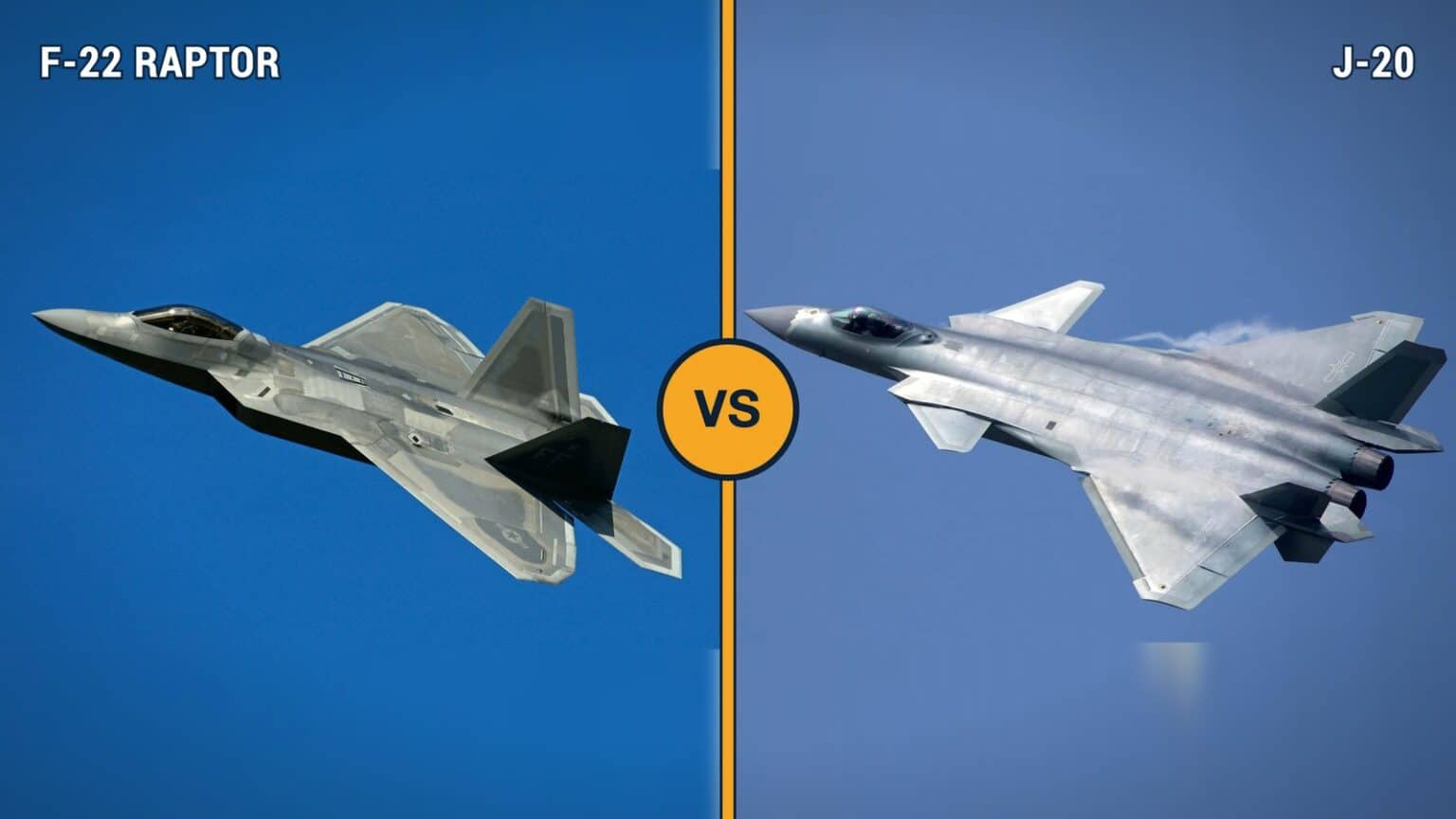
The F-22 came out of a Cold War requirement: fly into the most heavily defended airspace in the world, survive it, and shoot down anything that comes up to meet you. Everything about the aircraft follows from that, including all-aspect stealth, supercruise, thrust vectoring and a gun.
The Chengdu J-20 was designed twenty years later for a different map. China’s problem is not penetrating airspace over a land border, it is reaching a long way out over the Pacific.
That is why analysts believe the J-20 is built to hunt the things that make American air power work at range: KC-135 and KC-46 tankers, and the airborne early warning aircraft that hold the picture together.
Edge: neither. These are not the same aircraft built to different standards. They are different answers to different questions, which is why most head-to-head verdicts are really arguments about which scenario you assume.
Stealth: all-aspect against head-on
This is the clearest gap between them, and it is not about whether the J-20 is stealthy. It is.
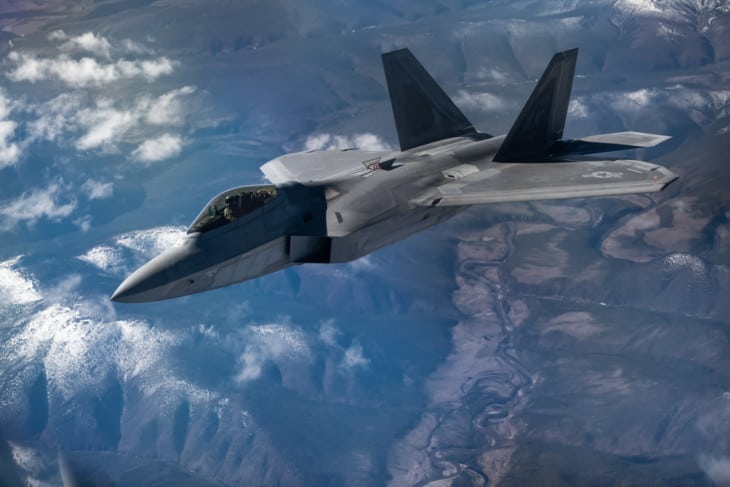
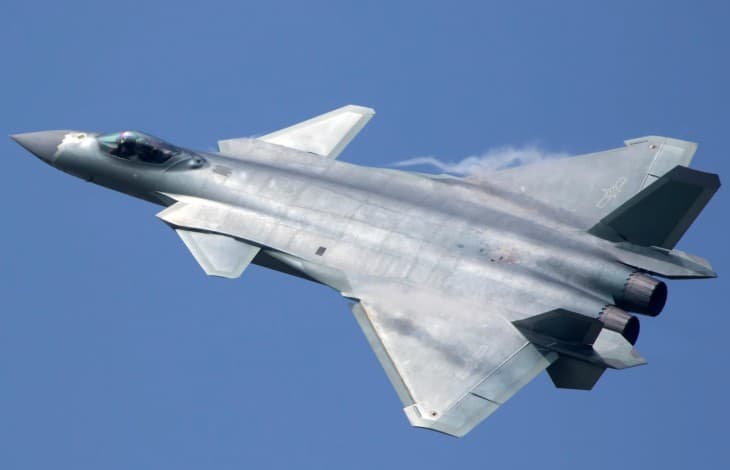
The difference is coverage. The F-22 is believed to be optimized for all-aspect stealth, meaning it stays hard to see from the side and the rear as well as head-on. The J-20 is assessed as optimized head-on, with its canards and its engine nozzles thought to compromise the side and rear aspects.
The canard argument is the one that gets repeated most and holds up least. Northrop Grumman put canards on a stealth airframe for its Advanced Tactical Fighter proposal, Lockheed Martin carried them into early Joint Strike Fighter work, and the X-36 was considered extremely stealthy with them.
The rear aspect is the more real problem, and China has been working on it. The round nozzles on early aircraft were replaced by serrated ones with the WS-10C from 2019, and the WS-15 on the J-20A continues that.
The rest of the J-20 airframe is serious work: a chined forebody, an electroconductive canopy, serpentine inlet ducts that hide the engine faces, sawtooth door edges and radar-absorbent coatings. Our guide to stealth fighter jets covers how those features work.
Edge: F-22. Being hard to see from every angle matters most in exactly the fight where these two would meet.
Reach: the J-20’s real advantage
On internal fuel the F-22 has a combat radius of roughly 460 to 600 nautical miles. The J-20’s is put at 1,100 to 1,200 nautical miles, around twice as far.

That comes straight out of the airframe. CSIS puts the J-20 at 20.3 to 20.5 m long against the Raptor’s 18.90 m, carrying about 12,000 kg of internal fuel to the F-22’s 8,200 kg.
There is a counterweight, and it is large. The United States operates something like 75 percent of the world’s aerial tankers by some estimates, while China’s tanker fleet is small, so the F-22’s shorter legs are extended by an infrastructure the J-20 does not have.
Which is exactly why analysts think the J-20 was built to shoot at tankers. Remove the refueling and the range comparison stops being theoretical.
Edge: J-20, and it is the one advantage that changes the shape of a Pacific campaign rather than the outcome of a single engagement.
The close fight: where the Raptor is still untouchable
The F-22’s thrust-vectoring nozzles move 20 degrees in the pitch axis, which gives it control authority at speeds and angles where a conventional fighter has run out of options. The J-20 only gets vectoring on WS-15-equipped aircraft, and the WS-15 was confirmed flying on a production J-20A in January 2026.
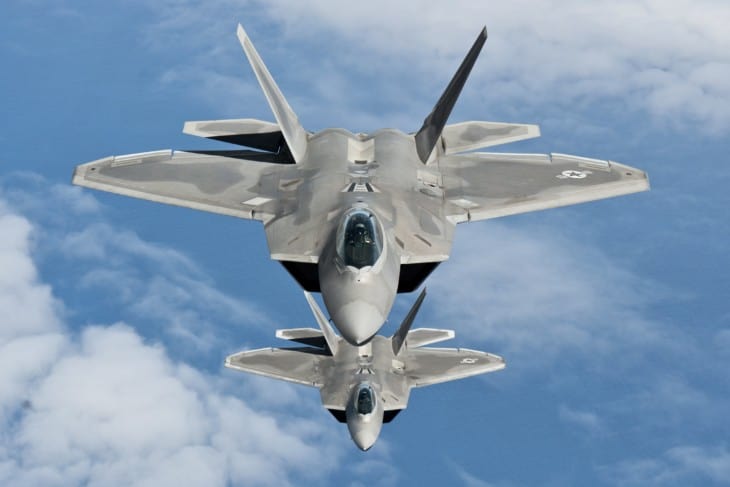
Then there is the gun. The F-22 carries a 20 mm M61A2 with 480 rounds. The J-20 carries no internal cannon at all.
That is a deliberate Chinese choice, not an oversight, and it says plainly what kind of fight the J-20 expects: long-range missile shots, not a turning engagement. It also means that if a J-20 runs out of missiles, it is finished as a combatant.
Missile counts run the same way. The Raptor’s eight internal stations take six AIM-120C/D plus two AIM-9 Sidewinders. The J-20’s main bay takes four medium or long-range missiles, with one PL-10 in each of the two small lateral bays.
Edge: F-22, decisively. Within visual range this is not close.
Sensors: the part nobody outside can score
The J-20’s sensor fit looks deliberately like the F-35’s. A chin-mounted electro-optical targeting sensor, the EORD-31 infrared search and track, and six passive electro-optical windows give it omnidirectional coverage without radiating.
That matters in a stealth-versus-stealth fight, because infrared search and track does not care about radar-absorbent material. The F-22 was supposed to have a dedicated IRST, but it was deleted during development as a weight and cost saving, with only the space and cooling provisions kept.
Those provisions are finally being used. A dedicated IRST is among the sensors now being added to the Raptor, along with all-aspect infrared functionality for its missile launch detector.
The F-22 also has a passive detection asset the J-20’s public description does not match. Its AN/ALR-94 electronic warfare system, described as among the most technically complex equipment on the aircraft, blends more than 30 antennas into the wings and fuselage and can geolocate threats at 250 nautical miles or more.
Edge: unscoreable. Both radars are classified, China publishes nothing official about the J-20’s, and no journalist has been in either cockpit. Anyone who gives you a confident winner here is guessing.
Numbers: 500 against a closed line
195 F-22s were built in total, including test aircraft. Production ran from 1996 to 2011 and then stopped, and roughly 143 are combat-coded today.

The J-20 fleet passed the F-22’s total in 2023. Analyst Andreas Rupprecht put the 500th airframe at mid-2026, AVIC has held a rate of 100 to 120 aircraft a year, and the Royal United Services Institute estimates 1,000 airframes across all variants by 2030.
Neither aircraft is exported. US appropriations acts have carried a provision barring funds for F-22 foreign sales every year since FY1998, and China has not offered the J-20 abroad.
Edge: J-20, and it is the gap that gets wider every year. A better aircraft you cannot build any more of is a fixed asset.
Combat record
The F-22 first went to war in 2014, striking targets in Syria, and has flown combat missions since in Afghanistan in 2017, against Iran in 2025 and 2026, and over Venezuela in 2026. None of that was air-to-air against a peer.
The J-20 has no publicly reported combat use. It has been deployed to units watching the East China Sea and the Taiwan Strait since 2021, and USAF general Kenneth Wilsbach confirmed in March 2022 that American F-35s had encountered J-20s over the East China Sea.
Edge: F-22, with the caveat that dropping bombs on undefended targets proves serviceability, not air superiority.
So who actually wins?
One on one, over a fixed point, with tankers available to both: the F-22. It is stealthier from more angles, it out-turns the J-20, it has a gun, and it carries more missiles internally.
Over the western Pacific, at the ranges that theater actually involves: the answer stops being obvious. The J-20 gets there without refueling, the F-22 mostly does not, and the tankers that fix that are what the J-20 was built to shoot at.
Then there is the arithmetic that neither pilot controls. China can lose J-20s and build more. The United States cannot replace a single Raptor.
For the wider picture, our breakdown of US vs China fighter jets covers the whole force comparison, and the J-20 also appears in our ranking of the best fighter jets in the world.
What nobody can tell you
Both aircraft’s radar performance, radar cross-section and electronic warfare capability are classified by their own governments. Every public F-22 versus J-20 verdict, including this one, is built on published dimensions, analyst estimates and inference. Treat any source that gives you exact radar cross-section numbers in square meters as unreliable.
FAQ
Sources and references used for research and fact-checking.
- Wikipedia, Chengdu J-20
- Wikipedia, Lockheed Martin F-22 Raptor
- Simple Flying, How The F-22 Raptor Stacks Up Against The Chengdu J-20
- Mitchell Institute China Airpower Tracker, J-20
- CSIS China Power Project, Does China's J-20 Rival Other Stealth Fighters?
- Army Recognition, China's J-20 stealth fighter finally flies with WS-15 engines to challenge the F-22 Raptor
About the Author

Tim is the owner and lead editor of AeroCorner since 2019, overseeing aviation content covering aircraft, airlines, airports, and the broader aviation industry. Through years of researching, writing, editing, and publishing aviation-focused content, he has developed extensive practical knowledge of commercial aviation and air travel. Based in Asia and a frequent traveler himself, Tim also brings firsthand passenger experience to AeroCorner’s coverage. Outside of publishing, he has also explored aviation firsthand through hands-on flight training in New Zealand.