



Table of Contents
| Measure | F-22A Raptor | F-14 Tomcat |
|---|---|---|
| Generation, first flight | Fifth, September 1997 | Fourth, December 1970 |
| Built for | Air dominance for the US Air Force | Fleet air defense for the US Navy |
| Crew | One | Two: pilot and radar intercept officer |
| Wing | Fixed | Variable sweep |
| Stealth | Low observable, missiles carried internally | None, missiles carried externally |
| Supercruise | Yes, above Mach 1.5 without afterburner | No, published cruise speed 420 knots |
| Radar | AN/APG-77 AESA | Hughes AWG-9; AN/APG-71 on the F-14D |
| Typical air-to-air load | Six AIM-120 and two AIM-9, all internal | Two AIM-54, three AIM-7 and two AIM-9 |
| Gun | M61A2 20 mm, 480 rounds | M61A1 20 mm, 675 rounds |
| Air-to-air kills in US service | A balloon and two unidentified objects (February 2023) | Two Su-22s (1981), two MiG-23s (1989), a Mi-8 helicopter (1991) |
| Built | 195, including test aircraft; line closed 2011 | 712, production ended 1991 |
| Exported | No, barred by US law since fiscal 1998 | Yes, to Iran from 1976 |
| Status, September 2026 | 184 in service, retirement barred to September 2027 | Retired by the US Navy in 2006; Iran’s fleet status unresolved |
How we compare the Raptor and the Tomcat
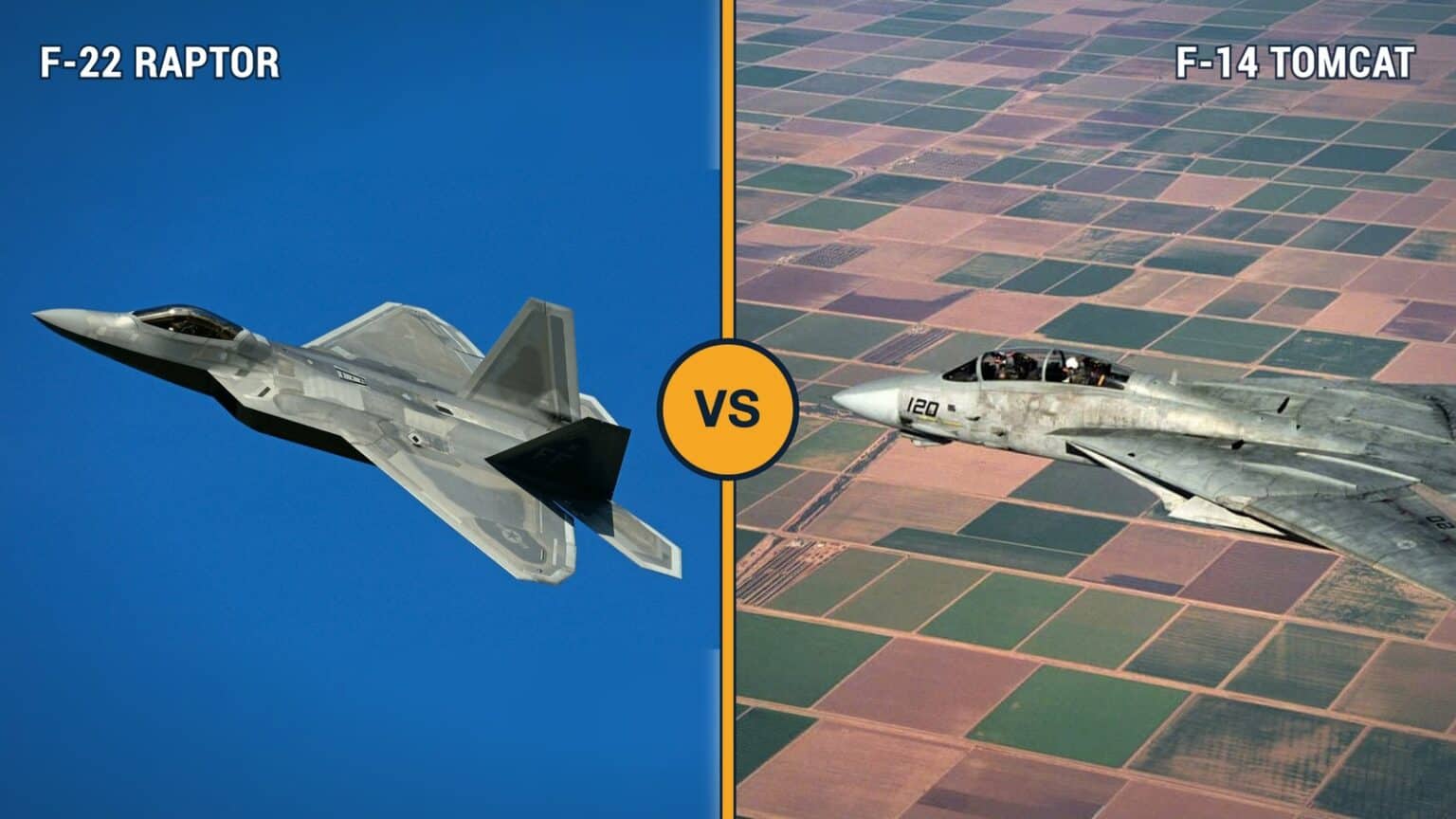
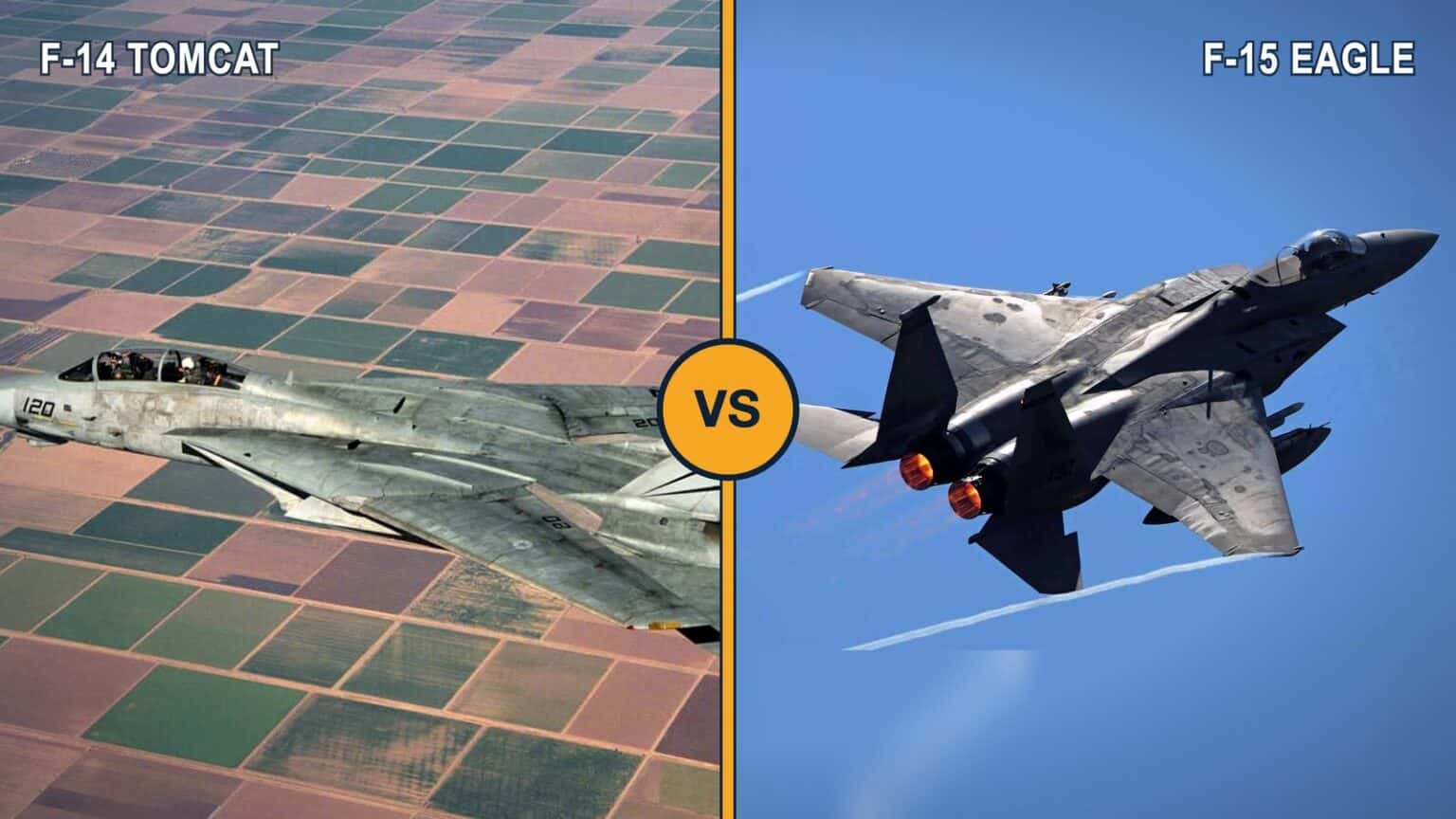
The F-22 and the F-14 never fought each other, and they were built a generation apart for two different services. The Tomcat defended Navy carriers against Soviet bombers; the Raptor was built to win control of the air for the Air Force.
We compare them on the questions readers actually ask: which is faster, which is bigger, which would win a fight, and what each still does better. Where published figures differ, we name the variant or condition they apply to.
Full specifications for the Lockheed Martin F-22 Raptor and the Grumman F-14 Tomcat sit in our aircraft database.
The measure decides the winner
The F-14 wins on top speed, wingspan and a record of shooting down enemy fighters. The F-22 wins on stealth, supercruise, thrust and sensors, which are the things that decide who fires first. On every measure that matters once a fight starts, the Raptor comes out ahead.
Is the F-14 faster than the F-22?
On paper, yes. The Tomcat’s published top speed is Mach 2.34, about 1,544 mph (2,485 km/h) at 40,000 feet, against Mach 2.25, about 1,500 mph (2,414 km/h), for the Raptor at altitude.
At sea level the two are almost identical. The F-14 is rated at Mach 1.2, or 794 knots, and the F-22 at Mach 1.21, or 800 knots.
What separates them is cruise speed. The Air Force says the F-22 cruises above Mach 1.5 without afterburner, and published figures put its supercruise at Mach 1.76, about 1,162 mph (1,870 km/h). The Tomcat’s published cruise speed is 420 knots, below the speed of sound.


That is why the Tomcat’s top-speed edge counts for little. The Air Force says the combination of stealth and supercruise drastically shrinks the envelope in which surface-to-air missiles can engage the F-22.
For how both jets compare across the field, see our ranking of the fastest fighter jets.
F-14 vs F-22 size: which is bigger?
They are closer in size than most people expect. The F-14 is 62 feet 9 inches (19.1 m) long and the F-22 is 62 feet 1 inch (18.9 m), a gap of just 8 inches.
The wings are where they differ. Spread fully forward, the Tomcat’s wings span 64 feet 1.5 inches (19.5 m), and swept fully back they span 38 feet 2.5 inches (11.6 m). The Raptor’s fixed wing spans 44 feet 6 inches (13.6 m).
The F-22 stands taller, at 16 feet 8 inches (5.1 m) against 16 feet (4.9 m). Empty, the two weigh almost the same: 43,340 pounds (19,700 kg) for the Raptor and 43,735 pounds (19,838 kg) for the F-14D.
The Tomcat was the largest and heaviest US fighter to fly from an aircraft carrier, a consequence of carrying its big AWG-9 radar and Phoenix missiles. See how both measure up in our list of the biggest fighter jets.
The Raptor is the heavier jet
At maximum takeoff weight the F-22 weighs 83,500 pounds (38,000 kg), about 9,150 pounds (4,150 kg) more than the F-14D’s 74,350 pounds (33,725 kg). The largest and heaviest US fighter to fly from a carrier is outweighed by an Air Force jet whose wingspan is nearly 20 feet shorter than the Tomcat’s with its wings spread.
Where the F-22 Raptor wins
Stealth decides who shoots first
The Tomcat was designed in the late 1960s with no attempt at stealth. Its missiles hang under the fuselage, under the engine nacelles and on the wing gloves, in full view of an enemy radar.
The F-22 carries every air-to-air missile inside: six AIM-120 AMRAAMs in the main bay and two AIM-9 Sidewinders in the side bays. The Air Force says its sensors let the pilot “track, identify, shoot and kill air-to-air threats before being detected.”
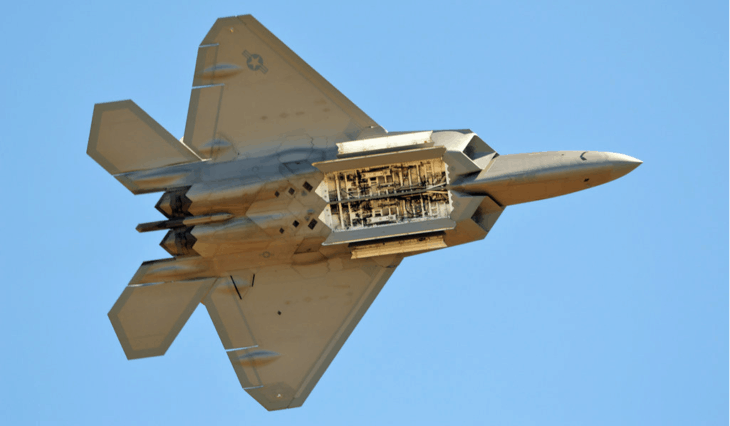
That is the gap between a fourth-generation and a fifth-generation fighter, which we explain in our guide to the five generations of fighter planes. The Raptor belongs among the true stealth fighter jets; the Tomcat was never meant to.
More thrust, more g
The Raptor has more thrust for its weight. At loaded weight with half its internal fuel, published figures give it a thrust-to-weight ratio of 1.25, against 1.02 for the F-14D with its General Electric F110 engines.
It can also steer its exhaust. The F-22’s engine nozzles vector thrust up to 20 degrees up and down, and with its large control surfaces they let it hold a trimmed angle of attack above 60 degrees.
Its airframe is rated to +9 g. The Tomcat was built for +7.5 g, and the Navy held it to +6.5 g in service to stretch its airframe life.
Where the F-14 Tomcat wins
A radar and missile built for reach
The Tomcat existed to stop Soviet bombers before they could fire on the carrier, and its weapons system was built around that job.
Its Hughes AWG-9 radar could track 24 targets at once and engage six of them out to about 60 miles (97 km). Its AIM-54 Phoenix missile hit a target 110 nautical miles (127 miles) away in an April 1973 test, the longest single Phoenix launch.
In the 1970s and 1980s, the usual carrier load was two Phoenixes, three Sparrows and two Sidewinders. A full load of six Phoenixes was rarely carried because of the weight stress it put on the airframe.


Two crew and a real air combat record
The F-14 flew with a pilot up front and a radar intercept officer in the back seat. The F-22 is a single-seater that leans on sensor fusion to give one pilot the same picture.
The Tomcat also shot down enemy fighters. In August 1981 two F-14s of VF-41 downed two Libyan Su-22s, and in 1989 two from VF-32 shot down two Libyan MiG-23s.
Its last kill in US service was a Mi-8 helicopter during the 1991 Gulf War. Iran’s Tomcats did far more: Iran claimed its F-14s shot down at least 160 Iraqi aircraft in its 1980s war with Iraq, 55 of them confirmed.
The Raptor’s publicly reported air-to-air kills are a Chinese surveillance balloon off South Carolina on February 4, 2023, and two high-altitude objects near Alaska and over Yukon later that month. It has flown combat since 2014, including the 2026 Iran war, but no F-22 kill of a crewed aircraft has been reported.
Could an F-14 beat an F-22 in a dogfight?
Very unlikely. The two never met in combat, and we could find no published account of them training against each other.
The closest evidence is how the F-22 did against other fourth-generation fighters. In its first big exercises, Northern Edge in 2006 and Red Flag in 2007, it flew against aggressor F-15s and F-16s with a simulated kill ratio of 108 to 0.
The Tomcat’s best weapon would struggle here. The AWG-9 and Phoenix were built to find bombers at long range, and the Air Force says the F-22’s stealth and supercruise minimize an enemy’s ability to track and engage it.
A 2018 National Interest analysis of an F-22 against Iran’s Tomcats reached the same conclusion. It judged that the Raptor would most likely win before the Iranian crews knew a fight had started.
Did the Navy want its own F-22?
It did, and that jet would have replaced the Tomcat. In 1988 the Navy announced the Navy Advanced Tactical Fighter, a carrier version of the Air Force’s new fighter, as the long-term F-14 replacement.
It would have borrowed the Tomcat’s signature feature. To land slowly enough for a carrier while still reaching Mach 2-class speeds, the design would have used variable-sweep wings, and it would have carried heavier weapons, including the Harpoon anti-ship missile.
The Navy called for 546 of them. As budgets fell after the Soviet Union collapsed and unit costs rose, it cancelled the program in 1991, betting that upgraded F-14Ds could hold the fleet-defense line until 2015.
Grumman tried to keep the Tomcat going instead. By 1994 it and the Navy were pitching the Super Tomcat 21 and the Attack Super Tomcat 21, but Congress judged the upgrades, priced in the billions, too expensive for an interim fix.
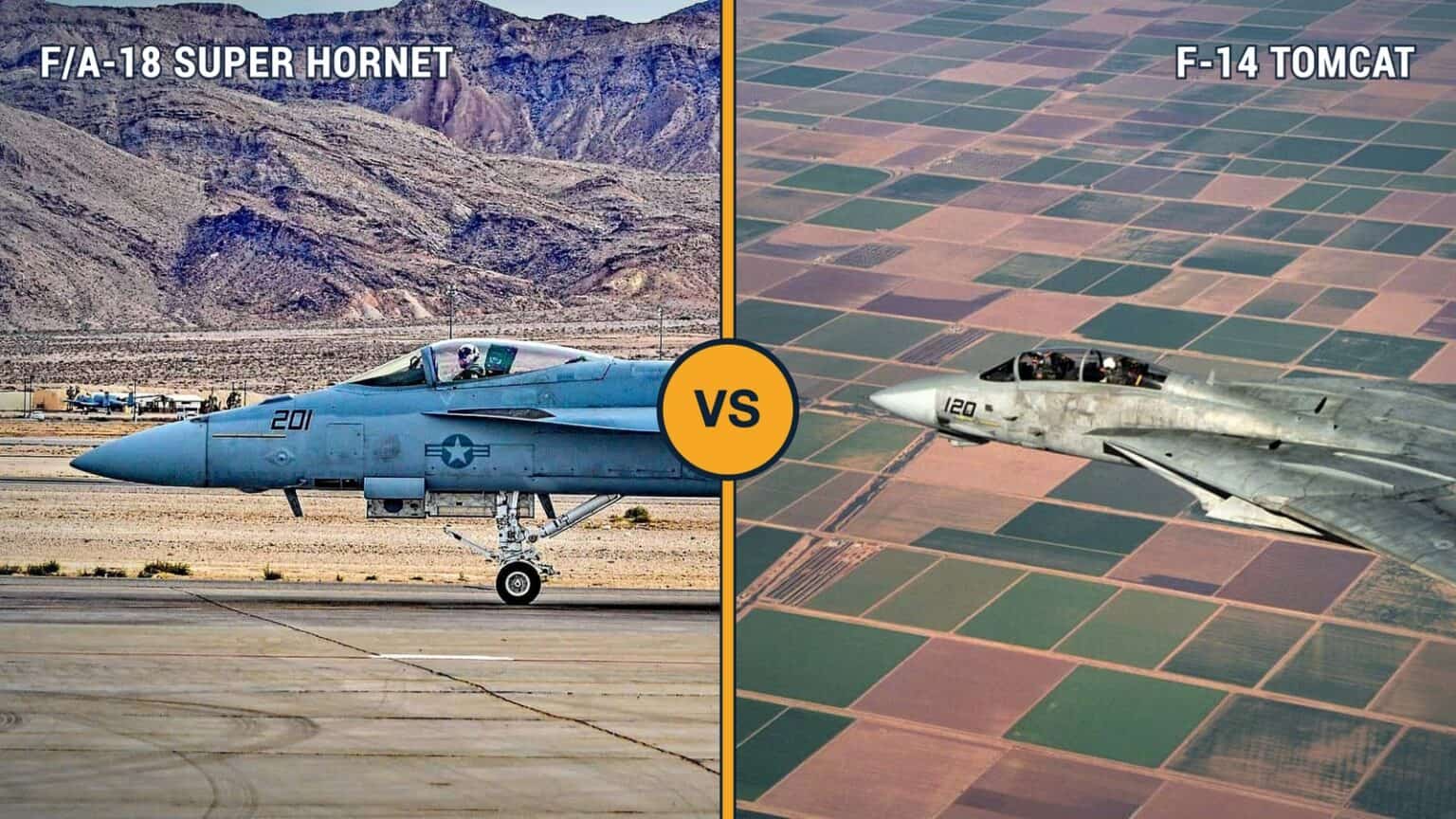
The job went to a smaller jet. The Navy retired the F-14 on September 22, 2006, supplanted by the Boeing F/A-18E/F Super Hornet, a trade we cover in our F-14 vs F/A-18 comparison.
Myth check: the F-22 replaced the F-14
It never did. The F-22 is an Air Force fighter, and the Navy’s version was cancelled in 1991. The Tomcat’s replacement was the Super Hornet. The Raptor and the Tomcat did share US service for about nine months, from the F-22 reaching initial operational capability in December 2005 to the F-14’s retirement in September 2006.
Dec 1970
The F-14 flies for the first time. Grumman built it to defend carriers against bombers far from the fleet.
Sep 1974
The Tomcat enters service. It deploys aboard USS Enterprise, replacing the F-4 Phantom II.
1988
The Navy picks a naval F-22 as its future fighter. The Navy Advanced Tactical Fighter is named the long-term F-14 replacement.
1991
The naval F-22 is cancelled. Tomcat production also ends, after 712 aircraft.
Sep 1997
The first F-22 flies. The Air Force’s new fighter is still eight years from service.
Dec 2005
The F-22 reaches initial operational capability. For nine months, both jets are in US service.
Sep 2006
The F-14 retires from the US Navy. The Super Hornet takes over its work.
Aug 2009
The last stored Tomcats go to the shredder. The Navy is keeping spare parts away from Iran.
Feb 2023
The F-22’s first air-to-air kill. It shoots down a Chinese surveillance balloon off South Carolina.
Mar 2026
Israeli strikes hit Iran’s Tomcat base. Satellite imagery shows at least two F-14s destroyed at Isfahan.
Apr 2026
The Senate passes the Maverick Act. It would let the Navy make one museum F-14D flyable again.
Why did the US destroy all its F-14s?
To keep the parts away from Iran. In 2007 the Navy announced it would shred its stored Tomcats so no components could reach Iran, which still flew the type.
In August 2009 the boneyard at Davis-Monthan Air Force Base in Arizona said the last of them had been taken away for shredding. Only 11 F-14s were left in desert storage by then.
One may yet fly again. The Maverick Act would transfer three F-14Ds to the U.S. Space and Rocket Center in Huntsville, Alabama, with spare parts to make one of them flyable or ready for static display.
The Senate passed it by unanimous consent on April 28, 2026. The House had not voted on it as of September 2026, so it is not yet law.
Are any F-14s still flying?
Possibly, in Iran, and the answer is unresolved. Israeli strikes hit the Tomcat base at Isfahan on March 7 and 8, 2026, and satellite imagery confirmed at least two, and more likely three, destroyed F-14s.
Estimates of how many Iranian Tomcats could still fly had ranged from a handful to about 25. On June 10, 2026, Iranian state media released footage presented as an F-14 returning from a mission, but its date and provenance are disputed and no independent source has confirmed it.
F-22s flew in the same war, on the other side. No encounter between a Raptor and an Iranian Tomcat has been publicly reported.
The F-22 today
The Raptor still flies front-line missions, but the fleet is small and fixed. Of 195 built, 184 were in service in June 2026, and the production line closed in 2011.
US law bars the Air Force from retiring any F-22 before September 30, 2027, and in June 2026 a House committee voted to extend that bar to 2032. For the Raptor against its stablemates, see our F-22 vs F-15 and F-22 vs F-35 comparisons.
It will not be exported, either. Every annual defense appropriations act since fiscal 1998 has barred its sale to any foreign government.
The verdict
The F-22 is the better fighter, and not by a small margin. It sees first, shoots first, cruises supersonic without afterburner, and carries its missiles inside a low-observable airframe.
The F-14 keeps its own records. It is faster at the top end, spreads a wider wing, and shot down enemy fighters in American and Iranian hands, something no F-22 has publicly done.
The better story is how close they came to being one aircraft. Had the Navy’s F-22 survived the 1991 budget cuts, the Tomcat’s replacement would have been a swing-wing Raptor. For where both sit in the wider field, see our ranking of the best fighter jets in the world.
FAQ
Sources and references used for research and fact-checking.
- U.S. Air Force, F-22 Raptor Fact Sheet
- Wikipedia, Lockheed Martin F-22 Raptor
- Wikipedia, Grumman F-14 Tomcat
- Wikipedia, Lockheed YF-22
- The National Interest, Air Battle: Stealth F-22 Raptor vs. Iran's F-14 Tomcat (Who Wins?)
- Air & Space Forces Magazine, House Panel Votes to Prohibit F-22 Retirements Through 2032
- The War Zone, Iranian F-14 Tomcats Meet Their Doom In Israeli Airstrikes
- 19FortyFive, Israel Said It Destroyed Iran's Last F-14 Tomcats in March: Three Months Later, Tehran Released Footage of One Still Flying
- U.S. Congress, S. 4161, Maverick Act (Engrossed in Senate)
- GovTrack.us, S. 4161: Maverick Act
About the Author

Tim is the owner and lead editor of AeroCorner since 2019, overseeing aviation content covering aircraft, airlines, airports, and the broader aviation industry. Through years of researching, writing, editing, and publishing aviation-focused content, he has developed extensive practical knowledge of commercial aviation and air travel. Based in Asia and a frequent traveler himself, Tim also brings firsthand passenger experience to AeroCorner’s coverage. Outside of publishing, he has also explored aviation firsthand through hands-on flight training in New Zealand.