



Table of Contents
| Measure | F-22A Raptor | F-16 Fighting Falcon |
|---|---|---|
| Generation, first flight | Fifth; first F-22 flew September 1997 | Fourth; YF-16 prototype flew January 1974 |
| Entered service | December 2005 | January 1979 (first operational F-16A) |
| Built for | Air dominance, with a secondary strike role | Lightweight multirole fighter: air combat, strike and air-defense suppression |
| Stealth | All-aspect low observable, weapons carried internally | None, weapons carried externally |
| Supercruise and thrust vectoring | Yes and yes | No and no |
| Air-to-air missiles | 6 AIM-120 and 2 AIM-9, all internal | Up to 6, external |
| Gun | M61A2 20 mm, 480 rounds | M61A1 20 mm, 500 rounds |
| Air combat record | First kill in February 2023 (a Chinese balloon); simulated 108 to 0 in training | Kills with Israel, the US, the Netherlands, Ukraine and others since 1981 |
| Cost per flight hour, FY2026 | $55,051 | $14,818 (F-16C) |
| Unit cost (Air Force fact sheets) | $143 million | $18.8 million (F-16C/D, fiscal 1998 dollars) |
| Built | 195, including 8 test aircraft | More than 4,600 |
| US Air Force fleet | 184 (June 2026) | 704 F-16Cs and 134 F-16Ds (FY2024) |
| Exports | Banned by law since fiscal 1998 | 2,102 in active service worldwide (2026) |
| Future in US service | Retirement barred until September 30, 2027; F-47 to follow in the 2030s | Upgraded and life-extended to fly through 2040 or beyond |
How we compare the F-16 and the F-22
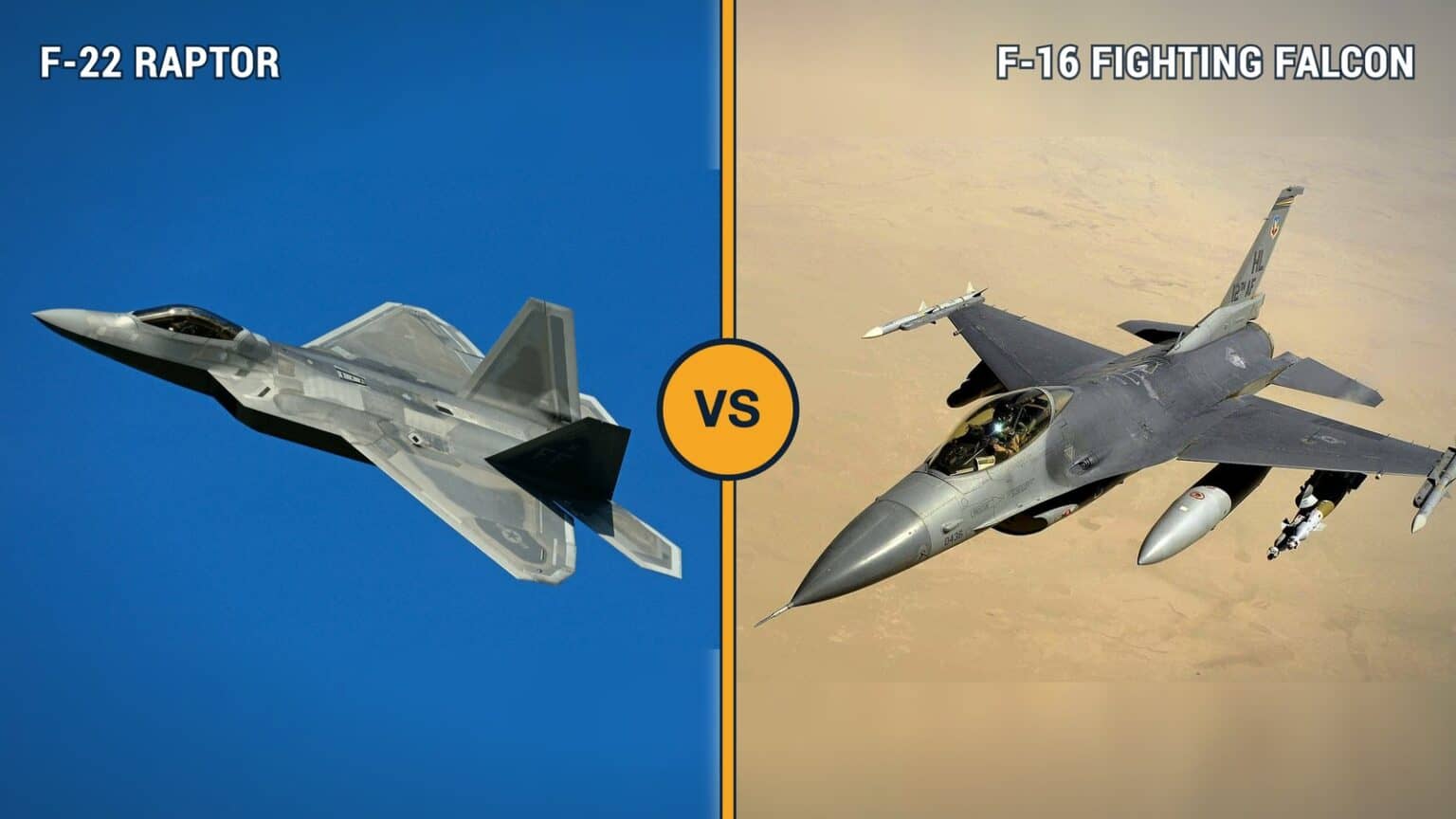
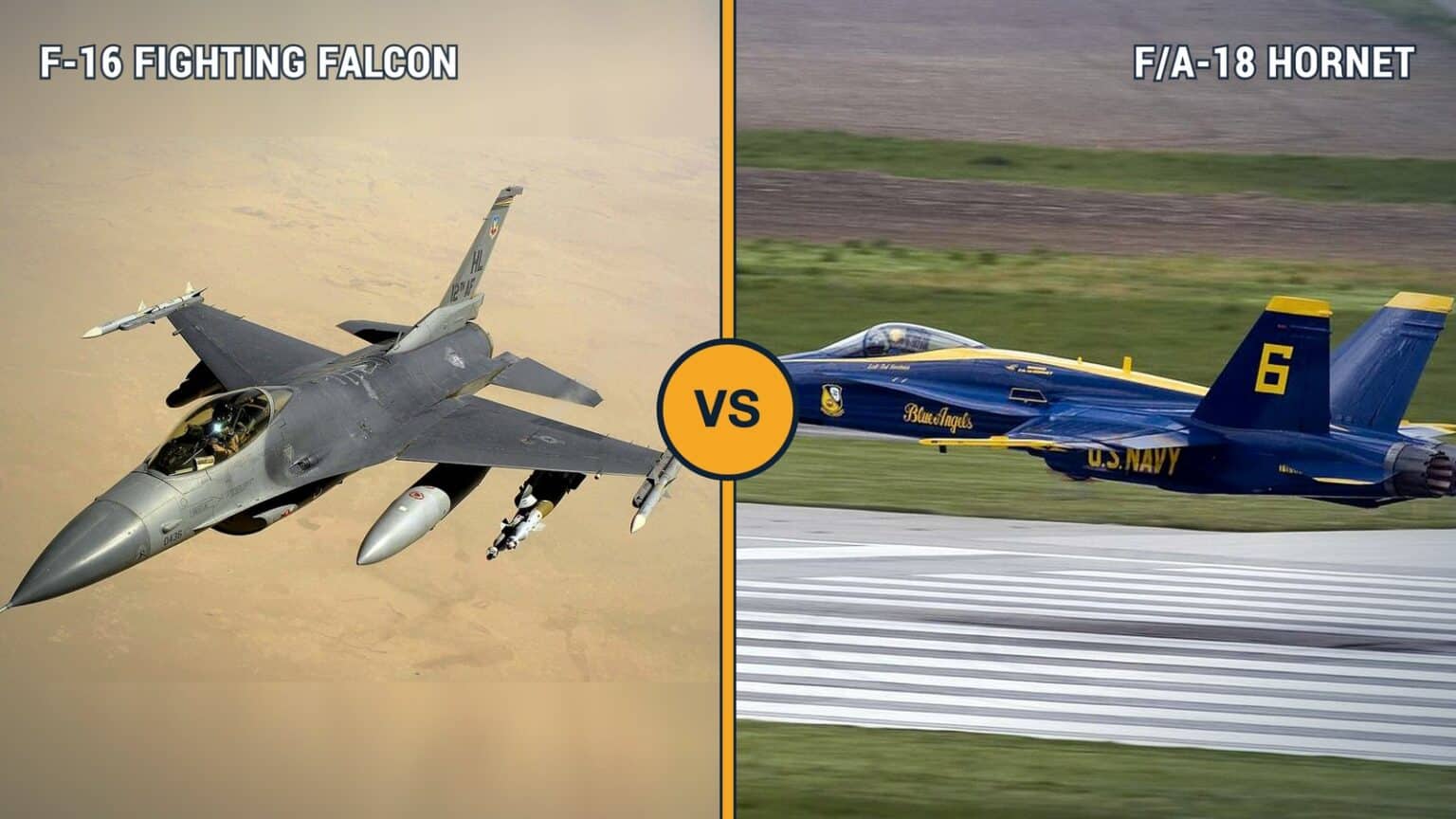
These two jets were built a generation apart for different jobs. The F-16 is a 1970s lightweight multirole fighter, and the F-22 is a stealthy air-dominance fighter that entered service in 2005.
We compare them on four measures: winning the air-to-air fight, cost and numbers, combat record, and what each jet will do next. Full specifications for the Lockheed Martin F-22 Raptor and the Lockheed Martin F-16 Fighting Falcon sit in our aircraft database.
The Raptor was meant to replace the F-16 too
The Air Force started the Advanced Tactical Fighter program, which produced the F-22, in 1981 to replace both the F-15 and the F-16. Production cuts left the Raptor replacing the F-15 in most active-duty squadrons, while the F-16 kept flying.
Where the F-22 wins
Stealth and internal weapons
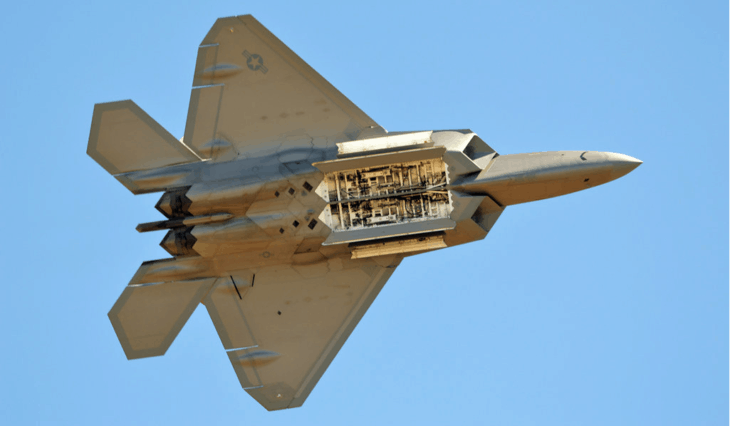
The F-22 carries its air-to-air load inside the airframe: six AIM-120 AMRAAMs in the main bay and two AIM-9 Sidewinders in the side bays. Carrying them internally keeps its radar signature low.
For strike missions it swaps four of the AMRAAMs for two 1,000-pound (450 kg) JDAM bombs or eight Small Diameter Bombs, still inside. The F-16 hangs its missiles, bombs and pods on external stations and has no stealth to protect it.
The Raptor’s APG-77 radar changes frequency more than 1,000 times per second, which makes its emissions hard to detect. For how it ranks among its peers, see our list of stealth fighter jets.
Speed and supercruise
The F-22 is the faster jet. Published specifications give it Mach 2.25, about 1,500 mph (2,414 km/h) at altitude, against Mach 2.05 for a clean F-16 at 40,000 feet.
The bigger difference is supercruise. The Air Force says the F-22 can cruise above Mach 1.5 without afterburner, while the F-16, like other fighters of its era, has to use fuel-hungry afterburner to stay supersonic.
Each of the Raptor’s two F119 engines is in the 35,000-pound thrust class, against 27,000 pounds for the single engine of an F-16C/D. See where both rank in our list of the fastest fighter jets.
A lopsided training record
The Raptor’s first big exercise was Northern Edge in Alaska in June 2006. Flying against F-15s, F-16s and Navy Super Hornets playing the enemy, the blue force it flew with scored 241 simulated kills for 2 losses, and both losses were F-15Cs.
“They couldn’t see us,” said Lt. Col. Wade Tolliver, commander of the 27th Fighter Squadron. “And that’s what makes the F-22 special.”
Across Northern Edge and Red Flag in February 2007, Raptors flying against aggressor F-15s and F-16s posted a simulated kill ratio of 108 to 0.
Where the F-16 wins
About a quarter of the cost to fly
The Pentagon’s fiscal 2026 reimbursement rates bill an Air Force F-16C at $14,818 per flight hour and an F-22A at $55,051. An hour in a Raptor buys almost four hours in an F-16.
Buying one was cheaper too. Air Force fact sheets list the F-16C/D at $18.8 million in fiscal 1998 dollars and the F-22 at $143 million.
Counting development, the Raptor program cost about $67.3 billion by the time production wound down, about $360 million for each production jet delivered.
Numbers the Raptor never had
The Air Force had 704 F-16Cs and 134 F-16Ds in fiscal 2024, about 40 percent of its fighter inventory. It flies 184 F-22s, so there are more than four Vipers, as pilots call the F-16, for every Raptor.
Worldwide the gap is far bigger. More than 4,600 F-16s have been built and 2,102 were in active service in 2026, against 195 F-22s built in total.
Availability widens it further. In fiscal 2024 the F-22 fleet was mission capable 40.19 percent of the time, down from 52 percent a year earlier and well below the Air Force average of 67.15 percent.

Anyone can buy one
Since fiscal 1998, every annual defense appropriations act has barred the sale of the F-22 to any foreign government, to protect its stealth technology. The US Air Force is its only operator.
The F-16 is still in production. Lockheed Martin has built it since 2019 after a two-year pause, and in January 2024 the US approved the sale of 40 new Block 70/72 jets to Turkey.
One jet, many jobs
The F-16 was designed as a lightweight fighter but became a mainstay of the Air Force’s tactical airpower, flying mainly strike and air-defense suppression missions.
The F-22 can hit ground targets too, but only with a small internal bomb load. Its main job is air dominance: clearing the sky so everything else can work.
F-16 vs F-22: who wins a dogfight?
The F-22, and not only because of stealth. Up close, the two are well matched on paper: at half internal fuel each produces more thrust than it weighs, 1.25 to 1 for the F-22 and 1.24 to 1 for the F-16, and both are rated to 9 g.
The Raptor then adds what the F-16 lacks: two-dimensional thrust-vectoring nozzles that swivel 20 degrees up or down, built into its flight controls. The Air Force says that combination lets it outmaneuver all current and projected aircraft.
Myth check: the F-16 is faster and more agile than the F-22
It is a common claim, and it is wrong. The F-22 tops out at Mach 2.25 against the F-16’s Mach 2.05, matches its thrust-to-weight ratio and 9 g limit, and adds thrust-vectoring nozzles. The F-16’s real advantage is price, not performance.
That does not make the Raptor unbeatable up close. At Red Flag Alaska in 2012, German Eurofighter Typhoons scored simulated kills on F-22s in close-range dogfights, and one German pilot said, “Yesterday, we have had a Raptor salad for lunch.”
Those were within-visual-range fights, where stealth counts for least. The Air Force built the F-22 to track, identify and shoot enemy fighters before they detect it, a matchup we explore in our Eurofighter Typhoon vs F-22 comparison.
Combat record: F-16 vs F-22
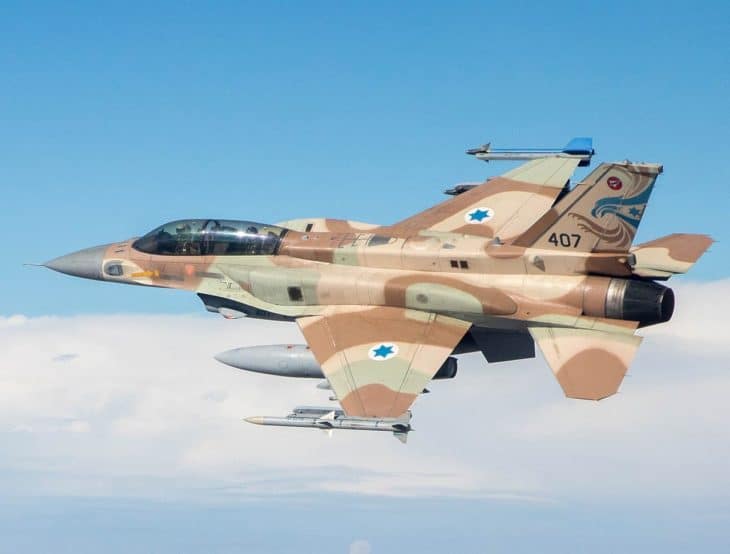
The F-16 has been fighting since 1981. Israeli F-16s scored its first air-to-air kill, a Syrian Mi-8 helicopter, on April 28 that year, and downed a Syrian MiG-21 on July 14.
Over Lebanon in 1982, the Israeli Air Force credited its F-16s with 44 air-to-air kills, mostly MiG-21s and MiG-23s, with no air-to-air losses. The first US Air Force F-16 kill came on December 27, 1992, when an F-16D downed an Iraqi MiG-25 with an AIM-120.
The newest came in July 2026. Gen. Dan Caine, chairman of the Joint Chiefs of Staff, told a Senate hearing that a Ukrainian F-16 had shot down a Russian fighter; Ukraine’s air force said it downed an Su-35 on July 8.
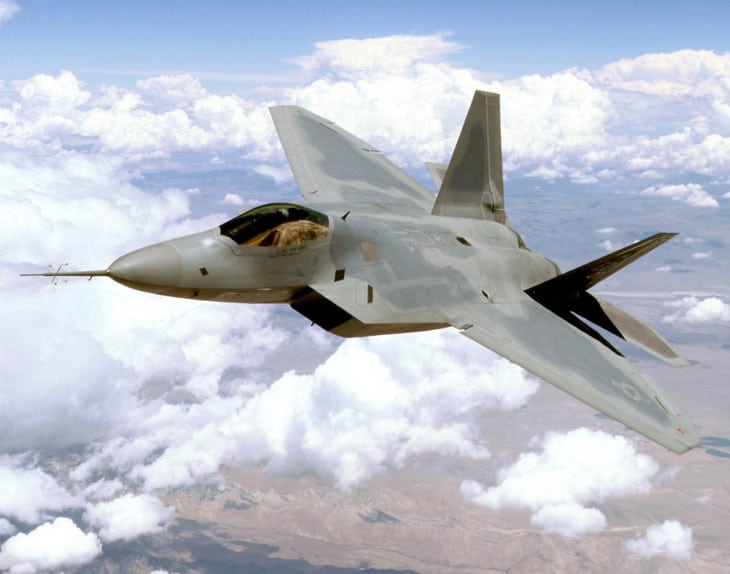
The F-22’s combat career began on September 22, 2014, with bombing strikes on Islamic State targets in Syria. Its first air-to-air kill was a Chinese surveillance balloon, shot down off South Carolina at 60,000 to 65,000 feet on February 4, 2023.
Its biggest war came in 2026. Eleven F-22s deployed to Ovda Air Base in Israel in February, and US Central Command says they flew more than 200 combat sorties against Iranian air defenses and other targets between March 1 and 9.
Ten of those Raptors landed in England on their way home in July. The two jets have never fought each other, and the Raptor has yet to be reported in a dogfight with an enemy fighter.
The F-16 has lost at least one. In October 1996 a Greek Mirage 2000 shot down a Turkish F-16D over the Aegean; Turkey’s defense minister confirmed it in 2012, while Greece officially denies it.
In February 2019 India said it had shot down a Pakistani F-16, which Pakistan denied. Foreign Policy reported that a US count of Pakistan’s F-16s found none missing.
F-16 vs F-22 size and cockpit
The F-22 is the bigger jet in every dimension. The Air Force lists it at 62 feet 1 inch (18.9 m) long, with a 44-foot 6-inch (13.6 m) wingspan, and 16 feet 8 inches (5.1 m) tall.
The F-16 is 49 feet 5 inches (15.1 m) long, with a 32-foot 8-inch (10 m) wingspan, and stands 16 feet (4.9 m) tall. The full side-by-side dimensions are in the database comparison at the top of this page.
An empty F-22 outweighs a fully loaded F-16
An empty F-22 weighs 43,340 pounds (19,700 kg), more than the 37,500-pound (17,000 kg) maximum takeoff weight the Air Force lists for the F-16. The Raptor’s own maximum takeoff weight, 83,500 pounds (38,000 kg), is more than double the F-16’s.
The Raptor also carries far more fuel inside: 18,000 pounds (8,200 kg), against 7,000 pounds (3,175 kg) in the F-16. For how both rank among the heavyweights, see our list of the biggest fighter jets.
Inside the cockpit
The F-16’s cockpit was built for the dogfight: a bubble canopy for all-round vision, a seat reclined 30 degrees instead of the usual 13 to help the pilot tolerate g-forces, and a side-stick instead of a center stick.
It was also the first production fighter designed to be slightly unstable on purpose, with fly-by-wire controls keeping it in hand. That cuts drag and sharpens its handling.
The F-22 has an all-glass cockpit: a head-up display and six color LCD screens, flown with a force-sensitive side-stick and two throttles. Its real edge is sensor fusion, which the Air Force credits with improving the pilot’s awareness of the fight.
Why was the F-22 discontinued?
The Air Force first planned 750 Advanced Tactical Fighters, then 381. Rising costs, early reliability problems and the lack of a matching enemy after the Cold War brought that down, and Defense Secretary Robert Gates capped the fleet at 187 operational jets in 2009.
Production ended in 2011 and the last Raptor was delivered in May 2012, for 195 in all including 8 test aircraft. Pentagon leaders wanted the money for the F-35, which uses F-22 technology but was designed to be cheaper, more flexible and exportable.
The short run forced the Air Force to keep 179 F-15C/Ds flying into the late 2020s, well past their planned retirement, a story we tell in our F-15 vs F-22 comparison. The F-16, by contrast, has been in production almost continuously since 1973.
What comes next for both jets
The F-22 is a fixed fleet of 184 jets. The fiscal 2023 defense bill bars the Air Force from retiring any before September 30, 2027, and the service has stopped asking to retire its 32 Block 20 training jets.
In June 2026 the House Armed Services Committee voted to extend that ban to 2032. The House passed its fiscal 2027 defense bill on July 22, but as of early September 2026 the bill had not become law.
The Air Force is still upgrading the Raptor, with a Link 16 datalink upgrade due fleetwide by fiscal 2027. Its successor is Boeing’s F-47 sixth-generation fighter, which the Air Force expects to replace or augment the F-22 in the 2030s.
The F-16 is staying longer. The Air Force is extending the structural life of 350 airframes beyond 8,000 flight hours, fitting the APG-83 AESA radar and a new electronic warfare suite, and plans to fly the type through 2040 or beyond.
Both are faster than the F-35A, which the Air Force lists at Mach 1.6. We set it against each of them in our F-22 vs F-35 and F-35 vs F-16 comparisons.
Jan 1974
The YF-16 flies by accident. A high-speed taxi test on January 20 becomes an unplanned first flight; the official one follows on February 2.
Jan 1979
The first operational F-16A arrives. It goes to the 388th Tactical Fighter Wing at Hill Air Force Base, Utah.
1981
The Advanced Tactical Fighter program begins. Its goal is a replacement for both the F-15 and the F-16.
Apr 1981
The F-16’s first air-to-air kill. An Israeli F-16 downs a Syrian Mi-8 helicopter over the Bekaa Valley.
Sep 1997
The first F-22 flies. The YF-22 prototype had flown in September 1990.
Dec 2005
The F-22 reaches initial operational capability. The 94th Fighter Squadron at Langley is first.
Jun 2006
Northern Edge. The Raptor-led blue force scores 241 simulated kills for 2 losses, neither of them an F-22.
2009
Production is capped at 187. Defense Secretary Robert Gates caps the fleet well short of the 381 the Air Force wanted.
May 2012
The last F-22 is delivered. 195 were built, including 8 test aircraft.
Sep 2014
The F-22’s first combat. Raptors bomb Islamic State targets in Syria.
Feb 2023
The F-22’s first air-to-air kill. A Raptor shoots down a Chinese surveillance balloon off South Carolina.
Mar 2026
Raptors go to war with Iran. CENTCOM says they flew more than 200 combat sorties in nine days.
Jul 2026
A Ukrainian F-16 downs a Russian fighter. Gen. Dan Caine confirms it to a Senate hearing.
The verdict
For air combat, the F-22 wins clearly. It is stealthier and faster, cruises supersonic without afterburner, matches the F-16 in a turning fight, and in training it posted a 108-to-0 score against F-15s and F-16s.
For almost everything else, the F-16 makes the stronger case. It costs about a quarter as much per flight hour, flies strike and air-defense suppression missions, is still in production and serves around the world.
The Air Force needs both: the Raptor to win the sky, and more than four Vipers for every Raptor to do the daily work. For the wider field, see our ranking of the best fighter jets in the world.
FAQ
Sources and references used for research and fact-checking.
- U.S. Air Force, F-22 Raptor Fact Sheet
- U.S. Air Force, F-16 Fighting Falcon Fact Sheet
- U.S. Air Force, F-35A Lightning II Fact Sheet
- Wikipedia, Lockheed Martin F-22 Raptor
- Wikipedia, General Dynamics F-16 Fighting Falcon
- Wikipedia, General Dynamics F-16 Fighting Falcon operational history
- Wikipedia, 1996 Turkish F-16 shootdown
- Office of the Under Secretary of Defense (Comptroller), Fiscal Year 2026 DoD Fixed Wing and Helicopter Reimbursement Rates
- Air & Space Forces Magazine, F-22 Raptor
- Air & Space Forces Magazine, F-16 Fighting Falcon
- Air & Space Forces Magazine, The Raptor in the Real World
- Air & Space Forces Magazine, Air Force Mission Capability Rates Reach Lowest Levels in Years
- Air & Space Forces Magazine, House Panel Votes to Prohibit F-22 Retirements Through 2032
- Congressional Research Service (via EveryCRSReport), FY2027 NDAA: Status of Legislative Activity
- Air & Space Forces Magazine, Buildup Against Iran Continues: F-22s to Israel, F-35s, F-15Es to Europe
- The War Zone, F-22 Raptors Arrive In England After Deployment To Israel For Iran War
- The Aviationist, Yesterday we had Raptor salad for lunch: Typhoon pilot after dogfighting with the F-22 at Red Flag Alaska
- The Aviationist, Ukrainian F-16 Shot Down Russian Fighter for the First Time
About the Author

Tim is the owner and lead editor of AeroCorner since 2019, overseeing aviation content covering aircraft, airlines, airports, and the broader aviation industry. Through years of researching, writing, editing, and publishing aviation-focused content, he has developed extensive practical knowledge of commercial aviation and air travel. Based in Asia and a frequent traveler himself, Tim also brings firsthand passenger experience to AeroCorner’s coverage. Outside of publishing, he has also explored aviation firsthand through hands-on flight training in New Zealand.