



Table of Contents
| Measure | F-16C/D Block 50/52 | MiG-29 / MiG-29M |
|---|---|---|
| Role | Lightweight multirole fighter, built for air combat and strike | Frontline air-defense fighter, with later multirole variants |
| First flight, service | Official first flight February 2, 1974; USAF service from 1978 | First flight October 6, 1977; Soviet service from 1983 |
| Built | 4,604 | More than 1,600 |
| Radar | AN/APG-68 pulse-Doppler on Block 50/52; AN/APG-83 AESA on upgraded jets | Zhuk-ME pulse-Doppler on the MiG-29M; older MiG-29s carry a shorter-range radar |
| Gun | 20 mm M61A1 Vulcan | 30 mm GSh-30-1, 150 rounds originally |
| Dogfight missiles | AIM-9 Sidewinder | R-73 (AA-11 Archer), plus a helmet-mounted sight |
| Medium-range missiles | AIM-120 AMRAAM | R-27 (AA-10 Alamo); R-77 on the MiG-29M |
| Cockpit | Reclined seat, side-stick controller, bubble canopy | Conventional stick, high-mounted canopy, helmet cueing |
| Operators | The USAF plus 25 other nations | Russia, Ukraine, India, Poland, Slovakia, Egypt, Algeria and others |
| Production | Ongoing, with Block 70/72 jets | Ongoing at a small scale, mainly the MiG-29M for export |
Two fighters from the same Cold War problem
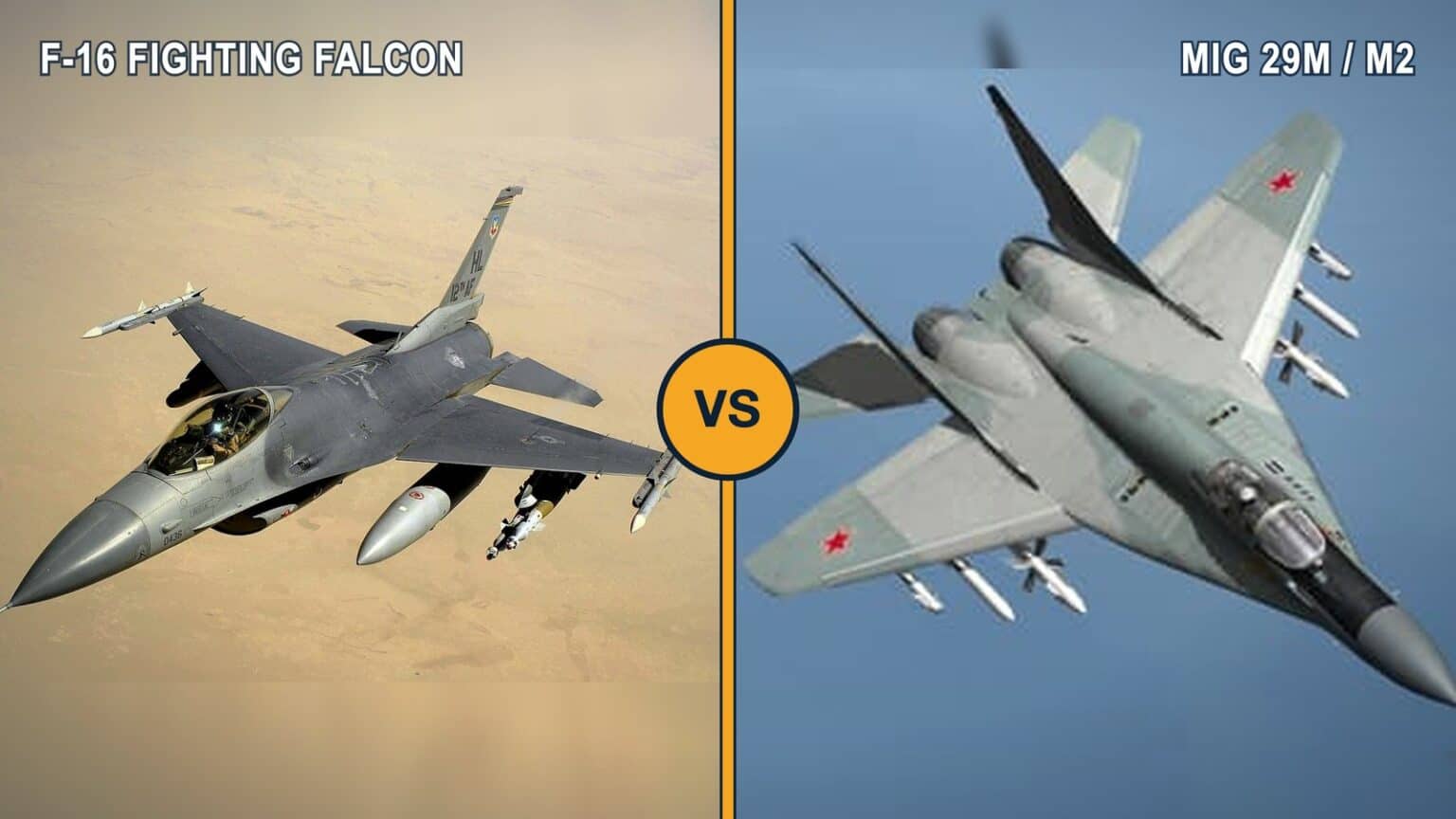
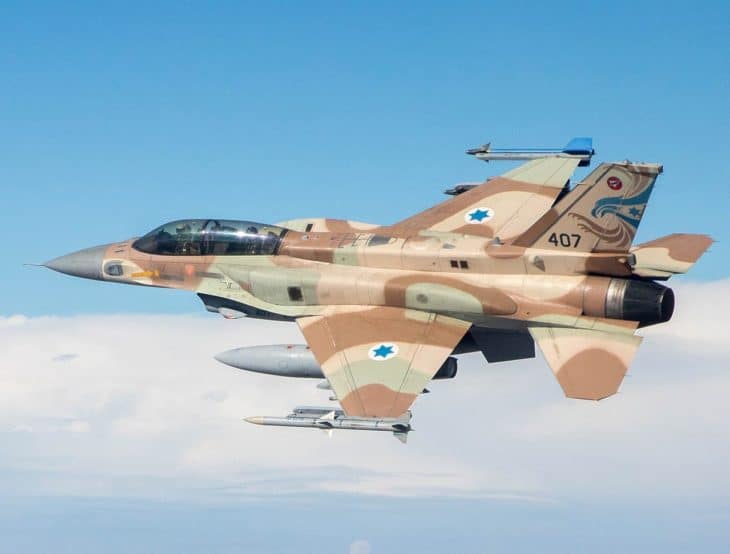
The F-16 Fighting Falcon began as a lightweight fighter that the US Air Force wanted to be cheap enough to buy in numbers. General Dynamics built the YF-16 prototype, and the official first flight was on February 2, 1974. Production jets entered USAF service in 1978.
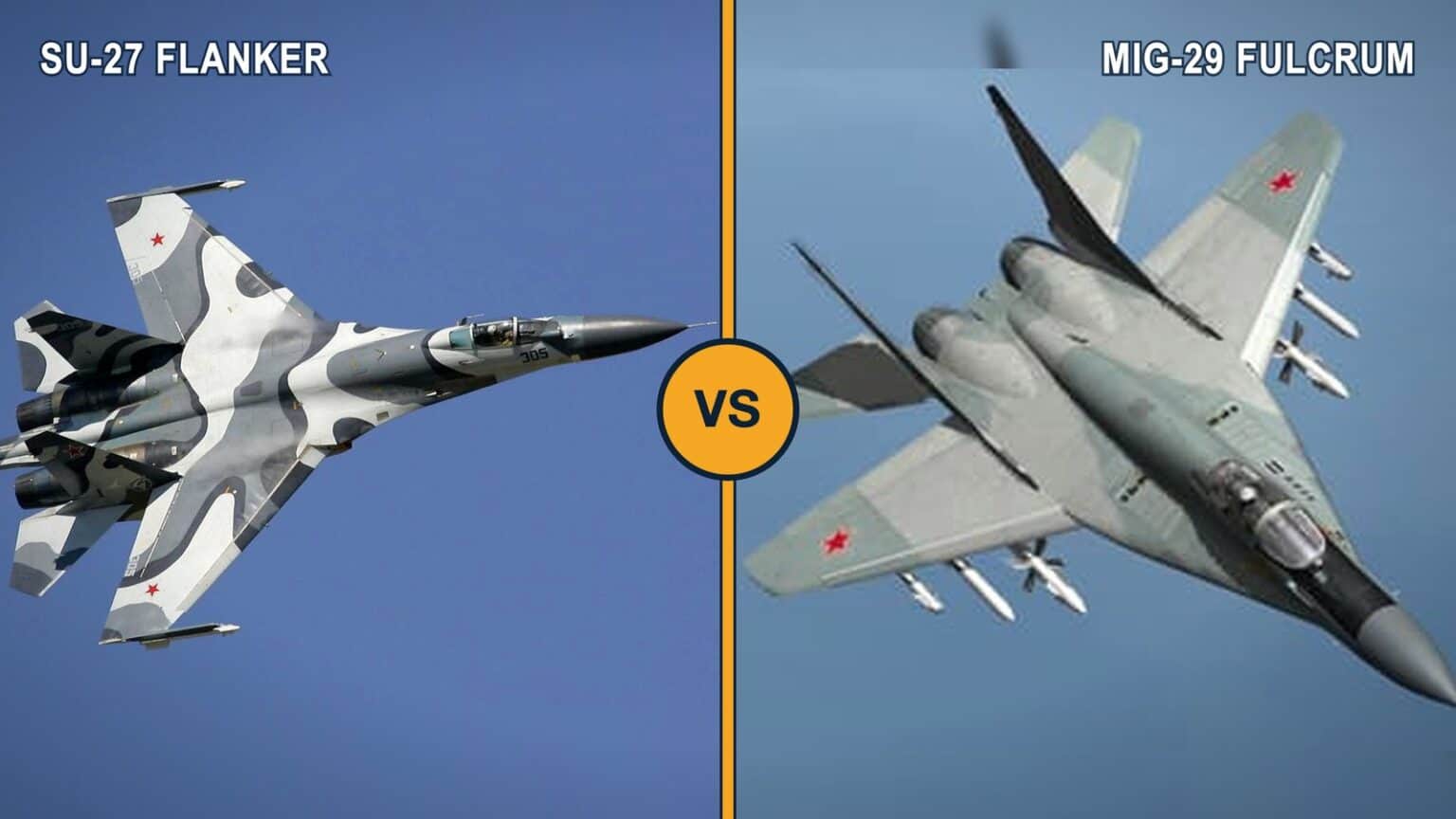
The MiG-29 was the Soviet answer to the same generation of American fighters. It first flew on October 6, 1977 and joined Soviet front-line units in 1983. The MiG-29M is a deep modernization with a new radar, more fuel and a wider weapons load.
Both are single-seat fighters from the late 1970s with a gun in the wing root and a mix of heat-seeking and radar-guided missiles, so they are fair opponents on paper. They solve the problem differently, with a single engine and fly-by-wire on one side and two engines and a short-range interceptor mindset on the other.
For the wider lineup, see our guide to the best fighter jets in the world.

Where the F-16 wins
Sensors and situational awareness
The F-16 is a better sensor platform. Block 50/52 jets carry the AN/APG-68 radar, and upgraded jets and Block 70/72 aircraft carry the AN/APG-83 AESA radar. Link 16 puts the pilot’s picture on the same network as the rest of NATO.
The early MiG-29 lacked HOTAS controls and a data link, and German evaluators found it harder to manage several radar locks at once in beyond-visual-range fights. The MiG-29M closes part of that gap with the Zhuk-ME radar and an infrared search-and-track sensor.
Endurance and maintenance
The baseline MiG-29 carries little fuel, which kept it tied to short-range air defense. The F-16 flies farther and stays on station longer, and its fleet size makes parts and training easy to find.
That matters most when you buy the aircraft. The MiG-29 was the cheaper jet to purchase, but it is the more demanding one to keep flying, and it was expected to have a shorter service life. The engine and range rows in the database comparison above carry the numbers.
A proven record in many wars
F-16s have flown for Israel, Pakistan, the United States and many others since the early 1980s, and they are still being upgraded. Israel’s F-16As took part in the 1981 strike on Iraq’s Osirak reactor.
In March 1999, during NATO’s Kosovo campaign, a Royal Netherlands Air Force F-16 shot down a Serbian MiG-29. One USAF F-16 and four USAF F-15s also shot down Fulcrums in that campaign, six Serbian MiG-29s in all.
Where the MiG-29 wins
The close-in turning fight
This is the MiG-29’s real advantage. German pilots flew the 24 MiG-29s East Germany had bought after reunification, and found them more maneuverable at slow speeds than the F-15, F-16, F-14 and F/A-18.
Below about 200 knots, the MiG-29 can point its nose well beyond where a Western jet can. The F-16 regains the advantage at higher speeds, where its fly-by-wire controls and high-g turns favor it.

The R-73 and the helmet sight
The R-73 (AA-11 Archer) is a short-range missile that German evaluators rated above the AIM-9 Sidewinder of the day. Paired with the helmet-mounted sight, it lets a MiG-29 pilot lock a target well off the nose.
The F-16 got its own helmet sight and AIM-9X later, so the gap narrowed. In the early 1990s, though, it was a real advantage, and it is why the MiG-29 was feared in a close merge.
Twin engines and a rugged airframe
The MiG-29 has two engines, so losing one does not end the flight. It was designed to fly from rough, damaged airfields, and its engine intakes have covers that keep debris out on poor runways.
Operators that want a tough fighter and already own Soviet-era weapons still find it attractive. Egypt and Algeria have both ordered the MiG-29M, although reported order sizes differ between sources.

F-16 vs MiG-29 over Ukraine
Ukraine flies both, which makes this more than a paper matchup. Its MiG-29s fought from the first day of the 2022 invasion as air-defense fighters, and by August 2022 they had been fitted with AGM-88 HARM anti-radiation missiles to hit radar sites.
Ukraine has since lost about three dozen of its MiG-29s, some of them to drone and missile strikes on the ground. F-16s from NATO stocks began arriving in 2024, giving Ukraine’s air force a Western fighter with a modern radar and missiles.
Myth check: the MiG-29 was never a match for the F-16
Western tests tell a more mixed story. After reunification, German pilots found the MiG-29 beat every NATO fighter in a slow, close-in fight. What it lacked was fuel, a data link and radar to match, which is why Western air forces beat it in the real wars where those mattered.
The decision also depends on the mission. An air force that mostly defends its own airspace from nearby bases can live with the MiG-29’s short legs, while one that must patrol far from home needs the F-16’s fuel and its allied support chain.
So which is better, the F-16 or the MiG-29?
For most air forces the F-16 is the better buy. It sees farther, flies farther, shares data with allies and has a mature support chain. That is why 26 air arms operate it.
The MiG-29 is the better pure dogfighter at low speed, and the newer MiG-29M narrows the sensor gap. In a real fight, though, the pilot, the missile and who sees the other first usually decide the result.
To go deeper, see how it stacks up against the F-35 in our F-35 vs F-16 comparison, or read about the top fighter jets in the world.
FAQ
Sources and references used for research and fact-checking.
About the Author

Tim is the owner and lead editor of AeroCorner since 2019, overseeing aviation content covering aircraft, airlines, airports, and the broader aviation industry. Through years of researching, writing, editing, and publishing aviation-focused content, he has developed extensive practical knowledge of commercial aviation and air travel. Based in Asia and a frequent traveler himself, Tim also brings firsthand passenger experience to AeroCorner’s coverage. Outside of publishing, he has also explored aviation firsthand through hands-on flight training in New Zealand.