



Table of Contents
| Judgment call | Sukhoi Su-27 Flanker | F-16 Fighting Falcon |
|---|---|---|
| Built to be | A heavy, long-range air-superiority fighter | A lightweight fighter; now a multirole workhorse |
| Program | The heavy (TPFI) half of the Soviet PFI requirement | USAF Lightweight Fighter program, the low end of a high/low mix with the F-15 |
| Like-for-like rival | F-15 Eagle | MiG-29 |
| First flight | 20 May 1977 (T-10 prototype) | 2 February 1974 (YF-16, official first flight) |
| Service entry | 1985 | Introduced August 1978 |
| Radar | N001 pulse-Doppler on the baseline jet | APG-68; APG-83 AESA on the F-16V and upgraded jets |
| Gun | 30 mm GSh-30-1, 150 rounds | 20 mm M61A1, 500 rounds |
| Hardpoints | 10 external pylons | 11 stations, 2 of them for sensor pods |
| Thrust-to-weight | 1.07 with 56% internal fuel | 1.24 at loaded weight with 50% internal fuel |
| Number built | 680 | 4,604, still in production |
| Air-to-air record | Two Eritrean MiG-29s downed by Ethiopia, 1999 | 44 kills in the 1982 Lebanon war alone |
| Flies for Ukraine | Yes | Yes, since 2024 |
The Su-27’s real rival was the F-15, not the F-16
In 1969 the Soviet Union learned of the U.S. Air Force’s F-X program, which became the F-15 Eagle. Moscow answered with a requirement for a new frontline fighter, known as PFI.
One aircraft could not meet that specification in the numbers needed at an affordable price, so it was split in two. The lightweight half produced the MiG-29. The heavy half went to Sukhoi and produced the Su-27.
The Americans had made the same split a few years earlier. The Air Force could not afford enough F-15s for every mission, so the Lightweight Fighter program produced the F-16 as the cheaper half of a high/low mix.
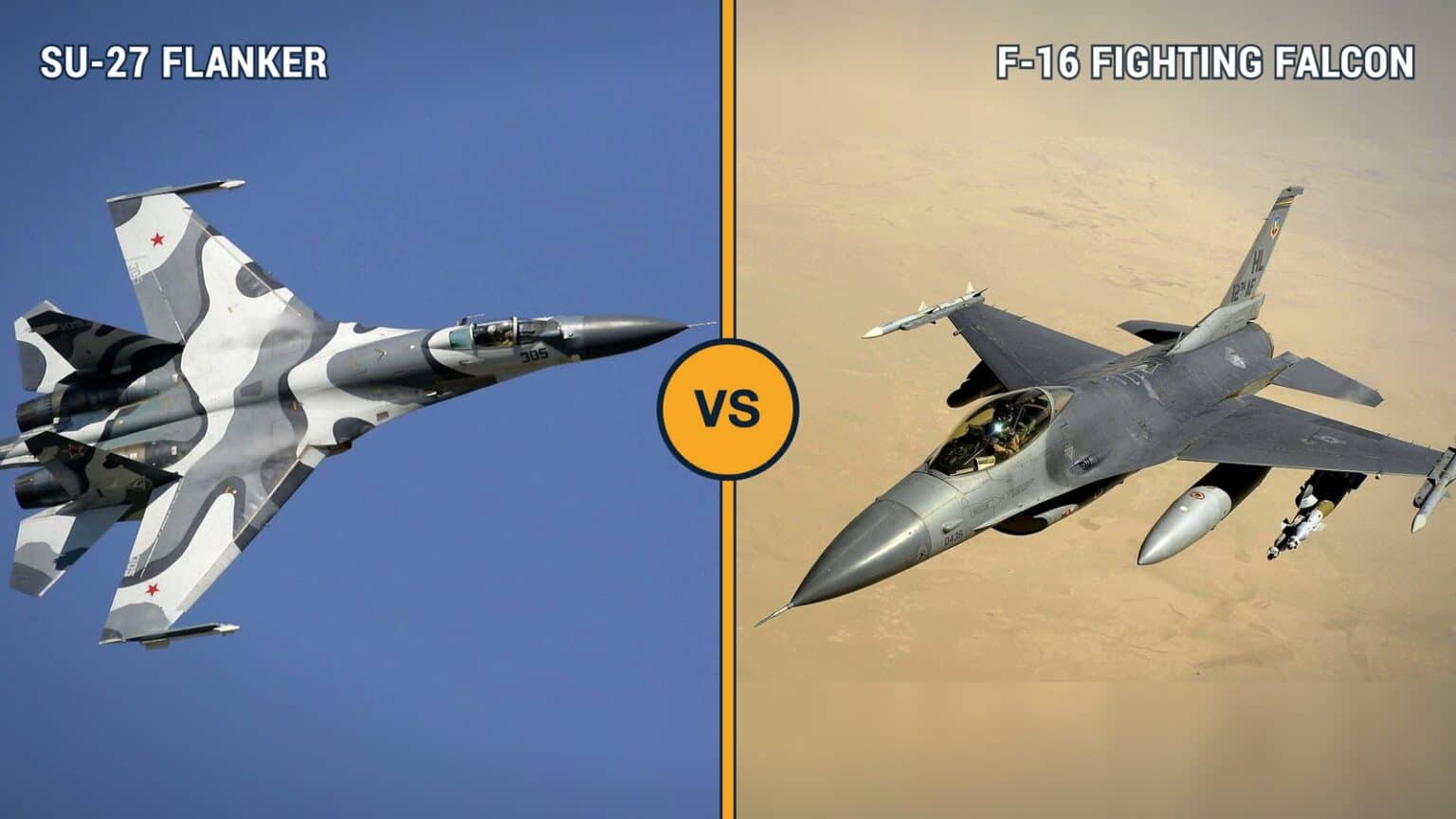
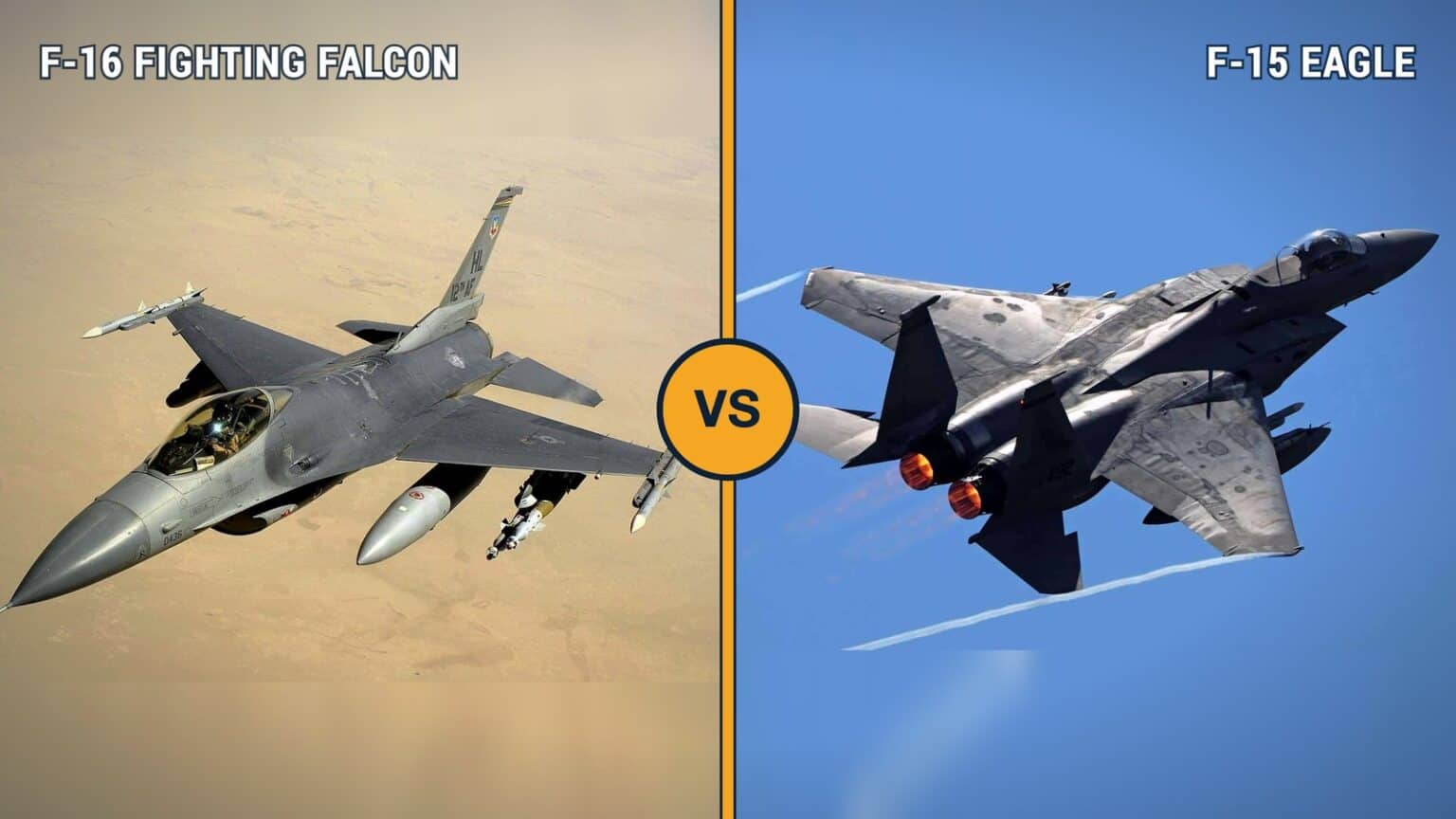
So Su-27 vs F-16 is a heavyweight against a lightweight. The like-for-like pairings are Su-27 vs F-15 and MiG-29 vs F-16, and our F-16 vs F-15 comparison shows how differently the two American halves turned out.
Su-27 vs F-16 size comparison
Side by side, the gap is obvious. The Su-27 is 71 ft 10 in (21.90 m) long with a 48 ft 3 in (14.70 m) wingspan. The F-16 is 49 ft 5 in (15.06 m) long with a 32 ft 8 in (9.96 m) span.
Empty, the Su-27 weighs 36,112 lb (16,380 kg), nearly twice the F-16’s 18,900 lb (8,573 kg). Maximum takeoff weight is 67,000 lb (30,500 kg) against 42,300 lb (19,200 kg).
The Su-27 has two engines in separate nacelles with a tunnel between them. The F-16 has one.
Where the Su-27 wins
Fuel and reach. The Su-27 holds 3,150 gal of fuel internally, against 1,050 gal for the F-16. That factor of three is the whole point of a heavy fighter: it can fly further, loiter longer and fight further from home without tanks.
The range figures in the database above need a warning. They list 2,190 mi for the Su-27 and 2,620 mi for the F-16, but they measure different things.
The F-16 number is ferry range with three drop tanks. The Su-27 number is on internal fuel at cruising altitude. Compared on internal fuel alone, the Su-27 is the longer-legged jet by a wide margin.

Top speed. The Su-27 is rated at Mach 2.35 at altitude, 1,554 mph. The F-16C is rated at Mach 2.05 clean at 40,000 feet, 1,353 mph.
Sensors for air combat. Besides its N001 radar, with look-down/shoot-down capability, the Su-27 carries an OLS-27 infrared search and track sensor in front of the cockpit. It is credited with 50 to 62 miles (80 to 100 km) of range and lets the pilot hunt a target by its heat.
Low-speed handling. The Su-27 had the Soviet Union’s first operational fly-by-wire flight controls. Its big wing gives a loading of about 77 lb/sq ft with 56% fuel, against 88.3 lb/sq ft for the F-16C, and a lower figure generally means a tighter instantaneous turn.
Test pilot Viktor Pugachev first demonstrated the Cobra maneuver in a Su-27 in 1989, briefly holding level flight at about 120 degrees angle of attack.
The Streak Flanker
A stripped Su-27 prototype called the P-42, with no radar, weapons or paint, took several time-to-climb world records from the F-15 Streak Eagle between 1986 and 1988. Several of those records still stood as of 2019.
Where the F-16 wins
Thrust for its weight. At a typical loaded weight with half its internal fuel, the F-16 has a thrust-to-weight ratio of 1.24. The Su-27’s published figure is 1.07 with 56% fuel.
More spare thrust means the F-16 bleeds less energy in a sustained turn and climbs back faster after one. Both jets are rated to 9 g, but the F-16 was the first fighter purpose-built to pull it.
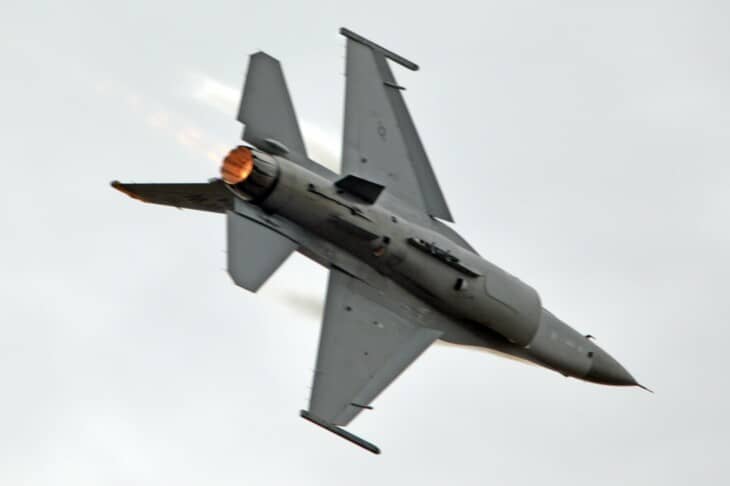
The cockpit. The F-16 was the first production fighter built around relaxed static stability and fly-by-wire controls. Its pilot flies with a side-stick under a frameless bubble canopy that gives a 360-degree view.
Bombs as well as missiles. The F-16 is rated to carry 17,000 lb (7,700 kg) of stores, against 9,750 lb (4,450 kg) for the Su-27. It is why a jet conceived as a lightweight day fighter ended up flying strike missions for air forces around the world.
Modern sensors. The F-16V and upgraded American and Taiwanese jets carry the AN/APG-83 SABR, an active electronically scanned array radar. That is a generation newer than the baseline Su-27’s N001, and it pairs with the AIM-120 AMRAAM, which recent F-16 versions carry.
Numbers. Lockheed Martin and General Dynamics built 4,604 F-16s, and about 2,102 were still in service in 2026, some 15% of all active combat aircraft in the world. New ones have been rolling off a line in Greenville, South Carolina, since 2023. Sukhoi built 680 Su-27s.
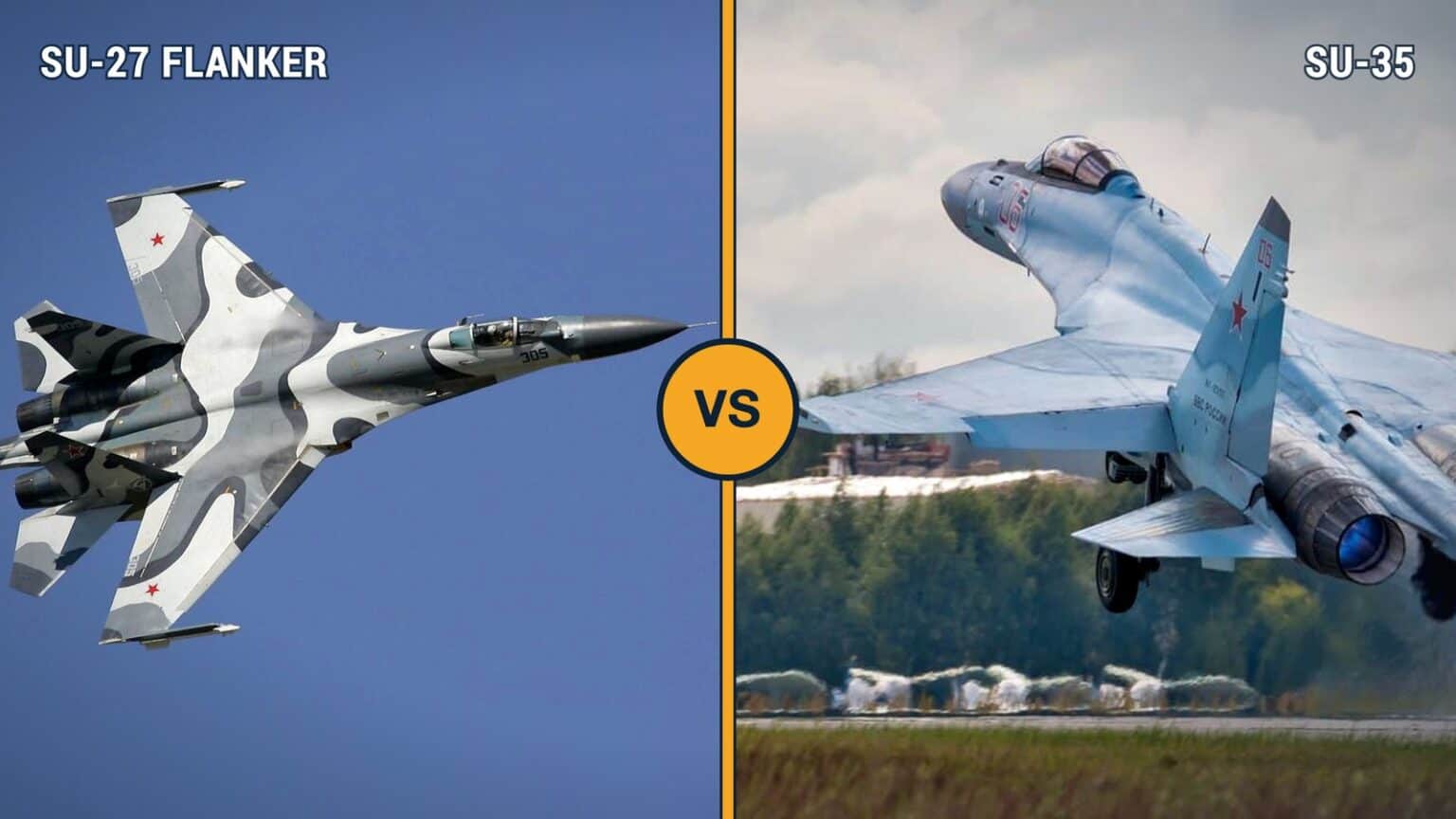
Russia has modernized its own Flankers, and a squadron of upgraded Su-27SM3s deployed to Syria in 2015. The airframe also grew into the Su-30 and Su-35, which our Su-27 vs Su-35 comparison covers.
Who would win in a dogfight?
It depends on which versions meet and where the fight starts. No public test result settles it, so any answer is a judgment from published figures.
Close in, it is roughly even on paper. The Su-27 has the lower wing loading and remarkable high-angle-of-attack handling. The F-16 has more thrust for its weight and superb visibility. Pilot training would decide it more than either airframe.
Beyond visual range, the matchup tilts toward whichever jet has the newer radar and missiles. A current F-16 with an AESA radar and AMRAAMs has the edge over a baseline 1980s Su-27; a modernized Su-27 narrows that gap and keeps its advantage in fuel.
Three Su-27 vs F-16 myths
The F-16 has one engine, not two. Neither jet has folding or swinging wings; the Su-27 has a fixed, clipped wing. And the F-16 is not the newer design: it first flew in 1974, three years before the Su-27 prototype.
The Su-27 and the F-16 have met, and now fly on the same side
The best-known encounter came over the Baltic Sea on 21 June 2017. A Polish Air Force F-16 Block 52+ on NATO air policing approached the Tu-154 carrying Russian Defense Minister Sergei Shoigu to Kaliningrad.
One of the escorting Su-27s maneuvered toward the F-16 and forced it to move away. A few minutes later the F-16 left the area.
Today the two types fight together. Ukraine went into the Russian invasion with Su-27s and had lost 19 of them by 21 April 2026.

European air forces, led by Denmark and the Netherlands, donated F-16s. The first arrived by the end of July 2024, and President Zelensky announced them in service on 4 August 2024.
Three air forces fly both
Of the Su-27’s current operators, three also fly the F-16. Ukraine is one. Indonesia bought two Su-27SKs in 2003 and three Su-27SKMs in 2010, alongside its F-16s. And the U.S. Air Force took delivery of two Su-27Ps from Belarus in 1995 and bought two Su-27UBs in 2011 for evaluation and training.
By the end of July 2026 Ukraine had confirmed the loss of five F-16s and three pilots. In July 2026 General Dan Caine, chairman of the U.S. Joint Chiefs, told a Senate committee that a Ukrainian F-16 had shot down a Russian fighter for the first time.
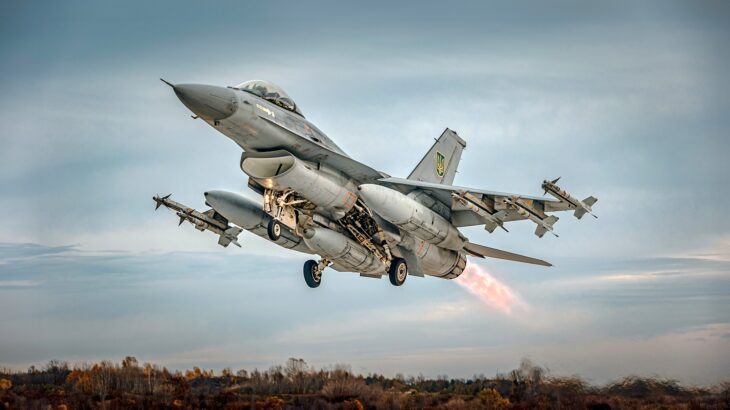

Caine did not name the type. Ukrainian sources say it was a Su-35S lost on 8 July 2026, a descendant of the Su-27, which would make the F-16’s first fighter kill over Ukraine a Flanker.
Verdict: which is better?
For pure air superiority over long distances, the Su-27. It is bigger, carries three times the fuel, is faster on paper and handles superbly at low speed.
For almost everything else, the F-16. It carries more ordnance, it was built in nearly seven times the numbers, it is still in production, and its current versions have the more modern radar.
Both families are still flying combat missions nearly half a century after their first flights. For how they rank against the wider field, see our list of the best fighter jets in the world.
FAQ
Sources and references used for research and fact-checking.
- Wikipedia, Sukhoi Su-27
- Wikipedia, General Dynamics F-16 Fighting Falcon
- Wikipedia, General Dynamics F-16 Fighting Falcon operators
- The Aviationist, New video shows close encounter between NATO F-16 and Su-27 Flanker escorting Russian Defense Minister plane over the Baltics
- The War Zone, Ukrainian F-16 Scored First Air-to-Air Kill Against a Russian Fighter: Top U.S. General
About the Author

Tim is the owner and lead editor of AeroCorner since 2019, overseeing aviation content covering aircraft, airlines, airports, and the broader aviation industry. Through years of researching, writing, editing, and publishing aviation-focused content, he has developed extensive practical knowledge of commercial aviation and air travel. Based in Asia and a frequent traveler himself, Tim also brings firsthand passenger experience to AeroCorner’s coverage. Outside of publishing, he has also explored aviation firsthand through hands-on flight training in New Zealand.