


Table of Contents
| Measure | F-22 Raptor | YF-23 Black Widow II |
|---|---|---|
| Role | Air superiority fighter in service | Prototype for the Advanced Tactical Fighter contest |
| Industry team | Lockheed, with Boeing and General Dynamics | Northrop, with McDonnell Douglas |
| First flight | 7 September 1997 (F-22A); YF-22 on 29 September 1990 | 27 August 1990 (PAV-1); 26 October 1990 (PAV-2) |
| Number built | 195, including 8 test aircraft | 2 |
| Status | Entered service in December 2005; production ended in 2011 | Lost the 23 April 1991 decision; both museum pieces |
| Thrust vectoring | Yes, 2D nozzles | No |
| Tail | Conventional twin vertical tails with horizontal stabilizers | Two all-moving V-tails |
How to read this comparison
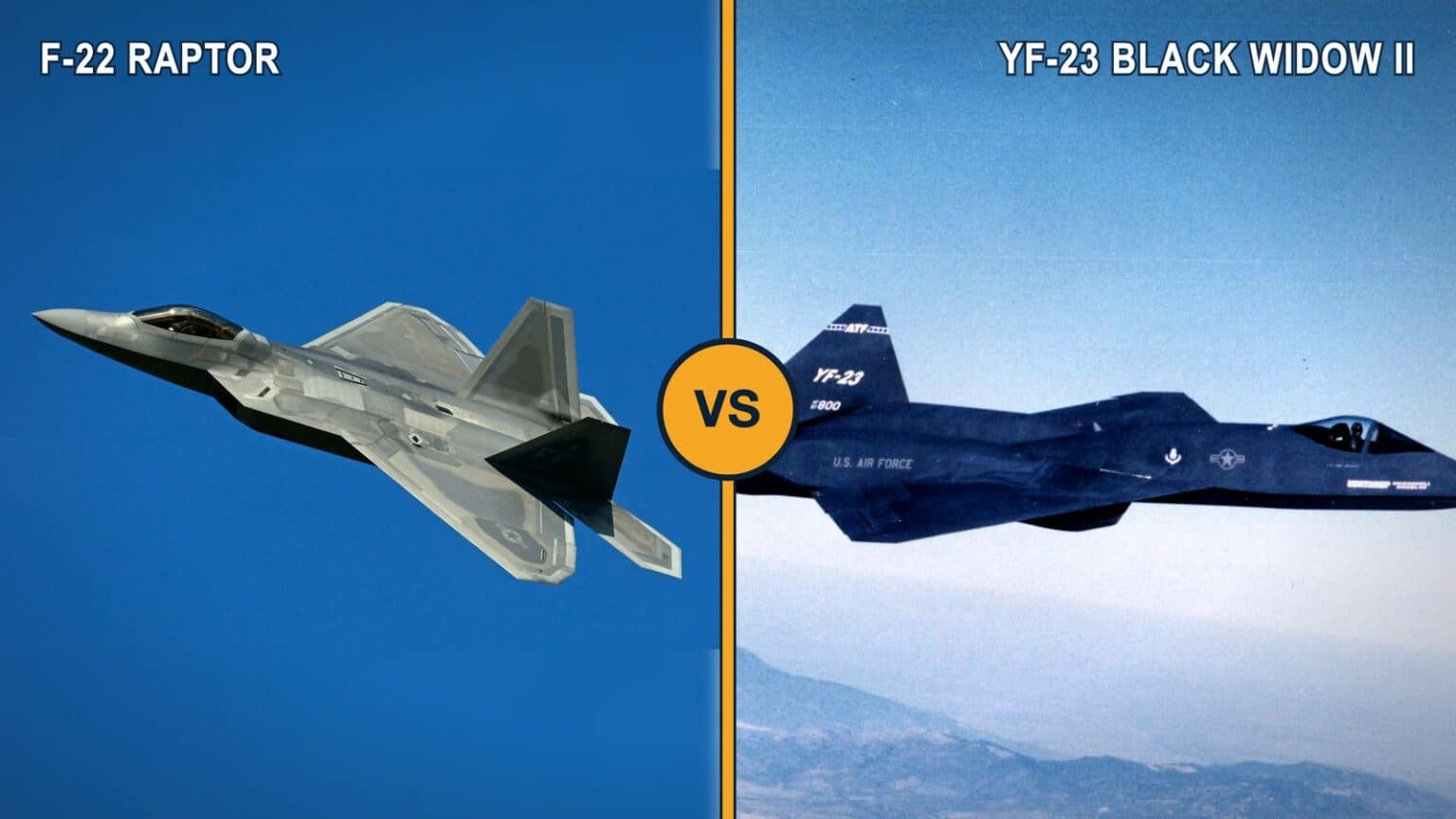
The F-22 is the production Raptor (F-22A), a combat aircraft. The YF-23 figures are for the prototypes, which carried no radar or weapons systems of a production jet and never entered service. Where the panel above shows a prototype figure, treat it as a test result, not a combat rating.
What each jet is
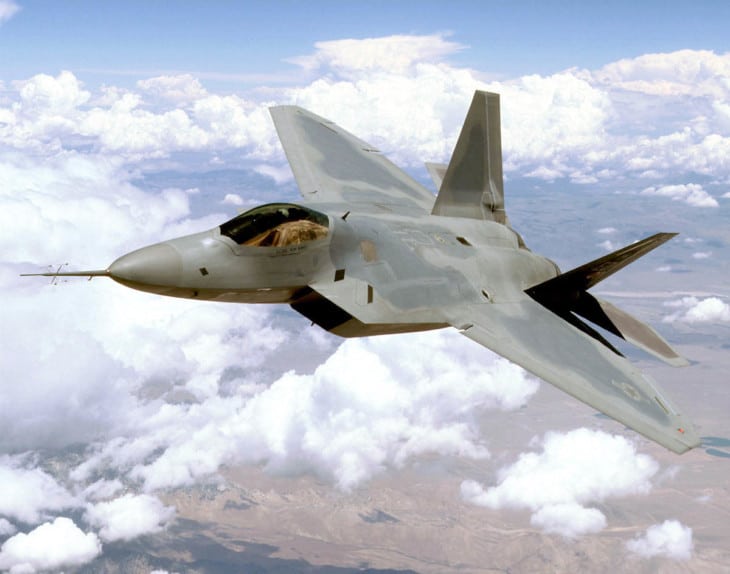
The F-22 Raptor is the Air Force’s only operational fifth-generation air superiority fighter. It grew out of the Lockheed YF-22, which flew on 29 September 1990, and the production F-22A first flew on 7 September 1997.
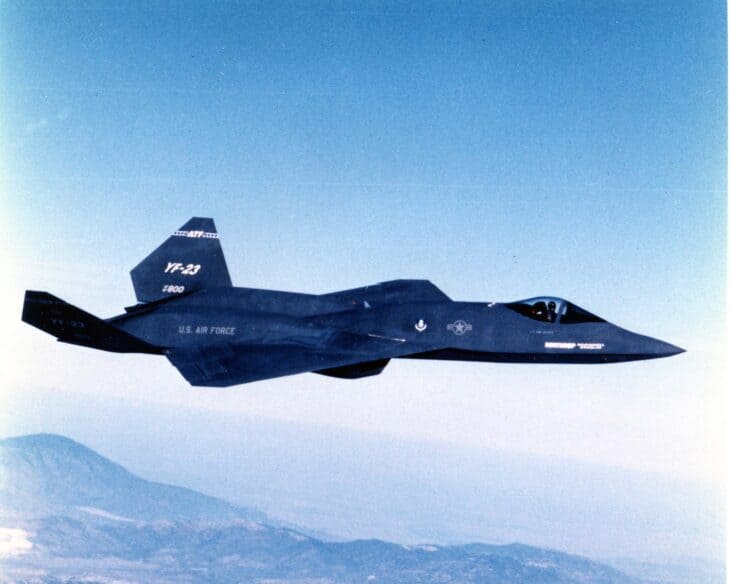
The YF-23 Black Widow II was Northrop and McDonnell Douglas’s entry in the same contest. The Air Force wanted a replacement for the F-15 under the Advanced Tactical Fighter program, and two teams built flying prototypes to compete for it.
Northrop built two. PAV-1, nicknamed “Gray Ghost,” flew first on 27 August 1990 with Pratt & Whitney engines. PAV-2, nicknamed “Spider,” flew on 26 October 1990 with General Electric engines.
“Black Widow II” is the jet’s unofficial name, a nod to Northrop’s World War II P-61 Black Widow.
The 1991 fly-off: why the stealthier jet lost
Lockheed and Northrop were picked as the two finalists on 31 October 1986. Each team received about $691 million (in 1985 dollars) and 50 months to build and demonstrate prototypes.
On 23 April 1991, Air Force Secretary Donald Rice announced the winner: the YF-22 team.
The YF-23 was judged stealthier and faster. The YF-22 was judged more agile, and Lockheed scored better on its technical ratings, its program management and its perceived risk.
The YF-23 also flew less. The two prototypes made 50 sorties totaling 65.2 hours, considerably fewer than the YF-22 team flew.
Some accounts add that Northrop’s cost overruns and delays on the B-2 bomber and the AGM-137 TSSAM missile hurt its case. That is speculation, not a published finding of the decision.
Edge: YF-22 team, on the record. It won the contract.
Stealth and shape
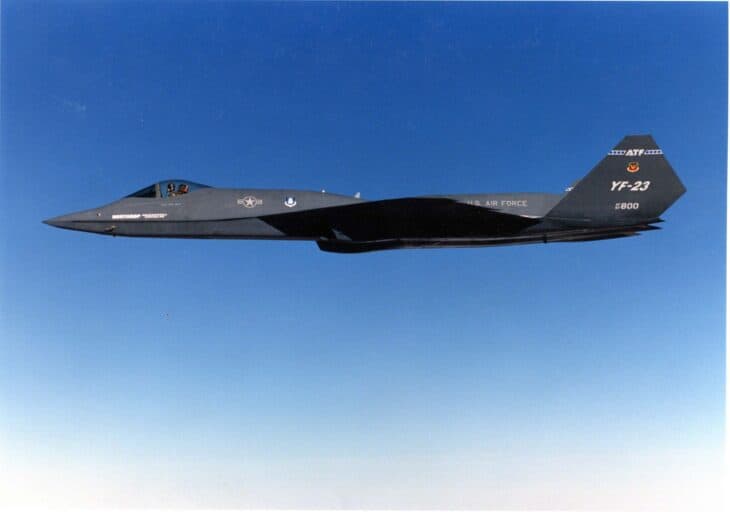
The YF-23 was built around stealth. It has a diamond-shaped wing with edges swept 40 degrees front and back, and two all-moving V-tails angled 50 degrees from vertical.
Its engine inlets are S-shaped ducts that hide the compressor faces from radar. Its exhaust runs along troughs on top of the rear fuselage, which shield the heat from sensors below.

The F-22 uses more conventional shaping, with twin canted vertical tails and horizontal stabilizers. It is stealthy by any normal measure, but the YF-23 was judged ahead of it on this one.
Edge: YF-23, as judged in the 1991 evaluation.
Speed and supercruise
Both jets could cruise faster than sound without afterburners, a trait called supercruise. The YF-23 PAV-1 reached Mach 1.43 on 18 September 1990. PAV-2 passed Mach 1.6 on 29 November 1990, and topped out at Mach 1.72 in supercruise.
The YF-22 reached Mach 1.58 in supercruise. The production F-22 cruises at about Mach 1.5 at 50,000 ft (15,200 m).
So the prototype YF-23 had a small edge in the tests. The production F-22 has since been flown by real squadrons for years, which no YF-23 ever was.
Edge: YF-23 in the prototype tests, F-22 as a fielded aircraft.
Agility and thrust vectoring
This is where the YF-22 won ground. The production F-22 has rectangular 2D nozzles that swivel 20 degrees up or down, which lets it point its nose faster than a conventional jet.
The YF-23 had no thrust vectoring. Its tests reached a maximum angle of attack of 25 degrees, and its designers traded maneuverability for stealth and speed.
That choice is the heart of the old debate. The YF-23 was closer to a long-range interceptor, and the F-22 was the better dogfighter.

Edge: F-22, for thrust vectoring and agility.
Engines: two choices, one winner
The ATF contest was also an engine contest. Each team flew prototypes with a choice of two engines, the Pratt & Whitney YF119 and the General Electric YF120.
Northrop flew one of each: PAV-1 used the YF119 and PAV-2 used the YF120. Lockheed did the same with its two YF-22s.
The Air Force chose the Pratt & Whitney engine, and the production F-22 flies on its descendant, the F119. The General Electric YF120 did not go into production.
Edge: even, since the YF-23 flew with both engines and the F-22 uses the one that won.
What happened to each program
The F-22 went on to 195 airframes, including 8 test aircraft. It entered service in December 2005 and made its combat debut in Syria in 2014.
Congress has banned F-22 exports in annual appropriations acts since fiscal 1998, so no foreign air force has one. Production ended in 2011 after a program cost of about $67.3 billion.
The YF-23 never entered service. A Navy version, the NATF-23, was proposed as an F-14 replacement in December 1990, but the Navy dropped its program by fiscal 1992 over cost.
Northrop Grumman later pitched an FB-23 bomber in 2004, which ended with the 2006 Quadrennial Defense Review. It also answered Japan’s 2018 fighter solicitation, and Japan did not proceed.
Edge: F-22, since it is the one that flew in combat.
Where you can see a YF-23 today
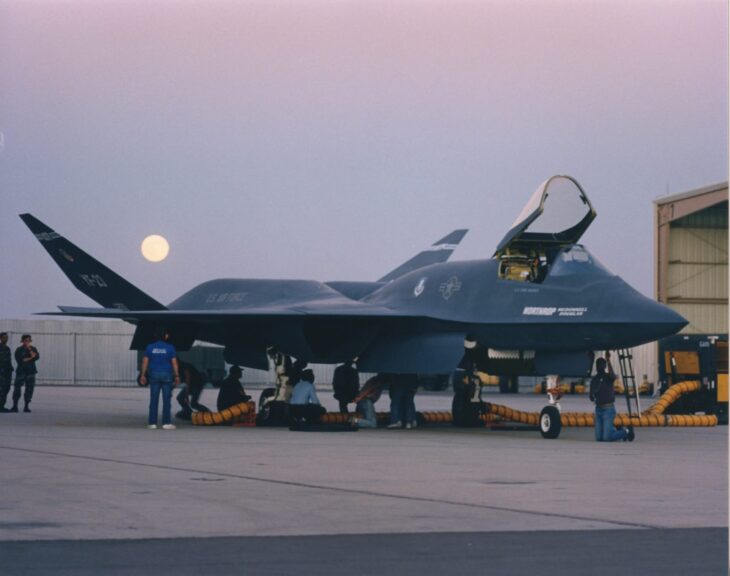
Both prototypes survive. PAV-1, the Gray Ghost, is in the Research and Development hangar of the National Museum of the U.S. Air Force near Dayton, Ohio.
PAV-2, the Spider, is at the Western Museum of Flight in Torrance, California.

Could the YF-23 have been better?
Fans have argued this for three decades. The YF-23 was stealthier and faster, but it was also unproven in the air for far fewer hours, and it had no thrust vectoring.
No one can say how a production YF-23 would have performed, because none was built. The record shows only what the two prototypes did in 1990, and what the Air Force decided in 1991.
Who wins: F-22 or YF-23?
The F-22 wins as an aircraft, because it is a finished fighter with radar, weapons and years of service. The YF-23 never had the chance to be one.
As a design, it is a closer call. The YF-23 was stealthier and faster, and the F-22 was more agile. The Air Force bet on agility and a lower-risk program, and the Raptor is the result.
FAQ
Sources and references used for research and fact-checking.
About the Author

Tim is the owner and lead editor of AeroCorner since 2019, overseeing aviation content covering aircraft, airlines, airports, and the broader aviation industry. Through years of researching, writing, editing, and publishing aviation-focused content, he has developed extensive practical knowledge of commercial aviation and air travel. Based in Asia and a frequent traveler himself, Tim also brings firsthand passenger experience to AeroCorner’s coverage. Outside of publishing, he has also explored aviation firsthand through hands-on flight training in New Zealand.