Fighter Jets
Boeing EA 18G Growler
ICAO: F18S
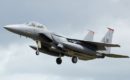
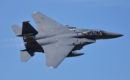
The newest F-15, built around a 12-missile load and a fly-by-wire Advanced Eagle airframe.
Updated: by Tim de Vries
The latest aviation news and stories sent to your inbox.
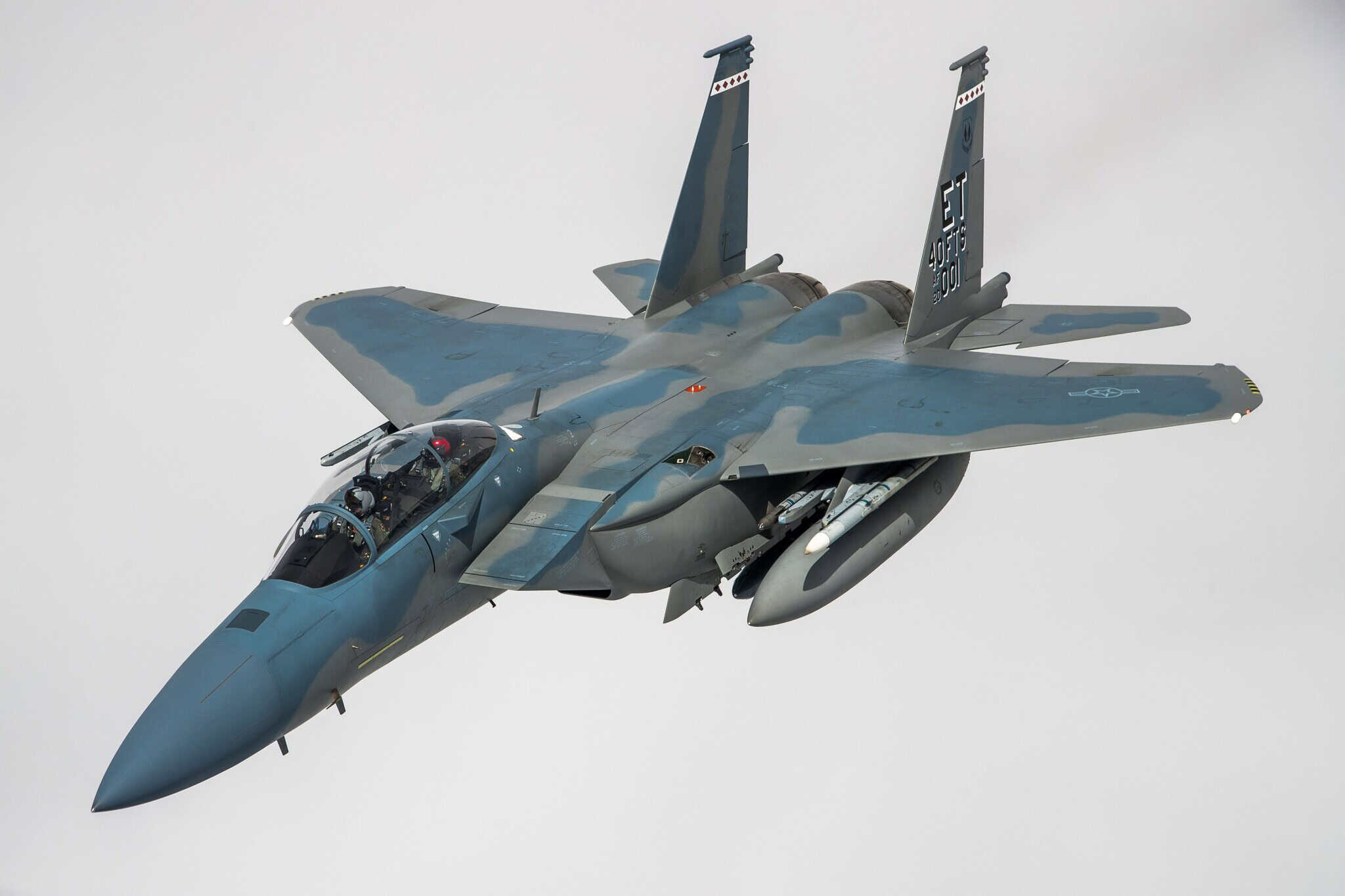
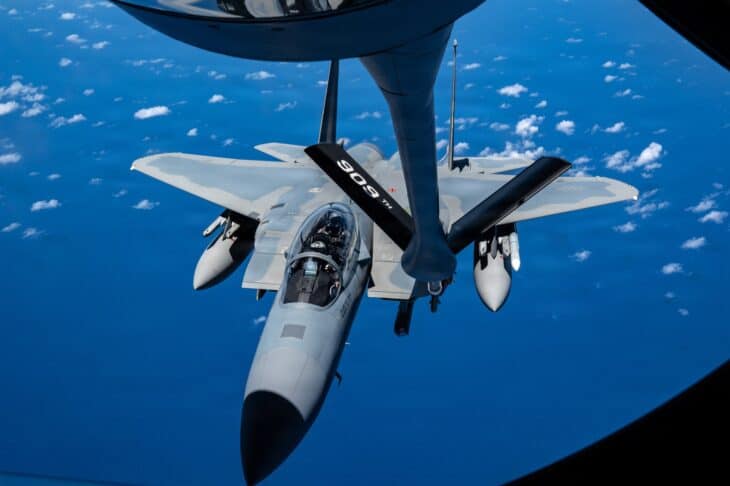
The Boeing F-15EX Eagle II is the newest F-15, a two-seat multirole fighter built on the Advanced Eagle airframe with digital fly-by-wire controls, an all-glass cockpit, an AESA radar and the EPAWSS electronic warfare suite. It can carry 12 air-to-air missiles or outsized standoff weapons, working alongside the F-22 and F-35 rather than replacing them. The U.S. Air Force now plans to buy 267 of them.
Live Fleet Activity (F15)
Fetching live data…


The F-15EX Eagle II is the newest version of the F-15, a two-seat multirole fighter built by Boeing in St. Louis for the U.S. Air Force. It looks almost identical to the Eagles that have flown since the 1970s, but underneath it has a strengthened structure, digital fly-by-wire controls, an all-glass cockpit, and modern radar and electronic warfare systems.
Its defining trait is weapons capacity. Boeing says the F-15EX carries more payload than any other fighter, including up to 12 AMRAAM air-to-air missiles, and it can carry outsized standoff and hypersonic weapons.
The first F-15EX flew on 2 February 2021, the Air Force named it Eagle II that April, and the type reached initial operational capability in July 2024. In April 2026 the Air Force more than doubled its planned fleet, to 267 aircraft.
The Air Force originally planned to replace its air superiority F-15C and F-15D Eagles with the F-22 Raptor. The Raptor buy was cut from a planned 381 production jets to just 187 in 2009, which left the old Eagles flying far longer than intended.
By the mid-2010s structural fatigue meant the F-15C/D fleet could not be kept going into the 2030s, and the F-35 was running late. Restarting F-22 production was judged too expensive, because the production line and its parts suppliers would both have to be rebuilt.
Boeing’s F-15 line, by contrast, was still open and building advanced Eagles for Saudi Arabia and Qatar. In 2018 Pentagon cost studies concluded that a mix of fourth- and fifth-generation fighters was the more affordable way to rebuild the fleet, and the Air Force and Boeing began talking about an “F-15X.”
Single-seat and two-seat versions were proposed as the F-15CX and F-15EX. The Air Force chose only the two-seater, because only two-seat F-15s were still in production, and eight jets appeared in the fiscal 2020 budget request.
In July 2020 the Air Force awarded Boeing a 1.2 billion dollar contract for the first eight aircraft. Testing moved quickly because the fly-by-wire system and cockpit displays had already been proven on the Saudi and Qatari jets, with those countries paying for the work.
The F-15EX is one member of a family Boeing calls the F-15 Advanced Eagle, a substantial update of the F-15E Strike Eagle. The first was the F-15SA for the Royal Saudi Air Force, which first flew on 20 February 2013. Saudi Arabia bought 84 of them.
The F-15SA introduced the digital fly-by-wire system, General Electric F110-GE-129 engines, a digital electronic warfare suite, and a revised wing structure. Fly-by-wire also cured flutter problems that had kept two wing weapon stations switched off on earlier F-15s, so the Advanced Eagle gets them back.
The F-15QA for Qatar followed, ordered in June 2017 in a 12 billion dollar deal for 36 jets that included weapons, support, and training. The QA added a new cockpit with a large area display for both crew members, a new mission computer, and a wing structure rated for 20,000 flight hours.
The F-15EX is essentially the Qatari jet adapted for the Air Force. It swaps in American-specific systems, most importantly the BAE Systems EPAWSS electronic warfare suite, and drops the missile-approach warning sensors the export jets carry.
A fourth version, the F-15IA for Israel, is based directly on the F-15EX. The F-15IDN for Indonesia was proposed but never ordered.
Before the Advanced Eagle, Boeing tried a more radical idea. On 17 March 2009 it unveiled the F-15SE Silent Eagle, a version of the F-15E reworked to be harder to see on radar, pitched at international customers who could not buy the F-22 or wanted something cheaper than the F-35.
The Silent Eagle’s key feature was a pair of conformal weapons bays that replaced the usual conformal fuel tanks along the fuselage sides. Inside them the jet could carry AIM-120 and AIM-9 missiles or JDAM and Small Diameter Bomb guided weapons, so it could fly without radar-reflecting weapons hanging underneath.
The design also canted the twin vertical tails 15 degrees outward and used radar-absorbent coatings. Boeing specified a Raytheon AESA radar and the BAE Systems Digital Electronic Warfare System.
Boeing flew a single demonstrator, the jet designated F-15E1. On 8 July 2010 it made an 80-minute flight from Lambert St. Louis International Airport and opened and closed its left-side weapons bay, which held an instrumented AMRAAM test missile.
On 14 July 2010, flying from Naval Air Weapons Station Point Mugu in California, F-15E1 launched an inert AIM-120 AMRAAM from the same bay. The test showed a missile could leave the bay in flight without harming the aircraft.
The Silent Eagle’s big chance was South Korea’s FX-III competition for 60 fighters. On 24 September 2013 South Korea’s Defense Acquisition Program Administration rejected the F-15SE after weighing the security situation, the combat environment, and the jets’ capabilities and prices, and restarted the program. South Korea went on to choose the F-35A.
No customer ever ordered the Silent Eagle, and only the one demonstrator flew. It is often described as a stealth F-15, but it remained a fourth-generation fighter with signature-reduction features rather than a true fifth-generation stealth design.
The program still mattered. Boeing redirected its F-15 effort to the less ambitious Advanced Eagle, and the large area display cockpit designed for the Silent Eagle ended up in the F-15QA and then the F-15EX.
The biggest change is in the flight controls. The digital fly-by-wire system lets the pilot maneuver hard with no angle-of-attack limits, and it makes the jet much more resistant to departing controlled flight and more tolerant of lopsided weapon loads.
The F-15EX is heavier than earlier F-15s because of its strengthened structure. Fly-by-wire and the wider thrust envelope of the F110-GE-129 engines still give it noticeably better handling than the legacy Eagles it replaces.
The radar is the Raytheon AN/APG-82(V)1 active electronically scanned array, which combines the APG-63(V)3 antenna with the processor from the Super Hornet’s APG-79. It works alongside the AN/ALQ-250 EPAWSS, a digital suite that warns of radar threats from every direction, locates them, and jams them.
For passive detection the jet can carry Lockheed Martin’s Legion Pod with an IRST21 infrared search and track sensor, which can pick up aircraft without transmitting a radar signal. Both crew members get large area displays and a helmet-mounted cueing system for aiming missiles well off the nose.
Engines are another break from the air superiority Eagle. The F-15C flies on Pratt and Whitney F100 engines, while the F-15EX uses the General Electric F110-GE-129, rated at 29,500 pounds of thrust each with afterburner.
The airframe is also built to last. Boeing rates the F-15EX for more than 20,000 flight hours, and its open systems architecture is designed so new software, sensors, and weapons can be added quickly.
In a typical air superiority load the F-15EX carries 12 air-to-air missiles, any mix of AIM-120 AMRAAMs and AIM-9 Sidewinders. Boeing describes the jet as optimized for massive payloads and missions where volume of fire matters.
For precision strike, one published configuration pairs 16 GBU-39 Small Diameter Bombs with four AMRAAMs, a 2,000-pound JDAM, two anti-radiation missiles, and two drop tanks. The stores system can carry every weapon the F-15E can.
The F-15EX can also carry multiple large standoff weapons such as the AGM-158 JASSM cruise missile, and outsized weapons like the AGM-183 ARRW hypersonic missile, adding firepower behind the frontline F-22 and F-35.
A 20 mm M61A1 Vulcan cannon with 500 rounds sits in the right wing root, the same position as on earlier Eagles.
The full specification table for the F-15EX is on this page. A few of its figures need context, because the numbers quoted for this jet vary depending on how it is configured.
The top speed of 1,434 knots is Mach 2.5 at high altitude, about 1,650 mph (2,655 km/h), without conformal fuel tanks. With conformal tanks fitted the limit falls to about Mach 2.0. Low down, the jet is limited to around Mach 1.2.
The 2,100 nautical mile (about 2,420 miles) range is a ferry figure, flown with conformal tanks and three external tanks. The combat radius published in the same specification is 687 nautical miles, and Air and Space Forces Magazine quotes a range of about 2,762 miles (about 2,400 nautical miles) without stating the configuration.
That matters because the first operational Air Force F-15EXs are not fitted with conformal fuel tanks. The ferry number describes what the airframe can do, not how the Air Force’s early jets are flown day to day.
The payload figure is Boeing’s total capacity across all weapon stations, including the two extra wing stations that fly-by-wire made usable. It describes what the jet can lift, not what it carries on a typical sortie.
The planned fleet size has moved repeatedly. After the fiscal 2021 budget brought orders to 20 aircraft, the Air Force planned 144 jets, then cut the plan to 80 in 2022.
The fiscal 2024 budget raised it to 104, and the fiscal 2026 budget to 129. In April 2026, with its fiscal 2027 budget request, the Air Force more than doubled the program to 267 aircraft and asked for 24 jets that year.
About 25 F-15EXs were in the Air Force inventory at that point, with contracts in place for more than 100. The original goal was to replace the F-15C and F-15D, but the Air Force now says the larger buy will also begin to replace the F-15E Strike Eagle, part of an aging Air Force fleet.
The first F-15EX was delivered to Eglin Air Force Base in Florida in March 2021, where test squadrons still fly it. Oregon’s 142nd Wing at Portland Air National Guard Base received the first operational jet in June 2024, and initial operational capability followed in July 2024.
Air National Guard units in Fresno, California, and New Orleans, Louisiana, are due to convert from the F-15C/D to the F-15EX next.
The first overseas base will be Kadena Air Base in Okinawa, Japan, which is replacing its legacy Eagles with 36 F-15EXs. The first Kadena-bound jet left Boeing’s St. Louis plant on 28 August 2026 and, as of early September 2026, was staging at Portland before the Pacific crossing.
Permanent basing at Kadena is due to begin in fiscal 2027, with the 67th Fighter Squadron as the wing’s first operational F-15EX unit.
In a letter to Senator Ted Budd made public in August 2026, Air Force Secretary Troy Meink confirmed that Seymour Johnson Air Force Base in North Carolina is the planned home for F-15EXs bought in the fiscal 2027 budget, pending funding. Twenty-four of the base’s F-15Es would move to Whiteman Air Force Base, Missouri, to replace A-10s there.
The flyaway cost, which covers the airframe, engines, radar, EPAWSS and the other installed systems, was about 90 million dollars per jet for production Lot 2, 97 million for Lot 3, and 94 million for Lot 4, according to contract figures reported in October 2023.
A Pentagon acquisition report the same month put the average procurement unit cost at 93.95 million dollars in then-year dollars, based on a 104-jet buy.
For how that compares with other front-line jets, see our guide to the most expensive fighter planes.
Israel is the first export customer for an F-15EX-based jet. It announced a buy of 25 F-15IAs in November 2024, and on 29 December 2025 the Pentagon awarded Boeing an 8.58 billion dollar contract that covers the 25 jets with an option for 25 more. Deliveries are expected to begin around 2031.
Other deals have been slower. Egypt was reported in November 2025 to be negotiating for up to 46 F-15EXs, while in early 2026 Boeing said its Indonesian F-15 campaign was no longer active.
An Advanced Eagle has also fought in the air. On 2 March 2026 a Qatari F-15QA shot down two Iranian Su-24 bombers heading for Al Udeid Air Base and Qatar’s Ras Laffan gas facility, the F-15QA’s first air-to-air victories.
The F-15EX is not a stealth fighter, and it is not expected to be as survivable against the latest air defenses as the F-22 and F-35. It is a 4.5-generation design: a fourth-generation airframe with modern sensors and software, as explained in our guide to the five generations of fighter planes.
Its value is in the mix. The F-15EX handles homeland and air base defense, no-fly zones against limited air defenses, and launching outsized standoff weapons in support of the stealth fighters at the front.
That makes it a complement to the F-22 and F-35 rather than a replacement. For the older Eagle in a similar matchup, see our F-22 vs F-15 and F-35 vs F-15 comparisons.
Its closest foreign counterparts are other heavy twin-engine fighters such as Russia’s Su-35 and China’s J-16.
The F-15EX combines the proven F-15 airframe with digital fly-by-wire controls, an all-glass cockpit, an AESA radar, and the EPAWSS electronic warfare suite. Its standout feature is capacity: it can carry 12 air-to-air missiles or very large standoff and hypersonic weapons, and Boeing rates its airframe for more than 20,000 flight hours.
The Air Force plans to buy 267 F-15EXs, a figure set in its fiscal 2027 budget request in April 2026. That more than doubles the previous plan of 129, and the larger buy is meant to replace both the F-15C/D and, over time, the F-15E Strike Eagle.
Not in the F-22’s main job. The F-22 is a stealth air superiority fighter built to survive heavily defended airspace, and the F-15EX is not expected to match it there. The F-15EX’s strengths are weapons capacity and the ability to launch outsized standoff missiles, and the Air Force uses the two as partners rather than rivals.
The F-15EX is the newest F-15 variant, based on the F-15E Strike Eagle rather than the original F-15C. Compared with older Eagles it adds digital fly-by-wire, a large area display cockpit, the APG-82(V)1 radar, EPAWSS electronic warfare, two extra wing weapon stations, General Electric F110-GE-129 engines, and a structure rated for more than 20,000 flight hours.
Contract figures reported in October 2023 put the flyaway cost at between about 90 million and 97 million dollars per jet, depending on the production lot. The Pentagon’s average procurement unit cost at that time was 93.95 million dollars, assuming a 104-jet buy.
Boeing gives the F-15EX a top speed of Mach 2.5, about 1,650 mph (2,655 km/h) at high altitude. With conformal fuel tanks fitted, the limit drops to about Mach 2.0.
The F-15EX uses two General Electric F110-GE-129 afterburning turbofans, each rated at 29,500 pounds of thrust with afterburner. It is the same engine used on Saudi Arabia’s F-15SA and the other Advanced Eagles.
Only as a single demonstrator. Boeing’s F-15E1 test jet flew with a Silent Eagle weapons bay in July 2010 and launched an inert AMRAAM from it, but no air force ordered the F-15SE. South Korea rejected it in 2013, and parts of its design, including the cockpit, carried over into the F-15QA and F-15EX.
No. The F-15EX carries its weapons externally and has no stealth shaping, so it relies on its electronic warfare suite, sensors, and long-range weapons for survivability. It is classed as a 4.5-generation fighter.
Sources and references used for research and fact-checking.