

Table of Contents
The Indonesian Air Force (TNI-AU) flew about 265 aircraft in FlightGlobal’s October 2025 count, and its best fighter is now the Dassault Rafale: six were formally accepted into service on May 18, 2026, the first of 42 on order. Its backbone is still a fleet of 33 F-16s.
Few air forces shop this widely. Indonesia flies American F-16s, Russian Sukhois and French Rafales side by side, has a contract for 48 Turkish KAAN stealth fighters, and its air chief said in October 2026 that Chinese J-10s will arrive in about six months.
This list ranks every combat jet type the TNI-AU flies by one measure: the fighting value it adds as of October 2026, weighing what each aircraft can do against how many Indonesia has. The order book, the deals that collapsed, the helicopters and the support fleet follow.
| Rank | Aircraft | Role | In service | On order |
|---|---|---|---|---|
| 1 | Rafale F4 | Multirole fighter | 6 | 36 |
| 2 | F-16 Fighting Falcon | Multirole fighter | 33 (25 A/C, 8 B/D) | None |
| 3 | Su-27 and Su-30 | Air superiority and strike | 16 (5 Su-27, 11 Su-30) | None |
| 4 | T-50i Golden Eagle | Lead-in trainer and light attack | 19 | None |
| 5 | Hawk 209 | Light fighter | 21 (plus 7 Hawk 109 trainers) | 12 M-346F to replace it |
| 6 | EMB-314 Super Tucano | Light attack | 13 | None |
How this ranking works
Each type is ranked by its fighting value in October 2026: its sensors, weapons and age, weighed against how many the TNI-AU flies. Counts start from FlightGlobal’s World Air Forces 2026 directory, which lists aircraft in day-to-day use as of October 2025, and are updated for jets delivered since. Two-seat trainer versions of each fighter are counted with it. Army and navy aircraft are left out.
1. Dassault Rafale F4: Six Jets In, 36 Still to Come
,_2026.jpg)
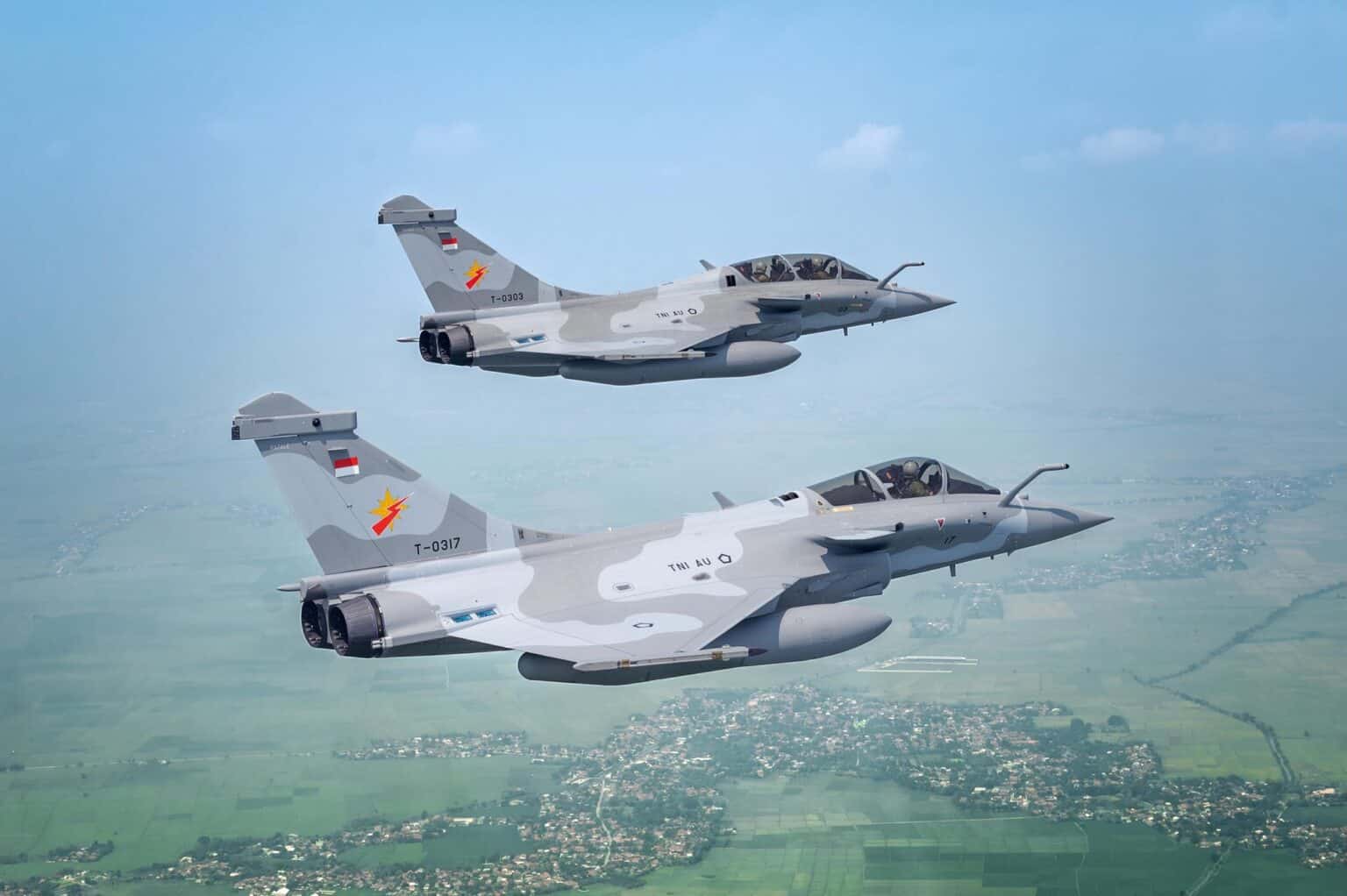
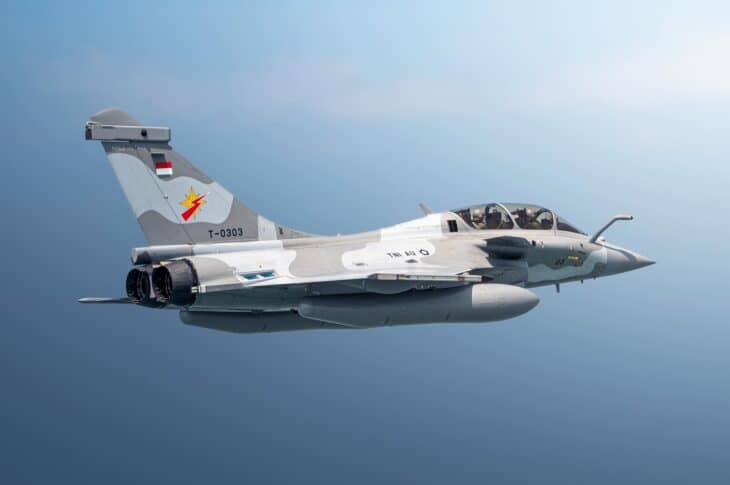
Indonesia signed for 42 Dassault Rafale F4 fighters on February 10, 2022: 26 single-seat and 16 two-seat jets. The contract came into force in three tranches, six in September 2022, 18 on August 10, 2023, and the last 18 on January 8, 2024.
The first three, all two-seaters, were handed over at Dassault’s Bordeaux plant on November 28, 2025, and landed at Roesmin Nurjadin Air Base in Pekanbaru, Sumatra, on January 23, 2026. Three more followed in May.
All six were formally commissioned at Halim Perdanakusuma Air Base in Jakarta on May 18, 2026, in front of President Prabowo Subianto. They fly with Air Squadron 12, and Asian Military Review reports they came with MBDA Meteor long-range air-to-air missiles and AASM Hammer guided bombs.
Six jets is a small force today. The Rafale still ranks first: it is the newest fighter Indonesia flies, it came with Meteor missiles, and 36 more are coming. A May 2025 letter of intent with France covers more, and Defense News reports officials are weighing 24 extra.
Indonesia sent four combat pilots and 12 technicians to France for Rafale training in August 2025, learning the jet that now anchors the French Air Force.
2. F-16 Fighting Falcon: The Backbone, Built From Two Batches
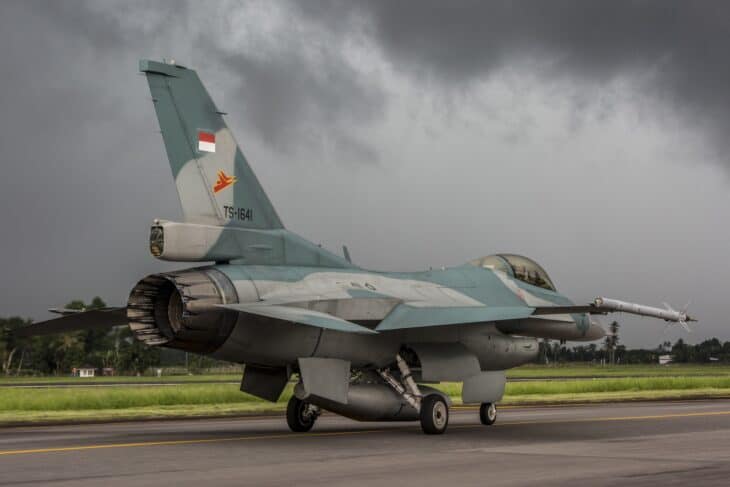

FlightGlobal counts 33 F-16 Fighting Falcons in Indonesian service: 25 single-seat F-16A and F-16C jets and eight two-seat F-16B and F-16D trainers. By numbers alone, it is the most important fighter Indonesia has.
The fleet came in two very different batches. Indonesia ordered 12 new F-16A/B Block 15 OCU jets in 1989, after a contest with the Mirage 2000, and the 10 that remain have been rebuilt under the Falcon STAR eMLU upgrade, done in Indonesia under Lockheed Martin supervision.
The rest are second-hand. During Barack Obama’s visit in November 2010, the US offered 24 ex-USAF F-16 Block 25s as a grant, approved in October 2011, and the jets were upgraded close to the later Block 50/52 standard.
A 2019 plan for at least 32 brand-new F-16V Block 70/72s was overtaken by the Rafale. The F-16 ranks second because the oldest jets were ordered in 1989 and no new F-16s are on order.
3. Su-27 and Su-30: The Russian Flankers Born of an Embargo
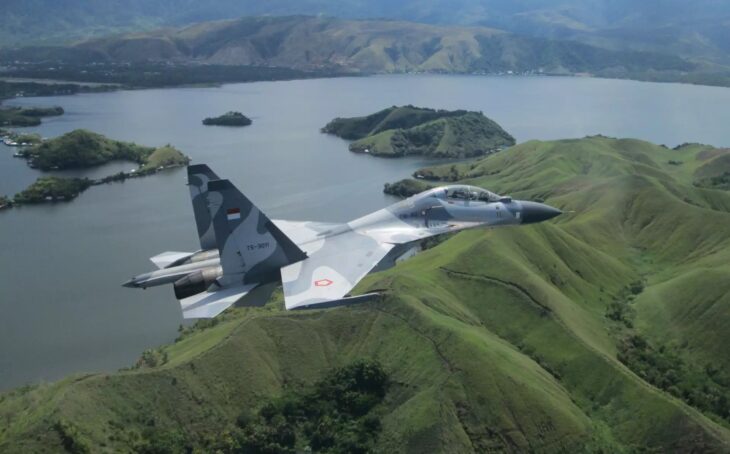

Indonesia’s 16 Sukhois exist because of a US arms embargo. After the 1999 East Timor crisis, Washington cut off arms sales until November 2005, grounding much of the American-built fleet, and Jakarta turned to Russia for fighters, missiles and radars.
The first two Su-27SK and two Su-30MK jets were bought in 2003. Three Su-27SKMs and three Su-30MK2s followed in a second batch, and a $470 million contract for six more Su-30MK2s was signed on December 29, 2011.
That makes five Su-27s and 11 Su-30s, flown by Air Squadron 11. From 2008 they gave the TNI-AU its first R-73 and R-77 air-to-air missiles, plus Kh-29, Kh-31 and Kh-59 air-to-ground missiles.
The Su-35 deal that died
In 2017, Indonesia’s defense minister confirmed a plan to buy Sukhoi Su-35s, and in July 2020 Russia’s ambassador still described a plan for 11. Bloomberg reported in March 2020 that US pressure had killed it, and on December 22, 2021, Air Chief Marshal Fadjar Prasetyo confirmed the purchase would not go ahead. The Rafale order came seven weeks later.
They are big, long-legged jets, but 16 airframes of three sub-types make a small, expensive fleet to support. No new Russian fighter is coming to join them.
4. T-50i Golden Eagle: The Supersonic Trainer With Teeth
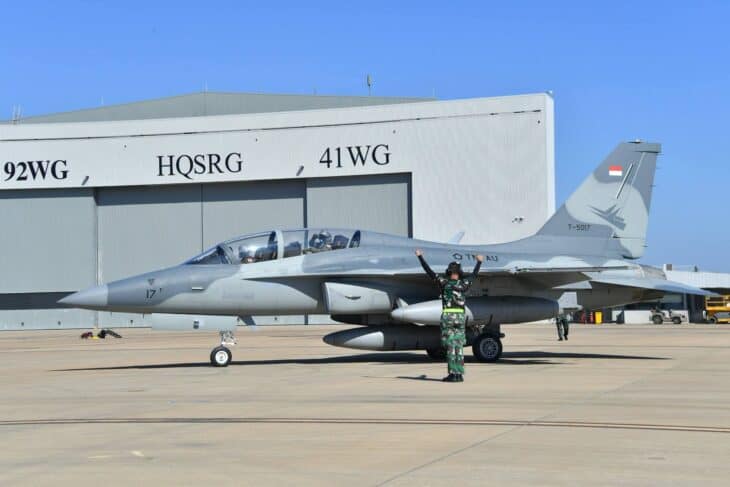

Indonesia was the first foreign buyer of the KAI T-50 Golden Eagle, South Korea’s first homegrown supersonic jet trainer. It ordered 16 in April 2011 for up to $400 million, and all were delivered by January 2014 to replace old Hawk Mk 53 trainers.
The first batch was upgraded with combat capability in 2018, and three were lost in accidents. Six more, under a 2021 contract, were delivered between February and July 2026, bringing KAI’s deliveries to 22.
That leaves about 19 in service, used for advanced training, light attack and aerobatic displays. It ranks above the Hawk because it is faster, newer and still growing.
5. Hawk 209: The 1990s Light Fighter on Its Way Out
.jpg)
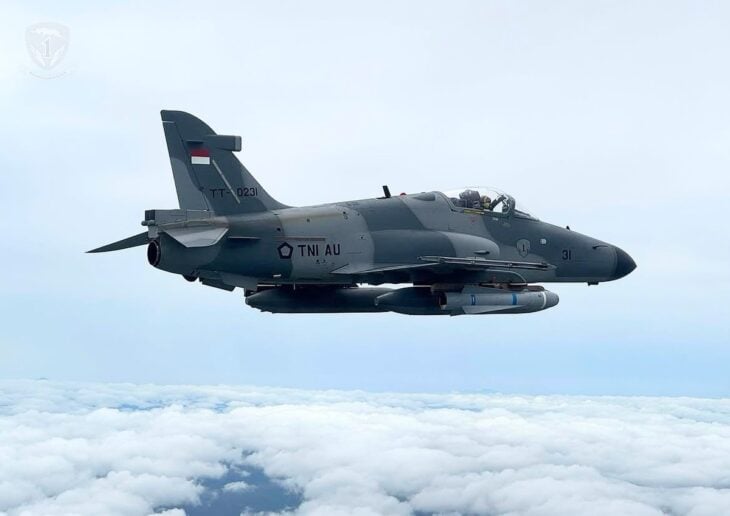
Indonesia ordered eight two-seat Hawk Mk 109 trainers and 32 single-seat BAE Hawk Mk 209 light fighters in 1993, and the last arrived by January 1997. FlightGlobal counts 21 Hawk 209s and seven Hawk 109s still flying.
Hawks against Australia, 1999
As Indonesian forces withdrew from East Timor in September 1999, the TNI-AU sent a flight of Hawk 109s and 209s to El Tari Airport in Kupang, West Timor, to cover the pullout. Twice that month, the Hawks were scrambled to intercept Australian military aircraft that had entered Indonesian airspace.
Their replacement is signed. Leonardo and Indonesia’s defense ministry agreed a contract for 12 M-346F Block 20 light fighters at Farnborough on July 21, 2026, with an AESA radar and a Link 16 datalink. Deliveries are expected to start in 2030.
6. EMB-314 Super Tucano: The Turboprop for Counterinsurgency
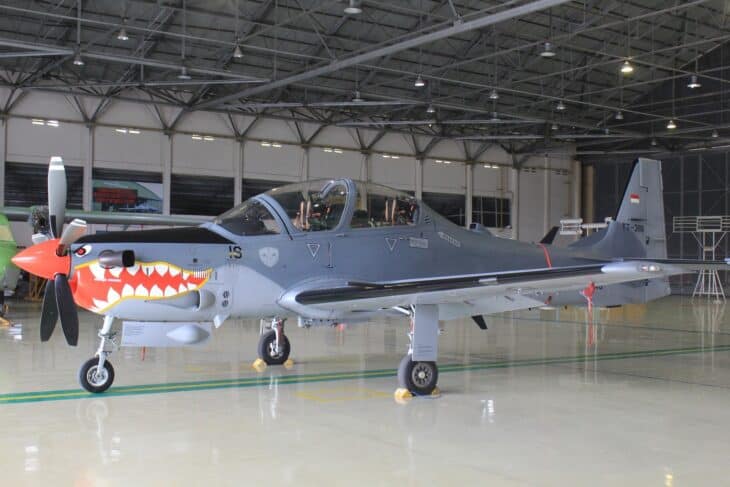

The Embraer Super Tucano replaced Indonesia’s OV-10 Broncos in the counterinsurgency role. A contract for eight was signed in June 2011 and a second for eight more in July 2012; the first four arrived in March 2012 and the last by 2014.
FlightGlobal counts 13 still in service. On November 16, 2023, two crashed during a routine training flight in Pasuruan, East Java, killing all four officers aboard, among them Lieutenant Colonel Sandhra Gunawan, commander of Air Squadron 21.
It ranks last as a fighter because it is not one. Over Indonesia’s jungles and islands, though, a slow turboprop with guns and bombs is often the right tool.
On Order: J-10, KAAN, KF-21 and M-346F
Indonesia’s order book is bigger than its fighter fleet. Four programs decide what the TNI-AU flies in the 2030s, and only some of them are firm.
Chengdu J-10CE: Coming, Number Unknown
Asked when the Chinese jets would arrive, Air Force Chief of Staff Air Marshal Mohamad Tonny Harjono told Republika on October 5, 2026: “Just wait.” The wait should be about six months, which points to the first Chengdu J-10CE fighters landing around April 2027.
The size of the order has never been published. The South China Morning Post and Firstpost reported 42 jets, and in June 2026 journalist Alan Warnes reported that the plan had doubled from 12 to 24, with PL-15E long-range missiles. Neither figure has been officially confirmed.
If it goes ahead, Indonesia would join Pakistan and Uzbekistan as a J-10CE operator, and would be a rare air force flying front-line fighters from the US, Russia, France and China at once.
TAI KAAN: 48 Stealth Fighters, From 2032
Indonesia signed a contract for 48 KAAN fifth-generation fighters with Turkish Aerospace at the IDEF 2025 show in Istanbul in July 2025. The contract includes local manufacturing and training support.
Defense News reports a value of about $10 billion, an overseas loan scheme signed in April 2026, and first deliveries in 2032. The KAAN has not yet entered service with the Turkish Air Force itself, so that date depends on Turkey’s own program.
KAI KF-21: A Partner Without a Purchase
Indonesia joined South Korea’s KF-21 Boramae program in 2010, agreeing to pay 20% of development in return for jets and technology for its state aircraft maker PTDI to build 48 in Bandung. Payments fell behind for years.
In late June 2026, Defense Logistics Agency head Yusuf Jauhan said domestic production “will not materialize.” Indonesia’s share was cut in exchange for a single prototype, and Jakarta is now discussing ready-built jets instead. The jet’s launch customer is the South Korean Air Force.
Leonardo M-346F: The Hawk Replacement
The M-346F deal moved fastest. A letter of intent was signed at the Singapore Airshow in February 2026, the 12-jet contract followed at Farnborough that July, and Indonesia becomes the 23rd user of the M-346.
The Deals That Fell Through: F-15EX, Su-35 and Mirage 2000
For every jet Indonesia ordered, another stalled. On August 21, 2023, it signed a memorandum of understanding for 24 Boeing F-15EX Eagle IIs, a year after the US approved a possible sale of up to 36.
It never became a contract. At the Singapore Airshow on February 3, 2026, Boeing’s Bernd Peters said: “it is no longer an active campaign for us.” The next day Indonesia signed a letter of intent for the M-346F instead.
The Sukhoi Su-35 died in 2021 (see above). A plan to buy 12 second-hand Mirage 2000-5s from Qatar, funded by loans approved in November 2022, was postponed in January 2024 over budget limits and cancelled on February 9, 2024.
Does Indonesia fly the F-15EX? No.
Indonesia was hailed in 2023 as the first export customer for the F-15EX, after its agreement for 24 jets. That agreement was never turned into a binding contract, and Boeing ended the campaign in February 2026. Indonesia does not fly the F-35 either.
Indonesian Air Force Helicopters
The TNI-AU’s helicopters are transport and rescue machines, not gunships: Indonesia’s AH-64E Apaches belong to the army. Most of the air force’s fleet was assembled locally by PTDI from Airbus designs.
| Helicopter | Role | In service | On order |
|---|---|---|---|
| H225M Caracal | Combat search and rescue, VIP | 14 | None |
| H215M / AS332 Super Puma | Transport, VIP | 12 | None |
| SA330 Puma | Transport | 9 | None |
| H145 | Utility | 4 | None |
| AW139 and BO105 | Search and rescue | 2 | None |
| AW189 | Transport, VIP | None | 6 (letter of intent) |
| H120 | Training | 10 | None |
For the army and navy side of the picture, see our guide to types of military helicopters.
The Support Fleet: Transports, Tankers, Trainers and Drones
An air force spread across thousands of islands lives on airlift. Indonesia’s transport fleet across all three services is the 10th largest in the world, with 72 aircraft in FlightGlobal’s count.
| Aircraft | Role | In service | On order |
|---|---|---|---|
| A400M MRTT | Tanker transport | 2 | 4 (letter of intent) |
| C-130B/H and L-100 Hercules | Tactical transport | 20 | None |
| C-130J-30 Super Hercules | Tactical transport | 5 | None |
| KC-130B Hercules | Tanker | 1 | None |
| C295 and CN235 | Transport | 12 | None |
| C-212 and NC212i | Light transport | 14 | None |
| Boeing 737 | Transport and maritime patrol | 6 | None |
| Falcon 8X | VIP transport and surveillance | 4 | None |
| Grob G120TP | Basic trainer | 30 | None |
| KT-1B Woongbi | Basic trainer | 16 | None |
The two Airbus A400M tanker transports were ordered in November 2021 and arrived in November 2025 and March 2026. They give the Rafales a modern tanker, alongside a single KC-130B.
Training starts on the Grob G120TP and the KAI KT-1 Woongbi before pilots move to the T-50i or the Hawk. FlightGlobal lists no airborne early warning aircraft in Indonesian service, so ground radars, like the Thales GM403 accepted in May 2026, do that job.
Drones are the newest arm. Indonesia bought 12 Turkish Anka drones for $300 million under a contract signed on February 3, 2023, shared between the air force, army and navy.
A Short History: From Tu-16 Bombers to Rafales
Indonesia’s air force has swung between suppliers more often than almost any other. Each swing was driven by politics, and each left a different fleet behind.
April 9, 1946
The air force is founded. It starts with Japanese aircraft left behind after World War II.
1962
A Soviet-built strike force. For the campaign against Dutch New Guinea, 26 Tu-16 bombers are based at Iswahyudi, and MiG-17s and MiG-21s join the fleet.
1965
The break with Moscow. After the failed 30 September Movement coup, Suharto’s government cuts ties with the Eastern bloc and the Soviet fleet withers.
Early 1980s
Operation Alpha. Indonesia secretly acquires 32 ex-Israeli A-4 Skyhawks, its personnel sent in secret by different routes.
1989
The first F-16s. Indonesia orders 12 F-16A/B Block 15 OCU jets.
1999 to 2005
The US embargo. After East Timor, Washington cuts off arms sales until November 2005, and Indonesia buys its first Sukhois in 2003.
February 2022
The Rafale order. Indonesia signs for 42 Rafale F4s.
May 18, 2026
Rafales commissioned. Six Rafales, an A400M and four Falcon 8Xs are accepted at Halim Perdanakusuma.
How Indonesia Compares
The obvious comparison is the neighbor to the south. The Royal Australian Air Force flies 71 F-35As and 24 F/A-18F Super Hornets, backed by six E-7A Wedgetail early warning jets and six KC-30A tankers, in FlightGlobal’s count.
Indonesia’s front line is 55 fighters (33 F-16s, 16 Sukhois and six Rafales), with no early warning jets and three tankers. In the air, Australia is clearly stronger today.
What Indonesia has is a big order book. If the remaining 36 Rafales, 48 KAANs and the J-10s all arrive, its fighter force would be roughly three times its current size. For the global picture, see our ranking of the largest air forces in the world.
FAQ
Sources and references used for research and fact-checking.
- FlightGlobal, World Air Forces 2026 directory (PDF)
- Asian Military Review, Indonesian Air Force commissions potpourri of new equipment
- AeroTime, Indonesia receives first three Rafale jets
- Wikipedia, Dassault Rafale
- Wikipedia, Indonesian Air Force
- Wikipedia, List of equipment of the Indonesian Air Force
- MiGFlug, Indonesia's J-10CE Fighters Due in Six Months, Air Chief Says
- Defence Security Asia, Indonesia doubles J-10CE fighter order to 24, arms jets with PL-15E missiles
- Defense News, Indonesia drops KF-21 co-production plans, eying stock warplanes instead
- Turkish Aerospace, Turkish Aerospace and Indonesia sign official contract for the sale of 48 KAAN
- Leonardo, Leonardo, PT Esystem Solutions and the Ministry of Defence of Indonesia sign M-346 F aircraft procurement contract
- The Aviationist, Indonesia abandons F-15EX, selects M-346F to replace Hawk
- The Korea Times, KAI completes delivery of 6 T-50i trainer jets to Indonesia
- Indonesian National Police, Bodies of four Air Force officers recovered in Super Tucano plane crash
- Tempo, Indonesian Air Force retrieves flight recorders of 2 crashed Super Tucano aircraft
- Defense News, Indonesia buys 12 Anka drones from Turkey's TAI
Get the Newsletter
The latest aviation news and stories sent to your inbox.
About the Author

Tim is the owner and lead editor of AeroCorner since 2019, overseeing aviation content covering aircraft, airlines, airports, and the broader aviation industry. Through years of researching, writing, editing, and publishing aviation-focused content, he has developed extensive practical knowledge of commercial aviation and air travel. Based in Asia and a frequent traveler himself, Tim also brings firsthand passenger experience to AeroCorner’s coverage. Outside of publishing, he has also explored aviation firsthand through hands-on flight training in New Zealand.