

Table of Contents
Air Force One and Air Force Two are not airplanes. They are radio call signs: Air Force One is any U.S. Air Force aircraft with the president aboard, and Air Force Two is any Air Force aircraft carrying the vice president but not the president.
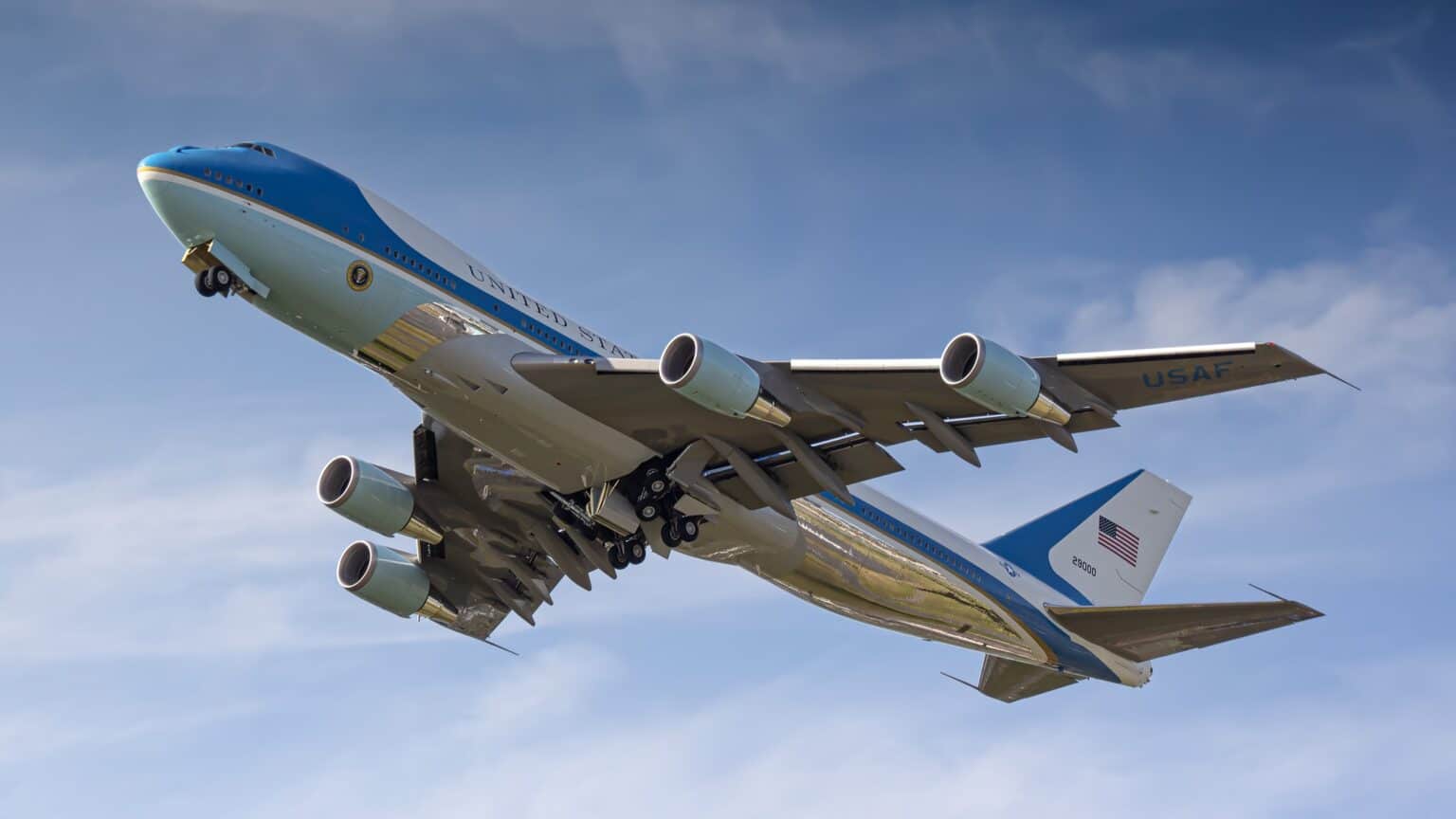
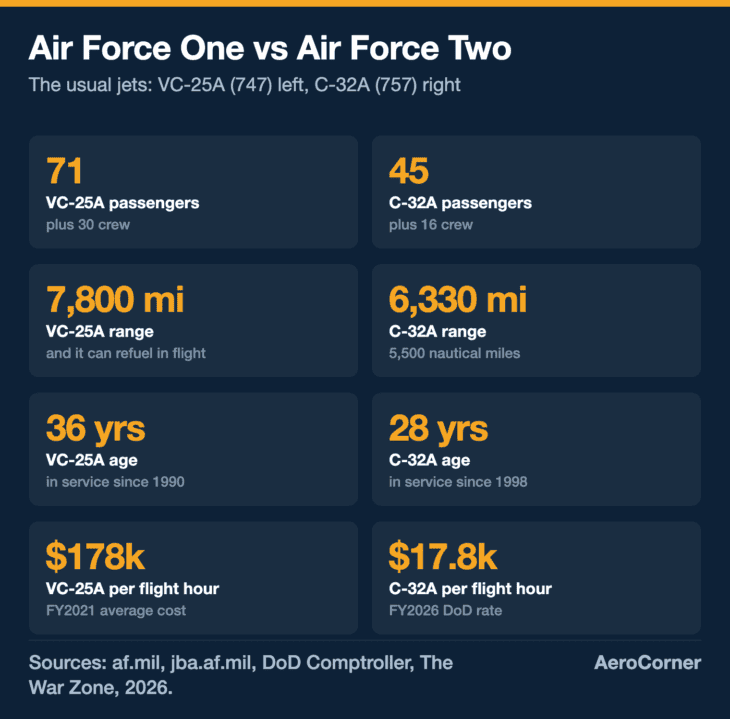
In practice the difference is the jet behind the name. The president usually flies a 747-based VC-25, and the vice president usually flies the C-32A, a modified Boeing 757 that carries 26 fewer passengers, flies about 1,470 miles (2,370 km) less without refueling and costs roughly a tenth as much per hour.
Below, the two are compared on the figures the Air Force, the FAA and the White House publish, as of October 2026: the call sign rule, the aircraft, size and range, the cabins, protection, cost and what replaces each fleet. For the jet itself, see our VC-25A Air Force One aircraft page.
| Criterion | Air Force One | Air Force Two |
|---|---|---|
| What the name means | Call sign of any U.S. Air Force aircraft with the president aboard | Call sign of any U.S. Air Force aircraft with the vice president aboard, and not the president |
| Usual aircraft | VC-25A, a modified Boeing 747-200B; since July 2026 also the VC-25B Bridge, a modified 747-8 | C-32A, a modified Boeing 757-200 |
| Fleet | 2 VC-25A (tails 28000 and 29000) plus 1 VC-25B Bridge | 4 C-32A on the Air Force fact sheet (The War Zone counts about 8) |
| Passengers and crew | 71 passengers, 30 crew | 45 passengers, 16 crew (varies by mission) |
| Range | 7,800 miles (12,550 km), plus in-flight refueling | 5,500 nautical miles, about 6,330 miles (10,190 km), unrefueled |
| Maximum takeoff weight | 833,000 lb (377,800 kg) | 255,000 lb (115,670 kg) |
| Speed | 630 mph (1,014 km/h) top speed, Mach 0.92 | 537 mph (864 km/h) cruise speed |
| In service | Since Sept. 6, 1990: 36 years | Since June 19, 1998: 28 years |
| Cost per flight hour | $177,843 (FY2021 average cost) | $17,814 to $19,354 (FY2026 DoD reimbursable rate) |
| Who flies it | Presidential Airlift Group, 89th Airlift Wing, Joint Base Andrews | 1st Airlift Squadron, 89th Airlift Wing, Joint Base Andrews |
How we compared
Aircraft figures come from the Air Force fact sheets for the VC-25 and the C-32, the call sign rules from FAA Order JO 7110.65, and the cabin details from the White House, all opened on October 15, 2026. Range: the C-32A is rated at 5,500 nautical miles, which is 5,500 x 1.1508 = about 6,330 statute miles; the VC-25A’s 7,800 miles is about 1,470 miles more. Ages count from the first VC-25A’s first flight as Air Force One (Sept. 6, 1990) and the first C-32A’s delivery (June 19, 1998). Cost: the VC-25A figure is the Air Force’s FY2021 average cost per flight hour, including fuel, consumables and overhaul. The C-32A figure is the FY2026 rate the Pentagon bills when the jet flies on a reimbursable basis, from $17,814 for another DoD user to $19,354 for outside users. They are different measures from different years, so the roughly 10 to 1 gap ($177,843 / $17,814) is an order of magnitude, not an exact ratio. The VC-25A has no published reimbursable rate.
The call sign: what the two names actually mean
The rule is written in the FAA’s controller handbook, Order JO 7110.65. When the president is aboard a military aircraft, controllers state the name of the service followed by the word “One.” When the vice president is aboard a military aircraft, it is the service name followed by “Two.”
So an Air Force jet becomes Air Force One or Air Force Two, a Marine helicopter becomes Marine One or Marine Two, and a civilian aircraft becomes Executive One or Executive Two. The same order adds “Executive One Foxtrot” and “Executive Two Foxtrot” for family members when the Secret Service or White House staff decide it is necessary.
The name exists because of a near mix-up. Controllers over Richmond, Virginia, once heard from both Air Force 8610, carrying President Eisenhower, and Eastern Air Lines Flight 8610, and his pilot, Col. William Draper, pushed for a single call sign for the president’s flight. The Air Force says the call sign was first used in the 1950s.
When neither leader is aboard, the jets fly as ordinary Special Air Mission flights, call sign SAM plus a number. After Richard Nixon resigned in 1974, his pilot asked controllers mid-flight to change the call sign from Air Force One to SAM 27000.
Myth: Air Force One is the president's plane
Air Force One is a call sign, not an aircraft. Without the president aboard, the VC-25As fly under Special Air Mission call signs such as SAM 28000, and a 757 that normally carries the vice president becomes Air Force One the moment the president boards. Even the rule bends for security: on Joe Biden’s February 2023 trip to Ukraine, the C-32 he flew to Poland used the call sign SAM060 instead.
The takeaway: the passenger decides the name, not the aircraft.
The aircraft: a 747 and a 757
The jet the world calls Air Force One is the VC-25A, one of two specially configured Boeing 747-200Bs with tail numbers 28000 and 29000. Each has four General Electric CF6-80C2B1 engines of 56,700 pounds of thrust apiece.
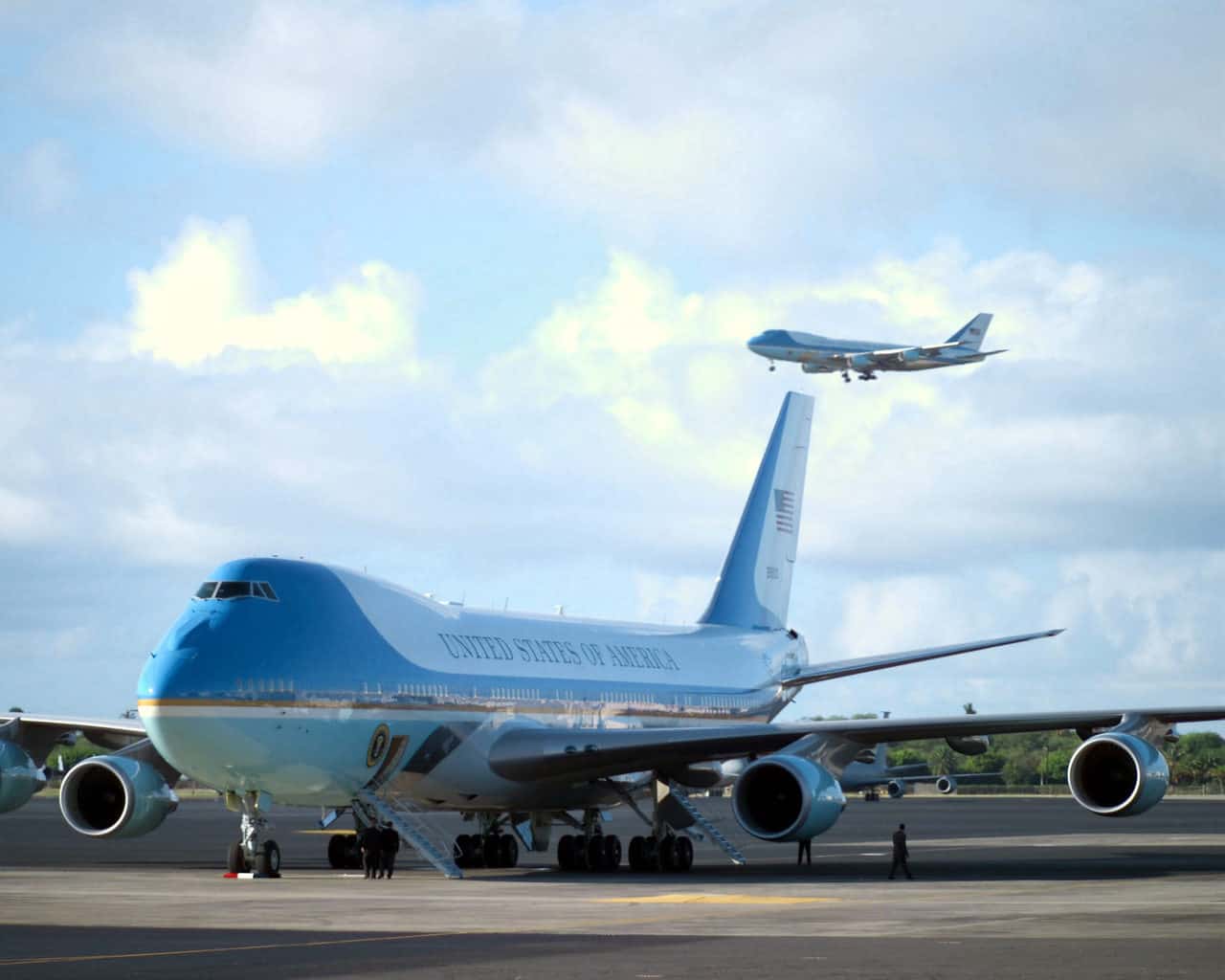

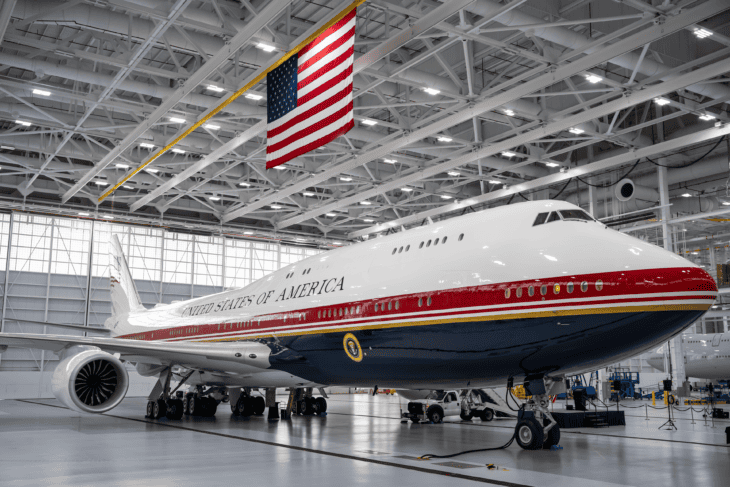
Since July 2026 there has been a third: the VC-25B Bridge, a Boeing 747-8 VIP jet gifted by Qatar and converted by L3Harris. The Air Force describes it as a bridge until Boeing delivers the two purpose-built VC-25Bs.
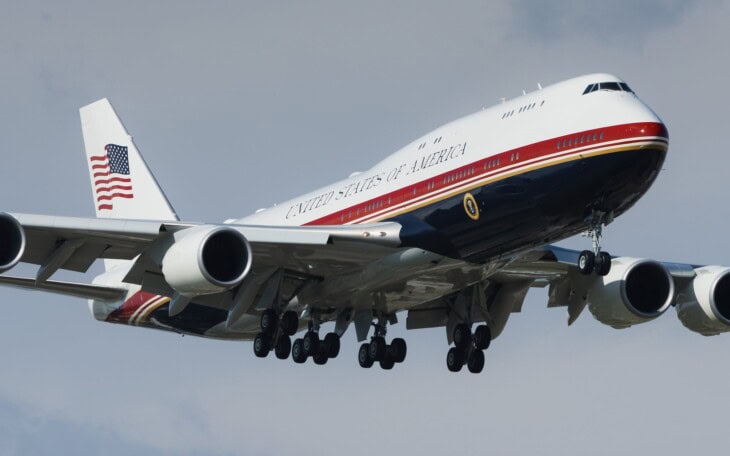
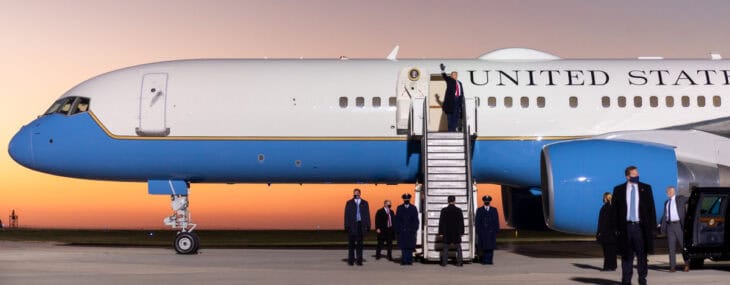
Air Force Two is usually the C-32A, the Air Force version of the Boeing 757-200, with two Pratt and Whitney PW2040 engines of 41,700 pounds of thrust each. Its main passengers are the vice president, the first lady, and members of the Cabinet and Congress.
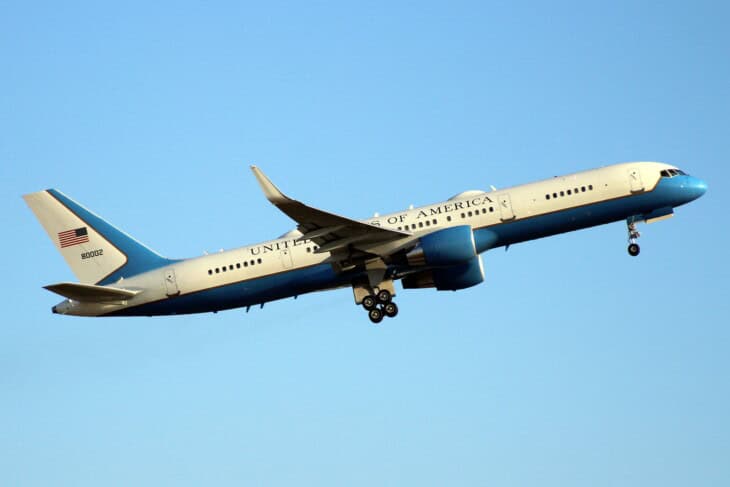
The Air Force fact sheet lists four C-32As. The War Zone, which tracks the fleet closely, put the count at about eight in February 2026, so the published number may be a floor.
The pairing is a habit, not a law. Vice presidents have flown a VC-25A as Air Force Two on long trips, and presidents fly the C-32A as Air Force One when an airport is too small for a 747.
The takeaway: Air Force One usually means a four-engine 747, and Air Force Two usually means a twin-engine 757.
Size, range and speed
The VC-25A is 231 feet 10 inches (70.7 m) long with a 195 foot 8 inch (59.6 m) wingspan. The C-32A is 155 feet 3 inches (47.3 m) long with a 124 foot 8 inch (38.0 m) span, so the 747 is about 77 feet (23.4 m) longer.
Weight shows the gap best. The VC-25A can take off at 833,000 pounds (377,800 kg), about 3.3 times the C-32A’s 255,000 pounds (115,670 kg), and its four engines make 226,800 pounds of thrust against the 757’s 83,400.
The VC-25A flies 7,800 miles (12,550 km) on a full load of fuel and can refuel in the air, which is why the White House describes its range as unlimited. The C-32A is rated at 5,500 nautical miles, about 6,330 miles (10,190 km), and its fact sheet lists no in-flight refueling.
The Air Force gives the VC-25A a top speed of 630 mph (1,014 km/h), or Mach 0.92, and the C-32A a cruise speed of 537 mph (864 km/h). Those are different measures, a top speed against a cruise speed, so they are not a like-for-like race.
The smaller jet has its own advantage: the C-32A can use runways as short as 5,000 feet. That is why a president heading to a small regional airport can arrive in a 757 instead of a 747.
The takeaway: the 747 goes farther and carries more, and the 757 gets into airports the 747 cannot.
Inside: an airborne office vs a VIP 757
The White House says the VC-25A has 4,000 square feet of floor space on three levels. The president’s suite includes a stateroom with a dressing room, lavatory and shower, an office and a conference room.
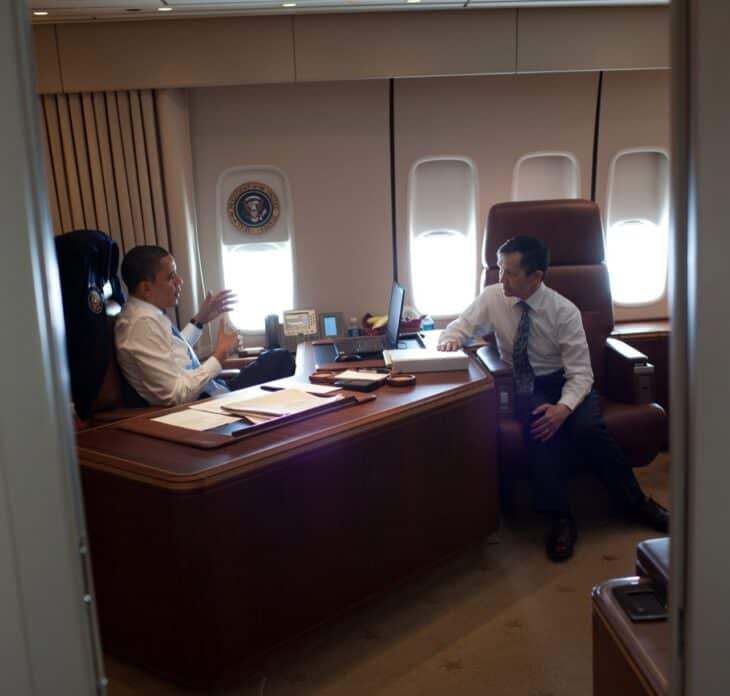
It also carries a medical suite that can work as an operating room, with a doctor always on board. Two galleys can serve 100 meals at a sitting, and there are separate sections for guests, senior staff, the Secret Service and the press.
The C-32A’s cabin is split into four sections. Up front is a communications center, a galley, a lavatory and 10 business-class seats, then a fully enclosed stateroom for the vice president.
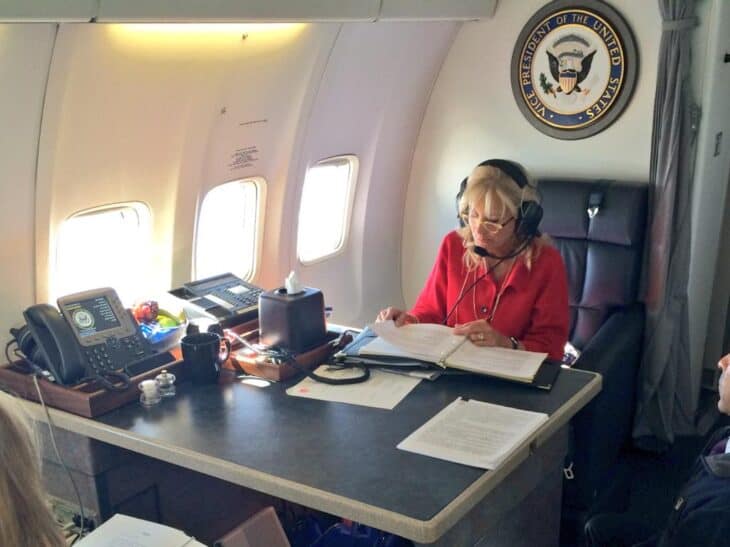
That stateroom has a changing area, a private lavatory, two first-class swivel seats and a divan for three that folds out into a bed. Behind it sit a conference and staff area with eight business-class seats and a rear cabin with 32 more.
The takeaway: both jets give their principal a private room with a bed, and the 747 adds a shower, an operating room and press seating that the C-32A’s published layout does not list.
Protection and communications
The VC-25A is built to keep working as a command post during an attack on the United States. The White House says its electronics are hardened against electromagnetic pulse, and it carries secure communications for exactly that job.
Its self-protection systems are not officially described, but some are visible from the ramp. The War Zone identifies AN/AAQ-24 laser turrets that blind heat-seeking missiles, the older AN/ALQ-204 infrared jammer, and missile launch warning sensors.
The VC-25A also carries its own baggage loader and front and rear airstairs, so it needs little help from the airport it lands at. The C-32A is pitched differently: the Air Force notes it sits high off the ground, which makes it easier to see under and around, a security point in its own right.
The new 747-8 is the weak spot. In July 2026 The War Zone reported that the Bridge jet lacks the visible countermeasures of the VC-25A, and The New York Times reported it lacks the older jet’s antimissile defenses.
The night Air Force Two's jet carried the president
On July 8, 2026, after a reported threat in Ankara, Turkey, President Trump boarded the VC-25A in front of the cameras. According to Washington Post reporting, he was then moved to a C-32A, the 757 that normally flies as Air Force Two, while the empty 747 left as a decoy. Neither the Bridge jet he had flown in on nor the famous 747 took him out of Turkey.
That episode is covered in detail in our report on the Air Force One decoy flight.
The takeaway: Air Force One’s 747 is built to survive an attack, and Air Force Two’s less conspicuous 757 has twice been the quieter way to move a president, in 2023 and in 2026.
What each one costs to fly
The Air Force told The War Zone in 2022 that the VC-25A cost an average of $177,843 per flight hour in fiscal 2021. That figure includes fuel, consumables and aircraft and engine overhaul.
The C-32A has a public price tag of its own. The Pentagon’s FY2026 schedule, effective October 1, 2025, bills it at $17,814 an hour to other defense users, $18,610 to other federal agencies and $19,354 to all other users.
The two are not the same kind of number, so the comparison is rough. Even so, an hour on the 747 costs about 10 times an hour on the 757.
The takeaway: the vice president’s jet is roughly an order of magnitude cheaper to fly than the president’s.
Fleet age and what replaces each jet
The first VC-25A flew as Air Force One on Sept. 6, 1990, which makes the type 36 years old. Boeing’s two replacement VC-25Bs, converted 747-8s, were due in 2024 and are now expected in 2028, according to the Air Force.
The Bridge jet was meant to ease that gap, but as of early October 2026 it was out of service again. ABC News reported on October 2 that it was getting “cosmetic upgrades” to its interior, that its last documented flight was September 16, and that the president had been flying the older Air Force One on recent domestic trips.
The C-32A arrived in June 1998, so the fleet is 28 years old. No replacement program has been announced, and the Air Force has planned to keep the C-32A in service until around 2040.
The look is changing first. In February 2026 a C-32A emerged in the red, white and blue scheme also chosen for the Bridge jet and the future VC-25Bs, replacing a cousin of the light-blue livery that has identified Air Force One since the Kennedy era.
Both fleets are flown by the 89th Airlift Wing at Joint Base Andrews, Maryland: the VC-25As by the Presidential Airlift Group and the C-32As by the 1st Airlift Squadron. Our guide to who pilots Air Force One covers how those crews are chosen.
The takeaway: Air Force One’s jets are older and have a replacement on the way, while Air Force Two’s 757s are younger and have no announced successor.
The difference in one sentence
Air Force One is whatever Air Force aircraft the president is on, usually a 747 built to serve as a flying command post, and Air Force Two is whatever Air Force aircraft the vice president is on, usually a 757 that carries fewer people, flies shorter distances and costs about a tenth as much an hour.
FAQ
Sources and references used for research and fact-checking.
- U.S. Air Force, VC-25 - Air Force One fact sheet
- Joint Base Andrews, U.S. Air Force, C-32 fact sheet
- Federal Aviation Administration, Order JO 7110.65, Chapter 2 Section 4, Radio and Interphone Communications
- The White House, Air Force One
- National Business Aviation Association, The First Air Force One
- U.S. Air Force, VC-25B Bridge program completes flight testing, prepares for summer rollout
- DoD Comptroller, FY 2026 Reimbursable Rates, Fixed Wing
- The War Zone, Air Force One 747s Now Cost $177k An Hour To Fly
- The War Zone, New VC-25B Air Force One will be pulled from service to be maxed out with upgrades
- The War Zone, C-32A Air Force Two jet emerges wearing Trump's new Air Force One paint job
- ABC News, Qatari-gifted Air Force One undergoing cosmetic upgrades, administration source says
- Wikipedia, Air Force One
- Wikipedia, Boeing C-32
Get the Newsletter
The latest aviation news and stories sent to your inbox.
About the Author

Tim is the owner and lead editor of AeroCorner since 2019, overseeing aviation content covering aircraft, airlines, airports, and the broader aviation industry. Through years of researching, writing, editing, and publishing aviation-focused content, he has developed extensive practical knowledge of commercial aviation and air travel. Based in Asia and a frequent traveler himself, Tim also brings firsthand passenger experience to AeroCorner’s coverage. Outside of publishing, he has also explored aviation firsthand through hands-on flight training in New Zealand.