

Table of Contents
The Spanish Air Force flies two fighters, and at the last full count the older one was the bigger fleet. FlightGlobal’s World Air Forces 2026 directory counts 81 EF-18 Hornets and 67 Eurofighter Typhoons, with 45 more Eurofighters on order.
Its official name is the Ejército del Aire y del Espacio, the Air and Space Force. In August 2025 Spain shelved the F-35 to buy European, and in June 2026 the European fighter it was counting on, FCAS, broke apart between France and Germany.
This guide ranks every aircraft type it flies by its weight in Spanish air power as of October 2026. It then covers the F-35 decision, the fighter Spain now has to find, its 2026 deployments, its bases and the American forces it hosts.
| Rank | Aircraft | Role | Fleet | Status |
|---|---|---|---|---|
| 1 | Eurofighter Typhoon | Air defense, multirole | 67 | 45 Halcón jets on order, first delivery pending |
| 2 | EF-18 Hornet | Multirole | 81 | Canary Islands jets retire December 2026 |
| 3 | F-5M and Hürjet | Fighter lead-in training | 19 F-5M | 30 Hürjets on contract, from 2028 |
| 4 | A330 MRTT | Aerial refueling, transport | 2 | Third conversion due in 2026 |
| 5 | A400M | Strategic and tactical airlift | 14 | Fleet rising to 20 |
| 6 | C295, CN235 and C212 | Transport, maritime patrol, search and rescue | 28 and 7 | 34 more C295s on order |
| 7 | MQ-9A Reaper | Surveillance drone | 4 | Still unarmed, weapons ordered 2025 |
| 8 | CL-215T and CL-415 | Firefighting | 10 and 4 | 7 DHC-515s ordered, delayed |
| 9 | Pilatus PC-21 | Pilot training | 31 | 9 more on order |
| 10 | NH90, Super Puma, S-76 | Search and rescue, special operations | 7, 6, 8 | 12 more NH90s and 6 H175Ms ordered |
| 11 | H135 and H120 | Helicopter training | 11 and 15 | 12 more H135s ordered |
| 12 | A310 and Falcon 900 | Government transport | 2 and 5 | A310s to be replaced by MRTTs |
How this ranking works
Aircraft are ranked by their weight in Spanish air power in October 2026: combat jets first, then the tankers and airlifters that move them, then patrol aircraft, drones, firefighters, trainers, helicopters and the government fleet. Counts come from FlightGlobal’s World Air Forces 2026 directory, which lists only aircraft in day-to-day use. The Spanish Navy’s AV-8B Harriers and the Army’s helicopters belong to other services and are not counted.
1. Eurofighter Typhoon: The Future of the Fleet
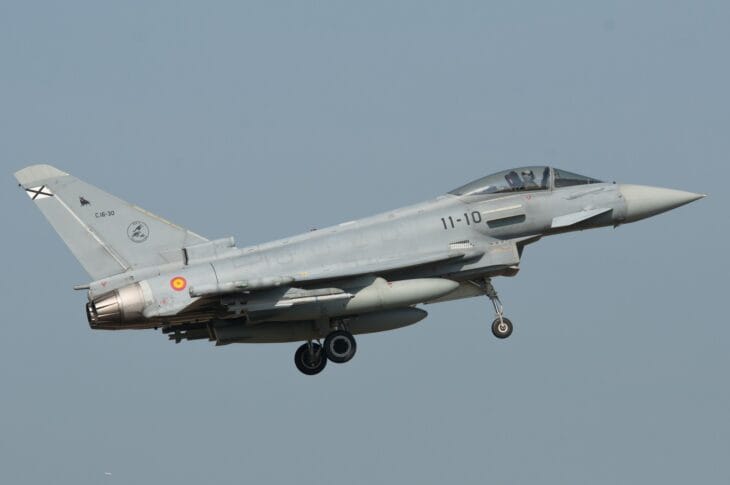

The Eurofighter Typhoon has served in Spain since 2003, with Ala 11 at Morón, near Seville, and Ala 14 at Los Llanos, Albacete. FlightGlobal counted 67 in day-to-day use, and Airbus describes Spain’s fleet as 70 aircraft.
It ranks first, ahead of the more numerous Hornet, because every Spanish fighter decision now runs through it. Spain helps build it: Airbus assembles Spanish Eurofighters at Getafe, near Madrid.
Two new batches, both called Halcón, will take the fleet to 115. Halcón I, 20 jets including four two-seaters, was signed at the ILA Berlin air show on June 23, 2022. Halcón II, 25 jets including four two-seaters, followed on December 20, 2024, at about €4.6 billion by Breaking Defense’s count.
The first Halcón, a two-seater, rolled out at Getafe on June 1, 2026, and ran its engines in early July. Spanish reports through September still described it as preparing for its first flight, so no Halcón had been delivered by then.
The first three new jets go to Ala 14 at Albacete. Air Force chief General Francisco Braco has said Halcón II will then replace the Hornets at Torrejón and Zaragoza. The wider family of European fighters is in our guide to European fighter jets.
The Canary Islands got used Eurofighters, not new ones
The Halcón I order was first meant to replace the Hornets at Gando, in the Canary Islands. Instead, Ala 46 received its first eight Eurofighters in June 2026 as Tranche 3 jets handed down from Albacete and Morón, with 20 planned, while the brand-new Halcóns go to the mainland.
2. EF-18 Hornet: The 1980s Jet Spain Cannot Retire Yet
.jpg)
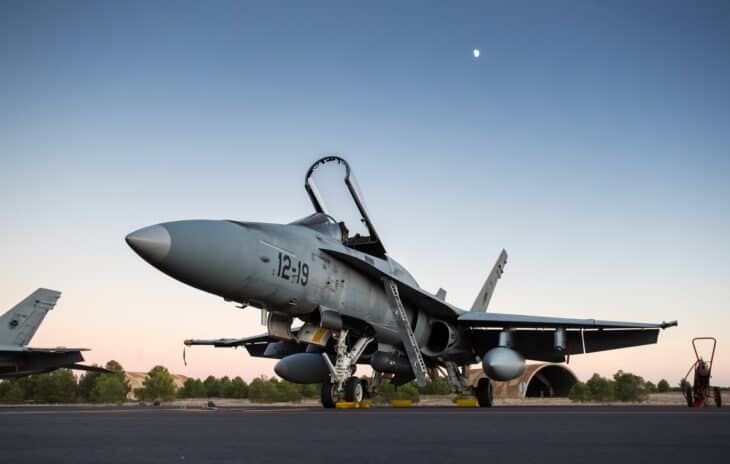
Spain ordered 72 F/A-18 Hornets in May 1983, 60 single-seaters and 12 two-seaters, and the first arrived at Zaragoza in July 1986. Designated C.15 in Spanish service, they replaced the F-4C Phantom.
FlightGlobal counted 69 combat Hornets and 12 two-seat trainers, 81 in all, as of October 2025. They fly with Ala 12 at Torrejón, outside Madrid, and Ala 15 at Zaragoza, upgraded over the years to the EF-18M standard.
Spain later added second-hand F/A-18As from the US Navy, which arrived from December 1995 and ended up at Gando in the Canary Islands. Their time is over: the last six operational Gando Hornets moved to Zaragoza in June 2026 for final retirement in December.
The mainland jets may last far longer than planned. Galaxia Militar reported in March 2026 that a government answer to Parliament opened the door to keeping about 60 EF-18Ms flying until around 2040, against an earlier target of 2030.
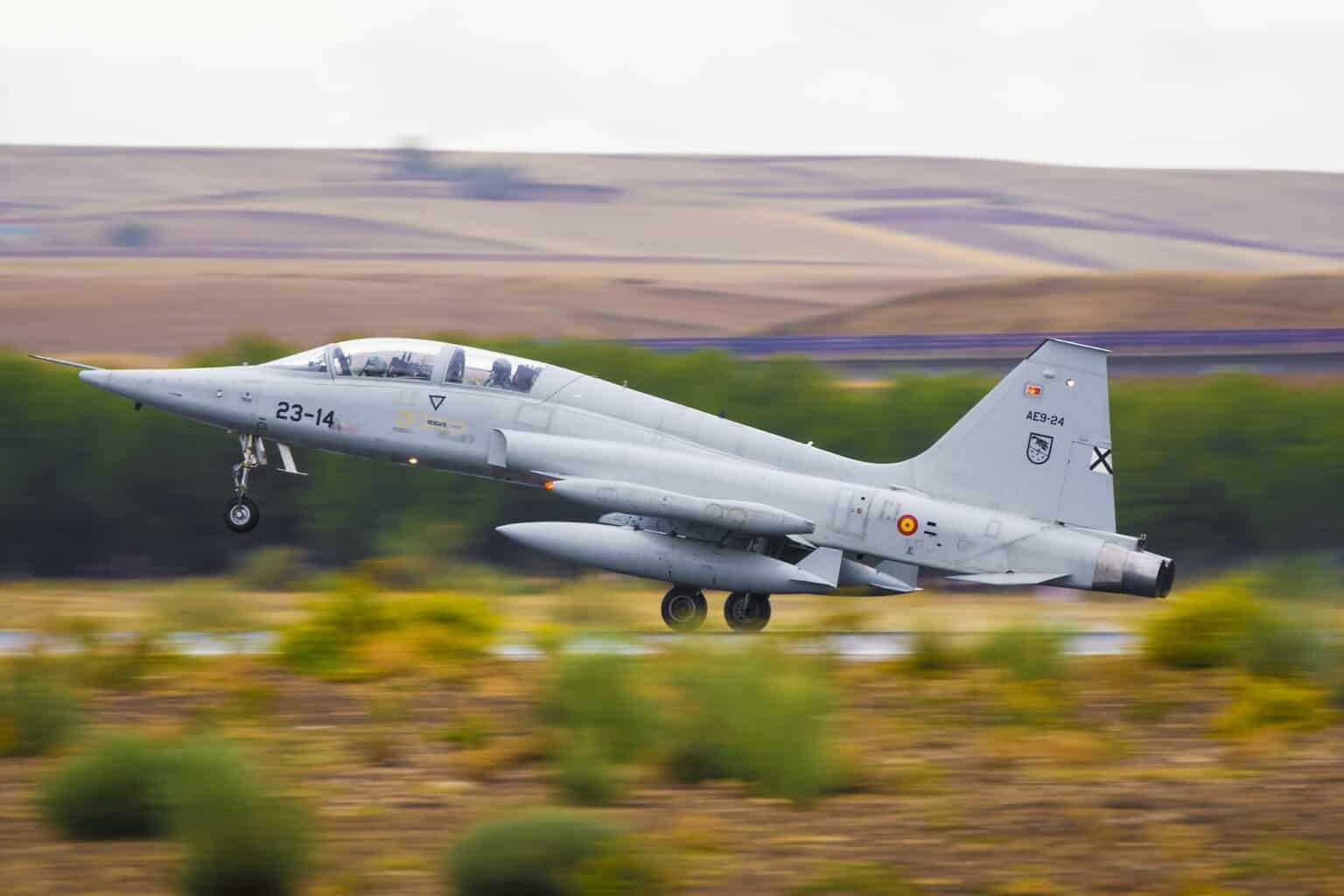
3. F-5M and the Hürjet: Training Fighter Pilots
.jpg)
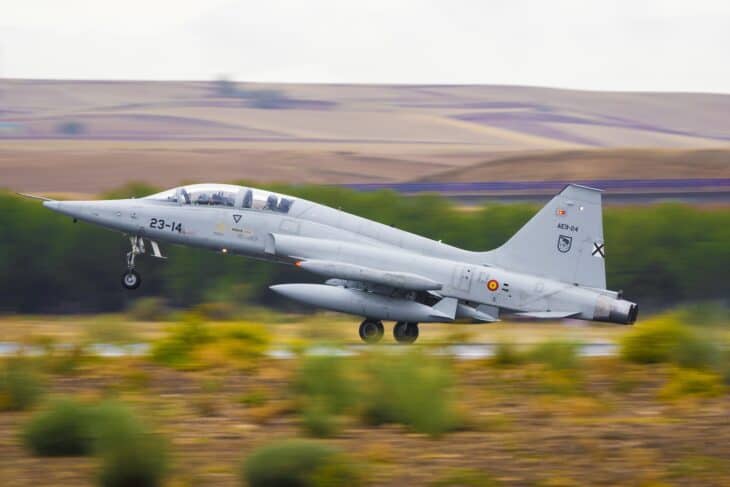
Spanish fighter pilots learn to fly fast jets at Ala 23, Talavera la Real, on the Northrop F-5. CASA built 70 of them under license from 1964, and the 19 survivors fly as modernized F-5Ms.
The first two-seat F-5Bs arrived at Talavera on November 12, 1970. In May 2026 the wing celebrated 300,000 F-5 flight hours.
Their replacement is Turkish. On December 28, 2025, Spain signed for 30 Hürjet jet trainers, worth about €2.4 billion to €2.6 billion depending on the report, with Airbus as national lead and Turkish Aerospace building the jets. The government had approved up to 45.
The 30 jets arrive in 2028 and 2029 in a basic configuration, then return to be fitted with Spanish equipment from the second half of 2031 to 2035. The jet comes from the same industry as the fighters in our guide to the Turkish Air Force.
Spain is the Hürjet's first export customer
The December 2025 contract made Spain the first country outside Turkey to buy the Hürjet. Airbus says the aim is to replace the F-5 fleet, and the finished jets will be based at Talavera la Real.
4. A330 MRTT: Airliners Turned Into Tankers
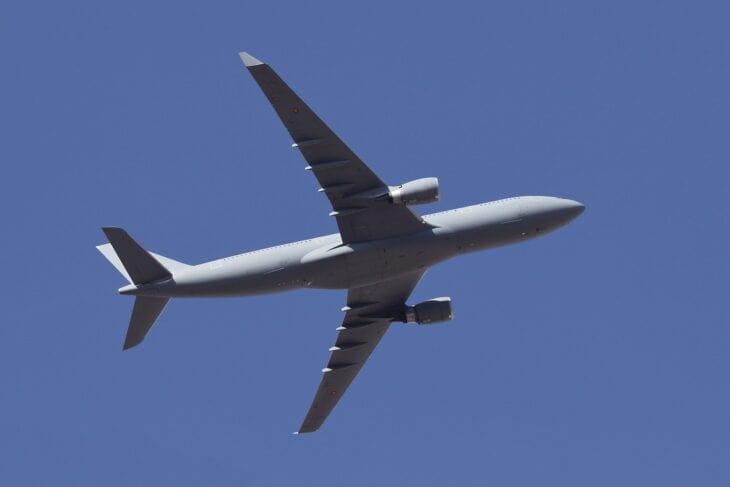

Spain went nearly nine years without a long-range tanker after it retired its Boeing 707s in 2016. In 2021 it bought three used Iberia A330-200 airliners for €810 million and had them converted at Getafe into the A330 MRTT.
The first was delivered in April 2025 and the second on October 29, 2025. Both fly with Ala 45 at Torrejón, which refuels Spanish Hornets and Eurofighters and, since April 2026, the Navy’s Harriers.
The third returned to Getafe in August 2026 after repainting in Malta, with delivery planned for 2026. On August 26, 2026, the government approved a €5.4 billion joint tanker framework with Poland, three newer MRTTs for Spain and four for Poland.
5. A400M: The Airlifters Spain Could Not Sell
.jpg)
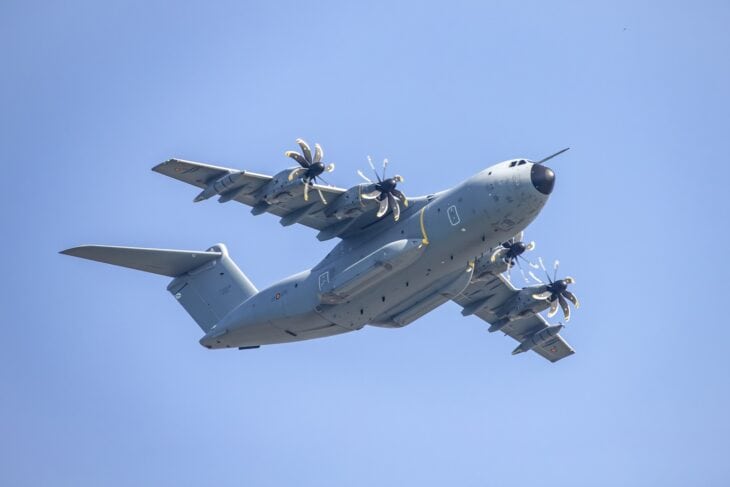
Spain ordered 27 Airbus A400M transports, but in 2013 it decided to put only 14 into service and sell the rest. All 14 were delivered between December 2016 and April 2023, and they fly with Ala 31 at Zaragoza.
The export sales never happened, and the plan kept growing. After a new agreement with Airbus, the fleet is set to reach 20, and Infodefensa reported on October 3, 2026, that the 15th was due that month with a 16th before the end of the year.
Spain also uses the A400M as a tanker. One deployed to Romania with Spanish fighters in 2026.
A centenary flight to Buenos Aires
On January 22, 1926, the Plus Ultra, a Dornier Wal flying boat crewed by Spanish military aviators, left Palos de la Frontera and reached Buenos Aires on February 10, about 6,380 miles (10,270 km) later. For the 100th anniversary, two Spanish A400Ms carried six H120 helicopters of the Patrulla Aspa display team to South America in January and February 2026.
6. C295, CN235 and C212: The Home-Built Turboprops
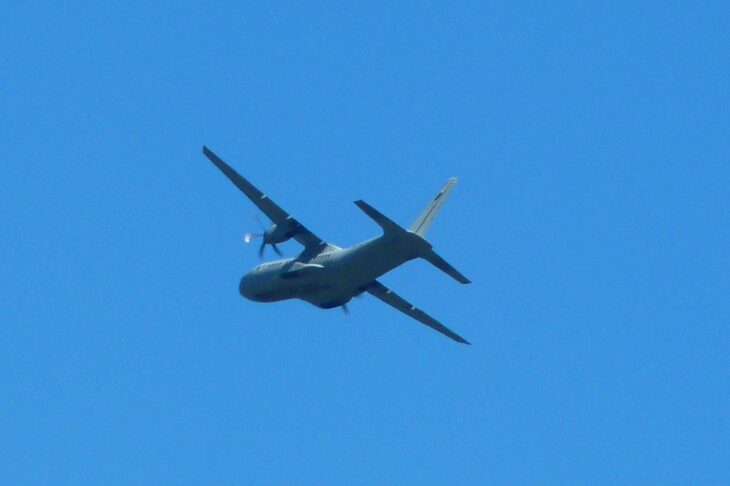

Spain’s medium transports are its own designs. FlightGlobal counts 20 C295 and CN235 transports, eight more in maritime patrol and surveillance roles, and seven older C212s.
On December 20, 2023, Spain ordered 16 C295s for maritime patrol and maritime surveillance. They replace the P-3 Orion, retired at the end of 2022, and the CN235 VIGMA patrol aircraft that entered service in 2008.
The first surveillance version was delivered in Seville on June 24, 2026, and went to Ala 46 in the Canary Islands. The first submarine-hunting patrol version is due in 2028.
A further 18 transports followed on December 23, 2025. They replace the CN235s at Matacán from 2026 to 2028 and the C212s at Alcantarilla from 2030 to 2032, for a planned fleet of 46 C295s.
7. MQ-9A Reaper: Six Years Unarmed
Spain bought four MQ-9A Block 5 Reapers and three ground stations. The first two arrived at the end of 2019, the last pair on November 23, 2020, and they fly with Escuadrón 233 at Talavera la Real.
They still carry no weapons. Spain announced it would arm them in February 2023 and placed the order with Lockheed Martin in August 2025, but Escudo Digital reported in September 2026 that strike capability is expected in 2027 at the earliest. Our comparison of the Reaper and the Predator explains what the type can do.
Spain’s own drone, the Airbus SIRTAP, made its first taxi run at Getafe in June 2026 and is aiming for a first flight in late 2026. Spain is also a partner in the delayed Eurodrone, with a requirement for 12 aircraft.
8. Canadair CL-215T and CL-415: The Air Force That Fights Fires
_del_43_Grupo_del_Ej%C3%A9rcito_del_Aire,_con_base_en_Torrej%C3%B3n_de_Ardoz_(15353070340).jpg)
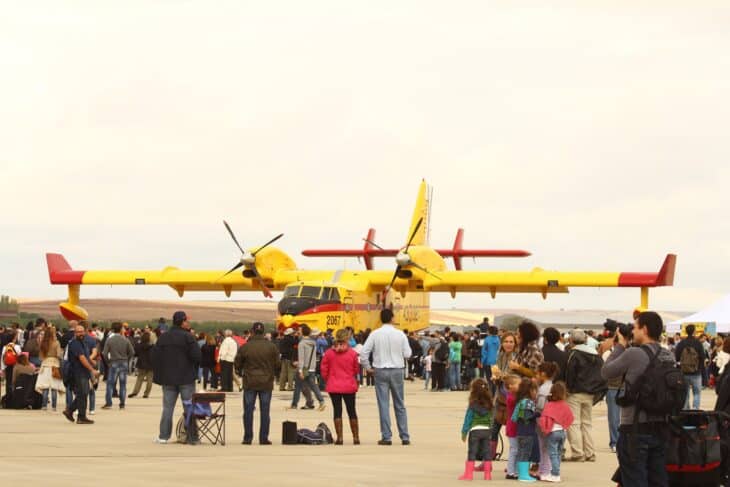
Spain’s water bombers are flown by Air Force crews of 43 Grupo at Torrejón. The fleet is 14 aircraft, 10 CL-215Ts and four CL-415s, of which 11 belong to the environment ministry and three to defense.
Spain has ordered seven new DHC-515s, the updated Canadair, through Canada’s government contracting agency. Five are paid for by the environment ministry and two through the EU’s rescEU program, and El Español reported in July 2026 that first deliveries, planned for 2027, will slip.
How these scoopers work, and why Europe depends on them, is in our guide to firefighting airplanes.
9. Pilatus PC-21: Every Pilot Starts Here
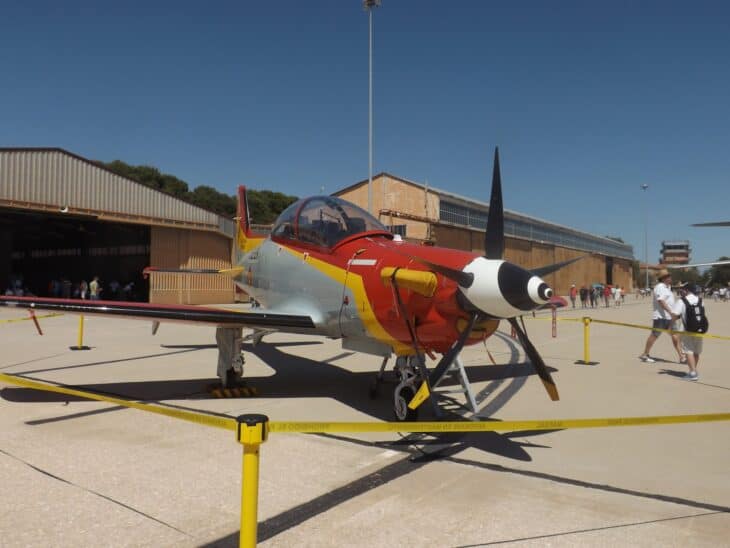

Spanish military pilots now train on the Pilatus PC-21, designated E.27, at the General Air Academy in San Javier, Murcia. It has replaced the CASA C-101 jet trainer for good, and the first batch of 24 was complete by mid-2022.
A second order of 16 brought the program to €445 million, with 14 for the academy and two for the CLAEX test center at Torrejón. FlightGlobal counted 31 in use and nine still to come, and Aviacionline called Spain the largest PC-21 operator in Europe.
Spain's display team was retired with its jet
The Patrulla Águila, founded at San Javier in 1985, flew its last display on the C-101 on June 15, 2025, after more than 500 shows, and was then deactivated. A PC-21 formation called Mirlo now flies the ceremonial flypasts. The Air Force chief has said Spain will have a team again, in the future.
10. NH90, Super Puma and S-76: Search and Rescue
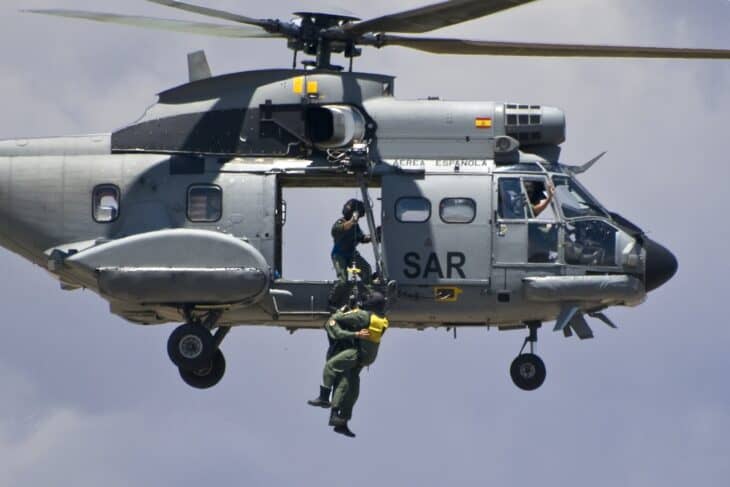

Three search and rescue squadrons cover Spain: 801 at Palma de Mallorca, 802 at Gando and 803 at Cuatro Vientos, Madrid. FlightGlobal counts seven NH90s, six Super Pumas and eight Sikorsky S-76s in the Air Force.
The NH90 flies with 803 Squadron of Ala 48, which took the first upgraded Standard 3 version in December 2024. Three NH90s went to Romania in July 2026 as counter-drone helicopters with Spain’s NATO detachment.
In December 2025 Spain approved a 100-helicopter Airbus order across its forces, and the Air Force’s share includes 12 more NH90s from 2031 and six H175Ms from 2028 for government flights, replacing the Super Puma and Cougar VIP fleet.
11. H135 and H120: Training Helicopter Pilots
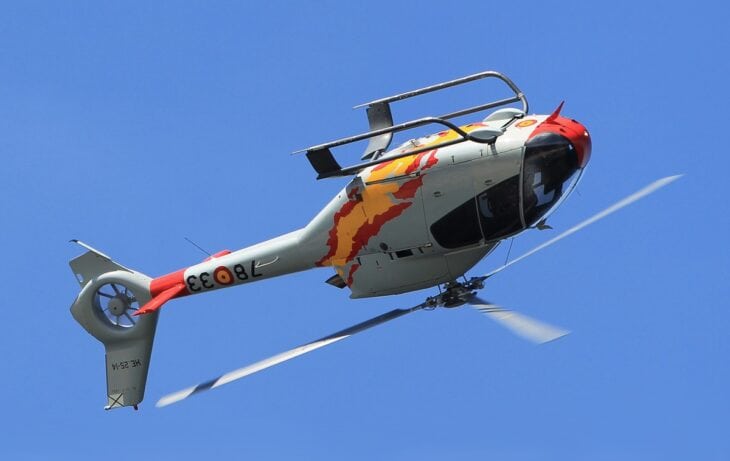

Helicopter pilots train with Ala 78 at Armilla. FlightGlobal lists 11 H135s and 15 smaller H120s, and the same December 2025 order adds 12 more H135s from 2027.
The H135 is replacing the S-76C in training. Aerospace Global News reported in 2025 that some of the eight surviving S-76s are moving to search and rescue in Mallorca instead of retiring.
12. A310 and Falcon 900: The Government Fleet
_Airbus_A310_MRTT.png)
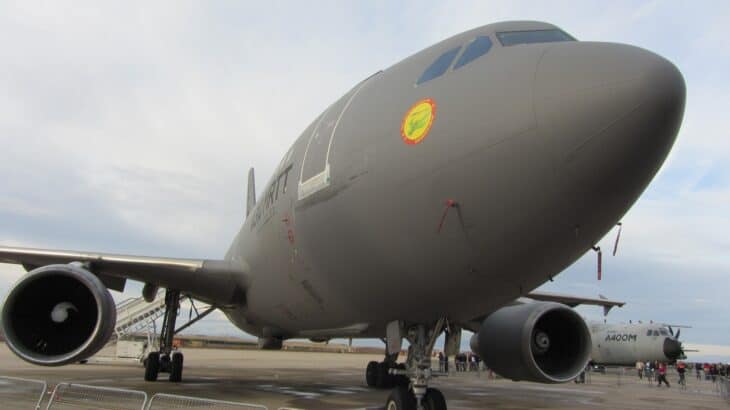
Ala 45 at Torrejón flies Spain’s government leaders. Its two Airbus A310s began life with Air France in 1990, and its five Dassault Falcon 900s were bought new in 1988 and second-hand in 2003.
The A310s are going. Defensa.com reported on October 13, 2026, that two of the three new MRTTs in the Polish deal will be fitted for VIP transport to replace them. A plan to replace the Falcons was shelved in 2024, when the ministry said it was not a priority.
What about radar planes and spy planes?
Spain has none of its own. It relies on NATO’s E-3A fleet for airborne early warning, and it has had no signals intelligence aircraft since its Boeing 707 spy plane last flew in 2014. In October 2026 the Air Force chose the Airbus A321 for three new SIGINT aircraft in a program valued at €436 million.
Why Spain Said No to the F-35
On August 6, 2025, El País reported that Spain had postponed an F-35 purchase indefinitely to prioritize European industry. The defense ministry said “the Spanish option involves the current Eurofighter and the FCAS in the future.”
Spain had never gone beyond a non-binding request for information. Its 2023 budget had set aside €6.25 billion to replace both the Navy’s AV-8B Harriers and part of the Hornet fleet.
The decision hurts the Navy most. The F-35B is the only short-takeoff jet that can replace the Harrier at sea, and the ministry told the Senate in 2026 that the Harriers will be kept flying until 2032, with no replacement named.
The Fighter Spain Lost: FCAS After the Split
Spain joined FCAS, the Franco-German sixth-generation fighter, in 2020. On June 8, 2026, France and Germany ended work on the jet itself after Airbus and Dassault deadlocked, keeping only the drone and data network parts.
Defense Minister Margarita Robles said “industrial interests have been prioritised over Europe’s security and defence interests.” Spain was paying about a third of the budget, and Spanish industry sources told the Catalan paper Ara that Madrid was not told in advance.
Spanish and German officials began talks on a new fighter in September 2026, and elEconomista reported that a deal could come by the end of 2026 or slip to mid-2027. In early October, Germany was also reported to be exploring the British, Italian and Japanese GCAP fighter, the one in our guide to the Italian Air Force.
Whichever way it goes, Madrid is now aiming for a new fighter around 2040, which is why the Halcón Eurofighters and the old Hornets have to last. The contenders are in our guide to sixth-generation fighter jets.
The 2026 Deployments: Romania and the Iran War
In February 2026, three Spanish Eurofighters and an A400M deployed to Mihail Kogălniceanu air base in Romania alongside German jets. From late July, seven Spanish Hornets, about 200 personnel, an A400M tanker and three NH90 counter-drone helicopters took over a NATO air policing rotation there.
Spain stayed out of the strikes in the 2026 Iran war. In March it refused to let the United States use Rota and Morón for strikes on Iran, and AeroCorner found no reports of Spanish fighters in the Gulf or of any Spanish fighter lost in 2025 or 2026.
Spanish Air Force Bases and the Americans at Morón
The fighter bases are Morón and Albacete for the Eurofighter, Torrejón and Zaragoza for the Hornet, and Gando in the Canary Islands. Zaragoza also hosts the A400Ms, and Albacete hosts NATO’s Tactical Leadership Programme, an advanced course for allied fighter pilots.
The United States uses two Spanish bases: Naval Station Rota, a US Navy hub, and Morón Air Base near Seville. The 1988 defense agreement that covers both renewed automatically in May 2026.
From Cuatro Vientos to the Air and Space Force
Spanish military flying began at Cuatro Vientos, in Madrid, in 1911, with French-built Farman aircraft. A military aviation service followed in 1913.
The Ejército del Aire became an independent service under a law of October 7, 1939, after the Civil War. A royal decree of June 27, 2022, renamed it the Ejército del Aire y del Espacio, effective June 30, and its space command now operates from Torrejón.
How Strong Is the Spanish Air Force?
The World Directory of Modern Military Aircraft ranks it 25th of 129 air forces, with 396 aircraft and a score of 41.6. Its Spain page was last updated in December 2024 and still lists retired trainers, so treat that as approximate.
Spending is catching up. NATO estimated Spain’s defense spending at 1.43% of GDP in 2024 and 2.00% in 2025, yet in June 2025 Prime Minister Pedro Sánchez refused NATO’s new 5% target, saying 2.1% would meet Spain’s needs.
Its strengths are two European fighters, a home-built transport fleet and new tankers. Its gaps are no stealth jet, no radar planes, unarmed drones and a future fighter with no partner yet. Our ranking of the best air forces in the world shows where that leaves Spain.
FAQ
Sources and references used for research and fact-checking.
- FlightGlobal, 2026 World Air Forces directory
- Airbus, Spain orders 25 additional Eurofighter jets (Halcón II)
- Airbus, Spain orders 20 Eurofighter jets under landmark contract
- El Español, Primer Eurofighter Halcón sale de la línea de ensamblaje de Airbus en Getafe
- Libertad Digital, El primer Eurofighter Halcón supera con éxito la prueba de motor
- El Confidencial Digital, Eurofighter Halcón I prepara primeras pruebas
- El Español, Primeros cazas Eurofighter del programa Halcón llegarán a la base de Albacete
- El Español, El Ala 46 recibe sus primeros Eurofighter en la base aérea de Gando
- Breaking Defense, Spain rules out F-35 order, prioritizes Eurofighter and FCAS
- The Aviationist, Spain shelves F-35 plans
- Zona Militar, España confirma que los AV-8B Harrier seguirán operativos hasta 2032
- Ejército del Aire y del Espacio, EF-18 Hornet
- Wikipedia (Spanish), McDonnell Douglas EF-18 Hornet
- Galaxia Militar, España examina la posibilidad de mantener en servicio los cazas F-18 Hornet hasta 2040
- Ejército del Aire y del Espacio, F-5
- Militär Aktuell, Spanish F-5s celebrate anniversary
- The Aviationist, Spain signs contract for 30 Hürjets
- Libertad Digital, El Ejército del Aire y del Espacio recibe su primer avión A330 transformado a MRTT
- Defensa.com, El Ejército del Aire y del Espacio recibe su primer avión A330 MRTT
- Defensa.com, Entregado el segundo A330 MRTT
- Defensa.com, El Gobierno aprueba un acuerdo marco de 5.400 millones para la compra de aviones cisterna
- Defensa.com, España negocia la compra de más aviones cisterna A330 MRTT
- Defensa.com, España prepara el relevo del A310: dos nuevos Airbus MRTT
- Infodefensa, El Ejército del Aire y del Espacio recibirá nuevos A400M antes de final de año
- Airbus, España adquiere 16 Airbus C295 en configuraciones de patrulla y vigilancia marítima
- Janes, Airbus DS delivers first C295 MSA for Spain
- Airbus, Spain orders 18 C295 transport aircraft
- The Defense Post, Spain receives final MQ-9A Block 5
- Escudo Digital, España sigue sin armar sus Reaper
- El Español, El dron español Airbus SIRTAP completa su primer rodaje
- ESUT, Eurodrohne: alle sind bereit, nur Spanien fehlt
- El Independiente, La heroica flota de hidroaviones que mantiene a raya el fuego
- Canadian Commercial Corporation, CCC and Spain sign contract for DHC-515 firefighter aircraft
- El Español, Canadair CL-415 llegarán de Grecia e Italia
- Aviacionline, 16 Pilatus PC-21 adicionales para el Ejército del Aire y del Espacio
- EFE via Diario Las Américas, La Patrulla Águila se despide en Murcia después de 40 años
- Breaking Defense, Spain approves $5.3 billion mega order of 100 Airbus helicopters
- Airbus, Airbus NH90 for the Spanish forces
- Aerospace Global News, Spanish Spirits earn a second life
- El Independiente, El caza Falcon: la envejecida flota que ningún Gobierno se atreve a renovar
- The Aviationist, Spain selects Airbus A321 for new SIGINT platform
- Infodefensa, El Airbus A321 será la base del futuro avión espía español
- The Aviationist, France and Germany end FCAS
- Reuters via Global Banking & Finance, Airbus, Indra and others offer Spain alternative FCAS fighter jet
- Ara, How does the breakdown between France and Germany over the European combat aircraft affect Spain
- elEconomista, España y Alemania negocian su propio caza de combate
- Aviation A2Z, Germany explores GCAP after FCAS collapse
- NATO Allied Air Command, Spanish Eurofighters deploy to Romania
- NATO Allied Air Command, Italian, Spanish and Turkish air defence detachments replace the French, Portuguese and Romanian jets
- Al Jazeera, Spain refuses to let US use bases for Iran attacks
- El Debate, España y Estados Unidos renuevan el convenio sobre las bases de Rota y Morón
- TLP, Tactical Leadership Programme
- El Debate, Así nació la aviación militar española
- Boletín Oficial del Estado, BOE no. 292, October 19, 1939
- Boletín Oficial del Estado, Real Decreto 524/2022, de 27 de junio
- La Moncloa, Robles: Mando del Espacio
- Airbus, Del Plus Ultra al Airbus A400M: celebrando un siglo de pioneros transatlánticos
- World Directory of Modern Military Aircraft, Spanish Air Force
- NATO, Defence Expenditure of NATO Countries (2014-2025)
- Associated Press, Spain rejects NATO's anticipated defense spending increase as unreasonable
Get the Newsletter
The latest aviation news and stories sent to your inbox.
About the Author

Tim is the owner and lead editor of AeroCorner since 2019, overseeing aviation content covering aircraft, airlines, airports, and the broader aviation industry. Through years of researching, writing, editing, and publishing aviation-focused content, he has developed extensive practical knowledge of commercial aviation and air travel. Based in Asia and a frequent traveler himself, Tim also brings firsthand passenger experience to AeroCorner’s coverage. Outside of publishing, he has also explored aviation firsthand through hands-on flight training in New Zealand.