

Table of Contents
On March 15, 1980, a 96-year-old man from rural Georgia was at the shipyard in Newport News, Virginia, as a nuclear-powered aircraft carrier bearing his name was christened and launched. President Jimmy Carter’s proclamation for the day called the ship “the largest warship ever constructed.”
Carl Vinson had spent 50 years in Congress building the U.S. Navy. He represented a landlocked district, rarely set foot on a ship or an airplane, and was nicknamed “the Admiral” anyway.
The carrier named for him has since hosted the burial at sea of Osama bin Laden, hosted a college basketball game with the president in the stands, and been announced as sailing toward North Korea while it was heading the other way. Here is what the ship is, who it honors, and where it is now.
What Is the USS Carl Vinson?
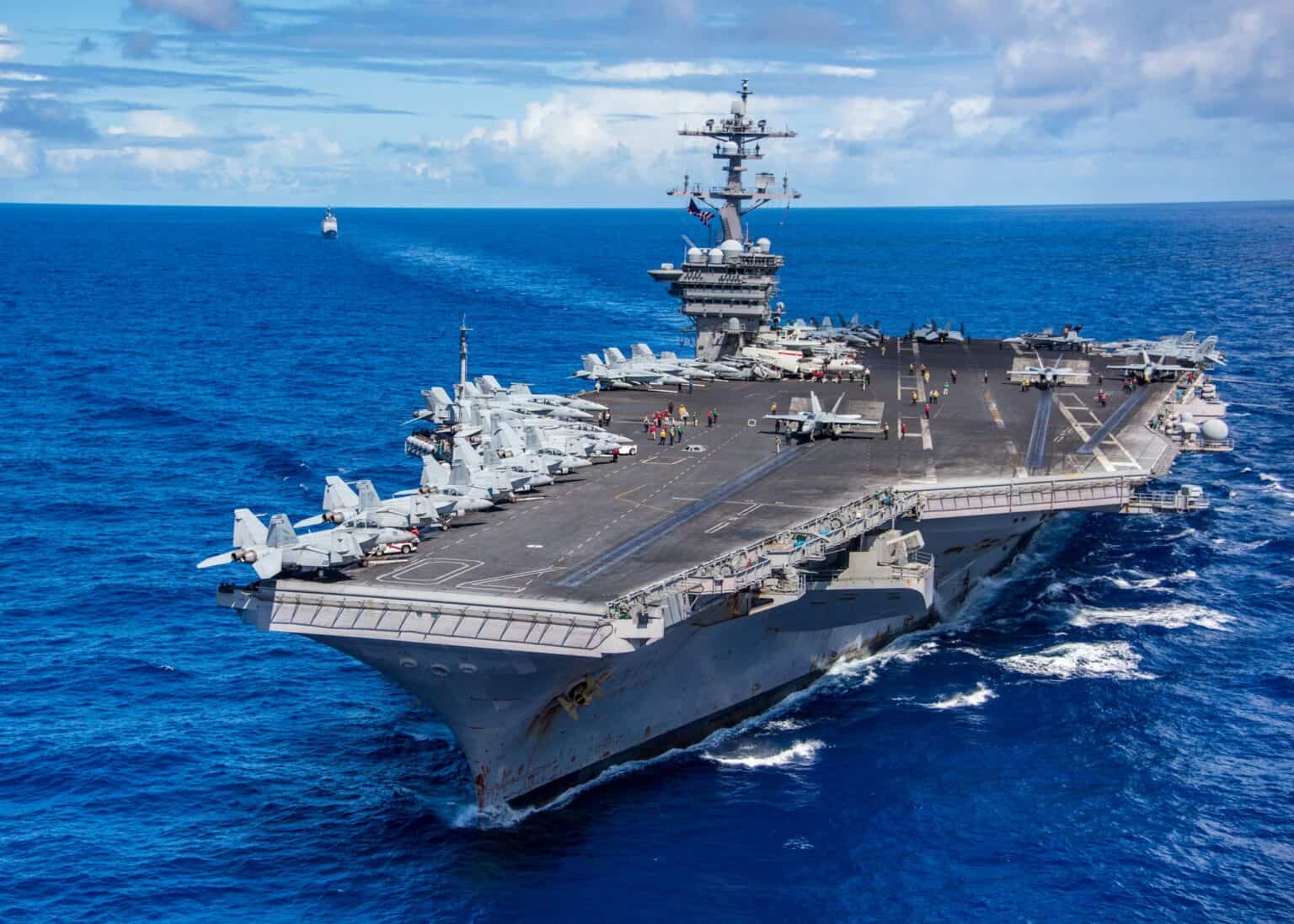
USS Carl Vinson (CVN-70) is the third of ten Nimitz-class aircraft carriers. She was commissioned on March 13, 1982, and is homeported at Naval Air Station North Island in San Diego.
She is the flagship of Carrier Strike Group 1 and carries Carrier Air Wing 2, the Navy’s “air wing of the future.” That wing mixes F-35C stealth fighters, Super Hornets, Growlers, E-2D Hawkeyes, CMV-22B Ospreys and Seahawk helicopters.
The Carl Vinson at a glance
Third Nimitz-class carrier, hull number CVN-70. Launched March 15, 1980, commissioned March 13, 1982. Homeport San Diego. Named for Georgia congressman Carl Vinson, the ‘Father of the Two-Ocean Navy.’ Buried Osama bin Laden at sea in 2011, first carrier to deploy with the F-35C in 2021, struck Houthi targets in Yemen in 2025.
| USS Carl Vinson (CVN-70) | |
|---|---|
| Class | Nimitz (third of ten) |
| Builder | Newport News Shipbuilding, Virginia |
| Keel laid | October 11, 1975 |
| Launched | March 15, 1980 |
| Commissioned | March 13, 1982 |
| Length | 1,092 feet (333 m) |
| Flight deck width | 252 feet (77 m) |
| Displacement | About 97,000 tons, full load |
| Speed | 30+ knots |
| Aircraft | More than 60 |
| Crew | About 3,000 ship’s company plus about 2,000 in the air wing |
| Homeport | San Diego, California |
Who Was Carl Vinson?
Carl Vinson was born in Baldwin County, Georgia, on November 18, 1883. He was sworn into the U.S. House on November 3, 1914, as the youngest member of Congress, and stayed until he retired in January 1965.
His district had no coastline, but he won a seat on the House Naval Affairs Committee in 1917. He chaired it for 16 years, then chaired its successor, the House Armed Services Committee, for 14 more.
Between the world wars he argued that the Navy had not even been built to the size the naval treaties allowed. His bills, culminating in the Two-Ocean Navy Act of 1940, provided for the massive shipbuilding effort of World War II. That is why the Navy calls him the “Father of the Two-Ocean Navy.”
The Admiral who stayed home
According to the New Georgia Encyclopedia, Vinson went to the Caribbean once in the 1920s, never traveled abroad again, rarely set foot on an airplane or ship, and never learned to drive a car.
President Richard Nixon named the third nuclear carrier for him in 1973. When the ship was launched, Carter’s proclamation noted that Vinson would be the first living American to attend the launching of a Navy warship bearing his name.
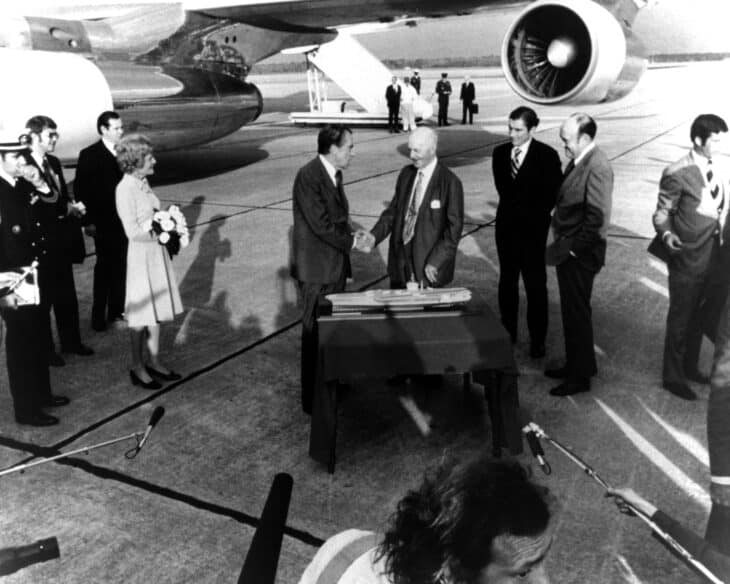

He did not see her commissioned. Vinson died in Milledgeville, Georgia, on June 1, 1981, at 97, nine months before the carrier joined the fleet.
Four Decades of the Carl Vinson
The ship’s first deployment, in 1983, was a voyage around the world to a new homeport at Alameda, California. Since then she has worked mostly in the Pacific, the Indian Ocean and the Middle East.
1983
Around the world. First major deployment, ending at her new homeport of Alameda, California.
1990s
Iraq. Operation Southern Watch and Desert Strike in the mid-1990s, then Operation Desert Fox in 1998.
Oct. 7, 2001
Afghanistan. Already deployed on September 11, her aircraft flew the opening carrier strikes of Operation Enduring Freedom alongside USS Enterprise.
2005 to 2009
Midlife overhaul. The third Nimitz-class carrier to go through a Refueling and Complex Overhaul.
Jan. 2010
Haiti. Earthquake relief. One embarked helicopter squadron delivered more than 280,000 pounds (127,000 kg) of aid and flew 240 medical evacuations.
2014 to 2015
ISIS. Carrier Air Wing 17 flew 12,300 sorties, more than 2,300 of them combat missions over Iraq and Syria.
March 5, 2018
Vietnam. Arrived at Da Nang, the first U.S. aircraft carrier to visit Vietnam in more than 40 years.
The Afghanistan strikes are the ones the Navy singles out. Its 40th-anniversary account says the ship was under way during the September 11 attacks and later launched the first airstrikes of the Global War on Terrorism, sharing the opening carrier strikes with USS Enterprise.
A Burial at Sea, Then a Basketball Game
On May 2, 2011, the body of Osama bin Laden was brought aboard Carl Vinson in the North Arabian Sea, within 24 hours of his death in Pakistan. A senior defense official said the burial was at sea because no country would accept the remains.
Preparations began at 1:10 a.m. Eastern time and were finished at 2 a.m. The body was washed, wrapped in a white sheet and placed in a weighted bag, and an officer read prepared religious remarks that a native speaker translated into Arabic.
The body was then placed on a flat board, which was tilted up on one side until it slid into the sea.
Six months later, on Veterans Day, the same flight deck held the first Carrier Classic. With the ship docked at North Island, No. 1 North Carolina beat Michigan State 67 to 55 on a court laid where jets normally launch.
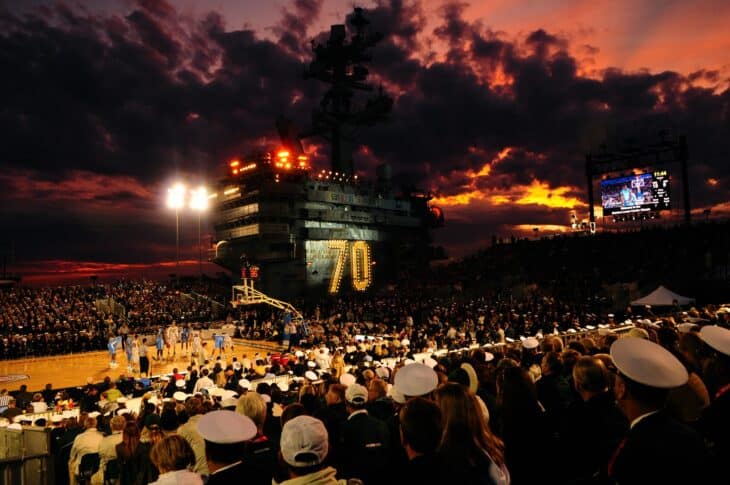

President Barack Obama watched from courtside. The White House counted more than 8,000 people in the stands, most of them in uniform.
The “Armada” That Was Sailing the Other Way
In April 2017, North Korea’s missile tests had the Pacific on edge. On April 8, U.S. Pacific Command canceled Carl Vinson’s planned visit to Australia and said the strike group would “sail north” to the Western Pacific.
Defense Secretary Jim Mattis said she was “on her way up.” President Donald Trump told Fox Business, “We are sending an armada, very powerful,” and North Korea condemned the approaching carrier.
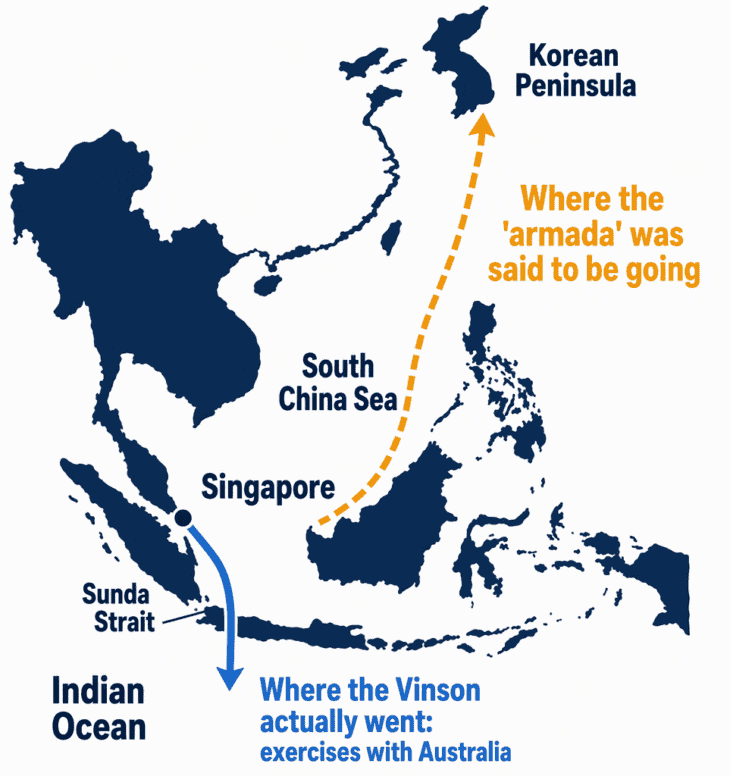
Then the Navy posted a photo dated April 15. It showed Carl Vinson passing through the Sunda Strait between Java and Sumatra, heading south, roughly 3,500 miles (5,600 km) from the Sea of Japan.
Myth: the carrier was steaming toward Korea when the armada was announced
While Washington described the strike group heading north, it was finishing a planned exercise with Australian forces in the Indian Ocean. The Navy’s own updates only said the ships were in the South China Sea, which technically reaches south of Singapore, without saying which way they were going. The carrier did turn north afterward, and officials said she would reach Korean waters by late April.
The episode did not slow the ship’s diplomatic career. The next year, on March 5, 2018, Carl Vinson tied up at Da Nang with the cruiser Lake Champlain and the destroyer Wayne E. Meyer, a visit the U.S. ambassador called “an enormously significant milestone.”
The First Carrier to Deploy With the F-35C
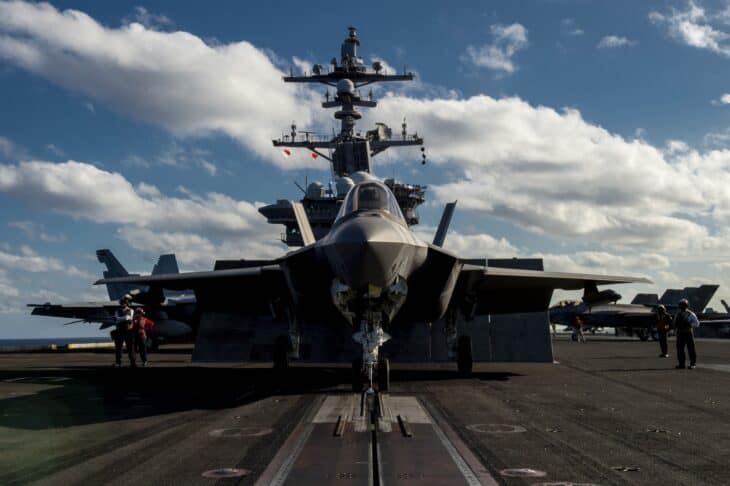
A 17-month maintenance period ending in 2020 rebuilt Carl Vinson to handle the F-35C Lightning II. When she left San Diego in August 2021, hers was the first carrier strike group to deploy with both the F-35C and the CMV-22B, the Navy’s version of the V-22 Osprey.
_Conducts_Routine_Flight_Operations_in_the_Philippine_Sea_(8802189).jpg)
The F-35Cs of Strike Fighter Squadron 147 flew alongside three squadrons of F/A-18E/F Super Hornets. Vinson’s air wing commander called her the first carrier to accommodate a mix of fourth- and fifth-generation fighters.
The same deployment left one of those jets on the seafloor. On January 24, 2022, an F-35C crashed in a landing mishap on the flight deck in the South China Sea, injuring seven service members, and the jet went over the side.
Thirty-seven days later, a Navy team aboard the diving support vessel Picasso used a CURV-21 remotely operated vehicle to rig the wreck and hoist it from about 12,400 feet (3,780 m) down.
Strikes on the Houthis in 2025
Carl Vinson left San Diego in November 2024 for a deployment that started in the Indo-Pacific. In March 2025 she was ordered to the Middle East, arriving in April.
There her strike group hit Iran-backed Houthi targets in Yemen during Operation Rough Rider. The Navy says the strikes disrupted threats to commercial shipping in the Red Sea, the Gulf of Aden and the Bab al-Mandeb Strait.
She came home on August 14, 2025, after nine months. The Navy says the strike group flew more than 10,000 sorties and 23,000 flight hours and sailed more than 275,000 nautical miles across all its ships.
Was the USS Carl Vinson in Top Gun?
Not as a filming location, as far as the production record shows. The American Film Institute’s catalog says filming took place in mid-July 1985 aboard USS Ranger, docked near Coronado, and that the crew was due to spend five days at sea aboard USS Enterprise that August.
The end credits do thank the crews of Enterprise, Carl Vinson and Ranger. Top Gun: Maverick was shot aboard two other Nimitz-class carriers, USS Abraham Lincoln and USS Theodore Roosevelt.
The movie that was partly filmed aboard Carl Vinson is Behind Enemy Lines, the 2001 thriller with Owen Wilson and Gene Hackman. Wilson spent a week aboard, and many of the crew appeared as extras.
The studio later held a sneak preview for 5,500 sailors aboard the ship. By then she was in the Arabian Sea flying missions over Afghanistan, and CNN reported the crew had flown 2,000 sorties since arriving in October.
Where Is the USS Carl Vinson Now?
As of early October 2026, Carl Vinson is in San Diego preparing for her next deployment. She finished a seven-month maintenance period at North Island on June 12, 2026, after more than 359,000 man-hours of work, and was at sea in August for carrier certifications.
A carrier on a race track
In June 2026, the NASCAR Cup Series raced on a street course laid out across Naval Base Coronado, and the route ran past USS Carl Vinson in Turns 3 and 4.
She is one of the Navy’s 11 carriers, and only a few of those are at sea on a typical day. That makes a ship fresh out of maintenance valuable.
Every Nimitz-class carrier is designed for about 50 years of service with one midlife refueling. For a ship commissioned in 1982, that points to the early 2030s, although the Navy has kept older sisters like USS Nimitz in service past that mark.
The man the ship honors almost never went to sea himself. More than four decades after he watched her launched, the carrier named for him has gone just about everywhere instead.
Sources and references used for research and fact-checking.
- The American Presidency Project, UC Santa Barbara, Proclamation 4735: Honoring Carl Vinson
- New Georgia Encyclopedia, Carl Vinson (1883-1981)
- Naval Air Force, U.S. Pacific Fleet, USS Carl Vinson (CVN 70): About Us
- U.S. Navy, Aircraft Carriers - CVN fact file
- U.S. Navy, USS Carl Vinson Celebrates 40th Commissioning Anniversary
- Wikipedia, USS Carl Vinson
- 19FortyFive, The US Navy Still Needs Nimitz-Class Nuclear Aircraft Carrier USS Carl Vinson After 44 Years
- U.S. Pacific Fleet (American Forces Press Service), Bin Laden Buried at Sea
- The White House (archived), President Obama Attends Carrier Classic
- The Everett Herald (Associated Press), Heels win Carrier Classic
- NPR, That 'Armada' Heading To North Korea? Actually, It Sailed South
- Military.com, US Carrier Still Thousands of Miles from Korean Waters
- The Maritime Executive, Carrier Was 3,000 nm Away During North Korea Tensions
- U.S. Pacific Fleet, U.S. Aircraft Carrier Arrives in Vietnam for Historic Visit
- U.S. Navy, Carl Vinson Carrier Strike Group Departs on Deployment
- NBC News, U.S. Navy recovers warplane that fell into South China Sea
- Seapower Magazine, U.S. Navy Recovers F-35C from South China Sea
- U.S. Navy, Carl Vinson Carrier Strike Group Returns from 9-month Deployment
- The National Interest, Where Are America's Aircraft Carriers Now?
- DVIDS, USS Carl Vinson completes Planned Incremental Availability
- AFI Catalog of Feature Films, Top Gun (1986)
- U.S. Navy All Hands, Top Gun: Maverick advance premiere
- CNN, Behind Enemy Lines preview aboard USS Carl Vinson
- Fox Sports, Racing on a naval base presents unique challenge for NASCAR drivers
Get the Newsletter
The latest aviation news and stories sent to your inbox.
About the Author

Tim is the owner and lead editor of AeroCorner since 2019, overseeing aviation content covering aircraft, airlines, airports, and the broader aviation industry. Through years of researching, writing, editing, and publishing aviation-focused content, he has developed extensive practical knowledge of commercial aviation and air travel. Based in Asia and a frequent traveler himself, Tim also brings firsthand passenger experience to AeroCorner’s coverage. Outside of publishing, he has also explored aviation firsthand through hands-on flight training in New Zealand.