

Table of Contents
In April 2020, the commanding officer of a nuclear aircraft carrier left his ship at Naval Base Guam after being relieved of command. As he went, his sailors cheered him and chanted his name.
The ship was USS Theodore Roosevelt. Nearly three decades earlier, she had flown more sorties in Desert Storm than any other carrier. Now a virus would infect more than a quarter of her crew without a shot fired.
Here is what the ship is, why she is called the Big Stick, what really happened in Guam, and where she is in 2026.
What Is the USS Theodore Roosevelt?
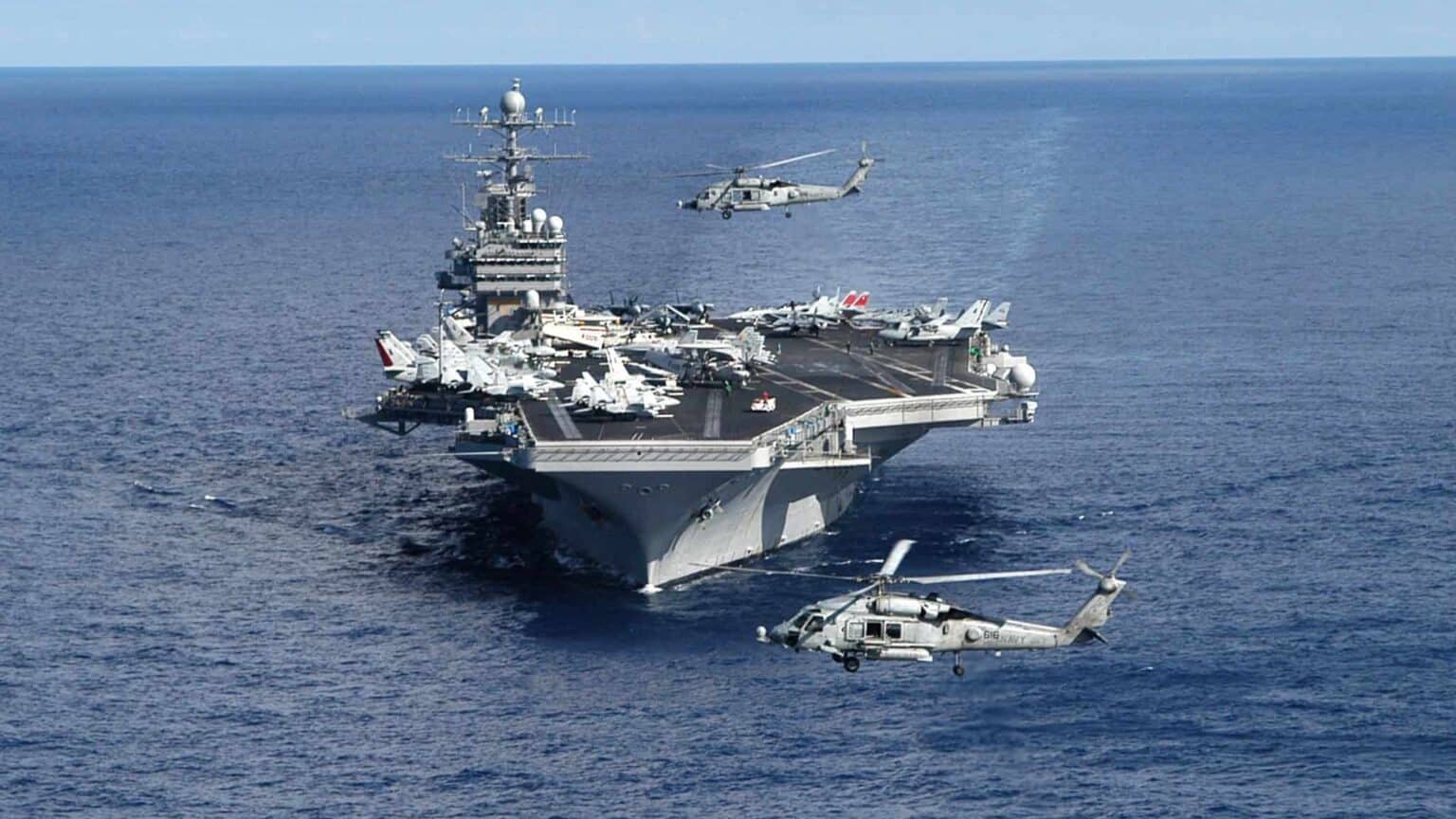
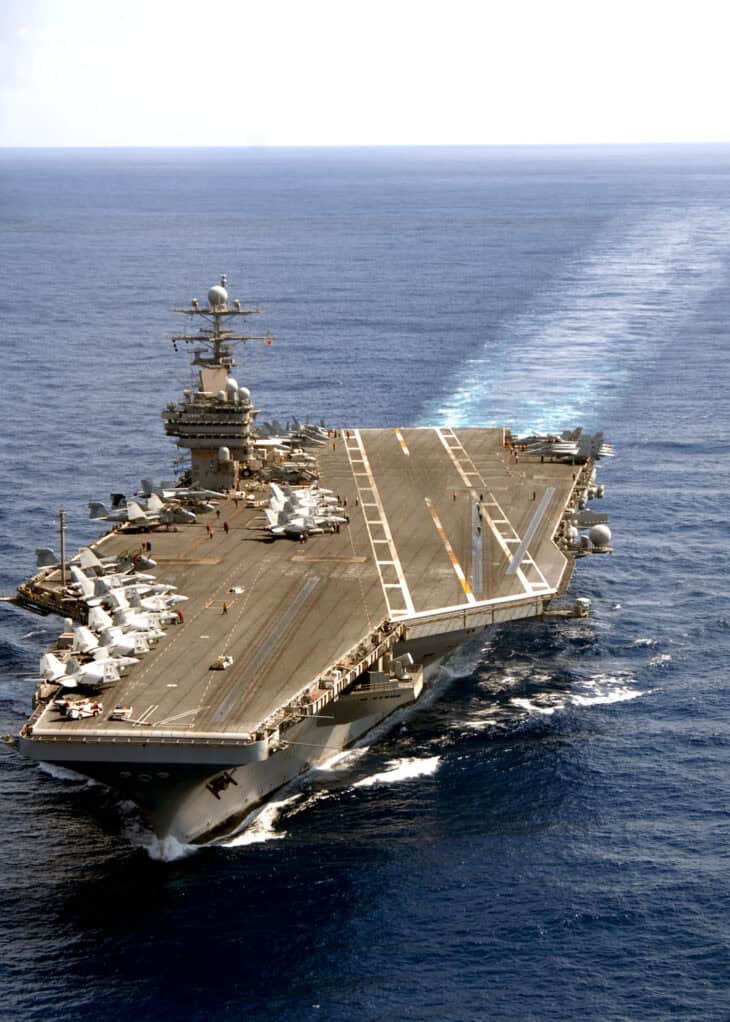
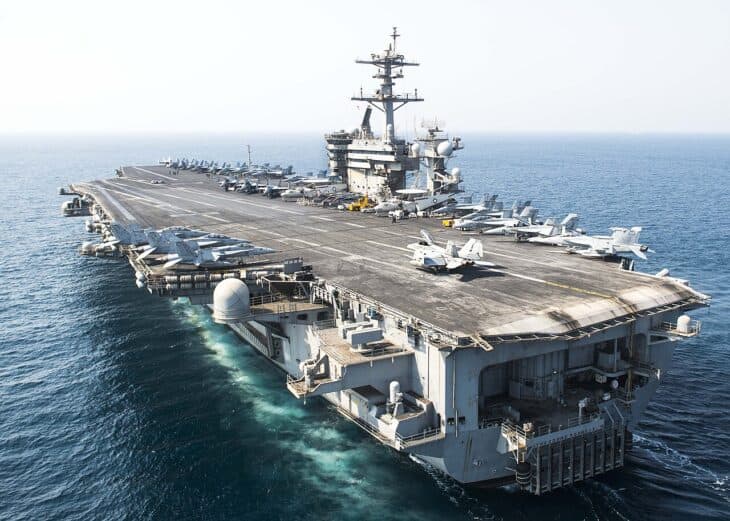
USS Theodore Roosevelt (CVN-71) is the fourth of ten Nimitz-class aircraft carriers, named for the 26th president. She was commissioned on October 25, 1986, and is homeported in San Diego.
She is the flagship of Carrier Strike Group 9 and carries Carrier Air Wing 11. The Navy describes her as 4.5 acres of sovereign U.S. territory and 97,000 tons of diplomacy.
USS Theodore Roosevelt at a glance
Fourth Nimitz-class carrier, hull number CVN-71, nicknamed the Big Stick. Christened October 27, 1984, commissioned October 25, 1986. The first carrier built from modules. Flew 3,897 sorties in Desert Storm. Hit by a COVID-19 outbreak in 2020 that infected 1,271 crew members. Left San Diego on a new deployment on September 27, 2026.
| USS Theodore Roosevelt (CVN-71) | |
|---|---|
| Class | Nimitz (fourth of ten) |
| Builder | Newport News Shipbuilding, Virginia |
| Ordered | September 30, 1980 |
| Keel laid | October 31, 1981 |
| Launched and christened | October 27, 1984 |
| Commissioned | October 25, 1986 |
| Length | 1,092 feet (333 m) |
| Flight deck | About 4.5 acres (1.8 hectares) |
| Displacement | About 97,000 tons |
| Crew | About 5,000 when deployed |
| Cost | $4.5 billion (2007 dollars) |
| Homeport | San Diego, California |
| Call sign | Rough Rider |
Why She Is Called the Big Stick
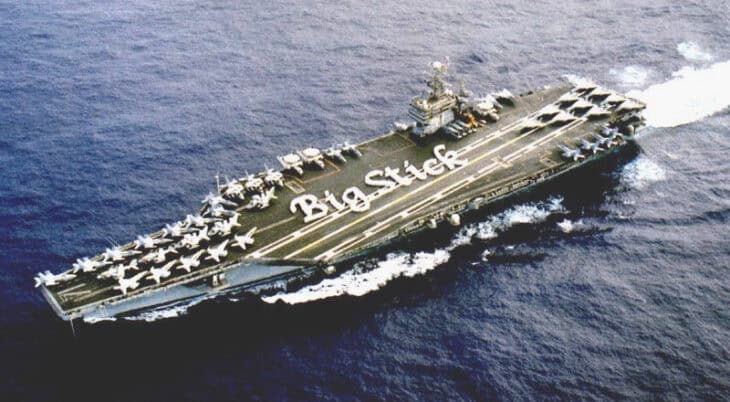
The nickname comes from Theodore Roosevelt’s foreign policy maxim, “speak softly and carry a big stick.” Few presidents had a better claim on a warship.
Roosevelt served as Assistant Secretary of the Navy just before the Spanish-American War of 1898. As president he sent 16 battleships, the Great White Fleet, around the world from December 16, 1907, to February 22, 1909.
Her launch date carries his name too. October 27 is Roosevelt’s birthday, and the Navy League chose it for the first Navy Day in 1922 for that reason. The carrier was christened on October 27, 1984, his 126th birthday.
Her radio call sign, “Rough Rider,” is the nickname of his volunteer cavalry unit in the Spanish-American War. Her motto, Qui Plantavit Curabit, translates as “He who has planted will preserve.”
The first president to fly
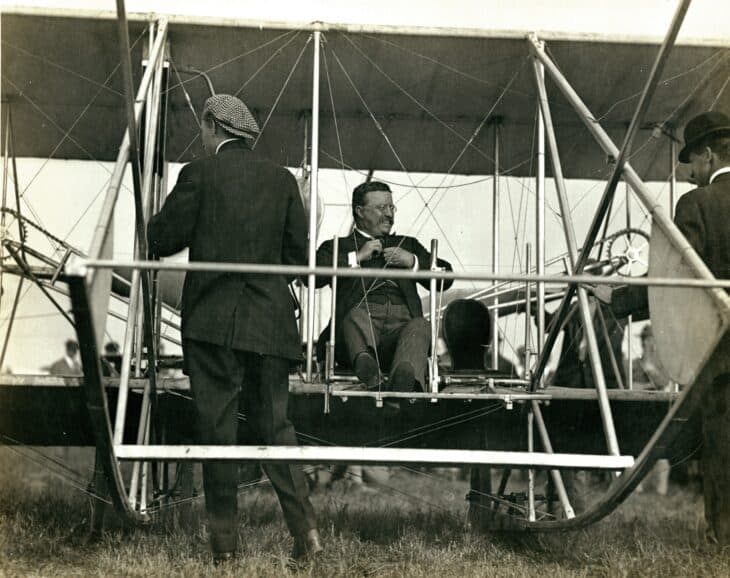
On October 11, 1910, after he had left office, Roosevelt took off from Kinloch Field in St. Louis with pilot Arch Hoxsey in a Wright Model B. They circled the field at less than 100 feet, and Roosevelt called it the finest experience he had ever had.
That makes him the first president to fly, though not the first to fly while in office. The carrier is the third Navy ship to carry his full name, after an earlier USS Theodore Roosevelt (ID-1478) and the Polaris missile submarine SSBN-600, which his daughter Alice Roosevelt Longworth sponsored in 1959.
_at_Kinloch_Field_during_the_1910_International_Aeronautic_Tournament.jpg)
One naming trap catches a lot of searchers. The Navy’s USS Roosevelt (DDG-80) is a destroyer named for Franklin and Eleanor Roosevelt, and the first carrier named for any president was USS Franklin D. Roosevelt (CV-42), commissioned on Navy Day in 1945.
The First Carrier Built in Modules
The ship nearly did not happen on schedule. President Jimmy Carter vetoed the 1979 defense authorization bill over this carrier, and she was authorized only in the 1980 bill, after the Iran hostage crisis changed the debate.
Secretary of Defense Caspar Weinberger struck the first weld on the keel on October 31, 1981. Days later, Navy Secretary John Lehman announced the name, and his wife, Barbara Lehman, christened the ship three years later.
Theodore Roosevelt was the first carrier assembled from large modules built separately on the ground and lifted into place by a 900-ton gantry crane. The method cut 16 months from construction, and every American carrier since has been built the same way.
Four Decades of Combat Cruises
She saw her first combat in 1991, and she has deployed for nearly every American air campaign since. The headline numbers come from the Navy’s own accounts of each cruise.
1991
Desert Storm. Flew 3,897 sorties, more than any other carrier, and dropped more than 4.8 million pounds (2,200 metric tons) of ordnance before the February 28 ceasefire.
1999
Kosovo. Called straight to the Ionian Sea on deployment for about two months of NATO airstrikes in Operation Allied Force.
2001 to 2002
Afghanistan. Left Norfolk eight days after September 11 and spent 160 consecutive days at sea, at the time a record for the longest period underway since World War II.
March 22, 2003
Iraq. Began launching strikes into Iraq from the Eastern Mediterranean alongside USS Harry S. Truman.
2009 to 2013
Midlife overhaul. A four-year, $2.4 billion refueling and complex overhaul at Newport News.
2015
ISIS and a new coast. A round-the-world cruise with 1,800 sorties against ISIS, ending at her new homeport of San Diego on November 23.
2024
The Middle East. A nine-month deployment that moved from the Western Pacific to the Middle East: more than 9,000 sorties, 21,000 flight hours and 71,000 nautical miles.
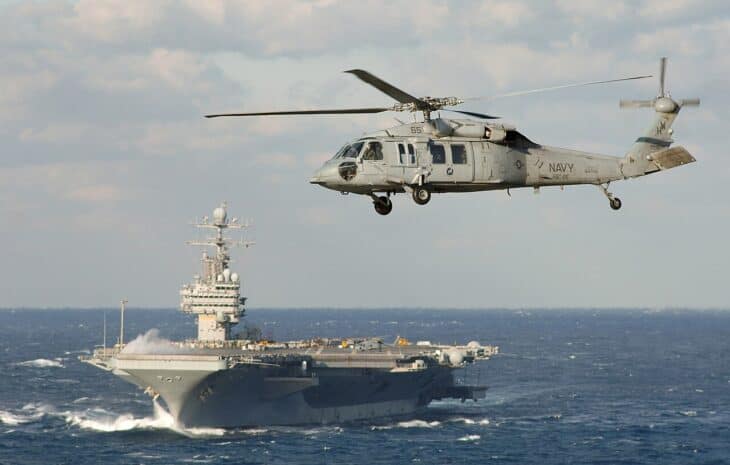
The 2024 cruise passed a milestone on March 19, when an F/A-18F Super Hornet made the 250,000th arrested landing on her deck. That summer she relieved USS Dwight D. Eisenhower in the Middle East before coming home in mid-October.
She also has a film credit. The Navy says Top Gun: Maverick was shot aboard two carriers, USS Abraham Lincoln and USS Theodore Roosevelt.
The Outbreak in Guam
In early March 2020, deployed in the Western Pacific, the carrier made a port call at Da Nang, Vietnam. On the last night, some sailors stayed at a hotel where two people had tested positive for COVID-19, and the ship had no test kits aboard.
The first sailor tested positive on March 22. The ship arrived in Guam on March 27, and the case count kept climbing faster than anyone could isolate the sick.
On March 30, Captain Brett Crozier sent a four-page memo by unclassified email to ten officers, three admirals in his chain of command and seven captains. He asked to move most of the crew ashore, because the virus could not be contained in the ship’s close quarters.
The next day the San Francisco Chronicle published the memo. On April 2, Acting Navy Secretary Thomas Modly relieved Crozier, saying the captain had shown “extremely poor judgment” by sending it to such a wide list.
Modly then flew to Guam and told the crew over the ship’s loudspeakers that Crozier was “too naïve or too stupid” to command if he had not expected a leak. He apologized the same day and resigned on April 7.
Six days later, Chief Aviation Ordnanceman Charles Robert Thacker Jr., 41, of Fort Smith, Arkansas, died of COVID-19 at U.S. Naval Hospital Guam. He had tested positive on March 30 and was found unresponsive in isolation on April 9.
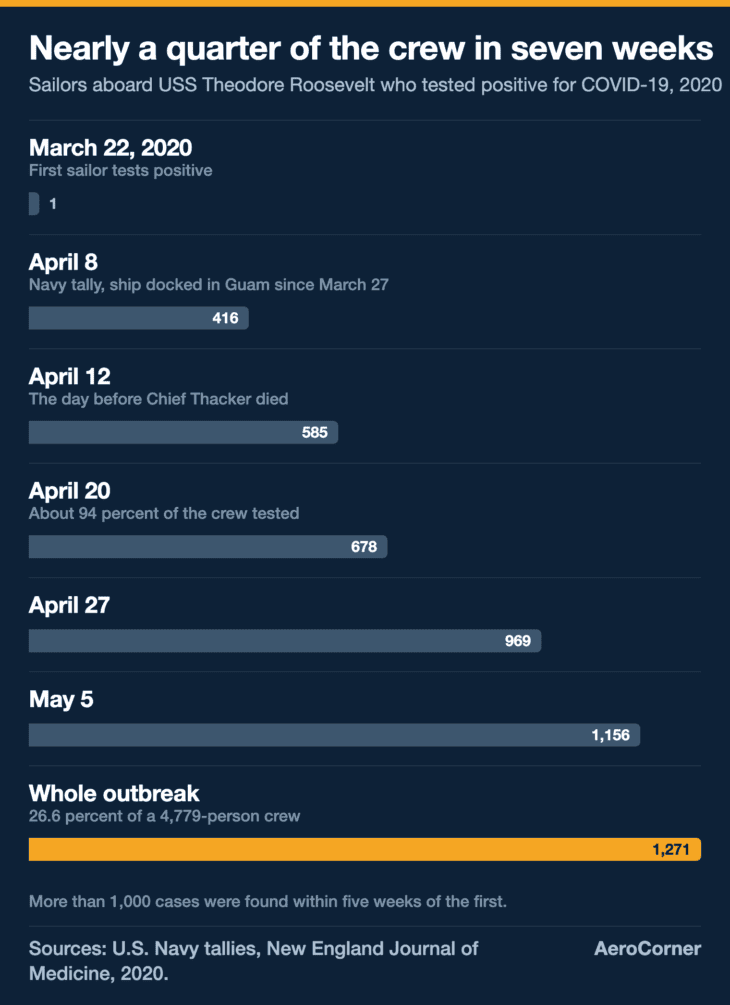
A Navy study in the New England Journal of Medicine later counted 1,271 positive cases among a crew of 4,779, or 26.6 percent. Of those, 76.9 percent had no symptoms when they tested positive.
Twenty-three sailors were hospitalized, four needed intensive care, and one died. The dates in the chart are the Navy’s running tallies, and the last bar is the study’s total for the whole outbreak.
The carrier went back to sea on May 21 with about 3,000 sailors, leaving about 1,800 in quarantine on Guam, with plans to come back for them.
Was Captain Crozier Fired for Leaking the Letter?
Myth: the Navy kept Crozier out of command because he leaked his letter
The Navy’s own final investigation concluded that Crozier did not intentionally leak the email. It upheld his removal for a different reason: the way he and his strike group commander handled the outbreak itself.
The first ruling did not hold. On April 24, the Chief of Naval Operations, Admiral Mike Gilday, and the acting Navy secretary recommended putting Crozier back in command, and Defense Secretary Mark Esper delayed a decision pending a deeper review.
That review, led by Admiral Robert Burke, was announced on June 19, 2020. It found that commanders were slow to move sailors off the ship, released some from quarantine too early, and disputed whether quarantined sailors needed individual hotel rooms.
Gilday said of Crozier, “Had I known then what I know today, I would have relieved him.” Rear Admiral Stuart Baker, the strike group commander, had his promotion put on hold, and Crozier was barred from future command.
Crozier retired in March 2022. On October 29, 2024, LTA Research, the company flight testing the Pathfinder 1 airship, named him chief executive, putting the Big Stick’s former captain in charge of building airships.
The First Carrier Ready for the MQ-25
In July 2021 the ship moved to the Puget Sound Naval Shipyard in Bremerton, Washington, for work to handle the F-35. About 3,000 sailors and their families moved with her, and she left for sea trials in March 2023.
Her newest first is a room, not an airplane. A Pentagon acquisition report dated April 21, 2026, says her Unmanned Air Warfare Center became the first fully operational, deployable one in March 2026. It is where operators will fly the MQ-25 Stingray, the Navy’s carrier-based tanker drone.
The drone itself is running late. The same report moved its initial operational capability from July 2027 to February 2029.
Where Is the USS Theodore Roosevelt Now?
In early October 2026, Theodore Roosevelt was crossing the Pacific on deployment. She left San Diego without ceremony on Sunday, September 27, 2026, after a year of work-ups that included COMPTUEX in April and May and leading the U.S. contingent at RIMPAC off Hawaii in June and July.
The Navy said only that she was conducting routine operations. NBC 7 San Diego reported that the strike group is expected to relieve the Japan-based USS George Washington in the Middle East, amid the U.S. war with Iran.
Escorts include the cruiser USS Chosin and three destroyers. Carrier Air Wing 11 brings F-35Cs, Super Hornets, EA-18G Growlers, E-2D Hawkeyes, Seahawk helicopters and CMV-22B Ospreys.
The National Interest reports that her arrival could put three carriers in the region at least briefly, and that she is unlikely to return before spring or summer 2027.
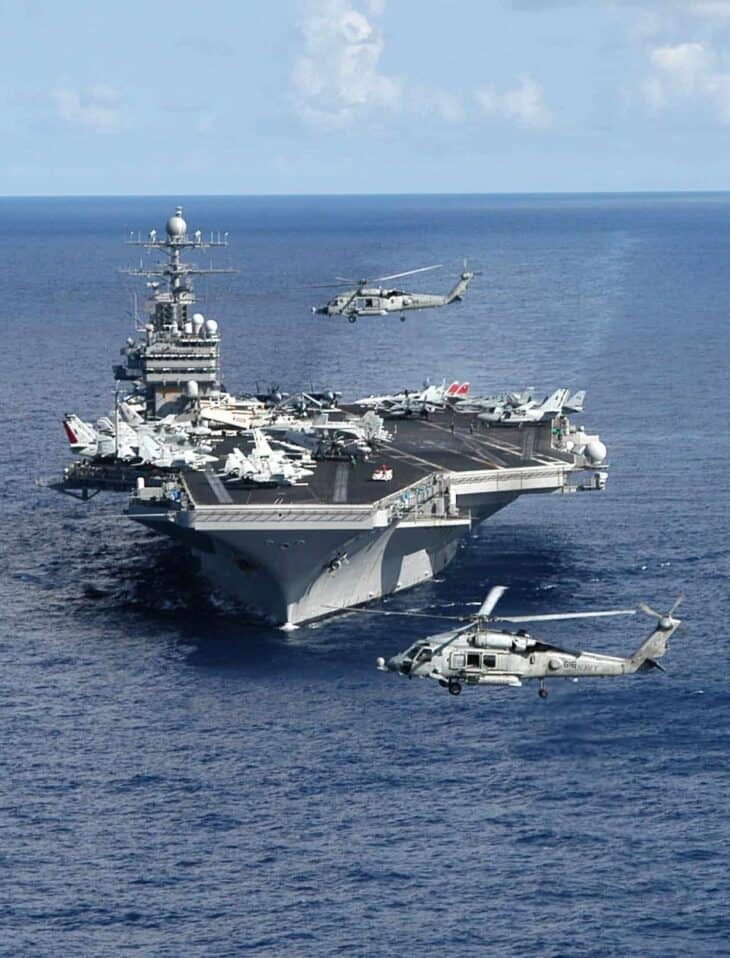
She is one of the Navy’s 11 aircraft carriers, and every Nimitz-class carrier is designed for about 50 years of service with one midlife refueling, and hers came in 2009 to 2013. For a ship commissioned in 1986, that points to the mid-2030s.
By then the sailors who chanted their captain’s name on that pier in Guam will mostly be gone. The Big Stick will still be on the books as the carrier that flew the most sorties of any in Desert Storm, and the one that taught the Navy how fast a virus moves through a ship.
Sources and references used for research and fact-checking.
- Wikipedia, USS Theodore Roosevelt (CVN-71)
- Naval Air Force, U.S. Pacific Fleet, USS Theodore Roosevelt (CVN 71): About Us
- Naval Air Force, U.S. Pacific Fleet, USS Theodore Roosevelt (CVN 71)
- U.S. Navy, Aircraft Carriers - CVN fact file
- Wikipedia, Navy Day
- Wikipedia, Great White Fleet
- Wikipedia, USS Theodore Roosevelt (SSBN-600)
- Wikipedia, USS Roosevelt (DDG-80)
- Wikipedia, USS Franklin D. Roosevelt
- This Day in Aviation, Arch Hoxsey
- U.S. Navy All Hands, Top Gun: Maverick advance premiere
- U.S. Pacific Fleet, Theodore Roosevelt Carrier Strike Group returns to San Diego after 9-month deployment
- Wikipedia, COVID-19 pandemic on USS Theodore Roosevelt
- Wikipedia, Brett Crozier
- New England Journal of Medicine (via PubMed), An Outbreak of Covid-19 on an Aircraft Carrier
- U.S. Pacific Fleet, Navy identifies USS Theodore Roosevelt Sailor who died of COVID-19
- NBC 7 San Diego (Associated Press), Navy upholds firing of carrier captain in virus outbreak
- LTA Research, LTA Research announces new CEO
- The War Zone, USS Theodore Roosevelt Is The First Carrier With A Drone Control Center Ready For MQ-25 Stingray Ops
- Stars and Stripes, US carrier Theodore Roosevelt to lead RIMPAC drills this summer in Hawaii
- The War Zone, Where Are The Aircraft Carriers?: September 30, 2026
- NBC 7 San Diego, USS Theodore Roosevelt deploys from San Diego
- The National Interest, Where Are America's Aircraft Carriers Now?
Get the Newsletter
The latest aviation news and stories sent to your inbox.
About the Author

Tim is the owner and lead editor of AeroCorner since 2019, overseeing aviation content covering aircraft, airlines, airports, and the broader aviation industry. Through years of researching, writing, editing, and publishing aviation-focused content, he has developed extensive practical knowledge of commercial aviation and air travel. Based in Asia and a frequent traveler himself, Tim also brings firsthand passenger experience to AeroCorner’s coverage. Outside of publishing, he has also explored aviation firsthand through hands-on flight training in New Zealand.