

On July 8, 2026, President Donald Trump climbed the airstairs of the legacy Boeing VC-25A that serves as Air Force One at Ankara Esenboga Airport, waved at the cameras, and stepped inside. According to reporting published on August 10 by the Washington Post, he never flew on it.
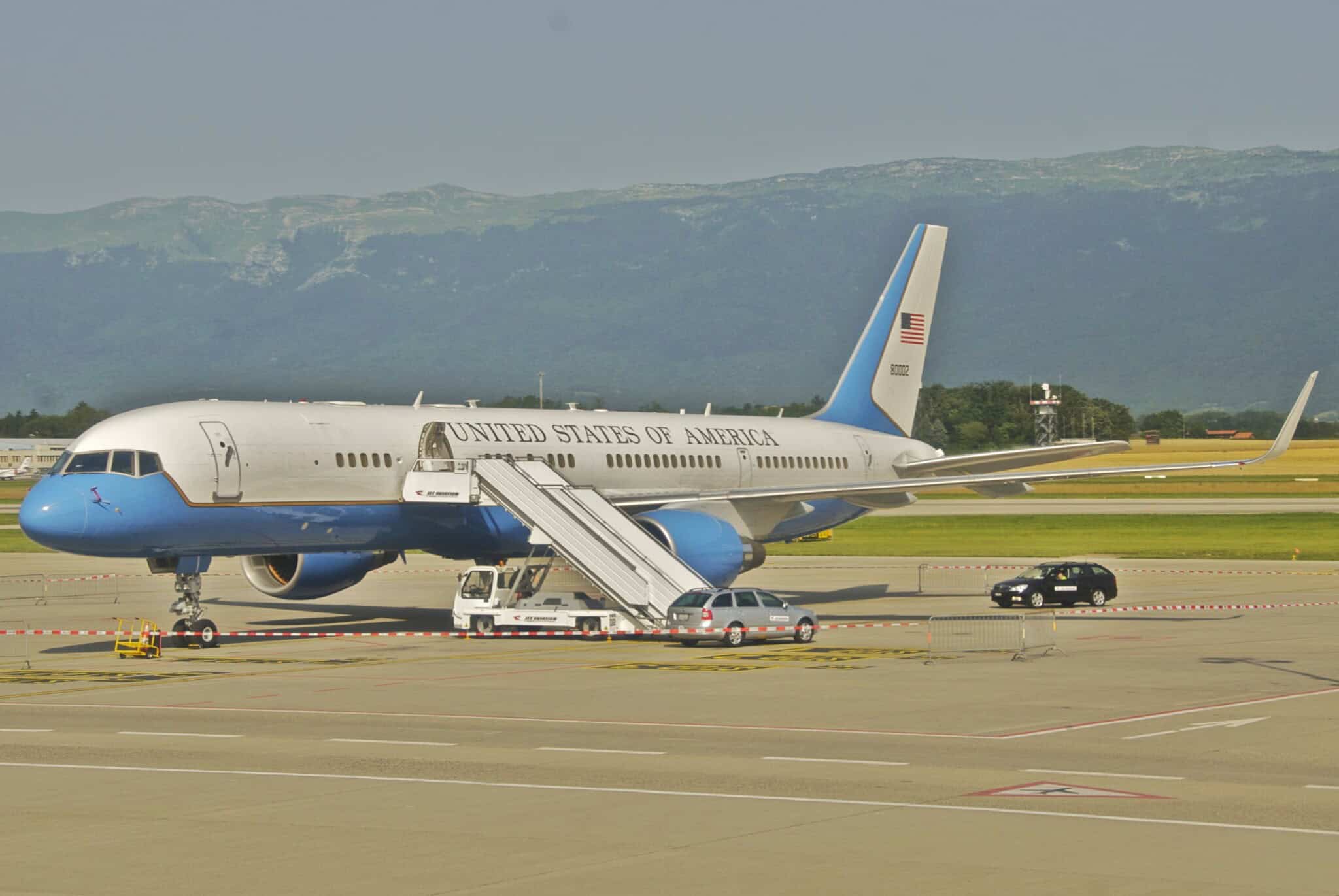
Minutes later, the Post reported, he was moved off the aircraft in an airport catering truck and driven to a C-32A, a military Boeing 757-200. The 747 departed as a decoy, carrying the traveling press and some White House staff who believed the president was on board with them.
The operation followed a credible Iranian threat against the president, on the night after U.S. forces renewed strikes on Iran. The White House did not dispute that something happened, telling reporters there are “many enemies of America who have their sights on him, and we use every tool at our disposal to address those threats.”
What was reported
The C-32A flew roughly 1,700 miles (2,700 km) from Ankara to RAF Mildenhall in England and landed shortly before the decoy did. Journalists aboard the 747 were told to keep their window shades down, an instruction passed to them as a Secret Service requirement.
One detail matters more to aviation readers than the catering truck does. The legacy jet initially appeared on radar with no callsign at all, then took up “AF1” in flight, while the president was somewhere over Europe on a different airplane.
The callsign is part of the deception
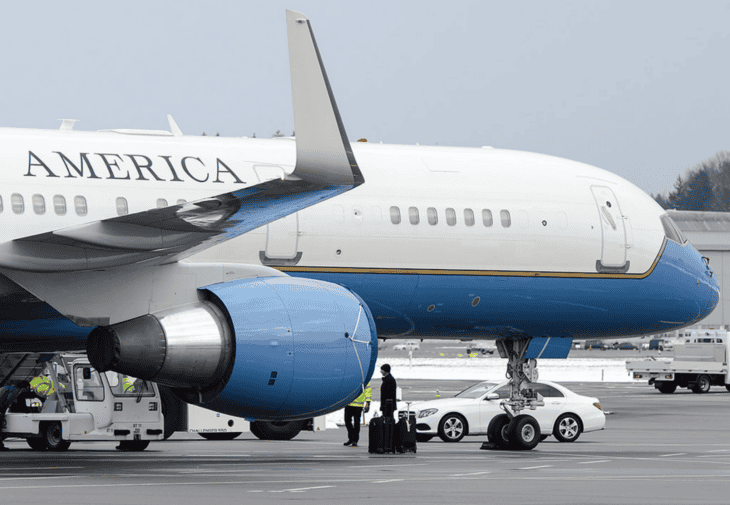
Air Force One is not an aircraft. It is the callsign carried by any U.S. Air Force aircraft with the president aboard. On July 8 the callsign and the president were reportedly on two different airplanes, which is the whole point of a decoy.
Presidential movements are already among the most tightly managed in aviation, from the fighter escort posture down to the airspace itself. The FAA made the no-fly zone over Trump Tower permanent in July. What the Post described goes a step further, using the flight itself as the deception rather than protecting it.
1990
The VC-25A pair enters service. Two heavily modified Boeing 747-200s take over presidential airlift with a full defensive countermeasures suite and hardened communications.
2025
Qatar gifts a 747-8. The U.S. accepts a VIP-configured Boeing 747-8 from the Qatari royal family and hands it to L3Harris for conversion.
July 1, 2026
The Bridge jet enters service. The converted 747-8 flies its first presidential mission, to Bismarck, North Dakota.
July 8, 2026
The Ankara switch. Trump boards the legacy VC-25A on camera, leaves by catering truck, and flies to England on a C-32A while the 747 continues as a decoy.
July 20, 2026
Trump confirms upgrades. He says the Bridge jet will be sent away to “be maxed out”; the White House puts the work at about a month.
August 10, 2026
The operation becomes public. The Washington Post reports the July 8 aircraft swap, five weeks after it happened.
The aircraft that actually did the job
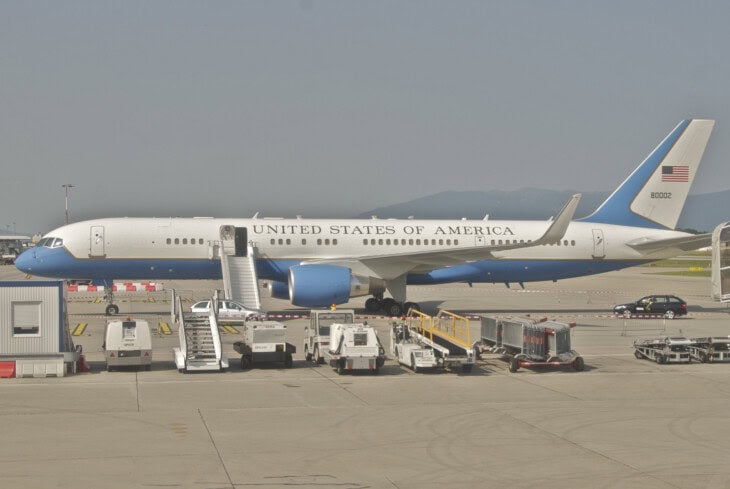
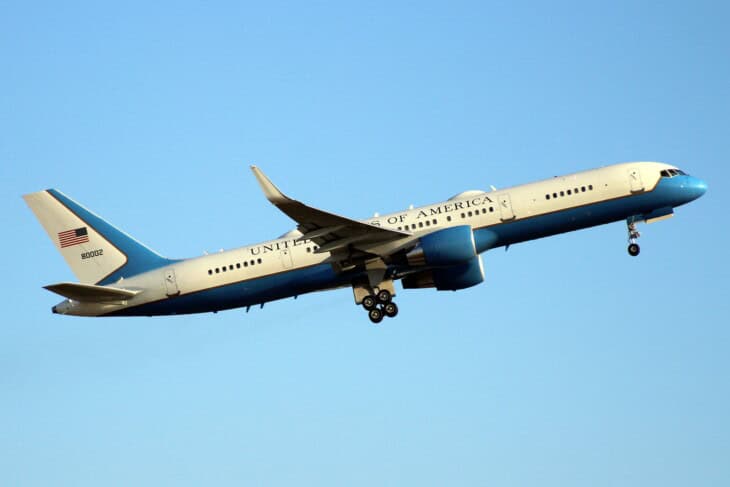
The C-32A is a specially configured Boeing 757-200 operated by the 1st Airlift Squadron of the 89th Airlift Wing at Joint Base Andrews. The Air Force fact sheet lists its normal customers as the vice president, who flies it under the callsign “Air Force Two,” the first lady, and members of the Cabinet.
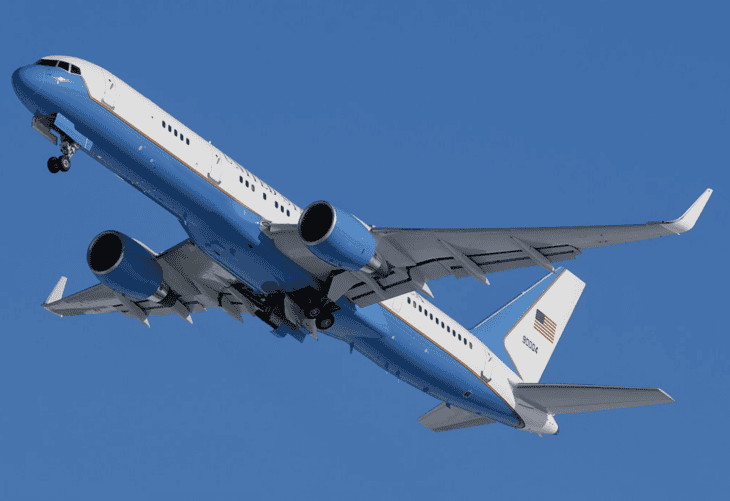
Four are in the inventory, all delivered in 1998. Each carries two Pratt & Whitney PW2040 engines, seats about 45 passengers, and has a published range near 6,325 miles (10,180 km), which is far more than the Ankara to England leg needed.
It is a capable long-range jet flown by the same wing that supplies presidential aircrews. What it is not is the hardened, self-sufficient platform the VC-25A was built to be, with its own airstairs, its own baggage loader, and aerial refueling capability.
On a mission built around concealment, though, its real advantage is that it is unremarkable. A USAF 757 moving between European bases is an ordinary sight in a way that a blue-and-white 747 never is.
Why neither 747 was the obvious choice
This is the part of the story that has been largely lost under the catering truck. The U.S. presidential airlift fleet was in an unusually thin spot on July 8, and the aircraft chosen that day reflects it.
The two VC-25As entered service in 1990 and are now 36 years old. Their designated replacement, the definitive VC-25B, has slipped by years, which is why a stopgap exists at all.
That stopgap is the VC-25B Bridge, the ex-Qatari Boeing 747-8 registered N7478D, converted by L3Harris and flown on its first presidential mission on July 1, 2026. Ankara came exactly one week later.
The Bridge jet does not carry the full defensive fit of the older aircraft. TWZ reported that it lacks the visible AN/AAQ-24 directional infrared countermeasures turrets, the AN/ALQ-204 infrared countermeasures system, missile launch warning sensors, and the EMP hardening carried by the VC-25A.
Trump confirmed the shortfall publicly on July 20, saying the aircraft would be sent away to “be maxed out.” Press secretary Karoline Leavitt said the upgrades would take roughly a month and that the president would fly the old Air Force One in the meantime.
The gap the switch exposes
On July 8 the fleet could offer a 36-year-old 747 with a complete countermeasures suite, or a nearly new 747 without one. Facing a credible threat, the mission was reportedly flown on neither. That is the aviation substance underneath the catering truck headline.
The catering truck was the most ordinary part
Most coverage has treated the catering truck as an improvisation. On a working ramp it is nothing of the sort, and that is precisely why it worked.
A catering high-loader is a truck with an enclosed box body mounted on a scissor lift. The body rises until its floor matches a cabin door sill, then a bridge plate is extended so carts can be rolled straight into the galley.
Loading one at a door on the far side of the aircraft while passengers board at the front is routine turnaround choreography, repeated thousands of times a day worldwide. It is opaque, it belongs there, and nobody photographs it.
The aviation blog Live and Let’s Fly identified the vehicle as belonging to DO & CO, the caterer that holds the contract at several major European stations. That detail has not been officially confirmed.
What is confirmed and what is not
This account rests on Washington Post reporting. The White House acknowledged that measures were taken against threats but has not confirmed the specifics, and the Air Force has released no public account of the July 8 movement. Treat the sequence as reported rather than officially established.
The decoy flight will mostly be read as a political story about what the White House said and when. Read as an aviation story, it is a snapshot of a presidential airlift fleet flying aircraft older than most of the crews aboard them, with a replacement that is late and a stopgap that is not finished.
Sources and references used for research and fact-checking.
Get the Newsletter
The latest aviation news and stories sent to your inbox.
About the Author

Tim is the owner and lead editor of AeroCorner since 2019, overseeing aviation content covering aircraft, airlines, airports, and the broader aviation industry. Through years of researching, writing, editing, and publishing aviation-focused content, he has developed extensive practical knowledge of commercial aviation and air travel. Based in Asia and a frequent traveler himself, Tim also brings firsthand passenger experience to AeroCorner’s coverage. Outside of publishing, he has also explored aviation firsthand through hands-on flight training in New Zealand.