

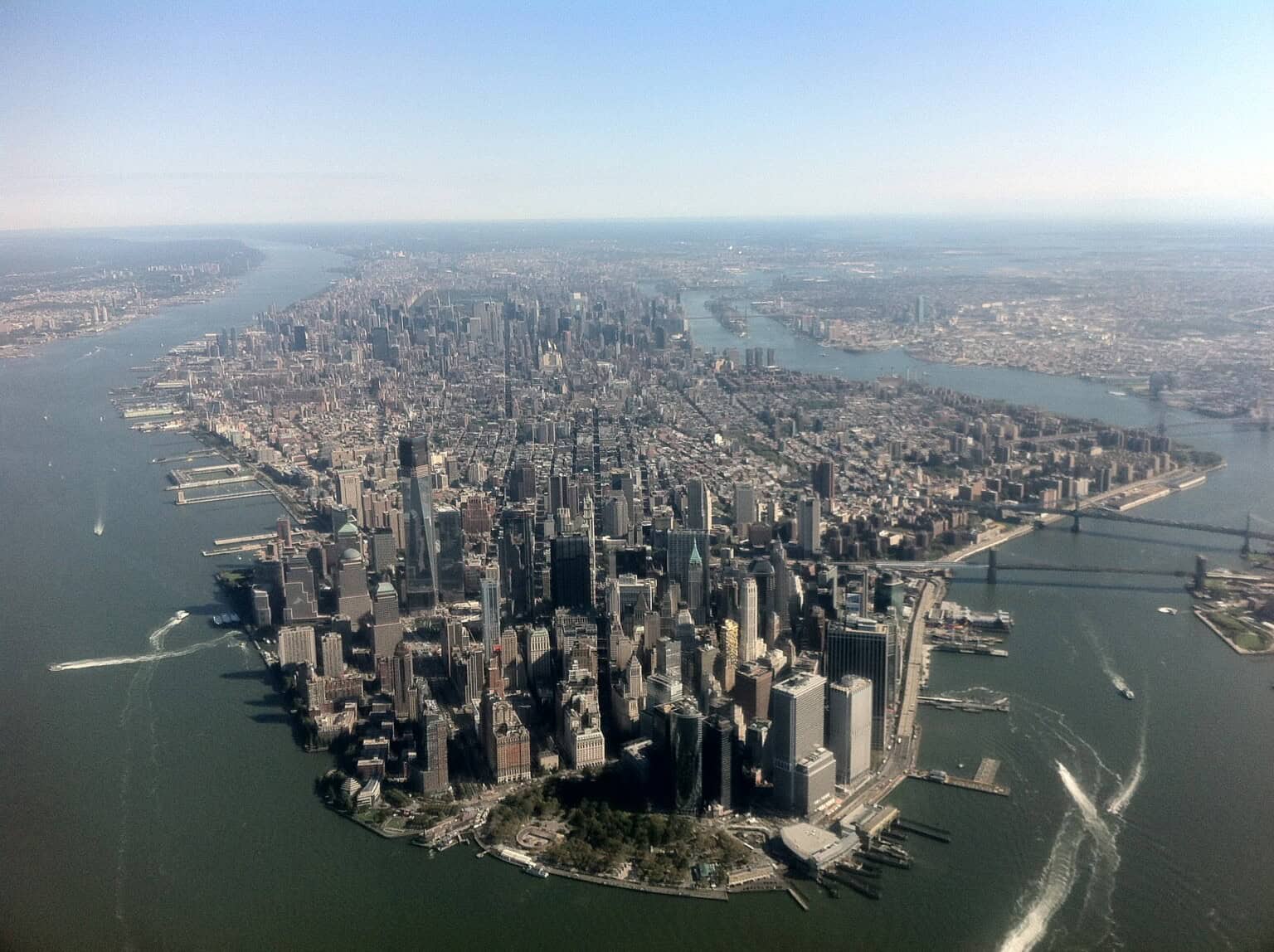
On July 31, 2026, the FAA published a final rule establishing Prohibited Area 75 over Trump Tower in Manhattan. The restriction takes effect at 0901 UTC on October 29, 2026, and converts what has been a temporary security measure since October 2025 into a permanent, charted piece of American airspace.
P-75 bans aircraft operations from the surface to 1,000 feet above ground level within one nautical mile of the building. Its time of designation is listed as continuous, and its using agency is the United States Secret Service, which asked the FAA for the restriction in September 2025.
What the rule actually does
The shape is not a clean circle. The FAA wrote P-75 as a one nautical mile arc centered on the tower with a straight edge cut across the southeast side, parallel to the East River, deliberately carving the river out of the prohibited zone.
That carve-out is the whole design compromise. The agency said it sought “minimal impact on helicopter operations and other operations that are routinely conducted along the Hudson and East River corridors,” and built the boundary to avoid typical aircraft routes.
A second final rule published the same day amends New York Class B airspace to exclude P-75, so the two pieces of airspace do not overlap. Both take effect on the same date.
Who this actually affects
The FAA notes that before the temporary restriction went up in October 2025, the only traffic operating in this airspace was law enforcement helicopters, air ambulance aircraft and drones. Airliners into LaGuardia, JFK and Newark are thousands of feet above a 1,000-foot ceiling and are unaffected.
Why this is not just another TFR
Presidential airspace protection normally arrives as a temporary flight restriction, published by NOTAM, active while the protectee is present, and gone when the motorcade leaves. Pilots check for them before every flight because they move.
A prohibited area is a different legal instrument. It is written into 14 CFR part 73, printed on aeronautical charts, and permanent until a future rulemaking removes it. Under 14 CFR 73.83, nobody may fly inside one without authorization from the using agency, which here means Secret Service permission rather than an air traffic control clearance.
That distinction is why the rule outlives any particular occupant. P-49 over the Crawford, Texas ranch was created for President George W. Bush in 2001 and is still charted prohibited airspace today, and P-40 has covered Camp David for decades regardless of who is in office.
What is genuinely unusual about P-75 is the setting. Camp David and the Crawford ranch are rural properties with room to spare, while this one sits in the middle of the busiest low-altitude helicopter environment in the United States, a few blocks from routes that carry Marine One and commercial sightseeing traffic alike.
September 2025
The request. The Secret Service asks the FAA to restrict flight around the president’s New York residence, citing its protective authority under 18 U.S.C. 3056.
October 20, 2025
A temporary fix. The FAA issues a Special Security Instruction under 14 CFR 99.7, restricting flight in the area without charting it permanently.
April 30, 2026
Proposal published. The FAA opens Docket FAA-2025-2635 for comment. It receives exactly two comments, both supportive.
July 31, 2026
Final rule. The FAA adopts the proposal without changes and creates 14 CFR 73.95, Prohibited Area P-75.
October 29, 2026
Effective. P-75 becomes active at 0901 UTC and appears on charts, alongside a companion amendment excluding it from New York Class B airspace.
The FAA classified the action as having minimal economic impact, describing it as producing “at most de minimis costs from minor rerouting of flights.” Its own environmental review treated the designation as routine.
Low-altitude urban airspace has drawn far more scrutiny since the January 2025 midair collision at Reagan National, which put helicopter routes threading congested Class B airspace under a wave of NTSB recommendations. A permanently charted hole in the New York helicopter environment is a small change by comparison, but it is a permanent one.
One thing the rule does not answer
The final rule does not say what happens to the temporary Special Security Instruction between now and October 29, 2026, or whether it remains in force until P-75 becomes effective. The FAA addressed only the permanent designation.
Sources and references used for research and fact-checking.
- Federal Aviation Administration, Establishment of Prohibited Area P-75; New York, NY (Final Rule, 91 FR 48255)
- Federal Aviation Administration, Amendment of Class B Airspace; New York, NY (Final Rule)
- Regulations.gov, Docket FAA-2025-2635, Establishment of Prohibited Area P-75
- Federal Aviation Administration, Establishment of Prohibited Area P-49; Crawford, TX
Get the Newsletter
The latest aviation news and stories sent to your inbox.
About the Author

Tim is the owner and lead editor of AeroCorner since 2019, overseeing aviation content covering aircraft, airlines, airports, and the broader aviation industry. Through years of researching, writing, editing, and publishing aviation-focused content, he has developed extensive practical knowledge of commercial aviation and air travel. Based in Asia and a frequent traveler himself, Tim also brings firsthand passenger experience to AeroCorner’s coverage. Outside of publishing, he has also explored aviation firsthand through hands-on flight training in New Zealand.