

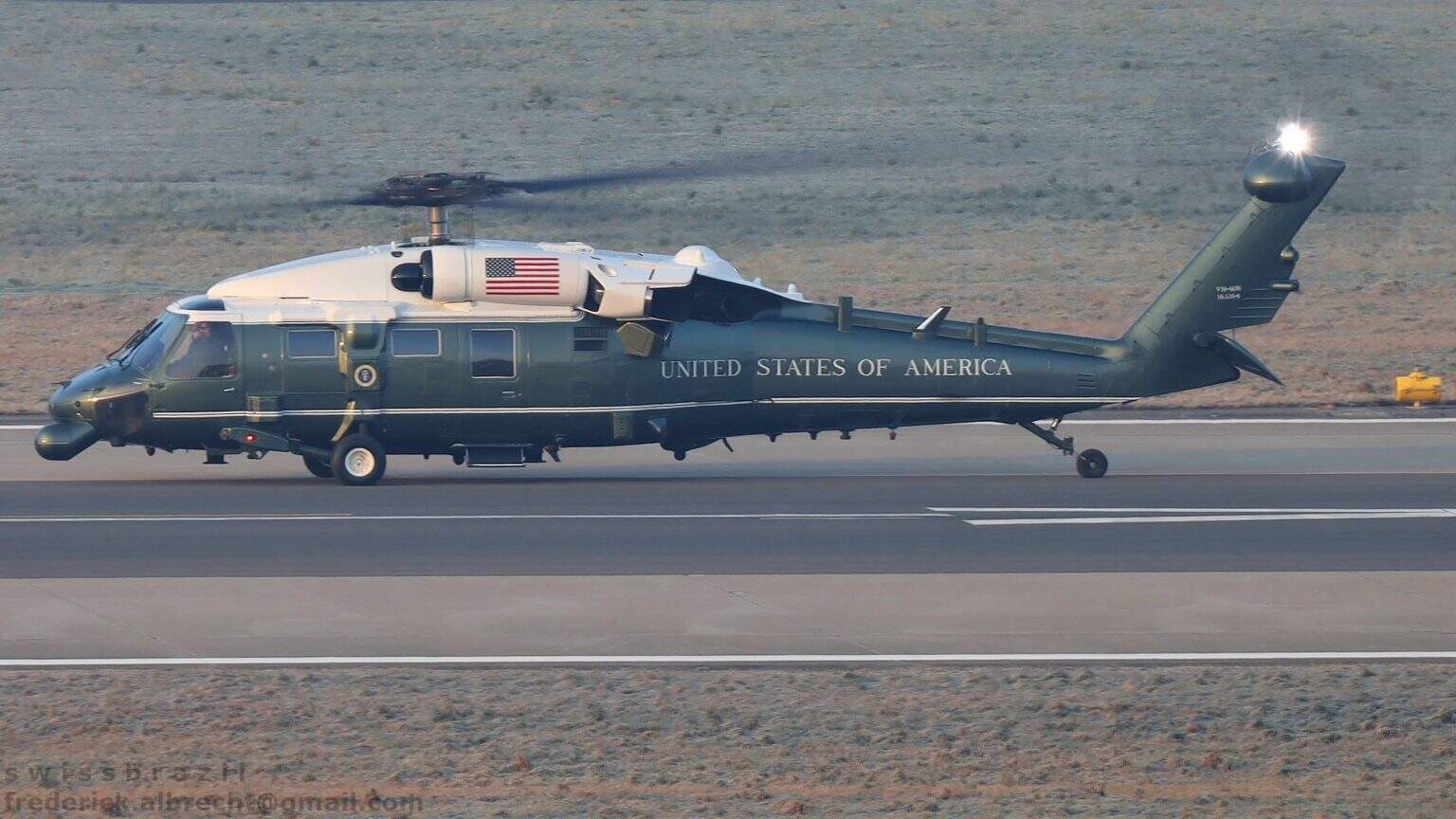
Marine One is the call sign of any US Marine Corps aircraft carrying the president of the United States. It is not one helicopter: in September 2026 three Sikorsky types can carry the name, the VH-3D Sea King, the VH-60N White Hawk and the new VH-92A Patriot, all flown by Marine Helicopter Squadron One (HMX-1).
The fleet is in the middle of a handover. The VH-92A flew its first presidential mission in August 2024, the VH-3D is due to retire after 2026, and the VH-60N is planned to serve until about 2030.
What finally lets the new helicopter take over is a granite helipad on the White House South Lawn, due for completion on September 17, 2026. Below: every Marine One type compared, how fast and far they fly, how they get overseas, why several identical helicopters show up for one passenger, and the August 2026 incident at Reagan National.
| Helicopter | Based on | Presidential service from | Passenger seats | Status (September 2026) |
|---|---|---|---|---|
| VH-3D Sea King | Sikorsky SH-3 Sea King | Late 1970s | 14 | Retiring after 2026 |
| VH-60N White Hawk | Sikorsky UH-60 Black Hawk | Late 1980s | 11 | Planned to serve until about 2030 |
| VH-92A Patriot | Sikorsky S-92 | August 2024 | 14 | Taking over; HMX-1 fleet to grow to 16 |
Marine One is a call sign, not an aircraft
Any Marine Corps aircraft becomes Marine One the moment the president boards, and drops the name when the president gets off. With the vice president aboard alone, the call sign is Marine Two. Until 1976 the Army shared the job, and its presidential flights used the call sign Army One.
What kind of helicopter is Marine One?
Three types share the mission in 2026, and all three are Sikorsky designs. Each is a heavily modified version of an existing military or civil helicopter rather than an aircraft built from scratch for the president.
VH-92A Patriot: the new Marine One
The VH-92A is a militarized version of the civil Sikorsky S-92. The Navy awarded the contract in May 2014, the first aircraft flew on July 28, 2017, and the type reached initial operational capability on December 28, 2021.
Sikorsky delivered the 23rd and final VH-92A in August 2024: 21 for the operational fleet and two for testing. On August 19, 2024, it flew as Marine One for the first time, carrying President Joe Biden from Chicago’s O’Hare International Airport to Soldier Field on his way to the Democratic National Convention.
It is larger than the helicopters it replaces. It seats 14 passengers with a crew of four and is powered by two General Electric CT7-8A turboshafts of 2,520 shaft horsepower each.
| Specification | VH-92A Patriot |
|---|---|
| Crew | 4 (pilot, co-pilot, communications operator, crew chief) |
| Passengers | 14 |
| Length | 56 ft 2 in (17.12 m) |
| Main rotor diameter | 56 ft 4 in (17.17 m) |
| Maximum takeoff weight | 27,700 lb (12,565 kg) |
| Engines | 2 × GE CT7-8A turboshaft, 2,520 shp each |
| Maximum speed | 190 mph (306 km/h), 165 knots |
| Cruise speed | 174 mph (280 km/h), 151 knots |
| Range | 620 miles (998 km), 539 nautical miles |
| Service ceiling | 14,000 ft (4,300 m) |
VH-3D Sea King: the veteran
The VH-3D is an executive version of the Sikorsky SH-3 Sea King, an anti-submarine helicopter adapted for VIP work. It joined the presidential fleet in the late 1970s, replacing the VH-3A Sea Kings that had carried presidents since the 1960s.
With 14 passenger seats, it is the roomier of the two legacy types, and it is still flying. A VH-3D carried President Trump on the August 4, 2026 departure that the NTSB is now investigating.
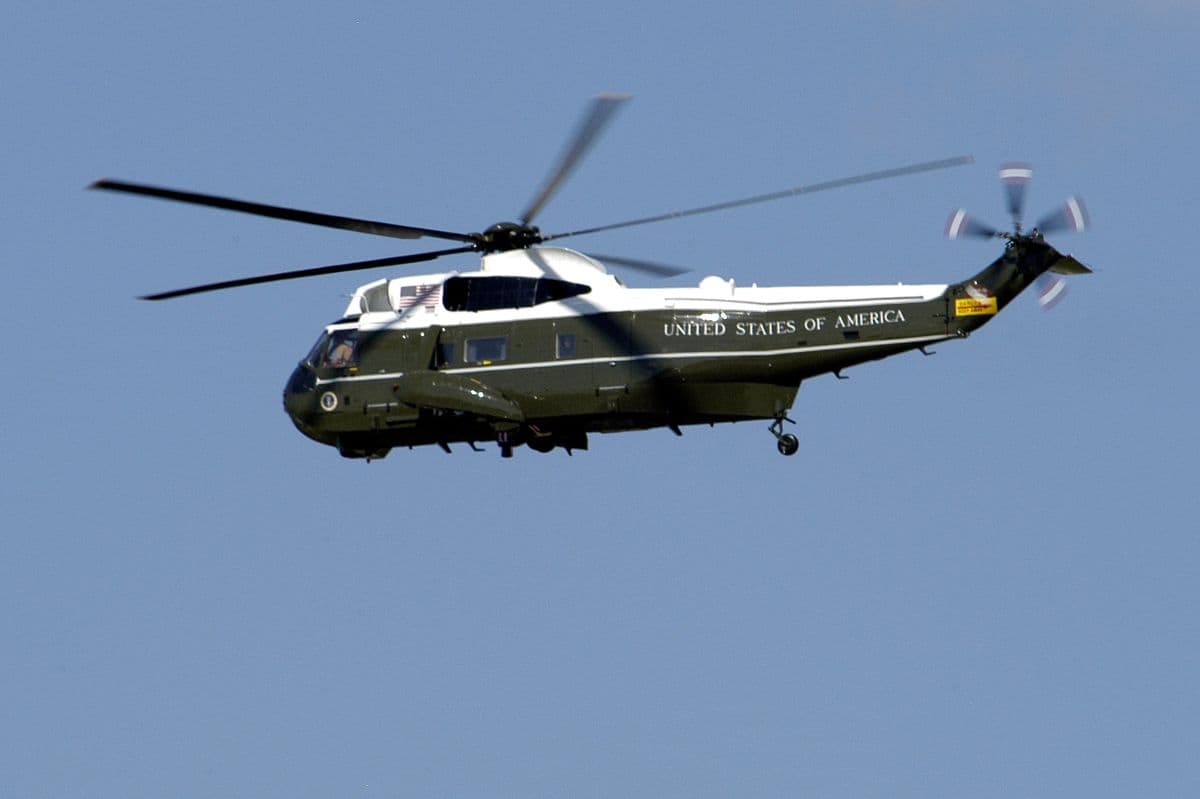
Marine Corps planning has the VH-3D serving through 2026. The new South Lawn helipad is what allows it to retire, because it lets the VH-92A handle departures from the White House itself.
VH-60N White Hawk: the one that stays
The VH-60N White Hawk is the presidential version of the Sikorsky Black Hawk. It entered presidential service in the late 1980s and seats 11 passengers, making it the smallest of the three.

Its size is an advantage. The helicopter folds to fit inside an Air Force transport jet, and the Marine Corps values its performance in hot, high-altitude conditions, which is why it plans to keep the type until about 2030.
Why replacing Marine One took 20 years
The first attempt failed. In January 2005 the Navy picked Lockheed Martin to build 28 VH-71 helicopters, but by March 2008 the program’s projected cost had grown from $6 billion to $11 billion, about $400 million per helicopter.
The VH-71 was canceled in June 2009. The Navy restarted the competition and in May 2014 awarded Sikorsky a $1.24 billion contract for the first six VH-92s.
Then came the lawn. Exhaust from the VH-92A’s engines and auxiliary power unit scorched the grass on the South Lawn and other landing sites, which restricted most of its operations to paved surfaces. Early problems with its encrypted communications added to the delay.
The fix: a granite helipad on the South Lawn
Construction of a helipad on the White House South Lawn began in early July 2026. It is made of 4-inch-thick (10 cm) Californian granite inlaid with the presidential seal and costs roughly $5 million to $6 million. President Trump said Sikorsky is paying for it, and private donations have also been reported. It was due for completion on September 17, 2026, a week before Chinese President Xi Jinping’s scheduled visit.
Until now, helicopter trips to and from the White House itself were still handled mainly by the VH-3D and VH-60N. Once the pad is in use, the VH-92A can take on that job too.
How fast and how far can Marine One fly?
The VH-92A has a maximum speed of 190 mph (306 km/h), or 165 knots, and cruises at 174 mph (280 km/h). Its published range is 620 miles (998 km), which is 539 nautical miles.
In practice, Marine One flights are short. Its core jobs are the hop between the White House and Joint Base Andrews, where the Air Force crews who fly Air Force One wait, trips to Camp David, and local legs during presidential travel.
No Marine One helicopter can cross an ocean under its own power. A range of a few hundred miles covers any trip around Washington, but not a transatlantic crossing, so the helicopters travel by cargo plane.
How does Marine One get overseas?
Marine One rides inside Air Force transport jets. The helicopters are flown in a C-17 Globemaster III or a C-5 Galaxy wherever the president travels, in the United States and abroad.
The VH-60N folds for that ride. The larger VH-92A needs its main rotor blades removed, and the C-17 has to carry a minimal fuel load during loading so the helicopter clears the rear ramp.
This video shows a C-17 unloading a VH-60N White Hawk at Prestwick Airport in Scotland.
Does Marine One fly alone?
Almost never. Marine One flies in a group of identical helicopters, sometimes as many as five, and only one of them carries the president.
The others are decoys for anyone watching from the ground. The helicopters shift formation regularly in flight to hide which one the president is on.
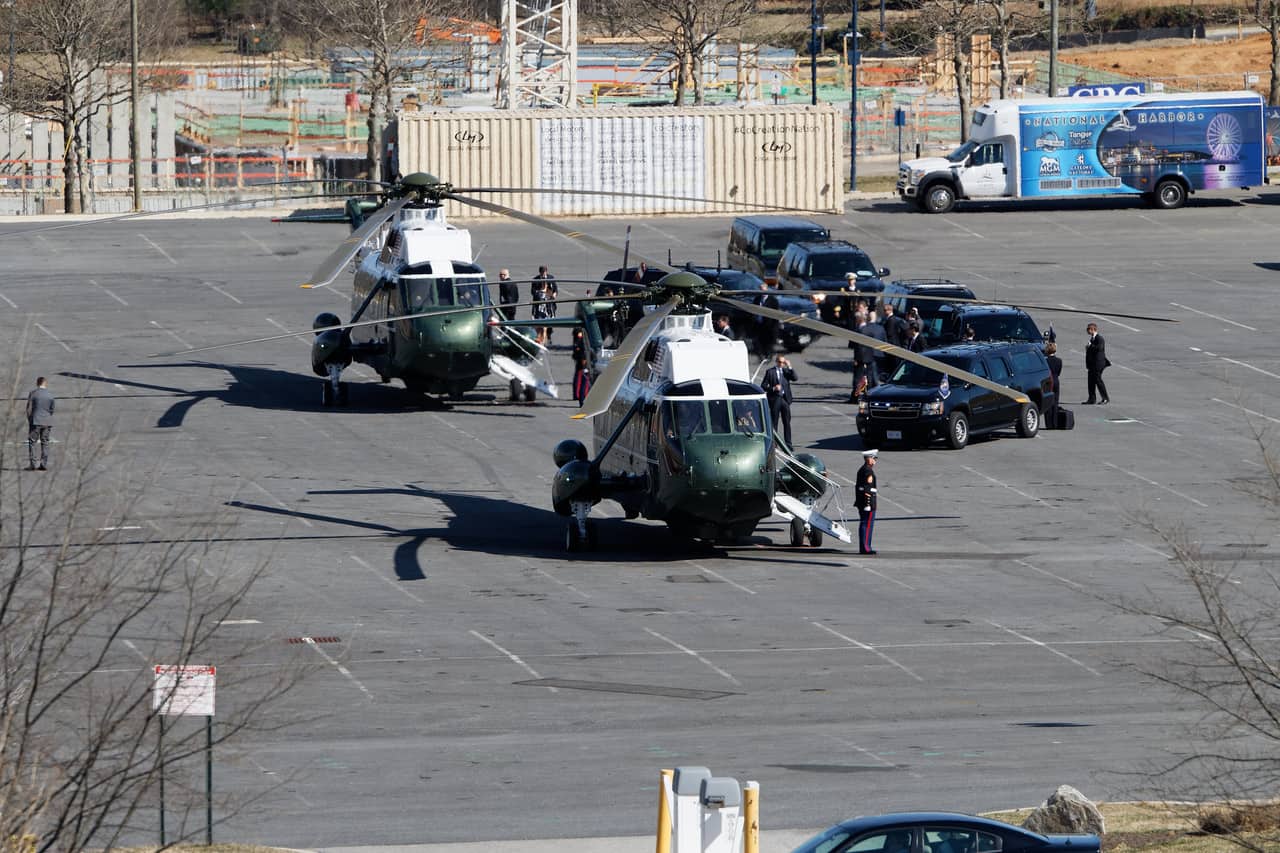
All-green MV-22 Osprey tiltrotors, nicknamed Green Tops, often fly alongside. HMX-1 operated 12 of them as of 2024, carrying White House staff, Secret Service agents and the press, not the president.
Is Marine One an Osprey now?
No. The Ospreys seen at presidential events belong to HMX-1, but they carry staff, security and media. The call sign Marine One goes only on the aircraft the president is aboard, and in 2026 that is a VH-3D, a VH-60N or a VH-92A.
Who flies Marine One?
Marine One is flown by Marine Helicopter Squadron One, HMX-1, the Nighthawks. It was founded on December 1, 1947 at Quantico, Virginia, as an experimental unit testing helicopters when rotary-wing flight was still in its infancy.
More than 800 Marines support the Marine One fleet, and every one must pass a Yankee White background check before touching a presidential helicopter. The squadron is also the main test unit for new Marine Corps assault helicopters, often using the same pilots who fly the president.
HMX-1 is based at Marine Corps Air Facility Quantico, with a detachment at Joint Base Anacostia-Bolling in Washington, DC. When the president lands, a Marine guard in blue dress uniform is there to receive the commander-in-chief.
The helicopters are known as White Tops, after the white upper fuselage that Col. Virgil Olson, the squadron’s commander, introduced for visibility. The high-gloss green and white scheme does for Marine One what the blue and white Air Force One livery does for the presidential jet.
Inside Marine One: bathroom, armor and defenses
Yes, Marine One has a bathroom. The executive VH-3A Sea Kings of the 1960s already had carpeting, radio telephones, a wet bar and a toilet, and Business Insider describes today’s cabin as about 200 square feet (19 m²) of space, including a bathroom.
The cabin is soundproofed well enough for passengers to talk at normal volume. In 2019 at least one VH-3D received a refreshed interior with cream seats, woodgrain and polished metal trim.
The VH-3D carries no weapons. Its protection comes from countermeasures instead: flares, chaff and AN/ALQ-144A infrared jammers against missiles, plus hardening against electromagnetic pulse (EMP).
The helicopters are also armored, with self-sealing fuel tanks and energy-absorbing landing gear to improve the odds of surviving a crash.
How much does Marine One cost?
The VH-92A program was estimated at $4.718 billion for 23 helicopters in fiscal 2015 terms. Spread across the fleet, development included, that works out to about $205 million per aircraft.
The canceled VH-71 had been projected at about $400 million each. Spending on the VH-92A continues: in August 2026 the Navy awarded Sikorsky $107.3 million for upgraded main rotor blades, with development running to March 2031.
The August 2026 Marine One incident at Reagan National
On August 4, 2026, a VH-3D carrying President Trump lifted off from the Ellipse, just south of the White House, at about 2:33 pm. White House construction had moved the departure to that temporary site.
About a minute later, American Airlines flight 3742, an Envoy Air Embraer 170, took off from Reagan National. At their closest the two aircraft were 0.82 nautical miles apart laterally and 700 feet (213 m) vertically, and both landed safely.
The NTSB’s preliminary findings say the crew tried at least twice to give the tower its required three-minute departure notice. The temporary site had no direct line of sight for radio, so the first call was not received and the second was unreadable.
Marine One continued to Joint Base Andrews, where the president boarded Air Force One for Los Angeles. The NTSB findings released on August 27, 2026 are preliminary.
A short history of Marine One
Eisenhower was not the first president to fly, but he was the first to ride in a helicopter. On July 12, 1957, Air Force Maj. Joseph Barrett flew him from the White House toward Camp David in a Bell H-13J, a small helicopter the Secret Service chose for its safety record.
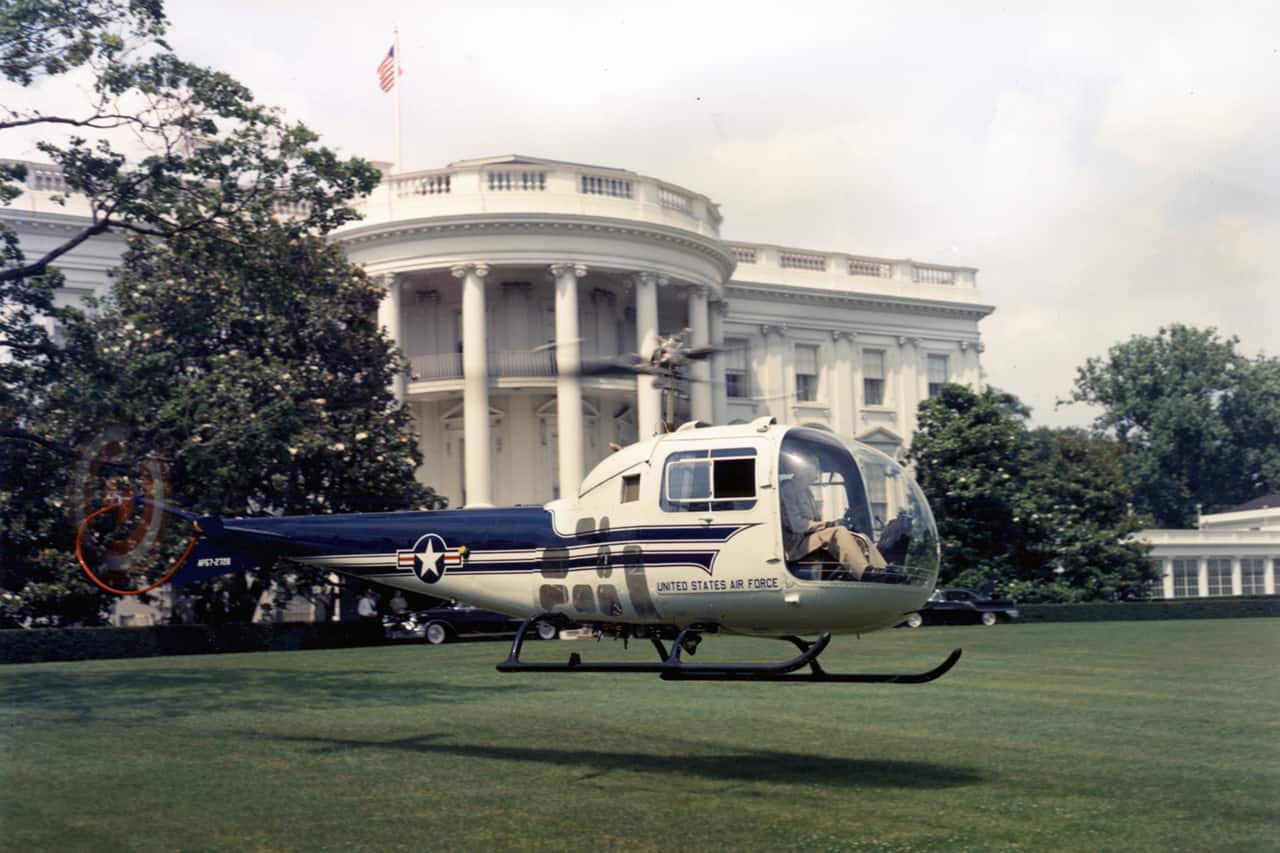
That first presidential helicopter was an Air Force aircraft, not a Marine one. The H-13J carried two passengers in any comfort, had a range of about 150 miles (240 km) and topped out around 100 mph (160 km/h).
The Marines got their turn that September. Urgently needed back at the White House during a vacation in Newport, Rhode Island, Eisenhower flew in an HMX-1 Sikorsky HUS-1 and turned a much longer journey into a seven-minute helicopter ride.
He found the bigger Sikorsky a vast improvement and switched to it. To avoid favoring either service, he alternated between Marine and Army helicopters, and the arrangement lasted until 1976, when the Marine Corps took over alone.
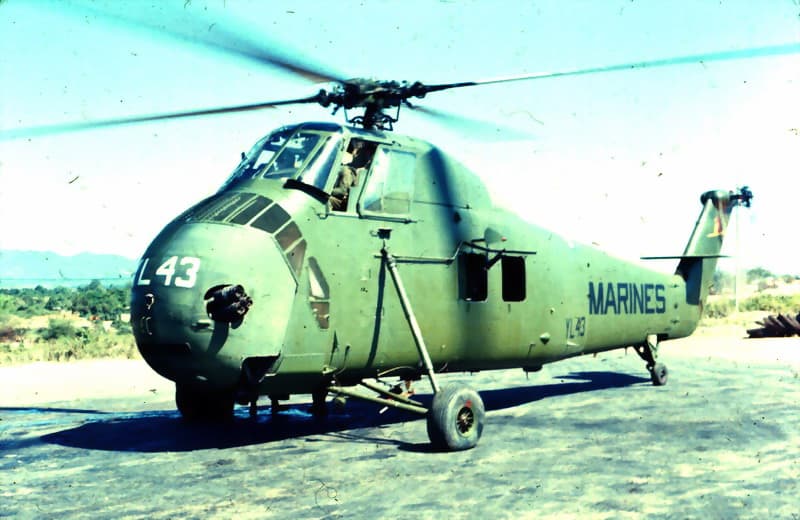
The helicopter that flew Johnson home
A Sikorsky VH-3A on display at the Ronald Reagan Presidential Library in Simi Valley, California, carried Lyndon Johnson from Andrews Air Force Base to the White House on the day President Kennedy was assassinated. It went on to fly Presidents Johnson, Nixon and Ford.
Here is how the presidential helicopter fleet evolved from Eisenhower’s H-13J to the VH-92A.
1947
HMX-1 is founded. The squadron stands up at Quantico, Virginia, on December 1 as an experimental helicopter unit.
July 1957
First presidential helicopter flight. Eisenhower leaves the White House in an Air Force Bell H-13J.
September 1957
First Marine flight with the president. An HMX-1 HUS-1 carries Eisenhower from Newport, Rhode Island, in seven minutes.
1960s
The Sea King era begins. The Navy buys eight executive VH-3A Sea Kings with a wet bar and a toilet.
1976
Marines take over alone. The Army stops flying the president, ending Army One.
Late 1970s
VH-3D enters service. The improved Sea King becomes the main presidential helicopter.
Late 1980s
VH-60N White Hawk joins. A presidential Black Hawk is added to the fleet.
2009
VH-71 canceled. The first replacement program is scrapped after its cost nearly doubles.
2014
VH-92 contract. Sikorsky wins a $1.24 billion award for the first six helicopters.
August 2024
VH-92A flies as Marine One. President Biden rides it from O’Hare to Soldier Field in Chicago.
September 2026
South Lawn helipad due. The granite pad lets the VH-92A take over White House departures.
FAQ
Sources and references used for research and fact-checking.
- Wikipedia, Marine One
- Wikipedia, Sikorsky VH-92 Patriot
- Wikipedia, HMX-1
- Marine Helicopter Squadron One, US Marine Corps, About HMX-1
- Smithsonian National Air and Space Museum, Ike and the First Presidential Helicopters
- George W. Bush Presidential Library and Museum, Marine One
- The White House (George W. Bush archive), White House Military Office: Marine One
- Ronald Reagan Presidential Foundation and Institute, Marine One exhibit
- Naval History and Heritage Command, VH-3 Marine One
- Military.com, VH-3D Sea King
- Business Insider (via Yahoo News), See inside Marine One, the soundproof presidential helicopter
- TWZ, Marine One Has A Plush New Interior
- TWZ, VH-92 Patriot Fully Taking Over Marine One Duties Has Slipped To End Of Decade
- FlightGlobal, VH-92A to assume full presidential transport duties by 2030
- The Aviationist, VH-92A Patriot Flies As Marine One For The First Time
- The Aviationist, New White House Helipad Shown Off to Reporters Ahead of Completion
- The Aviationist, Marine One and HMX-1 MV-22 Osprey tilt-rotor aircraft land on USS Gerald Ford
- Military Times, Marine One helipad to be built on White House lawn, Trump says
- Military Times, Marine One crew failed to reach air traffic control before safety incident, NTSB says
- The Spokesman-Review, White House construction was a factor in Marine One safety incident, NTSB finds
- CNN, Passenger plane taking off got too close to Trump's Marine One helicopter, NTSB and FAA to investigate
Get the Newsletter
The latest aviation news and stories sent to your inbox.
About the Author
Tim is the owner and lead editor of AeroCorner since 2019, overseeing aviation content covering aircraft, airlines, airports, and the broader aviation industry. Through years of researching, writing, editing, and publishing aviation-focused content, he has developed extensive practical knowledge of commercial aviation and air travel. Based in Asia and a frequent traveler himself, Tim also brings firsthand passenger experience to AeroCorner’s coverage. Outside of publishing, he has also explored aviation firsthand through hands-on flight training in New Zealand.