

Table of Contents
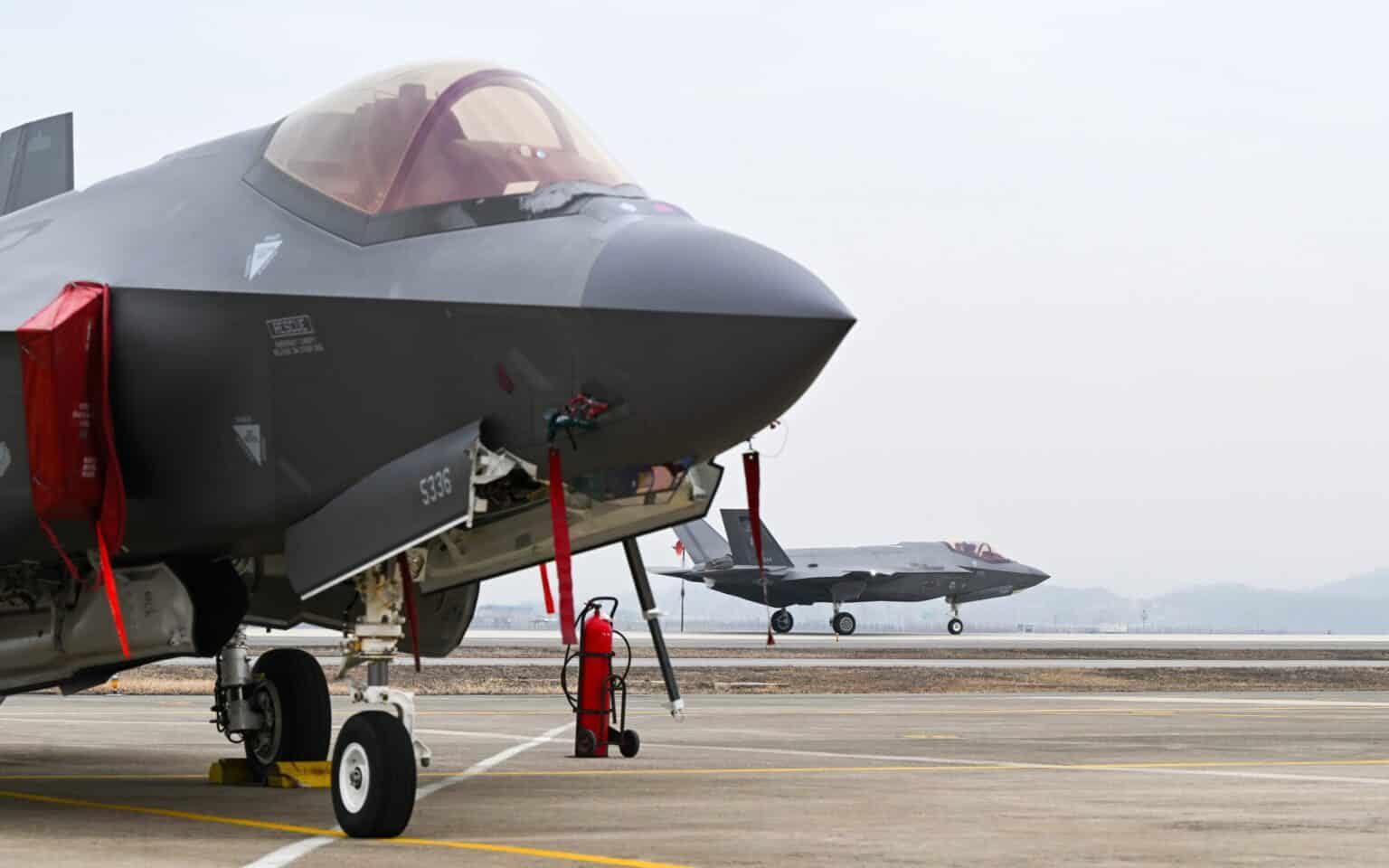
The best jet in South Korea’s air force is the F-35A stealth fighter. The Republic of Korea Air Force (ROKAF) flies 39 of them, has 20 more on order, and has made them part of the Kill Chain, its plan to strike North Korean missiles before they launch.
Behind the F-35s sit 59 F-15K Slam Eagles, about 167 F-16s and a homegrown light attack jet. The last F-5s from the 1970s and 1980s are due to retire by the end of 2027, and the country’s own fighter, the KF-21 Boramae, joined the air force on September 22, 2026.
This guide ranks every combat and lead-in jet the ROKAF flies by fighting value as of October 2026, then covers the KF-21, the radar planes and tankers, the US Air Force bases next door, and how the fleet really compares with North Korea’s.
| Rank | Aircraft | Role | In service | What comes next |
|---|---|---|---|---|
| 1 | F-35A Lightning II | Stealth strike fighter | 39 | 20 Block 4 jets from 2027 |
| 2 | F-15K Slam Eagle | Long-range strike fighter | 59 | AESA radar upgrade through 2037 |
| 3 | KF-16 and F-16C/D | Multirole fighter | 167 listed | KF-16U upgrade |
| 4 | FA-50 Fighting Eagle | Light attack fighter | 60 | None |
| 5 | KF-5E/F Tiger II | Light fighter | 48 to 61 | Retiring by end of 2027 |
| 6 | T-50, TA-50 and T-50B | Lead-in fighter trainer | 104 | 20 TA-50 Block II on order |
| New | KF-21 Boramae | Multirole fighter | 1 (delivered Sept. 2026) | 40 Block I by 2028, 80 Block II by 2032 |
How this ranking works
Jets are ranked by fighting value in October 2026: sensors, weapons and upgrade state, weighed against how many the air force flies. Aircraft on order count only once delivered, so the KF-21, with one production jet not yet declared operational, gets its own section. FlightGlobal’s 2026 directory sits behind a paywall, so counts use its 2025 edition plus newer figures from Korean officials, and ranges show where sources disagree.
1. F-35A Lightning II: The First-Strike Fighter
.jpg)
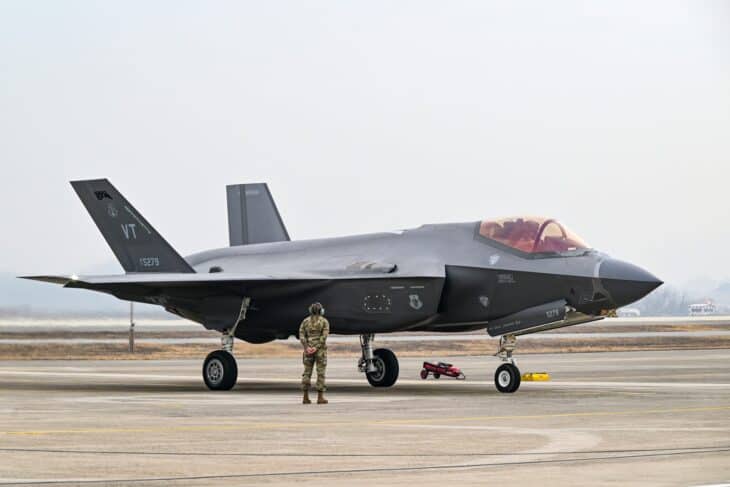
The F-35A tops the list because it is the only stealth fighter in Korean service and the spearhead of the Kill Chain. Seoul bought 40 in 2014 in a deal worth about $7 billion, roughly $175 million per jet.
The first two landed at the 17th Fighter Wing in Cheongju on March 29, 2019, and the Korea Times dates the first batch to 2019 through 2022. The US Air Force rates the F-35A at Mach 1.6, about 1,200 mph, with a range of more than 1,350 miles (2,170 km) on internal fuel.
One of the 40 will never fly again, which is why the fleet stands at 39. In December 2023 Korea signed for 20 more in the newer Block 4 configuration, due from 2027, which will take the stealth fleet to about 60.
The F-35 that cost more to fix than to buy
On January 4, 2022, an eagle hit an F-35A’s landing gear near Seosan and the pilot made a belly landing. About 300 parts were damaged and the repair was estimated at 140 billion won, around $107.6 million, more than the 110 billion won the jet cost new. The air force retired it in December 2023 and now uses it as a maintenance trainer, where crews performed the first wing removal ever done on an F-35.
2. F-15K Slam Eagle: The Long-Range Hammer
.jpg)
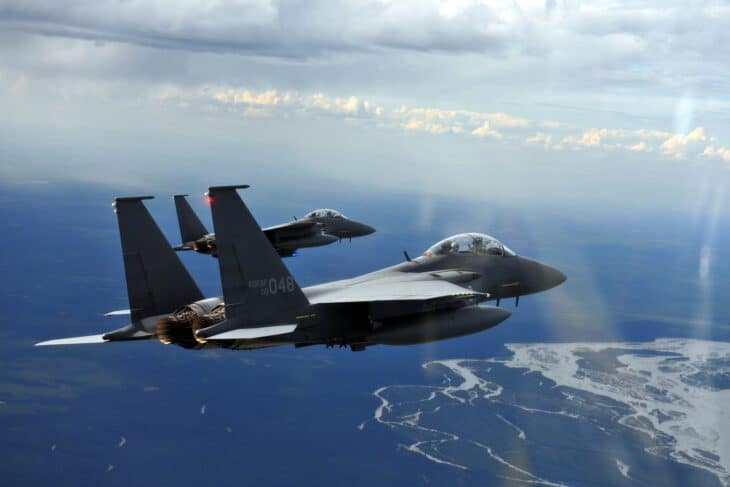
The F-15K is a Korean version of the American F-15E Strike Eagle, a two-seat jet built to carry heavy weapons a long way. Korea ordered 40 for delivery from 2005 and a second batch of 21 in 2008, and 59 remain after two fatal crashes, in 2006 and 2018.
It ranks second because it brings range and payload the F-35 cannot match from internal bays. The USAF rates the F-15E at 1,875 mph (3,018 km/h), better than Mach 2.5, and the Korean jets fly from Daegu with the 11th Fighter Wing.
They are getting a deep rebuild. The US approved the upgrade in 2024 at an estimated $6.2 billion, covering 70 AN/APG-82 AESA radars and 70 EPAWSS electronic warfare suites.
Boeing then won a $2.806 billion contract in early 2026 for the design and development work, which runs to the end of 2037. The air force expects to fly the F-15K until 2060.
3. KF-16 and F-16C/D: The Workhorse
.jpg)
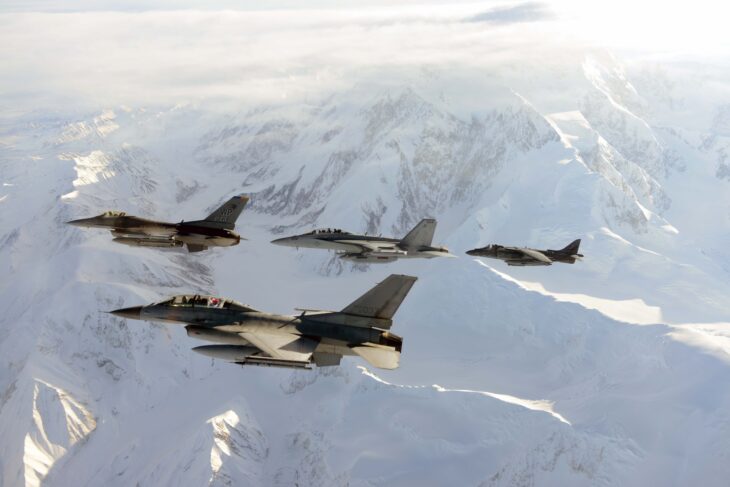
The F-16 is the most numerous fighter in Korea. Wikipedia’s inventory lists 118 single-seat KF-16C/U jets and 49 two-seat KF-16Ds, a mix of older Block 32 F-16s and 140 Block 52 KF-16s produced under license by KAI, the first delivered in December 1994.
In 2016 Lockheed Martin won a $1.2 billion contract to upgrade 134 of them to the F-16V standard with an AESA radar. The upgraded jets are called KF-16U, and Korea’s Monthly Aviation reported in 2023 that the work was planned to finish in 2028.
The fleet has had a hard two years. A KF-16D crashed on takeoff at Red Flag-Alaska in June 2025, and on February 25, 2026, an F-16C from Chungju went down near Yeongju after two jets touched during a night battle-damage check. Both crews ejected.
The day two KF-16s bombed a Korean village
On March 6, 2025, during a joint drill with US forces, two KF-16s dropped eight 500-pound MK-82 bombs on a civilian area of Pocheon. One digit of the target latitude had been entered wrong, and the pilots skipped a three-step check. By mid-April, 52 people were counted as injured, 38 of them civilians. Two commanders were dismissed, both pilots were grounded for a year, and all four were referred to military prosecutors in June 2025.
4. FA-50 Fighting Eagle: The Homegrown Light Fighter
.jpg)
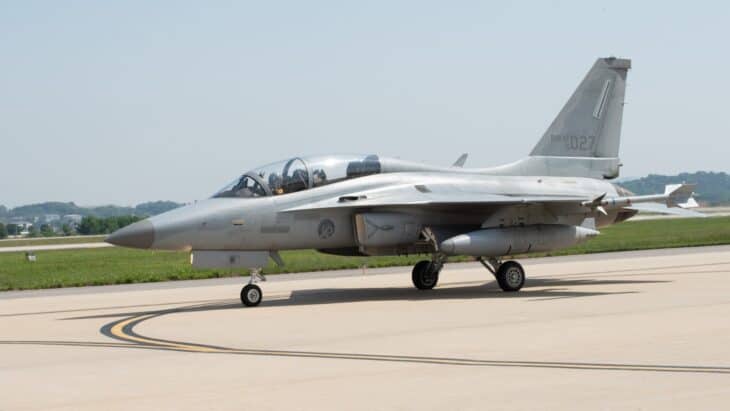
The FA-50 is a light combat jet built by Korea Aerospace Industries on the T-50 trainer airframe. Sixty were ordered for the ROKAF for delivery from 2013 to 2016, and KAI rates it at Mach 1.5.
It cannot match an F-16 for radar or range, but it is cheap to fly and was bought to replace the aging F-5s. It ranks above the F-5 because it is newer and faster, and the air force bought it specifically to take the older jet’s place.
5. KF-5E/F Tiger II: The Last Cold War Jets
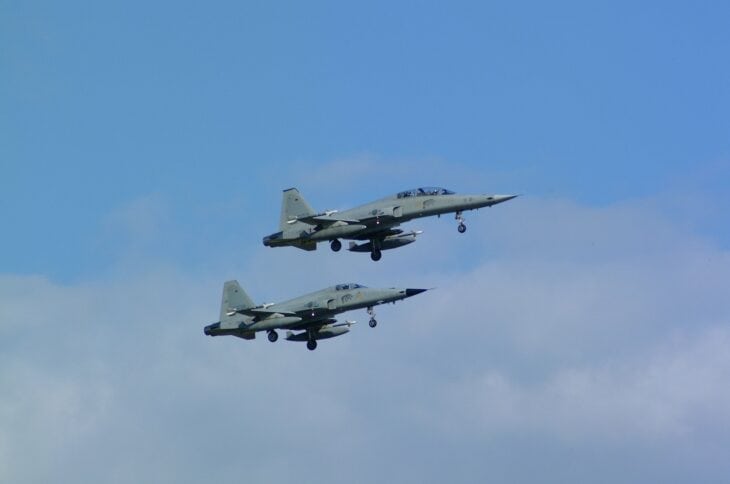
The F-5 is a 1970s light fighter, and Korea received 340 of them over the years, including 48 KF-5Es and 20 KF-5Fs assembled locally from 1982. Counts of the survivors range from 61 in a 2024 Korean report to 48 in May 2026, all now gathered at Suwon.
Their days are numbered. In May 2026, Air Force Chief of Staff Gen. Son Seok-rak said the F-5 would retire before the end of 2027, three years ahead of the original 2030 date, as the KF-21 arrives to replace it.
The F-4 Phantom beat them to it. Korea’s last three F-4Es retired at Suwon on June 7, 2024, 55 years after the type arrived in 1969, from a peak of up to 190 jets.
The F-5’s most remembered moment is a sad one. On January 11, 2022, Maj. Shim Jeong-min’s F-5E got fire warnings on both engines after takeoff from Suwon. Instead of ejecting he steered toward a hillside, crashing about 330 feet (100 m) from a village in Hwaseong. He did not survive.
6. T-50, TA-50 and T-50B: The Supersonic Trainers
_(7208976168).jpg)
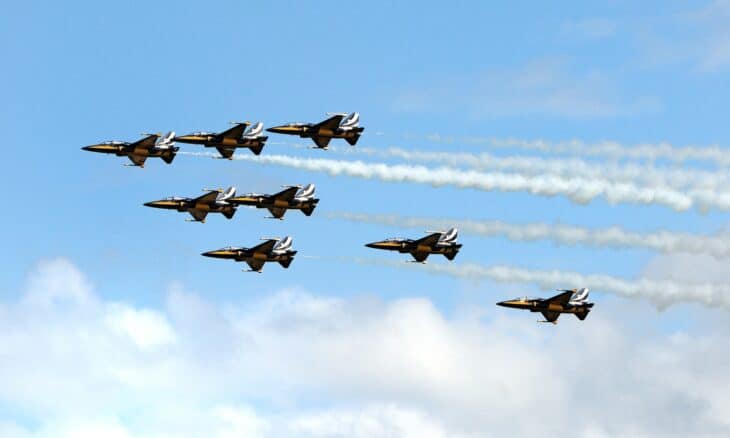
Korean fighter pilots train on the T-50 Golden Eagle, a supersonic jet built by KAI. The air force flies 72 T-50s and 22 armed TA-50 lead-in fighters, with 20 TA-50 Block IIs on order.
Ten more are T-50Bs flown by the Black Eagles, the air force’s eight-jet aerobatic team at Wonju. They won both the King Hussein Memorial Sword and the As the Crow Flies award at the Royal International Air Tattoo in 2022 and displayed in Australia for the first time at Avalon in 2023.
The inventory also lists 103 KT-1 Woongbi turboprop trainers and armed KA-1s.
The KF-21 Boramae: Delivered, Not Yet Operational
On September 22, 2026, the first production KF-21 flew from KAI’s plant in Sacheon to Yecheon Air Base, joining the 156th Fighter Squadron of the 16th Fighter Wing. The squadron, a former F-4 unit, was reactivated on June 1, 2026, to fly it.
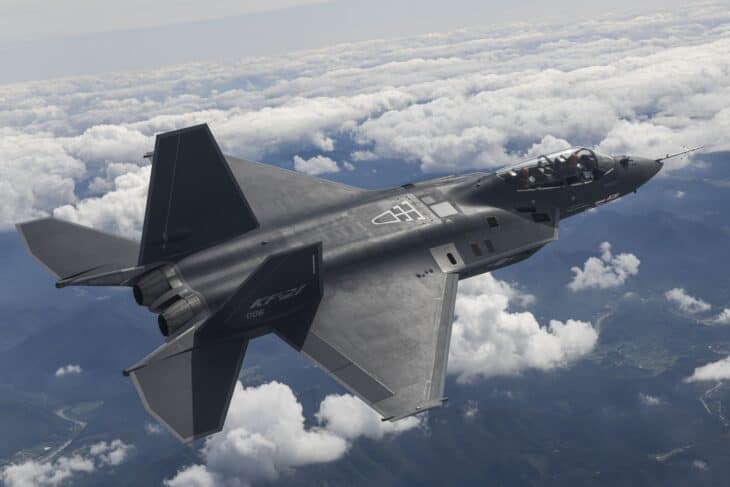

The KF-21 is a twin-engine fighter that first flew on July 19, 2022, with a top speed of Mach 1.81, about 1,370 mph (2,200 km/h). Korea is building it to replace its old F-4 and F-5 fleets.
It is not in this ranking yet because one jet is not a combat force. The air force says it will declare the KF-21 operational in the second half of 2027, with 40 air-to-air Block I jets due by 2028 and 80 Block IIs with long-range ground-attack missiles by 2032.
Its AESA radar is Korean, but its engines are American, General Electric F414s assembled in Korea.
The Eyes and the Reach: Radar Planes, Tankers and Spy Jets
Four E-737 Peace Eye radar planes, Korean versions of Boeing’s E-7 Wedgetail, were delivered between 2011 and 2012 and have suffered low availability. Their successors are four Bombardier Global 6500 business jets carrying an Israeli EL/W-2085 radar, picked in 2025 in a deal L3Harris valued at more than $2.26 billion and due by 2032.
Four KC-330 Cygnus tankers, the Airbus A330 MRTT, arrived from November 2018 to extend the fighters’ reach. Korea plans to buy up to two more, with a tender expected in the second half of 2026.
Four RQ-4 Block 30 Global Hawk drones, delivered between December 2019 and September 2020, watch North Korea from high altitude. Signals intelligence comes from Hawker 800 Peace Pioneer jets in service since 2001 and two Falcon 2000S aircraft, with four new Falcon 2000LXS-based Baekdu-II aircraft contracted for completion by the end of 2026.
Transports and the Presidential 747
The airlift fleet is 12 C-130H Hercules, four C-130J-30s and 18 CN-235s, flown by the 5th Air Mobility Wing at Gimhae. Korea ordered three Embraer C-390 jet transports in December 2023, and the first is due in December 2026, with the other two by December 2027.
The president flies on Code One, a Boeing 747-8i the air force leases from Korean Air, in service since January 2022. In June 2026 the government said it would extend the lease by five years when it expires in January 2027, at about 300 billion won, rather than buy a plane.
The US Air Force Next Door
The ROKAF does not face the North alone. The US Air Force runs two major bases in South Korea: Osan, near Pyeongtaek, home to the 51st Fighter Wing and Seventh Air Force headquarters, and Kunsan, home to the 8th Fighter Wing, the Wolf Pack.
The A-10s that flew from Osan since 1993 left in 2025, and an experiment that concentrated F-16s at Osan ended on September 28, 2026, when Seventh Air Force announced the jets would return to Kunsan. Air & Space Forces Magazine puts the US fighter force at an estimated 72 F-16s across the two bases.
South Korea vs North Korea: Is It Outnumbered?
On paper, yes. South Korea’s 2022 Defense White Paper, the latest edition, counts about 410 South Korean combat aircraft against about 810 in the North, and 65,000 air force personnel against 110,000.
The numbers hide a generation gap. As our guide to North Korea’s air force shows, the North’s best fighter is the MiG-29, delivered in the late 1980s, and hundreds of its jets are 1950s and 1960s designs. The white paper itself warns that its table compares quantity only and actual power may differ.
How it started
The ROKAF was founded on October 1, 1949. When the Korean War broke out less than nine months later, it had 1,800 people and 20 trainers and liaison planes, with no combat aircraft at all. Its first fighters were F-51D Mustangs, flown with US instructors under Maj. Dean Hess in a program called Bout One.
Today South Korea spends heavily to keep that lead. Its 2026 defense budget is 65.86 trillion won, up 7.5 percent, and Global Firepower ranks its military fifth of 145 countries for 2026, with North Korea 31st.
The honest verdict is that South Korea fields one of the most capable air forces in Asia, built around stealth, long-range strike and a fighter it designed itself. Its weakness is age at the bottom of the fleet and readiness, not numbers, and the F-5’s retirement and the KF-21’s arrival are aimed squarely at both.
FAQ
Sources and references used for research and fact-checking.
- Wikipedia, Republic of Korea Air Force
- Lockheed Martin, Republic of Korea F-35
- Yonhap, First F-35A stealth fighters arrive in South Korea
- Stars and Stripes, South Korea F-35 bird strike
- Defence Security Asia, Bird strike forces South Korea to retire a US$85 million F-35A fighter
- The Aviationist, First F-35A wing removal
- The Korea Times, Korea strengthens stealth fighter fleet with purchase of 20 additional F-35As
- Defense News, F-35 customers in Asia-Pacific monitor Lockheed upgrade saga from afar
- US Air Force (Wayback Machine copy), F-35A Lightning II fact sheet
- The Korea Times, Military plans to deploy F-35A stealth fighters to multiple locations
- The Aviationist, Boeing awarded contract for ROKAF F-15K upgrade
- Wikipedia, McDonnell Douglas F-15E Strike Eagle
- Wikipedia, List of F-15 losses
- US Air Force (Wayback Machine copy), F-15E Strike Eagle fact sheet
- Wikipedia, General Dynamics F-16 Fighting Falcon variants
- Inside Defense, Lockheed receives $1.2B contract to upgrade Korean F-16s
- Monthly Aviation (Korea), KF-16 performance improvement program
- F-16.net, South Korean KF-16D crashes at Eielson AFB
- Stars and Stripes, South Korea air force F-16 crash
- F-16.net, South Korean F-16 crash update
- Wikipedia, 2025 Pocheon accidental bombing
- Stars and Stripes, South Korea accidental bombing
- Asia Economy, Pocheon bombing investigation findings
- Korea JoongAng Daily, 2 senior Air Force officials dismissed over Pocheon bombing
- MBC, Pocheon bombing referred to military prosecutors
- Yonhap, Korea's first production KF-21 heads to Air Force
- The Aviationist, First production KF-21 Boramae delivered to ROKAF
- Janes, South Korea inducts first production KF-21 fighter
- Seoul Economic Daily, Korea's supersonic fighter KF-21 to deliver first unit
- Wikipedia, KAI KF-21 Boramae
- Korea Aerospace Industries, FA-50
- Wikipedia, KAI T-50 Golden Eagle
- Wikipedia, Northrop F-5
- The Korea Herald, Air Force chief vows to retire F-5 before end of next year
- Militarnyi, South Korea to retire F-5s early due to KF-21 success
- Aerospace Global News, South Korea KF-21 and F-5 retirement
- Segye Ilbo, F-5E crash in Hwaseong
- Dong-A Ilbo, F-4 Phantom retires after 55 years
- Wikipedia, Black Eagles aerobatic team
- Australian Defence Magazine, ROKAF Black Eagles to fly at Avalon 2023
- Wikipedia, Boeing E-7 Wedgetail
- L3Harris, Republic of Korea selects L3Harris airborne early warning and control
- The Aviationist, L3Harris receives contract for ROKAF AEW&C
- Wikipedia, Airbus A330 MRTT
- SBS via Daum, Second aerial tanker project
- Janes, US delivers fourth and final RQ-4 Global Hawk UAV to RoKAF
- Janes, KAI awarded contract to deliver four Baekdu-II ISR aircraft systems
- Wikipedia, Lockheed Martin C-130J Super Hercules
- Wikipedia, List of Embraer C-390 Millennium orders and deliveries
- Segye Ilbo, C-390 delivery schedule for Korea
- Wikipedia, Code One
- Seoul Economic Daily, Korea to extend lease of presidential jet
- Wikipedia, Osan Air Base
- Wikipedia, Kunsan Air Base
- Wikipedia, 25th Fighter Squadron
- Air & Space Forces Magazine, 7th Air Force super squadron test ends as F-16s return to Kunsan
- New Daily, 2022 Defense White Paper force comparison
- Ministry of Unification, South and North Korean military strength comparison
- The Korea Times, South Korea defense white paper opinion
- The Korea Times, Defense ministry to publish white paper for first time in 4 years
- Global Firepower, South Korea military strength 2026
- Global Firepower, North Korea military strength 2026
- eToday, 2026 defense budget passes National Assembly
- Wikipedia, Bout One
Get the Newsletter
The latest aviation news and stories sent to your inbox.
About the Author

Tim is the owner and lead editor of AeroCorner since 2019, overseeing aviation content covering aircraft, airlines, airports, and the broader aviation industry. Through years of researching, writing, editing, and publishing aviation-focused content, he has developed extensive practical knowledge of commercial aviation and air travel. Based in Asia and a frequent traveler himself, Tim also brings firsthand passenger experience to AeroCorner’s coverage. Outside of publishing, he has also explored aviation firsthand through hands-on flight training in New Zealand.