

Table of Contents
North Korea’s air force is huge on paper and ancient in practice. South Korea’s defense ministry counts 810 North Korean combat aircraft, yet the best fighter in the fleet is the MiG-29, a Soviet jet delivered in the late 1980s.
Behind the MiG-29s sit hundreds of jets that most air forces retired a generation ago: MiG-21s, Chinese-built MiG-19s and MiG-17s, and Il-28 bombers. The US Defense Intelligence Agency calls North Korea one of the only air forces still operating MiG-21s, MiG-19s, MiG-17s and MiG-15s.
This list ranks every combat type the Korean People’s Army Air Force (KPAF) flies by combat value as of October 2026, weighing what the aircraft can do against how many North Korea can field. The surprises follow: a homemade airborne radar plane, copies of America’s Global Hawk and Reaper drones, and the Russian fighters that have been promised but not seen.
| Rank | Aircraft | Role | Estimated fleet |
|---|---|---|---|
| 1 | MiG-29 Fulcrum | Air defense fighter | 18 to 40 |
| 2 | Su-25K/UBK Frogfoot | Ground attack | 34 to 68 |
| 3 | MiG-23ML/P Flogger | Fighter, interceptor | 40 to 56 |
| 4 | MiG-21 and J-7 | Fighter, interceptor | 56 to about 200 |
| 5 | J-6 (Chinese MiG-19) | Fighter, ground attack | About 100 |
| 6 | J-5 (Chinese MiG-17) | Fighter, ground attack | About 107 |
| 7 | Il-28 and H-5 Beagle | Light bomber | About 80 |
| 8 | An-2 Colt | Special forces transport | 250 to 270+ |
| 9 | MiG-15 trainers and Su-7 | Trainer, stored attack jet | 34 trainers, 18 Su-7 in storage |
How this ranking works
Aircraft are ranked by combat value in October 2026: what the type can do, weighed against how many North Korea can put in the air. Nobody outside North Korea can count its fleet, so every number is an estimate, and the ranges show where IISS, FlightGlobal, US intelligence and South Korea’s defense ministry disagree. Helicopters, transports, drones and the new radar plane are covered after the ranking.
1. MiG-29 Fulcrum: The Only Modern Fighter North Korea Has
.jpg)
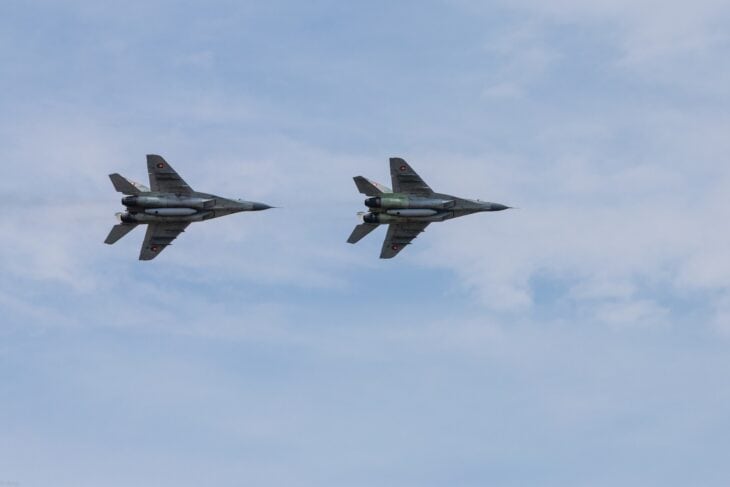
The MiG-29 tops the list because nothing else in the fleet comes close. It is the only fourth-generation fighter North Korea owns, and it flies with the elite Guards 1st Air Division in Pyongyang.
Nobody agrees on how many there are. IISS counted 18 in 2020, FlightGlobal’s 2025 survey lists 35, and the Korea Economic Institute of America put the figure at around 40 in 2012.
The jets arrived from the Soviet Union in the late 1980s, with a 1991 DIA study dating the first to 1988. GlobalSecurity reports that North Korea assembled about 30 of them itself from Soviet kits.
In a May 2025 live-fire drill, a MiG-29 fired a new radar-guided air-to-air missile that analysts at 38 North likened to the American AIM-7 Sparrow, a Cold War design. In another state-media photo from the same event, a more modern missile appeared to have been edited onto a MiG-29.
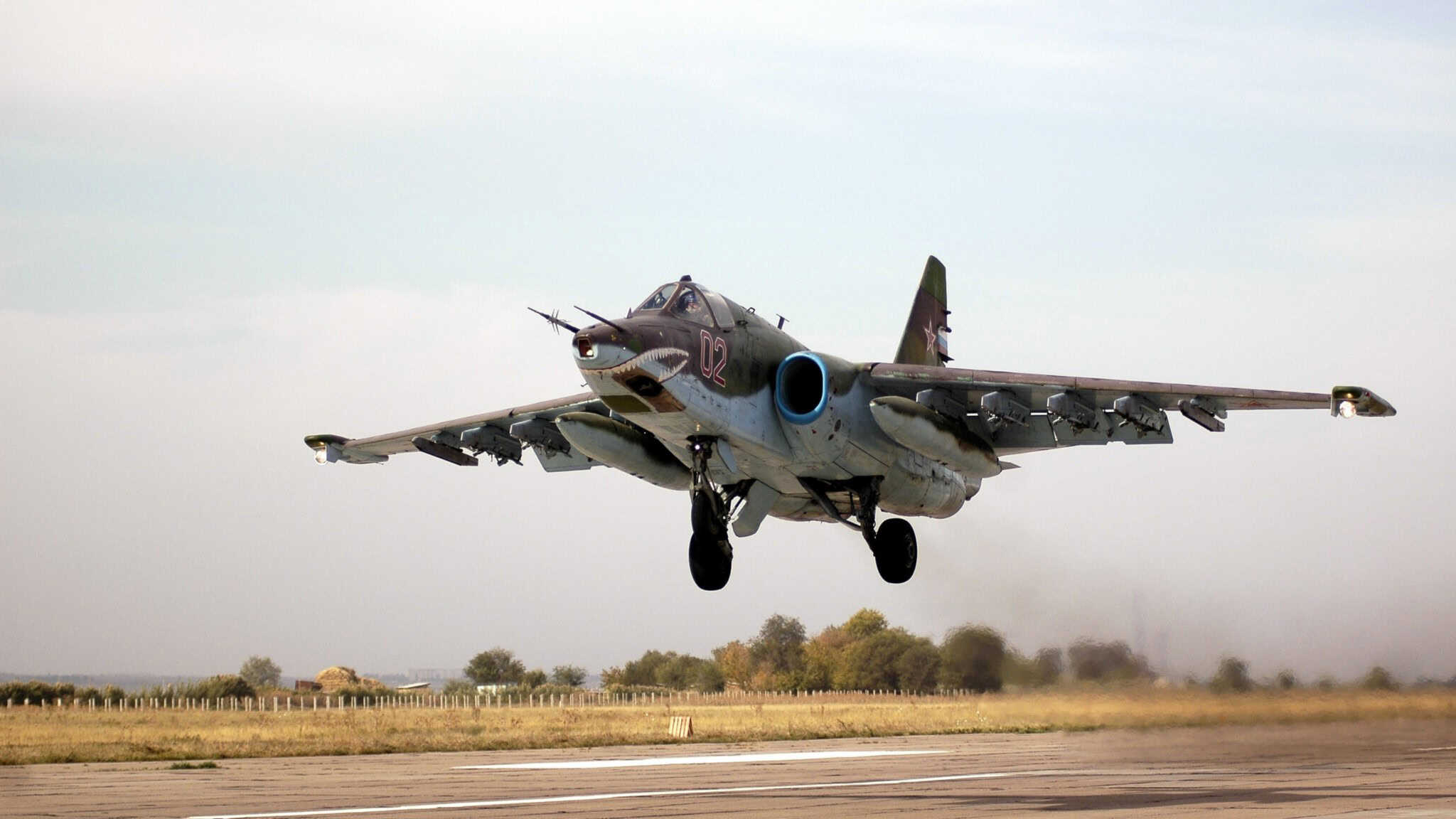
2. Su-25 Frogfoot: The Attack Jet Carrying the New Missiles

The Su-25K Frogfoot is a Soviet close-support jet built to attack ground targets. North Korea’s arrived from 1988, ten that year and ten more in 1989, according to the DIA.
IISS counted 34 single-seat and two-seat Su-25s together in 2020. FlightGlobal lists 34 of each, which would double the fleet, so the true number sits somewhere between the two.
The Su-25 is also the jet North Korea chose to show off its newest weapons. At the air force’s 80th-anniversary display in late November 2025, one carried a new air-launched cruise missile that 38 North compared to Europe’s Taurus and Russia’s Kh-69.
Kim Jong Un said at the same event that the air force would receive “new strategic military assets” and play a role in nuclear deterrence. The War Zone noted there was no hard evidence the weapons on display were genuine, working systems.
3. MiG-23 Flogger: The Swing-Wing Interceptor


The MiG-23 is a Soviet swing-wing fighter. North Korea began receiving its first 46 in 1985, according to the DIA, in the ML fighter and P interceptor versions.
Estimates run from 40 to 56. IISS counted 56 in 2020, the same figure South Korea’s 2018 Defense White Paper gave.
When North Korea shelled South Korea’s Yeonpyeong Island in 2010, eight or nine MiG-23s were moved forward to Hwangju air base. They rank third because they are newer and faster than the MiG-21s, but there are far fewer of them.
4. MiG-21 and J-7: The Jets With a Combat Record
.jpg)
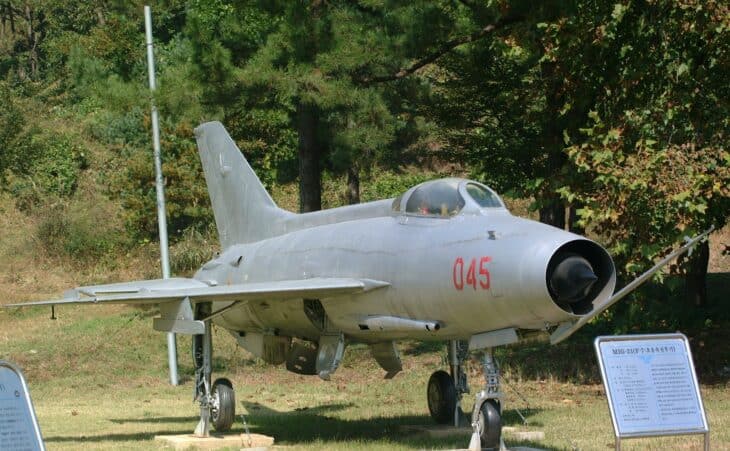
The MiG-21 is the fighter North Korea has used in anger. The first arrived in 1963, and North Korean pilots flew MiG-21s for Egypt against Israeli F-4 Phantoms in 1973.
On April 15, 1969, a North Korean MiG-21 shot down a US Navy EC-121M reconnaissance plane over the Sea of Japan, 90 nautical miles off the North Korean coast. All 31 Americans aboard were killed.
The size of today’s fleet is the most disputed number on this list. FlightGlobal lists 26 MiG-21s and 30 J-7s, the Chinese copy, while IISS counted about 150 and South Korea’s 2018 White Paper about 200 of the two types combined.
Accidents and seizures give rare glimpses of the fleet. A North Korean MiG-21 crashed in China’s Liaoning province on August 17, 2010, killing its pilot, and another was found hidden aboard the ship Chong Chon Gang when Panama searched it in 2013.
North Korea bought used MiG-21s from Kazakhstan
In 1998 a contract covered about 40 retired Kazakh MiG-21s for roughly $8 million, routed through a Czech front company. Six dismantled jets were seized on an An-124 at Baku in March 1999, but most of the rest reached North Korea anyway, by rail through China according to GlobalSecurity. Kazakhstan admitted the sale that September, and its defense minister was fired.
5. J-6: China’s MiG-19, About 100 Strong

The Shenyang J-6 is China’s licensed copy of the Soviet MiG-19. North Korea still fields about 100, a figure IISS, FlightGlobal and South Korea’s White Paper broadly agree on.
The DIA’s 1991 study found most of the type assigned to ground attack rather than air combat. That is still the realistic job for a jet armed with guns and unguided weapons against a modern South Korean air force.
6. J-5: China’s MiG-17, Still in Service

The J-5 is China’s build of the MiG-17, a subsonic fighter designed in the early 1950s. IISS counted 107 in 2020 and FlightGlobal lists 106, plus 135 two-seat FT-5 trainers.
That makes the J-5 one of the most numerous jets in the fleet and one of the least useful in modern combat. It ranks above the bombers only because there are more of them and they can still carry guns and rockets.
7. Il-28 and H-5: The 1940s Bomber Design
.jpg)
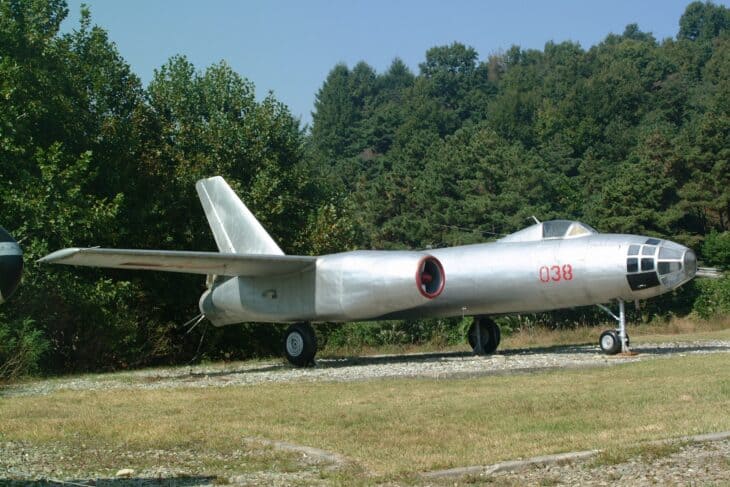
The Ilyushin Il-28 and its Chinese copy, the Harbin H-5, are North Korea’s only bombers. IISS counts 80, and the DIA counted 82 in three regiments in 1991.
They are not purely museum pieces. IISS reports that North Korea trial-fired Styx anti-ship missiles from an Il-28 or H-5 in October 2008 and again in November 2011.
8. An-2 Colt: The Biplane Built for Invasion
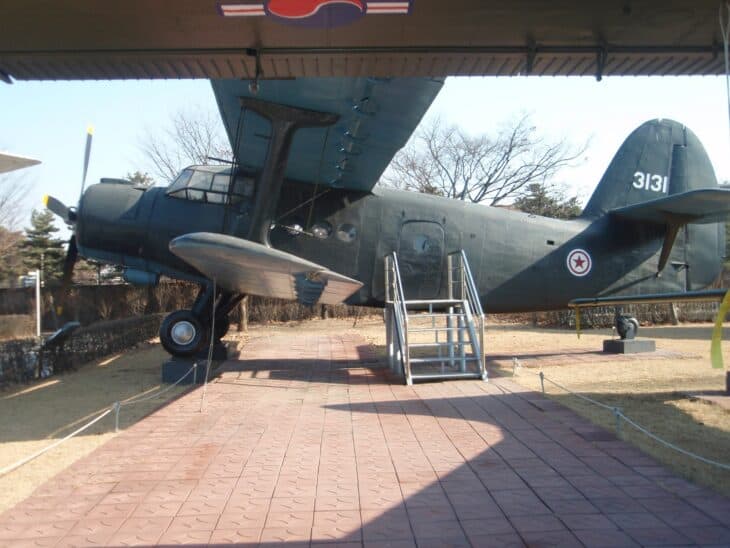

The An-2 is a single-engine biplane from the late 1940s, and North Korea has more of them than any other aircraft. The DIA counted more than 250 in 1991, and later estimates run past 270.
Its job is the reason it ranks at all. The DIA’s 2021 report says the An-2s are probably tasked with flying special forces into South Korea.
IISS adds that since 2014 some have been seen carrying bombs and satellite navigation, and possibly a terrain-following radar. A cheap biplane is a serious problem when hundreds of them arrive at once.
9. MiG-15 Trainers and the Su-7: The True Museum Pieces
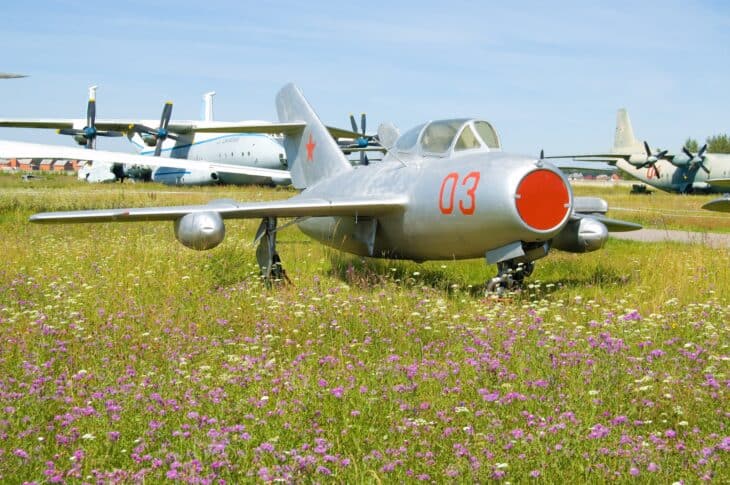

The MiG-15 first fought over Korea in 1950, the jet that defined the fighter war of the Korean conflict. North Korea still lists about 34 two-seat versions, four MiG-15UTIs and 30 Chinese FT-2s, as trainers.
The Su-7 ground-attack jet is in the same category. IISS counts 18 Su-7s, all in storage, which puts them closer to a reserve parts pile than a combat unit.
The Surprises: A Homemade Radar Plane and Copycat Drones
The newest aircraft in North Korea’s air force are not fighters. Since 2023 it has revealed an airborne early warning (AEW) aircraft and two large drones that look like American designs.
The Il-76 radar plane
In March 2025, satellite imagery showed an Il-76 at Pyongyang’s Sunan airport with a large radome mounted on its back. It is one of the state airline Air Koryo’s three cargo Il-76s, converted over roughly 16 months from October 2023.
38 North noted a triangular radome similar to some Chinese AEW aircraft, whose three fixed radar arrays each cover 120 degrees, which could suggest Chinese help. Kim Jong Un inspected the aircraft later that month, and state media published photos without describing it.
An airborne radar would let North Korea see low-flying threats over its mountainous terrain. IISS analysts said one aircraft would not be enough, and South Korea’s military called it large, heavy and probably easy to shoot down.
The Saetbyol-4 and Saetbyol-9 drones
In July 2023, Kim showed Russia’s defense minister two drones that state media named the Saetbyol-4 and Saetbyol-9. The first has a wingspan of about 115 feet (35 m), close to the RQ-4 Global Hawk’s, and the second about 66 feet (20 m), matching the MQ-9 Reaper’s.
By September 2025, serial numbers showed at least two Saetbyol-4s and probably six Saetbyol-9s, according to 38 North. Its analysts found no significant demonstration of what either can actually do.
Production may now be scaling up. Photos from Kim’s factory visits in September 2026 showed assembly halls building both types alongside dozens of one-way attack drones resembling Israel’s Harop.
What about the Russian MiG-29s and Su-27s?
In December 2024, the head of US Indo-Pacific Command, Adm. Samuel Paparo, said Russia and North Korea had reached some agreement on transferring MiG-29s and Su-27s, apparently in return for North Korean troops in Russia’s war on Ukraine. As of October 2026, no delivery has been confirmed by either government or shown in any imagery we found. What is documented is Russian air defense help: a multinational sanctions monitoring team reported in 2025 that North Korea had received at least one Pantsir air defense system.
Helicopters and VIP Transports
North Korea’s helicopter fleet grew from about 40 to 275 during the 1980s, according to the DIA. FlightGlobal’s 2025 survey lists the types below.
| Helicopter | Role | Listed count |
|---|---|---|
| MD 500D (Hughes 500) | Light utility, anti-tank | 84 |
| Mi-2 Hoplite | Light utility | 48 |
| Harbin Z-5 | Utility | 48 |
| Mi-8/Mi-17 Hip | Transport | 41 |
| Mi-24 Hind | Attack | 20 |
| Mi-14 Haze | Naval, anti-submarine | 8 |
| Mi-26 Halo | Heavy lift | 4 |
The Mi-24 Hind is the only dedicated attack helicopter, and the Mi-8 and Mi-17 carry troops. The most interesting entry, though, is American.
Between March 1983 and November 1984, a West German firm shipped 86 Hughes 500 helicopters to North Korea in breach of US export controls. The DIA put the number at 87, and the brothers behind the deal pleaded guilty in 1988.
They were sold as civilian helicopters, but they did not stay that way. Some were displayed in 2013 armed with AT-3 anti-tank missiles.
Kim Jong Un’s own flights run through the state airline. Air Koryo keeps two Il-62s for government VIP use, one painted all white for Kim, plus a Tu-154B and two Tu-204s.
How Powerful Is North Korea’s Air Force, Really?
By headcount it is formidable. South Korea’s 2022 Defense White Paper credits the North with 1,570 aircraft, including 810 combat aircraft, and about 110,000 people serve in the air force, which would place it among the largest air forces in the world.
By capability it is weak, and the gap is training as much as hardware. The DIA’s 2021 report estimates North Korean pilots fly as few as 15 to 25 hours a year, while NATO pilots fly at least 150.
The hardware gap is just as stark. South Korea now builds its own fighter, the KF-21 Boramae, while the newest fighter North Korea has confirmed receiving is the MiG-29 of the late 1980s.
That is why Pyongyang has put its real money into missiles and drones. The air force’s main job, as US intelligence has long assessed it, is defending North Korean airspace, and its realistic offensive tools are An-2s, cruise missiles and copycat drones rather than fighters.
FAQ
Sources and references used for research and fact-checking.
- US Defense Intelligence Agency, North Korea Military Power (2021)
- US Defense Intelligence Agency via FAS, North Korea: The Foundations for Military Strength, Chapter 5A
- IISS, Flying against the odds: North Korea's air force
- Wikipedia, Korean People's Army Air Force
- Wikipedia, 1969 EC-121 shootdown incident
- Korea Times, N. Korean leader calls for increased aerial combat posture
- Asia Economy, Can North Korean Fighter Jets Conduct Counter-Flights Against China?
- Korea Economic Institute of America, The Asymmetrical Challenges of North Korea's Air Force
- GlobalSecurity, Air Force Modernization
- PIR Center, Scandal with MiG-21 sale to North Korea
- RFE/RL, Kazakh Report: November 23, 1999
- The Telegraph, Intelligence experts analyse North Korean fighter jet crash
- 38 North, Sparrow Returns to the Peninsula: Observations on North Korea's May 15 Air Drills
- 38 North, New Missiles But Fewer Launches, a Missile Sub Reveal and a Nuclear-Armed Air Force
- The War Zone, Analyzing North Korea's New Air-Launched Guided Weapons
- 38 North, Quick Take: First Look at North Korea's Airborne Early Warning Aircraft
- Reuters via The Kathmandu Post, North Korea leader Kim Jong Un touts AI suicide drones, early warning aircraft
- Al Jazeera, North Korea's Kim Jong Un oversees tests of new AI-equipped suicide drones
- 38 North, Imitation Is the Sincerest Form: North Korea Unveils Two Types of Copycat UAVs
- 38 North, Current Status of North Korea's Drone Program
- Global Defense Corp, North Korea reveals new drone production lines
- Militarnyi, North Korea shows off mass production of Harop clones
- Defense One, Russia in talks to send fighter jets to North Korea, INDOPACOM says
- The War Zone, Russia Giving North Korea MiG-29s And Su-27s Isn't That Straightforward
- Janes, North Korea has taken delivery of Russian air defence systems, UN claims
- Arms Control Wonk, Berlin Games: A Tale of Hughes Helicopters, Diplomats and North Korea's Arms Trading Networks
- GlobalSecurity, Panghyon
- Wikipedia, Air Koryo
Get the Newsletter
The latest aviation news and stories sent to your inbox.
About the Author

Tim is the owner and lead editor of AeroCorner since 2019, overseeing aviation content covering aircraft, airlines, airports, and the broader aviation industry. Through years of researching, writing, editing, and publishing aviation-focused content, he has developed extensive practical knowledge of commercial aviation and air travel. Based in Asia and a frequent traveler himself, Tim also brings firsthand passenger experience to AeroCorner’s coverage. Outside of publishing, he has also explored aviation firsthand through hands-on flight training in New Zealand.