

Military Helicopters
Mil Mi-26 “Halo”
ICAO: MI26
The armored Soviet gunship that also carries eight troops, in service for more than 50 years.
Updated: by Tim de Vries
The latest aviation news and stories sent to your inbox.
The Mil Mi-24 is the Soviet gunship NATO calls the Hind: an armored attack helicopter with a cabin for eight troops. Its export versions are the Mi-25 and Mi-35, and it has fought from Afghanistan to Ukraine. As of October 2026 dozens of air forces still fly it, and the upgraded Mi-35M is still in production.
Live Fleet Activity (MI24)
Fetching live data…


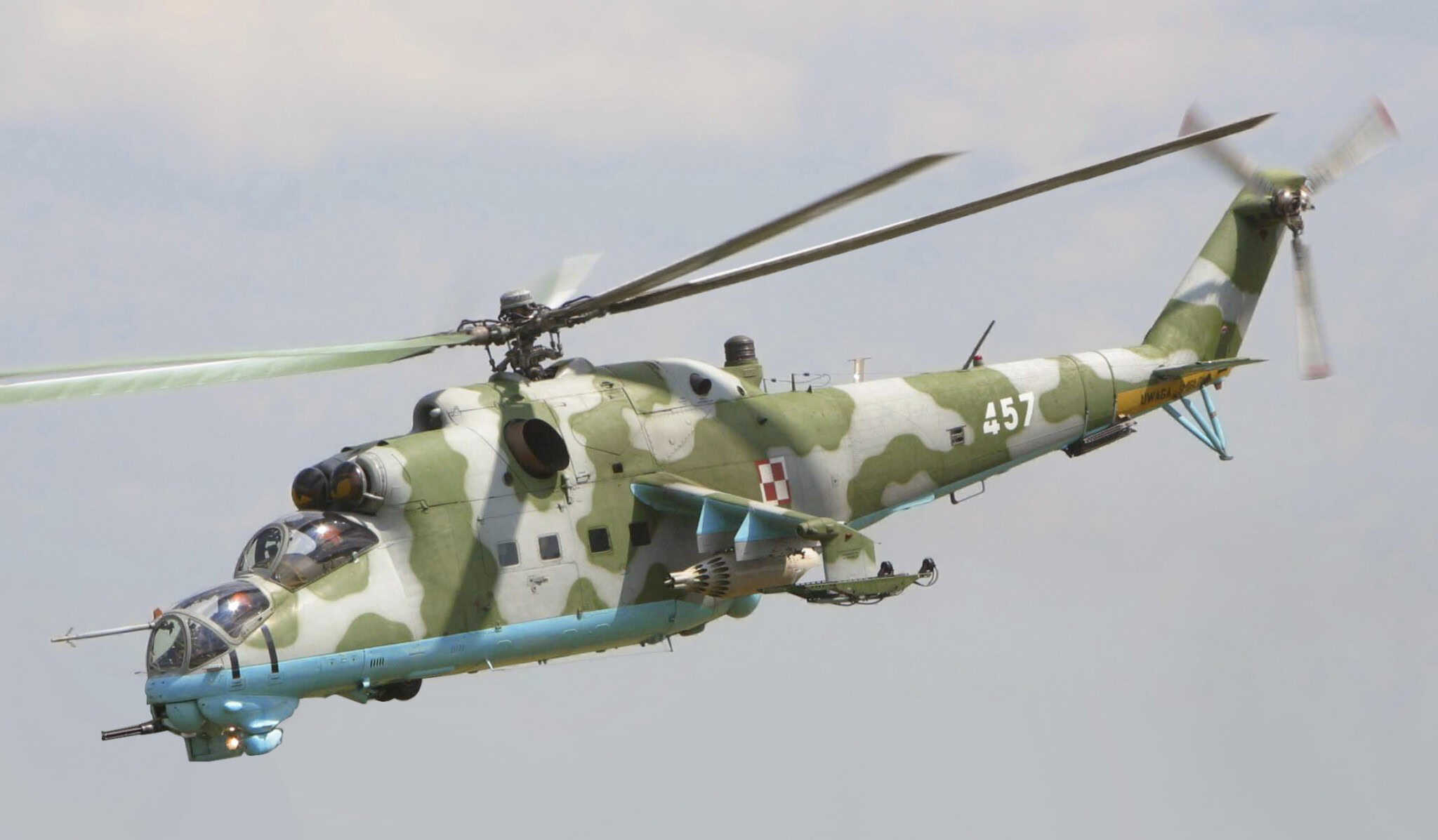


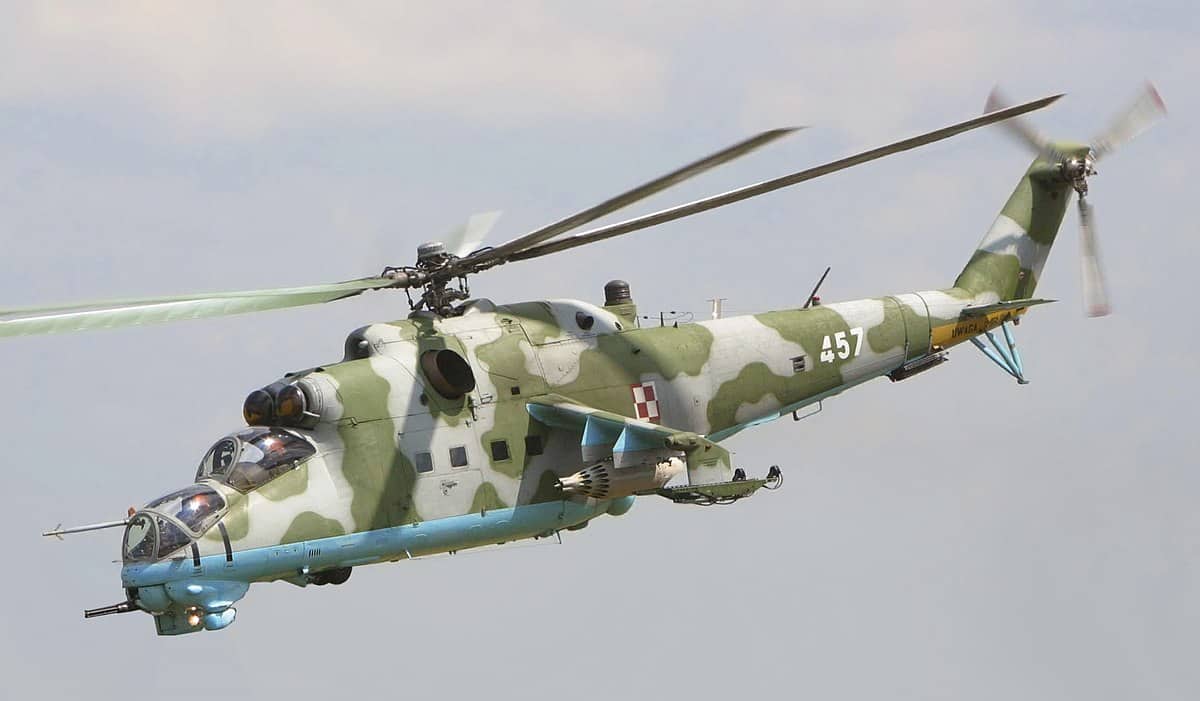
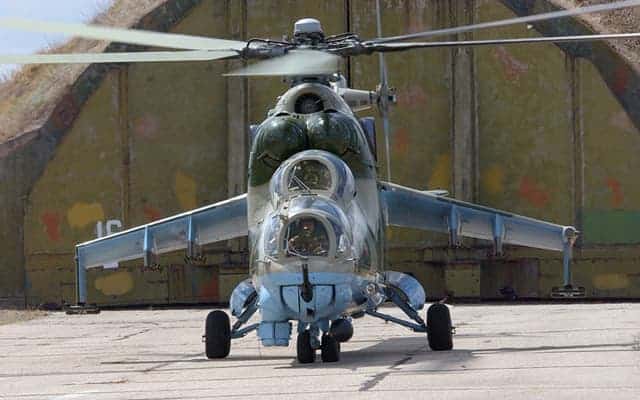
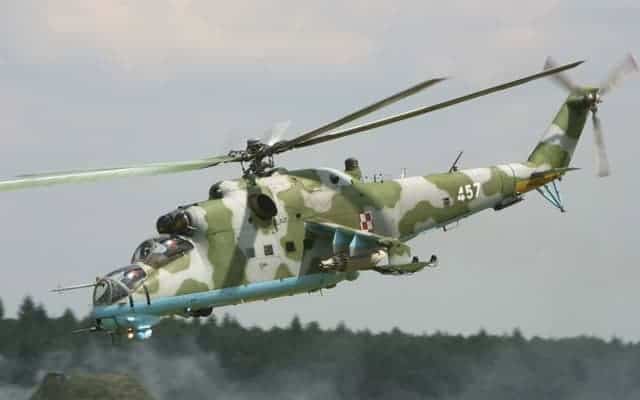
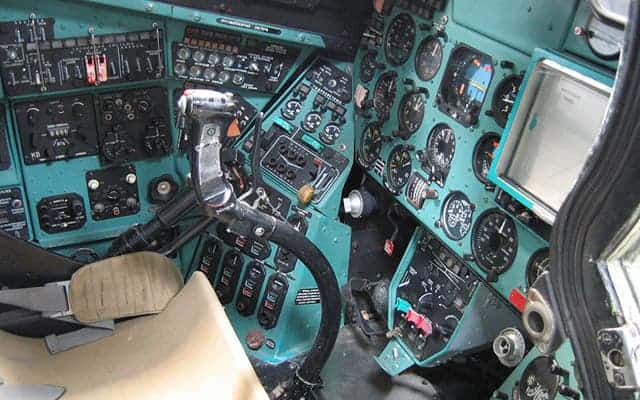
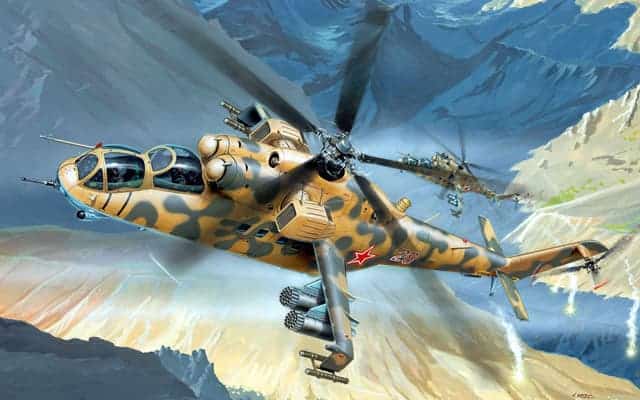
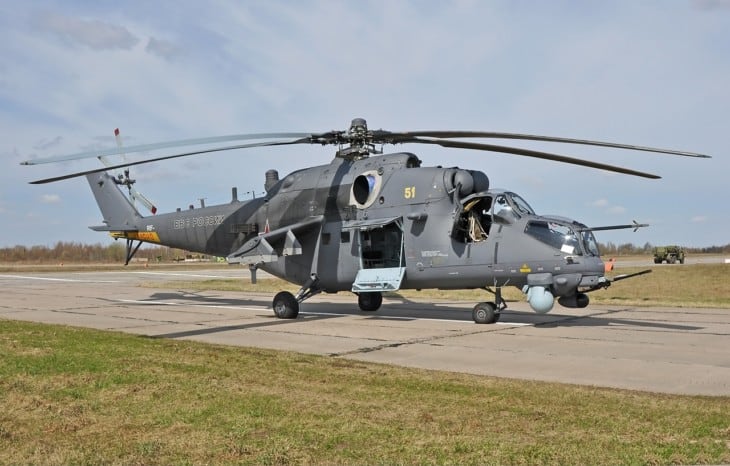
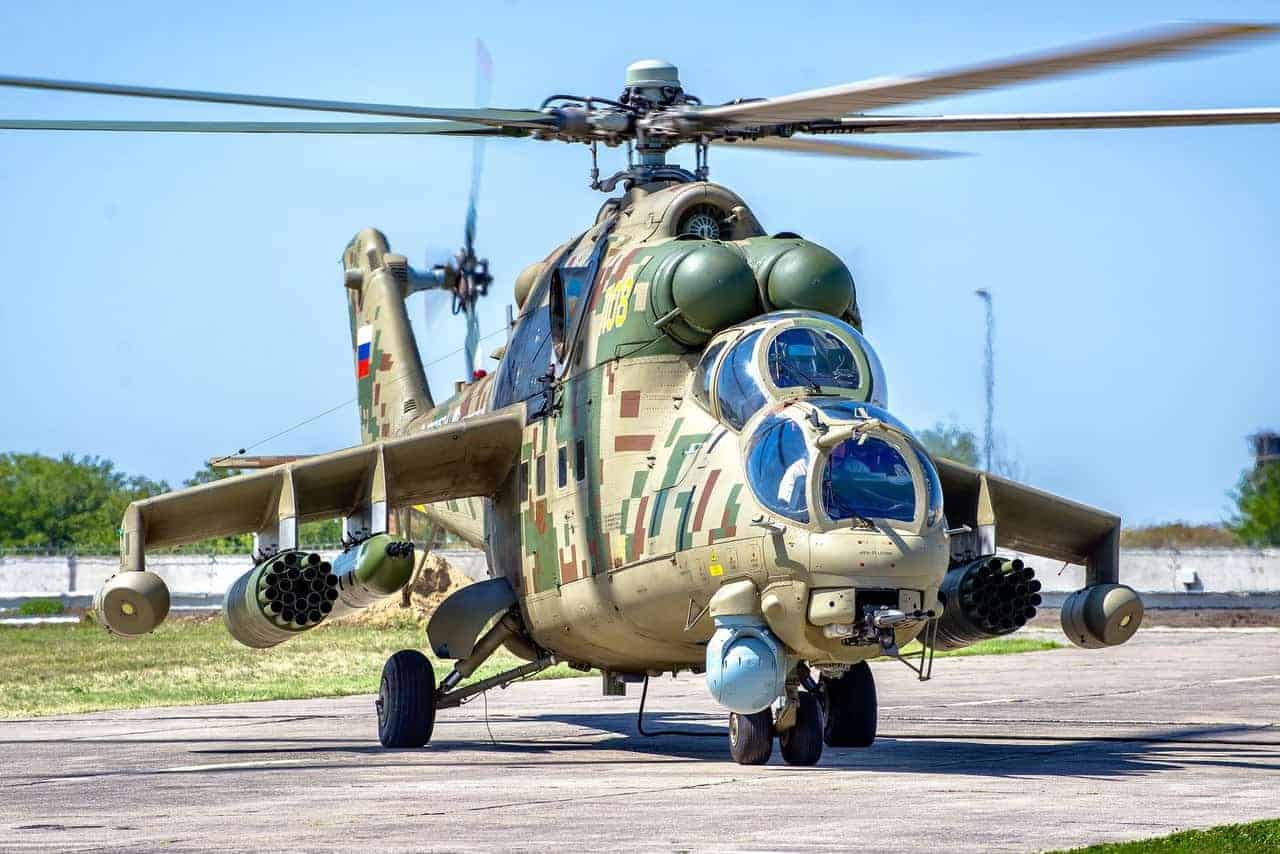
The Mil Mi-24 is a large Soviet-designed helicopter gunship that can also carry troops. NATO calls it the Hind, and its export versions are the Mi-25 and the Mi-35.
The cabin holds eight troops or four stretchers, and the helicopter can lift 5,300 lb (2,400 kg) on an external sling. The Federation of American Scientists calls it a close counterpart to the AH-64 Apache, with the difference that, unlike the Apache and other Western assault helicopters, it can also carry up to eight troops.
The specification panel on this page describes the Mi-24V, the Hind-E. Where the Mi-35M and other versions differ, the sections below say so.
The core of the Mi-24 came from the Mi-8 transport. Two top-mounted turboshaft engines drive a 56 ft 9 in (17.3 m) five-blade main rotor and a three-blade tail rotor.
Development began in the early 1960s, according to the Czech defense ministry. The first prototype flew on September 19, 1969.
Acceptance testing began in June 1970 and ran for 18 months. The changes that followed addressed structural strength, fatigue and vibration.
The production version, the Mi-24A, entered production in 1970 and reached initial operating capability in 1971. It was accepted into the state arsenal in 1972, which is why the panel’s production span starts in 1970 and not at the service date.
Later Russian designs dropped the idea of a gunship with a big cabin. The Mi-28 cut its troop capacity to three, and the Ka-50 has no large troop cabin.
Two stub wings sit at mid-fuselage and carry the weapons, three stations on each side. At high speed they also provide lift, up to a quarter of the total.
The wing span on the panel, 21 ft 5 in (6.54 m), is the span of these stub wings and not the rotor.
Mil worked to make the Mi-24 fast. The airframe is streamlined, with retractable tricycle landing gear to cut drag.
From the Mi-24D onward, the two crew sit in tandem under a “double bubble” canopy. Aerospaceweb notes that the Mi-24D also gained armor around the cockpit and rotor system.
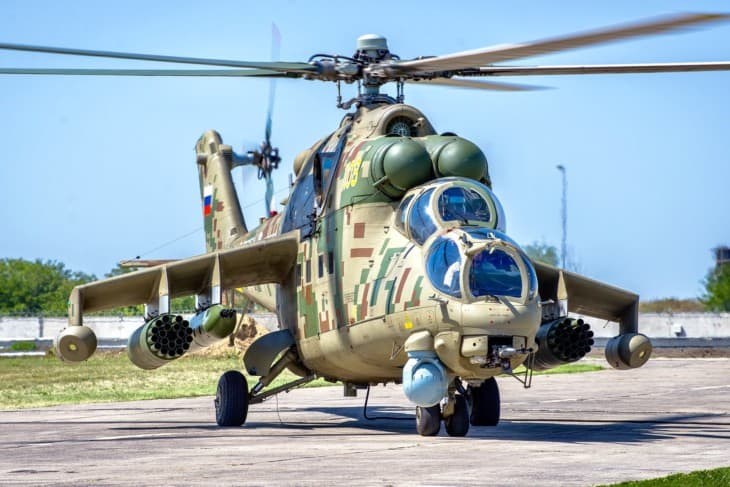
The crew of two is a pilot and a weapons operator. The cabin behind them is 4 ft 9 in (1.46 m) wide, according to the Czech defense ministry.
The Mi-24A (Hind-A) was the first production model. Aerospaceweb describes it as a transitional design for two pilots, a gunner and an observer, with a rear cabin for up to eight troops.
The Mi-24D (Hind-D) was redesigned as a gunship and anti-armor helicopter, with stepped tandem cockpits. Aerospaceweb dates its service entry to March 29, 1976, and the export version is the Mi-25.
The Mi-24V (Hind-E) added the Sturm-V system, Spiral anti-tank missiles and improved engines. Aerospaceweb gives its service entry as 1980, and its export version is the Mi-35.
The Mi-24P (Hind-F) swapped the nose machine gun for a fixed 30 mm cannon. The Mi-24VP, Mi-24VM and Mi-35M carry a twin-barrel 23 mm gun in a flexible nose mount instead.
South Africa’s ATE modernized the type as the SuperHind. Wikipedia lists Algeria with 30 SuperHind Mk III as of 2024.
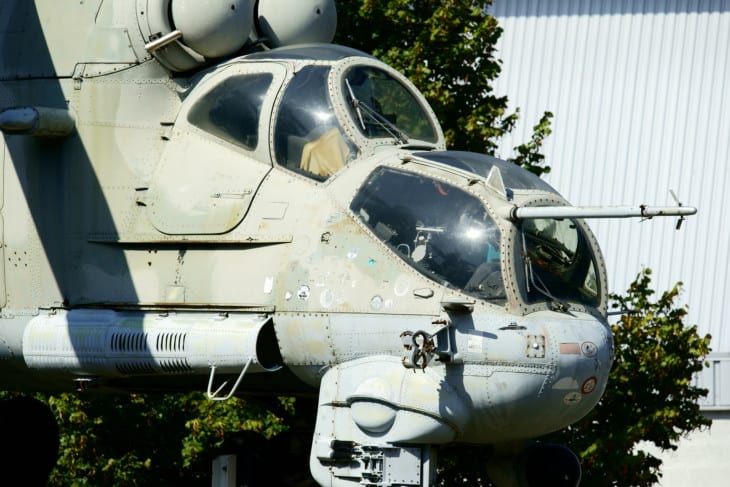
The Mi-35 is the export version of the Mi-24V. The Czech defense ministry says it is built by Rostvertol in Rostov-on-Don.
The Mi-35M is a newer, modernized gunship. Airforce Technology says Rostvertol has built it in series since 2005, and a 2023 Key.Aero review quoted by Wikipedia says upgraded Mi-35Ms “remain in production.”
A Belarus delivery report from April 2024 gives its crew as three, with eight paratroopers in the cabin. It lists Klimov VK-2500-II engines, a twin-barrel 23 mm cannon, and S-8 or S-13 rockets alongside Shturm-V or Ataka-M anti-tank missiles.
Iraq ordered 34 Mi-35Ms in 2013, and Pakistan received four in 2018. Wikipedia also lists a Mi-35P version flown by Peru and Russia.
The Mi-24D and Mi-24V carry a four-barrel 12.7 mm Yak-B gun in a nose turret. Aerospaceweb gives the Mi-24D 1,470 rounds for it, and the Mi-24P’s 30 mm GSh-30K cannon carries 750.
The stub wings hold rocket pods, bombs and anti-tank missiles. The Czech defense ministry lists S-5 57 mm and S-8 80 mm rocket pods, and Aerospaceweb says the Mi-24V can carry up to twelve AT-6 Spiral missiles.
The wingtip rails carry the guided missiles. The early versions used the 9M17 Falanga, and the Mi-24V and later use the 9K114 Shturm.
Airforce Technology puts the Shturm’s maximum range at 3.1 miles (5 km) and the later Ataka at 5 miles (8 km). Aerospaceweb adds that the Mi-24V can carry up to four FAB-250 bombs and two FAB-500 bombs.
The full specification table for the aircraft is on this page. A few of its figures need context, because the sources that publish them describe different versions.
Start with speed. The panel’s top speed is 208 mph (335 km/h), the Mi-24V figure in Aerospaceweb’s table, with a cruise speed of 183 mph (294 km/h).
Other sources run lower. The Czech defense ministry lists a high-speed cruise of 193 mph (310 km/h) for its Mi-24.
Range needs a caveat too. The published flight range is 243 nm (280 mi, 450 km), but the Czech defense ministry gives a tactical operating range of just 99 miles (160 km).
With auxiliary tanks the ferry range reaches 605 nautical miles (1,125 km), according to Aerospaceweb. The five fuselage tanks alone hold 560 gal (2,100 L), and two cabin tanks add 450 gal.
The ceiling figure is less useful in the mountains than the hover ceiling. Aerospaceweb lists the Mi-24V’s hover ceiling in ground effect at 7,210 ft (2,200 m) and out of ground effect at 4,915 ft (1,500 m), against a service ceiling of 14,750 ft (4,500 m).
Wikipedia’s current specification block gives a higher service ceiling of 18,860 ft (5,750 m), so treat the figure as variant-dependent.
Weight depends on the version. The panel carries a maximum takeoff weight of 26,500 lb (12,000 kg), which Aerospaceweb and Wikipedia both give for the Mi-24V.
The Czech defense ministry prints about 27,600 lb (12,500 kg), and the Belarus delivery report gives the Mi-35M as 25,400 lb (11,500 kg).
The TV3-117 turboshafts produce 2,200 shp each, according to Wikipedia and Airforce Technology. Sources credit the engine to Isotov or to Klimov, the company that builds the family.
The first combat use of the Mi-24 was with Ethiopian forces in the Ogaden War against Somalia in 1977 and 1978.
Mi-24s were supplied to the Afghan government in April 1979, and the first one lost in action was shot down by guerrillas on July 18, 1979. The Soviet Army used them mainly to bomb Mujahideen fighters.
Once the United States supplied Stinger missiles, Soviet Mi-8 and Mi-24 helicopters became favorite targets. The last Soviet Mi-24 shot down in Afghanistan fell on the night of February 2, 1989, and both crewmen died.
It was also the last Soviet helicopter lost in nearly 10 years of war.
The Mi-24 met the AH-1 Cobra in the Iran-Iraq War. Iraqi Mi-25s fought Iranian AH-1J SeaCobras, and the final claimed tally was 10 SeaCobras against six Mi-25s.
Wikipedia notes that the numbers are small and the claims disputed, so neither gunship can be said to have had a clear technical edge.
Nicaragua lost two Mi-25s to Contra Stingers. Sri Lanka has flown the type since November 14, 1995, and has lost more than five to Tamil Tiger man-portable missiles.
A modified Mi-24, the A-10, set an absolute helicopter speed record of 228.9 mph (368.4 km/h) on September 21, 1978, with its stub wings removed. The record stood until 1986, when a modified Westland Lynx broke it, and the fastest helicopters have gone faster since.
Both sides fly it. On May 2, 2014, two Ukrainian Mi-24s were shot down near Sloviansk by pro-Russian insurgents.
The War Zone reported in January 2026 that about 34 of Ukraine’s roughly 100 Hinds were operational in February 2022. The Czech Republic, North Macedonia and Poland have since supplied more, though some became spares.
Ukraine’s fleet includes the Mi-24PU1, an upgrade of the Mi-24P with uprated engines, a new defense system against infrared-guided missiles and a night-capable target designator. At least two Mi-24RKhR reconnaissance versions, built for chemical and radiation detection, also still fly.
The War Zone says Ukrainian crews use Hinds as aerial artillery and for special forces work, personnel recovery and anti-drone missions. They have also adapted them to fire U.S.-supplied Hydra 70 mm rockets.
The same article says at least 11 Hinds have been lost since the invasion and that the real number is likely higher.
On the Russian side, a Mi-35M that took part in the assault on Hostomel airfield in the invasion’s first days was shot down over the Kyiv Reservoir, according to Ukrinform.
Wikipedia, citing the open-source tracker Oryx, lists 18 Russian and nine Ukrainian Mi-24 and Mi-35 losses as of May 27, 2025.
Dozens of air forces. Wikipedia lists Russia as the primary user, plus operators including Algeria, Angola, Armenia, Azerbaijan, Belarus and Poland, each with its own fleet date.
Production figures differ by source. Wikipedia’s infobox counts 2,648 built, while Airforce Technology says more than 3,500.
Several European air forces are leaving. Wikipedia says the Czech Republic retired its Hinds and transferred them to Ukraine in August 2023, and that Hungary retired its fleet in 2026.
The Czech Air Force is replacing them with the AH-1Z Viper.
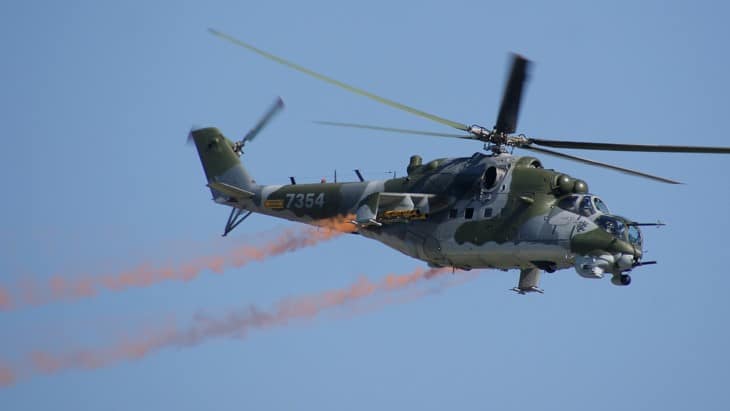
Russia announced in October 2007 that it would replace its Mi-24s with Mi-28Ns and Ka-52s by 2015. It still flies the Hind, and it is still building the Mi-35M.
The picture keeps changing. The figures above are the latest confirmed ones, from January 2026 reporting and Wikipedia’s fleet table.
The best documented price is Brazil’s. StrategyPage reported in April 2009 that Brazil was paying $12.5 million each for a dozen Mi-35M helicopters, which is the $12.5 million shown on the panel.
That is an export contract price, not a flyaway cost, and spares, training and weapons change the total.
A figure of $36 million has circulated since 2022, when Ukrinform quoted ArmyInform saying a downed Mi-35M “costs $36 million.” No method was given, so treat it as an estimate.
No source ranks helicopters by firepower, so there is no official title. The Mi-24 is among the most heavily armed, with a nose gun, rocket pods, up to twelve anti-tank missiles and bombs on its stub wings.
The Mi-24 first flew on September 19, 1969, and the Mi-24A went into production in 1970. It was accepted into service in 1972, and the Mi-35M is still being built.
Brazil paid $12.5 million each for a dozen Mi-35M helicopters, according to a 2009 report. That is an export price and not a flyaway cost.
The Mi-24V’s top speed is 208 mph (335 km/h), and its cruise speed is 183 mph (294 km/h). Other sources list slightly lower figures depending on the version.
The Mi-35 is the export version of the Mi-24V, built by Rostvertol. The Mi-35M is a newer, upgraded gunship that is still in production.
Soviet pilots gave it that nickname for its armor and firepower, a term also used for the World War II Il-2 Shturmovik. Another unofficial nickname, “Crocodile,” came from its camouflage scheme.
Eight troops, or four stretchers. A Mi-28 carries three.
Hind is NATO’s reporting name for the Mi-24. The letter after it marks the version: Hind-A is the Mi-24A, Hind-D the Mi-24D, Hind-E the Mi-24V and Hind-F the Mi-24P.
Yes. Russia, Ukraine and dozens of other countries still fly it as of October 2026, though the Czech Republic and Hungary have retired theirs.
Sources and references used for research and fact-checking.
.jpg)