

Table of Contents
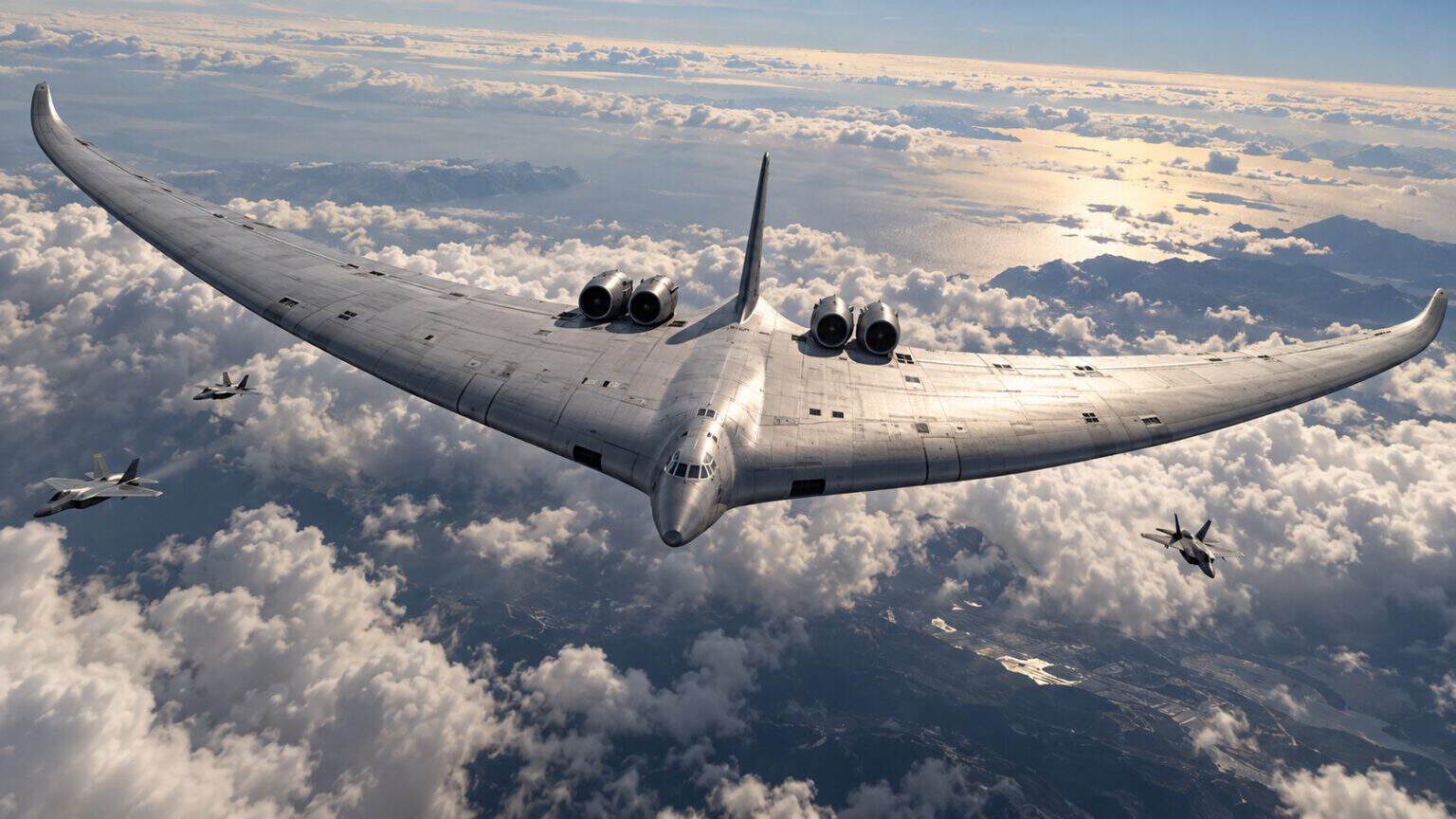
Picture a wing 1,120 feet (341 m) from tip to tip, with 22 fighter jets hanging beneath it like ornaments. Inside sits a nuclear reactor meant to keep the whole thing in the air for 41 days without landing.
That is the Lockheed CL-1201, and it regularly goes viral as the flying aircraft carrier the Pentagon almost built. The drawings are real. The engineering report behind them is real too, dated September 12, 1969.
What the viral version leaves out is the most interesting part. Here is what the CL-1201 actually was, how big it would have been, how its nuclear engines were supposed to work, and why it never left the paper.
What Was the Lockheed CL-1201?
The CL-1201 was a Lockheed design study for an enormous nuclear-powered aircraft, worked out in the late 1960s. Its paper trail leads to Lockheed Report LR-22802, “A Study of Very Large Nuclear-Powered Aircraft in a Potential Mission Application,” by G. Daniel Brewer and two colleagues.
It was never built, never ordered, and never got past drawings and calculations. Two versions were studied: a giant military transport and an airborne aircraft carrier. The carrier is the one everyone remembers.
The CL-1201 at a glance
What: a Lockheed design study for a nuclear-powered giant aircraft, documented in a September 1969 report. Wingspan: 1,120 feet (341 m). Length: 560 feet (171 m). Weight: about 12 million pounds (5,450 metric tons) in NASA’s figures, a little less in other accounts. Power: one nuclear reactor feeding four turbofans, plus up to 182 lift jets for takeoff. Endurance: 41 days. Versions: an attack aircraft carrier and a logistics transport. Built: none.
How Big Was the CL-1201?
Bigger than anything that has flown, by a margin that is hard to picture. The wingspan of 1,120 feet is nearly three times that of the Stratolaunch Roc, whose 385-foot (117 m) wing is the longest ever flown, and well beyond anything in our ranking of the biggest aircraft in the world.
The fuselage would have run 560 feet (171 m), and the aircraft would have stood 153 feet (47 m) tall. NASA gave its weight as 6,000 tons (5,450 metric tons), or about 12 million pounds. Bill Rose’s account of the design gives a lighter 5,265 tons.
A 1971 NASA report put the scale in terms its readers would know. It described the Lockheed design as 15 times the gross weight of the Boeing 747 and of Lockheed’s own C-5 Galaxy, the two giants NASA used as its yardstick.
| Aircraft | Wingspan | Maximum weight | Status |
|---|---|---|---|
| Lockheed CL-1201 | 1,120 ft (341 m) | About 12 million lb (5,450 t) | Paper study, 1969 |
| Stratolaunch Roc | 385 ft (117 m) | 1.3 million lb (590 t) | First flew 2019 |
| Antonov An-225 Mriya | 290 ft (88.4 m) | 1.41 million lb (640 t) | Destroyed 2022 |
| Lockheed C-5 Galaxy | 222 ft 9 in (67.9 m) | 840,000 lb (381 t) | In service |
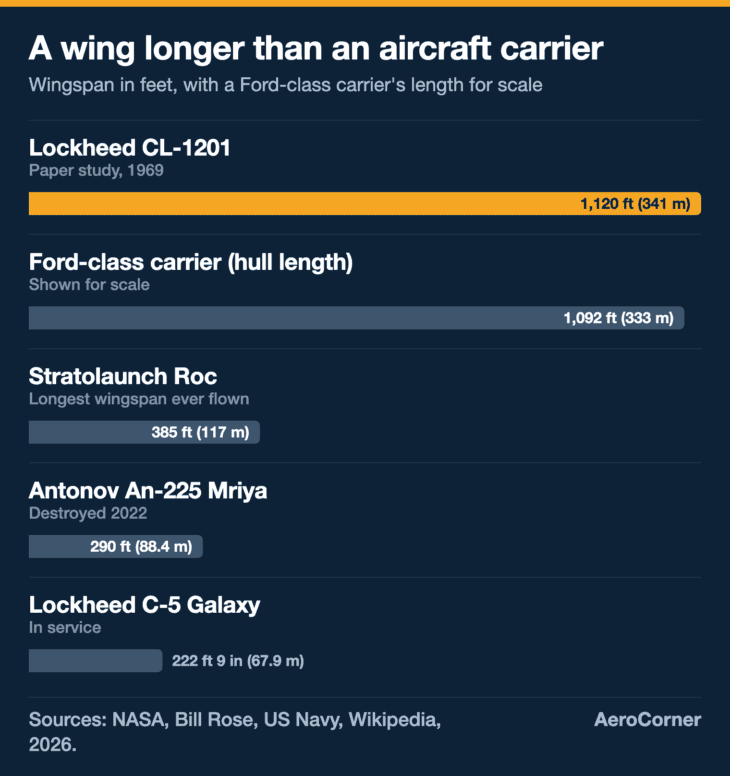
By weight, the gap is just as wild. The Antonov An-225, the heaviest aircraft ever to fly, topped out at 640 metric tons. The CL-1201 would have weighed about eight and a half times as much.
Longer than the ship it was named after
A Ford-class supercarrier is 1,092 feet (333 m) long. The CL-1201’s wing would have measured 1,120 feet from tip to tip, so the flying aircraft carrier would have been wider than a real aircraft carrier is long.
That comparison is with the newest American carrier, which our guide to the Ford-class aircraft carrier covers in full. Lockheed was not drawing a big airplane. It was drawing something closer to a flying ship.
How Would a Nuclear-Powered Airplane Actually Fly?
The reactor never touched the air directly. According to Bill Rose’s account of the design, a single reactor with a 30-foot (9 m) core would heat liquid sodium. That metal carried the heat to exchangers in the four main turbofans through a sealed secondary loop.
Air entering each engine would be heated by the exchanger instead of by burning fuel, then pushed out the back as thrust. The reactor was rated at about 1,830 megawatts, and the four turbofans were credited with a combined 500,000 pounds of thrust.
Below about 16,000 feet, the engines would burn ordinary JP-5 jet fuel. Only at altitude would they switch to nuclear heat, then cruise above 30,000 feet at around Mach 0.8 for up to 41 days.
Fuel would no longer set the limit. Food and water for the crew would.
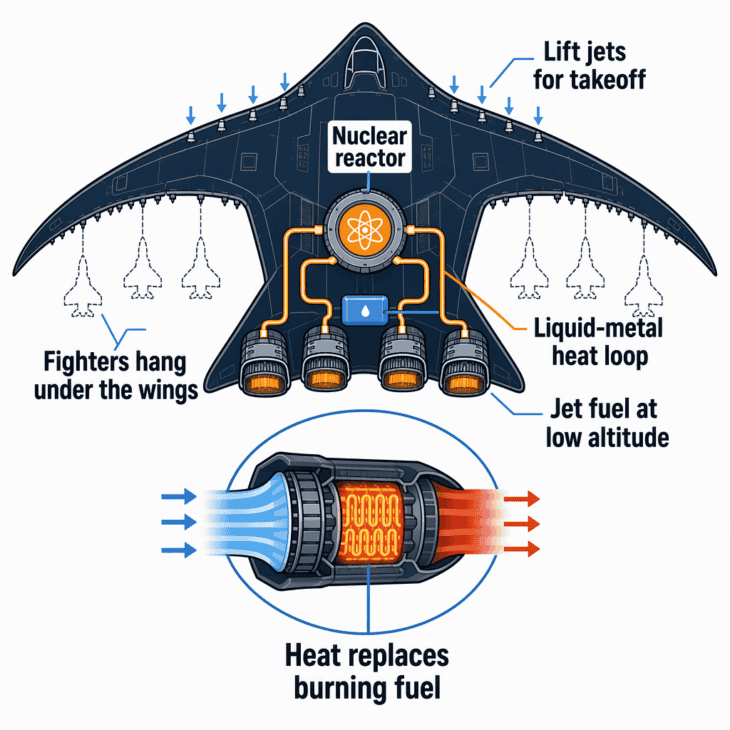
Getting off the ground was a separate problem. A conventional takeoff would have needed an airfield built around it, so the attack version carried 182 small lift jets to push it into the air with little or no takeoff run. Two retractable banks of 24 sat in the forward fuselage, and the rest lined the wings.
Those lift jets added up to a reported 15 million pounds of thrust, more than the aircraft weighed. The transport version, meant for short takeoffs rather than vertical ones, used a reported 54 lift engines instead.
The Two Versions: Attack Carrier and Flying Transport
The attack aircraft carrier, or AAC, is the version that made the CL-1201 famous. It had a crew of 845 and carried 22 multirole fighters on docking pylons under the wings, where they could be refueled, rearmed and serviced in flight.
A small internal hangar held two transport aircraft for shuttling people to and from the ground. Some accounts count 24 aircraft in total. For self-defense, Rose’s account mentions a suggestion of long-range AIM-54 Phoenix missiles on top of its own air wing.
The second version was the logistics support aircraft, or LSA. It was meant to carry several hundred combat troops and their equipment directly to crisis points anywhere in the world.
One sub-study even had 707-type transports docking with the LSA in flight to ferry troops down to the ground. A third designation, the CL-1201-1-2, sits between the two known versions in the numbering, and nothing about it has ever been published.
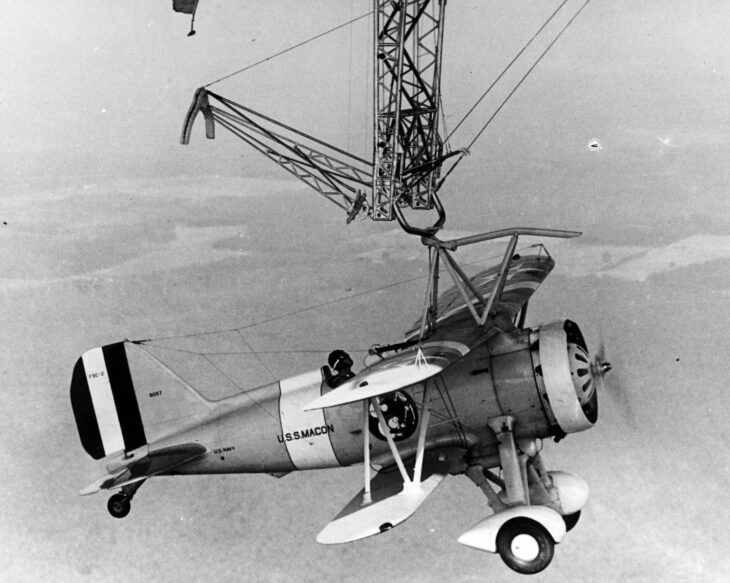
The idea of a flying carrier was not new even then. In the 1930s, the US Navy’s airships Akron and Macon launched and recovered small Sparrowhawk biplane fighters from a trapeze. In the early 1970s, Boeing studied a 747 that would carry up to 10 “microfighters.”
Why Was the Lockheed CL-1201 Never Built?
The simplest answer is that the engine did not exist. The United States had spent 15 years and about $1 billion trying to build a flyable aircraft reactor under the Aircraft Nuclear Propulsion program, which began as Project NEPA in 1946.
The closest it came was the NB-36H, a modified Convair B-36 Peacemaker bomber. It flew 47 times between September 1955 and March 1957 with a working reactor on board, but the reactor never powered the airplane. It was there to test whether shielding could protect the crew.
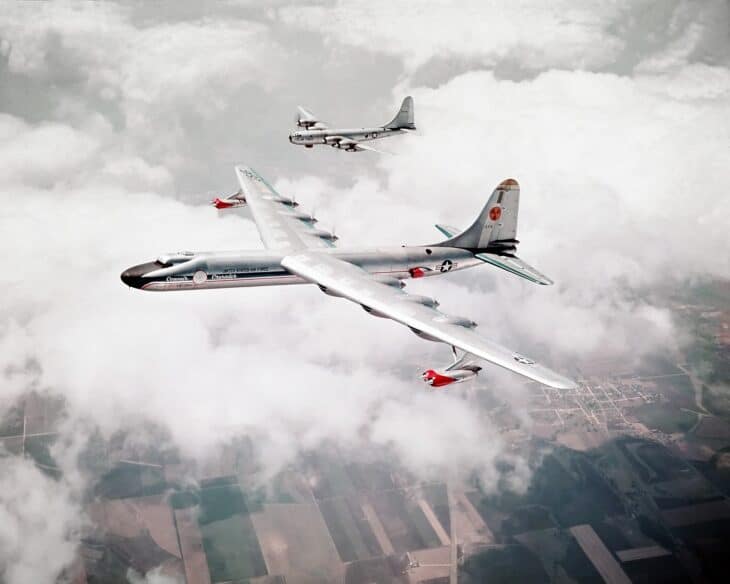

President Kennedy canceled the whole program in March 1961, citing the cost and the lack of a flight-worthy reactor. So when Lockheed’s report appeared in September 1969, the CL-1201 depended on a power plant that Washington had stopped trying to build eight years earlier.
Safety was the second wall. A reactor in an airplane has to survive a crash without releasing its fuel. NASA’s own 1971 design work on compact aircraft reactors aimed for containment that could survive impacts at up to 1,000 feet per second (about 680 mph), and NASA described the experiments behind it as still underway.
Then there is the airport problem. Even with lift jets, a machine this size needs somewhere to set down, be serviced and be defended. The NASA report suggested that an air-cushion landing system, rather than wheels, would let such an aircraft operate from rough ground or water.
Finally, there was never a program to cancel. The Department of Defense does not appear to have any record of what became of the study. Rose suggests it was probably more of an engineering exercise than a serious proposal.
Was the CL-1201 Even Possible?
Surprisingly, the airframe was not the impossible part. NASA noted that the design’s structure came to about 25 to 30 percent of its gross weight, the same range as ordinary transport aircraft, using conventional materials.
Size actually helped: NASA credited the aircraft’s sheer dimensions with letting it use its materials more efficiently. The impossible part was a light, crash-proof reactor. Both the American NB-36H and the Soviet Tu-95LAL carried reactors only to test shielding, and neither flew on nuclear power.
NASA’s interest is a clue to what the study was really about. Its 1971 report looked at giant nuclear aircraft as ocean freighters and found that, at around 4,000 tons, nuclear power beat conventional fuel on routes longer than 3,000 nautical miles (3,450 miles).
The Myth vs. the Reality
Myth: the Air Force ordered a flying aircraft carrier
Popular retellings say the US Air Force tasked Lockheed with building a nuclear airborne carrier. The surviving record is thinner: NASA described it in 1971 as one company’s preliminary conceptual study, and the carrier was only one of two mission versions.
The CL-1201 is usually told as a weapon that almost happened. A better reading is a size study. The title of Lockheed’s report says as much: very large nuclear aircraft, tested against “a potential mission application.”
A second myth is the price tag. People often search for what the CL-1201 would have cost, but none of the published accounts of the study gives a figure. Any dollar amount attached to it online is a guess.
The third claim is that it was secretly built. Some corners of the internet tie it to UFO sightings, but no airframe, part or test article has ever been documented. The number built is zero.
So the next time the CL-1201 turns up in your feed, the drawing is genuine and the headline numbers match what NASA reported from Lockheed’s study. What it shows is not a secret weapon. It is a careful answer to a question engineers still ask: how big could an airplane get if fuel stopped being the limit?
Sources and references used for research and fact-checking.
- NASA Lewis Research Center, Large Nuclear-Powered Subsonic Aircraft for Transoceanic Commerce (NASA TM X-2386)
- Tails Through Time (via Internet Archive), The Lockheed CL-1201 Flying Aircraft Carrier
- Wikipedia, Lockheed CL-1201
- Secret Projects Forum, Lockheed CL-1201 Logistic Support Aircraft
- Found And Explained, Never Built: CL-1201
- Wikipedia, Aircraft Nuclear Propulsion
- Wikipedia, Convair NB-36H
- Wikipedia, Airborne aircraft carrier
- Wikipedia, Scaled Composites Stratolaunch
- Wikipedia, Antonov An-225 Mriya
- Wikipedia, Lockheed C-5 Galaxy
- Wikipedia, Nuclear-powered aircraft
- Wikipedia, Gerald R. Ford-class aircraft carrier
Get the Newsletter
The latest aviation news and stories sent to your inbox.
About the Author

Tim is the owner and lead editor of AeroCorner since 2019, overseeing aviation content covering aircraft, airlines, airports, and the broader aviation industry. Through years of researching, writing, editing, and publishing aviation-focused content, he has developed extensive practical knowledge of commercial aviation and air travel. Based in Asia and a frequent traveler himself, Tim also brings firsthand passenger experience to AeroCorner’s coverage. Outside of publishing, he has also explored aviation firsthand through hands-on flight training in New Zealand.